
In the never ending saga of showcasing my beutiful Morbihan dept 56 in my lovely Bretagne to the world here is more from Ambon, This was a find on another of my road warrior trails and glad stop by and even better to have found me pictures in my cd rom vault to show in my blog for you and me, Therefore, here is my take on the Chapelle Notre Dame de Mille Secours of Ambon !! Hope you enjoy the post as I,
The Chapelle Notre Dame de Mille Secours of Ambon is located at the entrance to the hamlet of Brouel part of the town of Ambon, It was built in 1580 on a hill overlooking the former salt marshes and the old port of Sablac. In the Gothic style, with remarkable decorations, the granite facade is supported by two powerful buttresses, which shelter two twin basket-handle arched doorways.
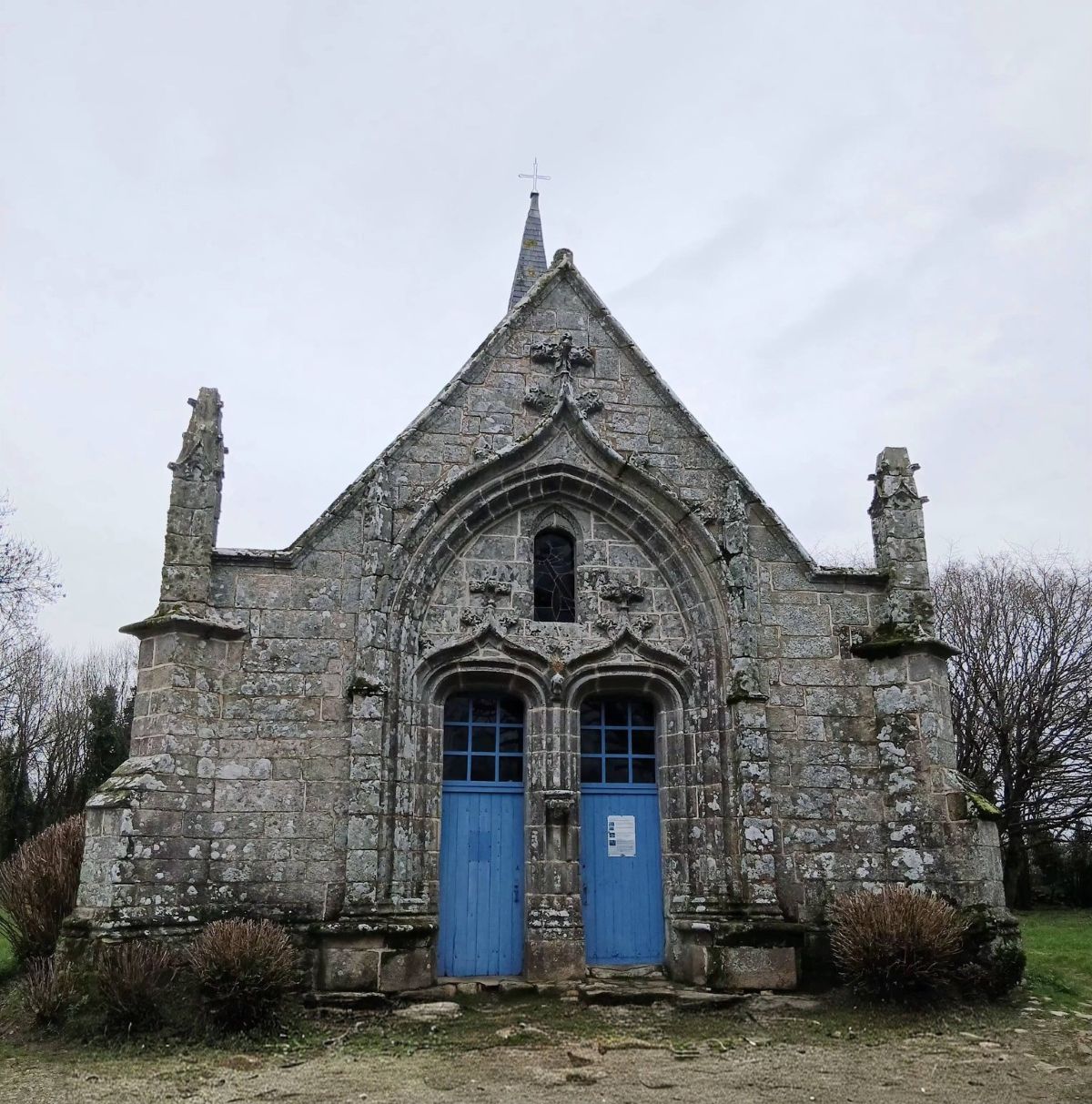
Following the route of the old railway line that overlooks the marshes in Ambon, you arrive at the hamlet of Brouel. Its Chapelle Notre Dame de Mille Secours was erected when boats came to load goods, testifies to the wealth of that era During the French revolution, it became a chapel of ease or a parish encompassing several hamlets for Brouel (the sea) and Billion (the land). It was ceded to the town of Ambon in 1852.
A bit of history I like on the town of Ambon was a hillock between two bodies of water at the bottom of the Pénerf river. Until 1824, Damgan, Pénerf, Kervoyal, and Ambon formed a single entity. However, some events specific to Ambon can be noted: in 888, Alan-Meur crushed the Normans at Questembert and drove them back into the sea at Bétahon. In the 17C, this parish became the seat of the seneschal’s court of Vannes. During the 19C, Ambon was primarily a very large rural town whose economy was based mainly on agriculture and the exploitation of salt marshes, In 1824, an administrative reorganization took place, and the town of Damgan (see posts) gained its independence, along with the port of Pénerf. In 1832, the hamlets of Pénescluz and Moustero were annexed to Muzillac (see post) . In the 20C, tourism began to develop, particularly after the train line connecting Vannes to La Roche-Bernard stopped in Ambon in 1903. During the Great War or WWI, as in all rural communities, women worked in the fields to replace the men who had gone to the front. The years following the war were characterized by rural exodus and a gradual decline in population, which only began to increase again in 1990. The 1930s were marked by the cessation of salt production.
The town of Ambon on its heritage: https://www.ambon.fr/patrimoine
The Damgan La Roche Bernard tourist office of Ambon: https://www.damgan-larochebernard-tourisme.com/lieux-incontournables/ambon-le-village-paludier/
The Morbihan dept 56 tourist office on the chapel: https://morbihan.com/a-voir-a-faire/suivez-le-guide/chapelle-de-brouel-ambon-fr-4411905/
There you go folks, another gem in my beautiful Morbihan, and hopefully will be yours too. Worth the detour me think. Again, hope you enjoy this post on the Chapelle Notre Dame de Mille Secours of Ambon !! as I
And remember, happy travels, good health, and many cheers to all !!!


