
The town of Meulan-en-Yvelines in dept 78 Yvelines and in the Île de France region of my belle France, It sits on the right bank of the Seine river, 16 km from Mantes-la-Jolie, 33 km from Versailles, and 40 km from Paris, I came to it from Versailles along as usual to connect with the A13 Autoroute de Normandie dir Rouen, continue to exit/sortie 8 dir Les Mureaux on the D43 road to roundabout bear left onto the D14 road to go over the Seine on the Pont Rhin et Danube bridge at end bear right onto Rue du Pont Saint Cosme and cross the Seine river again continue bear left onto Rue du Fort cross Seine river again on pont aux Perches and continue to place Brigitte Gros and City hall, The town I knew was name Meulan but because of strong confusion over the Meulan in Seine et Marne dept 77 on July 11 2010 change name to Meulan en Yvelines. This is a memorable town as it was here my dear Mom Gladys was cure at the hospital RIP,(see post), I am glad found me a couple pictures in my cd rom vault not the best but all could find and worth it to include in blog for you and me, Therefore, here is my take on curiosities of Meulan en Yvelines !!! Hope you enjoy the post as I
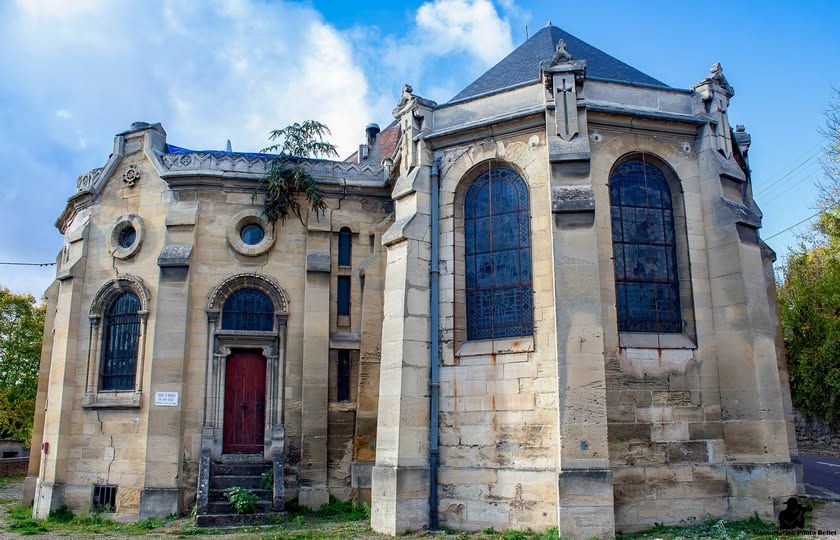
The Church Saint Nicholas is located at rue de l’Église: Since the French Revolution, this has been the only church in the town. Behind its sober neoclassical façade of 1764, flanked by a purely functional bell tower of the same year, and behind lies a Gothic church erected in two phases: the third quarter of the 12C and the first quarter of the 13C, with regard to the first two bays. The church is distinguished above all by its ambulatory plan without radiating chapels and without a transept. Rather curiously, the four cylindrical pillars of the apse’s apse are topped with volute capitals in an early Romanesque style. Otherwise, one finds Gothic capitals with waterleaf and acanthus leaf motifs of good quality, and seven ribbed vaults still surviving from the first phase of construction. However, the church remained unfinished, and the clerestory was never built. The nave is therefore dark. In the first quarter of the 16C, it was decided to cover it with vaults at a lower level than originally planned, which led to the blocking of the temporary side windows. In addition, the church has suffered for several centuries from the instability of the ground, and the vaults of the first two bays, as well as the south aisle wall, had to be rebuilt in 1765. More problematic, from an aesthetic point of view, are the alterations and additions of the 1870s. Since then, the sanctuary has been adorned with very heavy-looking balustrades affixed to the high walls, and a neo-Gothic chapel of the Virgin opens from the central bay of the ambulatory.
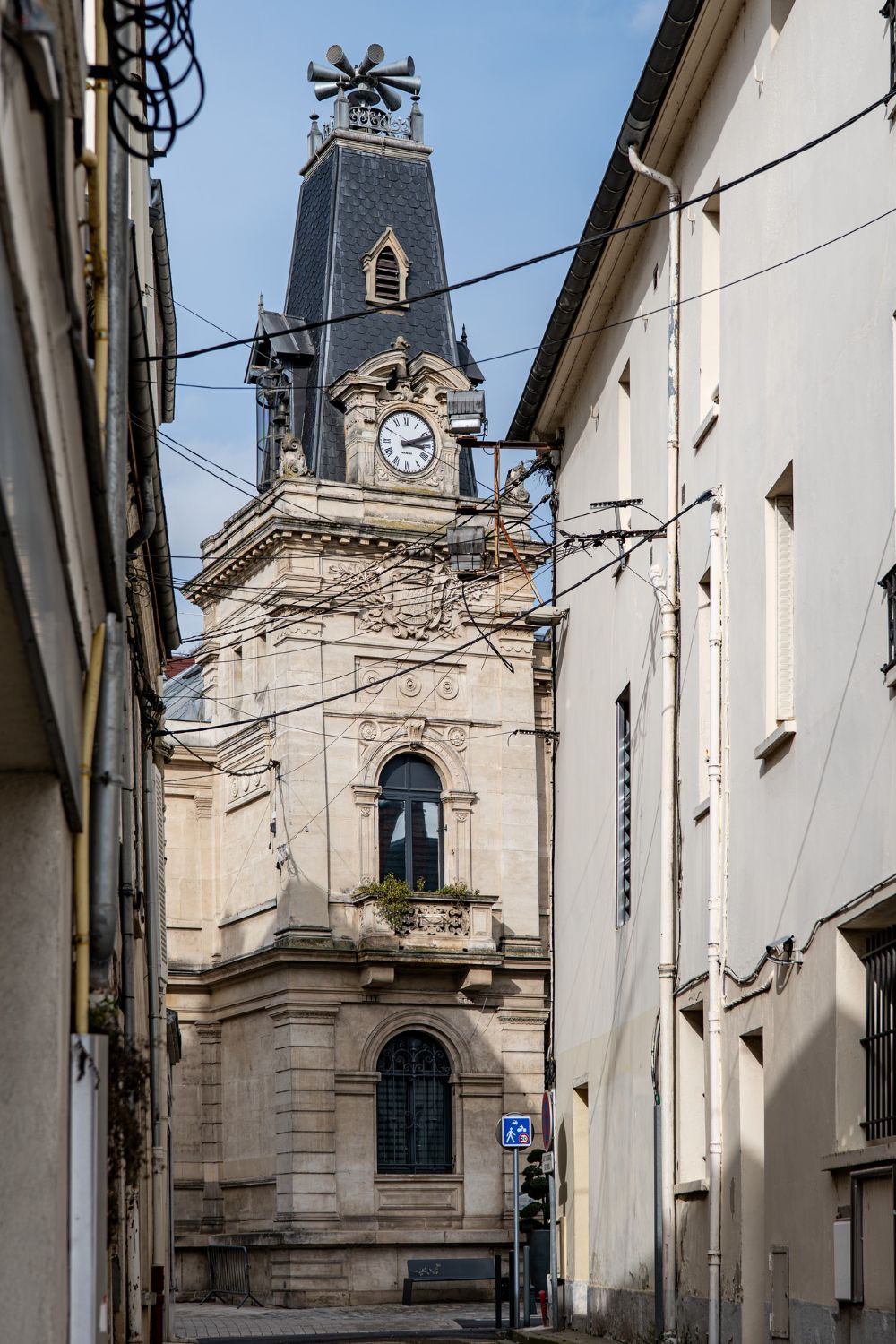
The old N13 highway ran right through the center of town, along what is now Rue du Maréchal Foch, formerly Rue Basse. While the street itself has retained some old features, Meulan has lost many of its medieval buildings. First and foremost is the former Notre-Dame church, built in the 15C and demolished in 1880 to make way for the current City/town hall. After extensive renovations and accessibility improvements, the building, constructed in 1884, reopened in 2019. A stroll through the collection of vintage postcards of Meulan. The Grand Staircase depicted in two restored paintings. The Meulan Bridge, Evening Effect, by Léon-Gustave Ravanne, a French painter born in Meulan in 1854 and who died in Les Mureaux in 1904. Several French museums hold works by the artist. The former Notre-Dame church, a painting by Henri Ménard. He donated it to the town of Meulan in 1906, when he was treasurer of the Meulan Savings Bank. Two works of art belonging to the town’s heritage, restored in 2018.
Some other things to see here are the old bridge on Île-Belle dating from 1150, aka the Pont aux Perches (Perch Bridge), is missing four arches and provides access to a 19C farm; it belongs to the town. The Saint-Côme bridge spans the Seine for a length of 55 meters between Île Belle and Île du Fort. The Priory of Saint-Nicaise, whose chapel dated from the 11C, was destroyed in 1793. The ruins of the castle of the Counts of Meulan stand on the hill near the partly Romanesque church dedicated to Saint Nicholas. On March 31, 1526, Francis I granted the castle to Jean VIII de Créquy, husband of Marie d’Acigné.
A bit of history I like tell us that originally, Meulan was a river port on the Seine and a Gallic trading post, located on the border between the Veliocasses to the north and the Carnutes to the south. It was an ancient place of worship and certainly an early Gallic oppidum, perhaps the unreliable military outpost, situated between the locality of Thun and the bank of the Seine at a place called La Rive. The oppidum belonged to the Carnutes, to whom the Romans granted control of the entire left bank of the Seine in what is now the Yvelines department (78). The Roman road from Beauvais to Orléans passed through Meulan and crossed the Seine at Les Mureaux before continuing towards Flins and Maule. Having become the seat of the County of Meulan, the town was pillaged in 878 by Vikings led by Rollo. Around the 10C, it was the capital of the Counts of Meulan. The town was united with the royal domain in 1204 by Philip Augustus. Reunited with the royal domain, this town became the seat of a provostship which appears in the account of 1234, but was included in the dowry of Blanche of Castile (1240-1253), in that of Margaret of Provence (1260-1285), then in the appanage of the House of Évreux (1298-1365). From Louis of Évreux, last son of Philip III the Bold, Meulan passed in 1319 to his son Philip III, King of Navarre and Count of Évreux, then in 1343, upon the latter’s death, to his son Charles II of Navarre, known as the Bad. The English seized it in 1346. Reverting to the control of Charles the Bad, the town was besieged by Bertrand Du Guesclin, who recaptured it during the Siege of Meulan on April 11, 1364, on behalf of King Charles V the Wise. At the Treaty of Avignon in 1365, Charles II of Navarre was forced to exchange the towns of Meulan and Mantes for Montpellier. Duke John I of Burgundy seized Meulan in 1417. At the beginning of 1423, the Lord of Graville and the knights loyal to Charles VII took Meulan by surprise. Possession of the town gave the Dauphinois (supporters of the Dauphin) the means to intercept all water communications between Paris and Normandy. The Parisians armed themselves and joined forces with English, Norman, and Picard soldiers under the command of John of Lancaster, Duke of Bedford, and laid siege to the town, which surrendered after a two-month siege. In 1435, a party of Armagnacs seized Meulan. Under the Ancien Régime (monarchy), Meulan served as a staging post for stagecoaches on the Caen-Paris route. In 1638, Louis XIII authorized the establishment of an Annonciade monastery there. During the French revolution, the old Gothic church of Saint-Nicolas was converted into a grain market. In 1900, the Summer Olympics committee, through the Paris Sailing Club, selected the Meulan lake to host the sailing events. This same lake again hosted the sailing events for the 1924 Summer Olympics. On August 27, 1944, American troops arriving via Les Mureaux crossed the Seine on pontoon bridges, lost a tank at Meulan, and then continued their advance towards Condécourt and Longuesse. The above credit from wikipedia
On this memorable town (see post) I tell you from my books a bit more on the history of the old castle on the Île du Fort in Meulan, In the 15C, the Earl of Salisbury was Lord of Meulan. He had new bastions built at the tip of the island. These defensive works reveal the influence that firearms were beginning to exert on the art of fortification. The house commonly called the Provost’s House, and sometimes the King’s House, was located at the Fort, at the entrance to the Grand Pont . It was a large building flanked by two turrets, and its vaulted base served as a gateway to the fortified enclosure. Four main gates provided access to the town: the Paris Gate, the Vexin Gate, the Mantes Gate, and the Petit Pont Gate. The Rue du Vieil Abreuvoir (Old Watering Trough Street) now occupies the site of the moat that was dug at the foot of the eastern wall of the Meulan enclosure. This moat was filled with water from the Seine, brought in by means of a channel cut into the river. To reach the foot of the castle, one first had to cross two enclosures defended by a moat whose crests were crowned by palisades that protected the wall-walk where the archers were stationed. Meulan was a fortified town that withstood numerous sieges. Du Guesclin captured it in 1364; the English seized it after three months of effort in 1423 (the Hundred Years’ War); Mayenne had to lift the siege he had undertaken, which earned the town the gratitude of Henry IV. In 1638, Louis XIII ordered the establishment of a community of Annunciation nuns in Meulan, in honor of Charlotte du Puy de Jésus Maria, whose prayers were said to have ended the long period of infertility suffered by Anne of Austria. This convent, begun only in 1670 and completed in 1683, has since given way to attractive bourgeois houses. The town grew in importance during the Middle Ages, becoming the seat of the County of Meulan, a buffer zone between Normandy and the royal domain; bridges, ramparts, and a castle were built there at that time. Sacked by the Vikings led by Rollo in 878, the town was annexed to the royal domain in 1204 by Philip Augustus. The new fortress built after the destruction of the old one was designed by Pierre de Sarmaise, former governor of Macé le Barbier, and by the engineer Jean Barde, both chosen by Duguesclin to direct these works which began in 1365 and continued until 1379.
The town of Meulan en Yvelines on its history : https://ville-meulan.fr/votre-ville/presentation/histoire-de-la-ville
The Parish group Meulan-Triel on the churches see Saint Nicolas : https://meulan-triel.fr/index.php/le-groupement-paroissial-meulan-triel/
There you go folks, you can tell Meulan en Yvelines is not a tourist town but worth a stop over on your way from Paris to Normandy on either the A15/D14 or the A13 roads. I am happy to have it in my blog, memories forever. Thanks for reading me since Nov 26 2010! Again, hope you enjoy this post on curiosities of Meulan en Yvelines !!! as I.
And remember, happy travels, good health, and many cheers to all !!!


