
And again taking you to off the beaten paths of my area and a wonderful coastal town with wonderful memories near me, I take you to Riantec, with new pictures found in my cd rom vault that should be in my blog for you and me, The never ending search of places to see near me, Therefore, let me give you my take on this is Riantec !!! Hope you enjoy the post as I
The town of Riantec is located in my beautiful Morbihan department no 56, in the lovely region of Bretagne and in my belle France. The town is part of the first ring of the Lorient metropolitan area. Situated beyond the harbor, it is 15 km from Lorient, 4 km from Port Louis, 10 km from Nostang, 50 km from Vannes, and 25 km from my current home from which we came alont the D33 Route de Landaul then Route de Landevant continue passing Landevant, Nostang ,Merlevenez, same road now Route de Merlevenez ,then bear left onto Rue Pierre Corvest becoming Rue de la Madeleine in City center Riantec bear left onto Rue du Riant on next roundabout bear right onto Allée de Lipstadt continue ahead to parking at the church, To the south, the Gâvres peninsula protects Riantec from the Atlantic Ocean, via the Petite Mer de Gâvres (Little Sea of Gâvres). Riantec is crossed by three departmental roads: the RD 781, which connects Plouhinec to Port-Louis via Riantec; the RD 33, which leads to Merlevenez, Nostang, and Landévant;(my route) and the RD111 towards Locmiquélic and in the direction of Lorient.
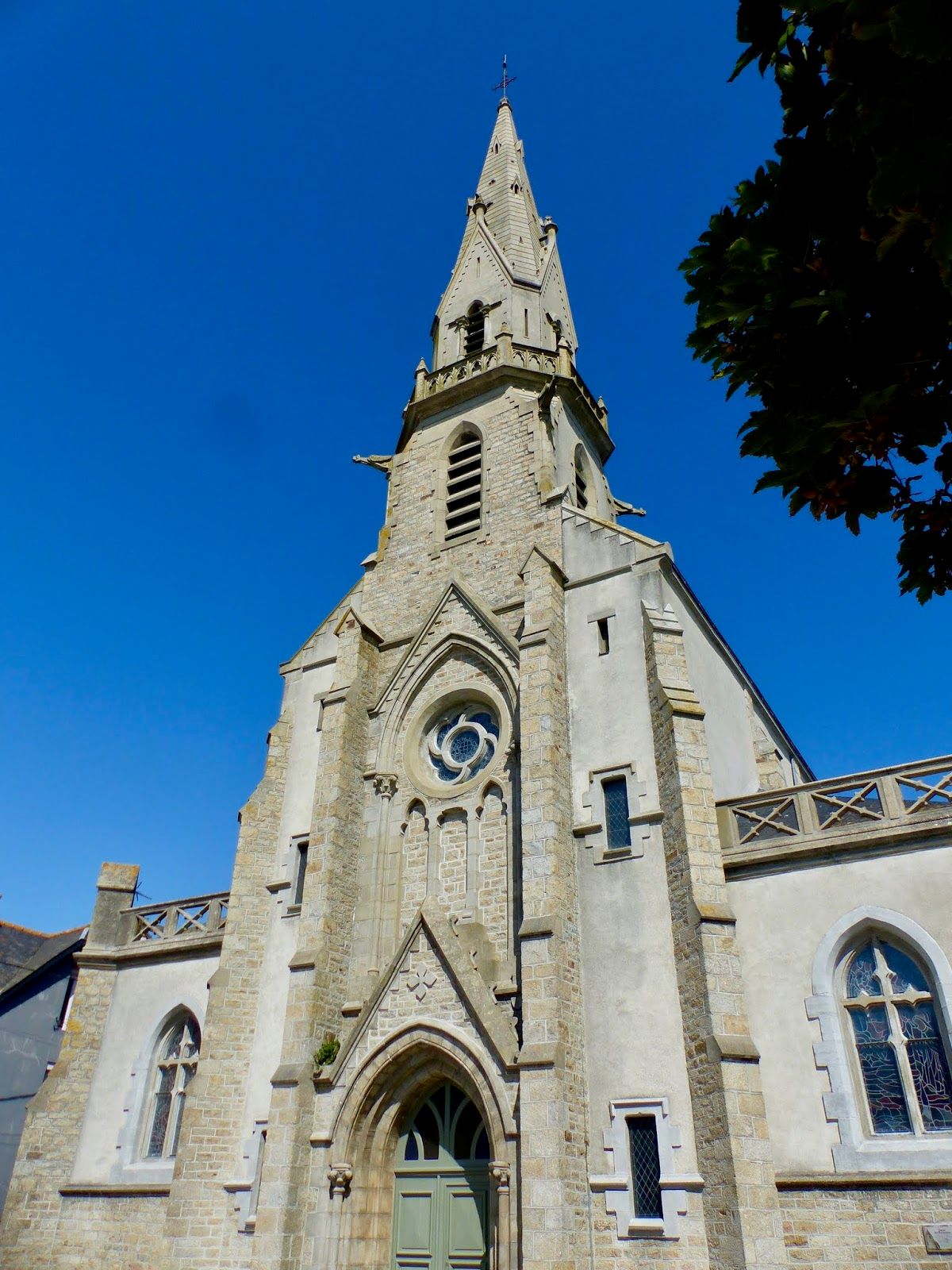
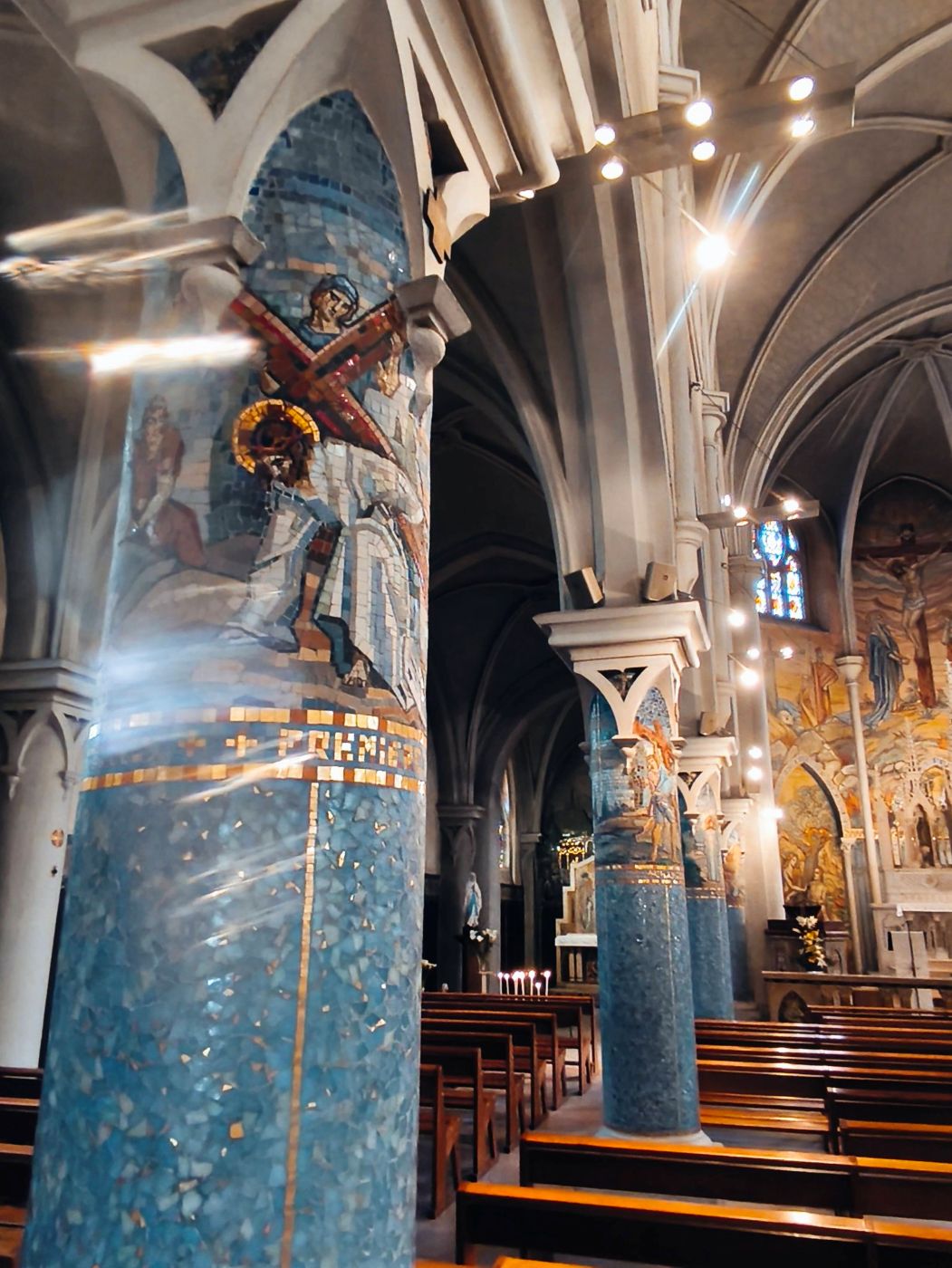
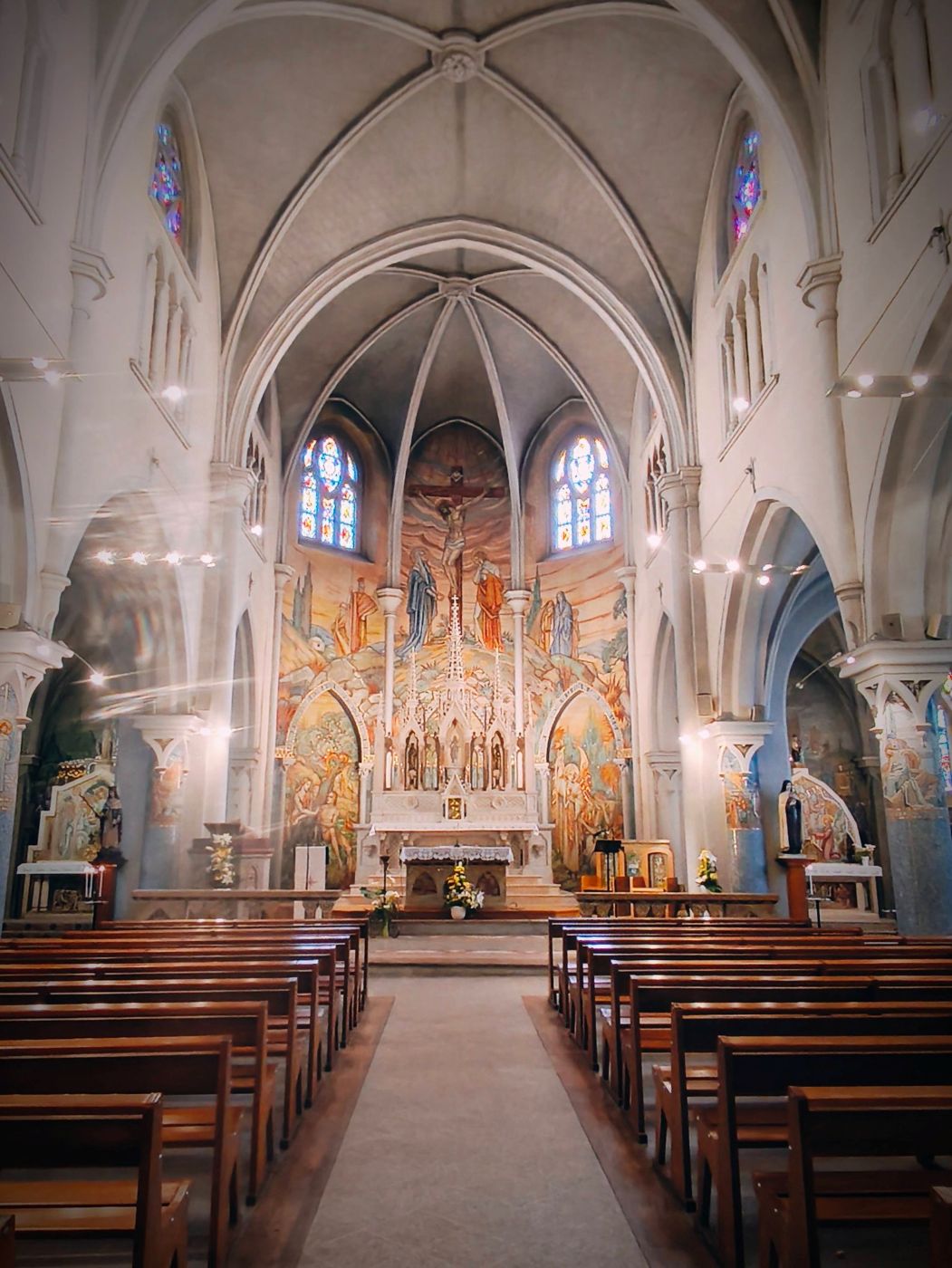
The Church Sainte Radegonde (Radegund) is dedicated to Radegonde of Poitiers (see post), it was rebuilt in the Neo-Gothic style between 1923 and 1927. Inside, one can admire a mosaic Stations of the Cross, mosaic-covered supporting pillars, stained-glass windows, a marble altar, and a vaulted ceiling. The parish Church of Saint Radegund retains some remains of an earlier structure. Its shape is rectangular, with two side aisles forming six bays leading to the chancel. It measures approximately 25 meters by 12 meters. The south door and the nave arcades are all in the Gothic style.
The Mauméjean workshop made a significant contribution to the church’s Art Deco decoration, creating the stained-glass windows, the mosaic motifs on the marble communion table, the frescoes depicting the Redemption and the WWII, the mosaics on the altars of Saint Anne giving birth to the Virgin Mary and the Holy Family, and the Stations of the Cross, which are unique in that they are displayed along the nave pillars.
The stained-glass windows were restored in 2006-2007. One of the windows, restored as early as 1927, depicts the fire that destroyed the old church. The church also houses two 15C statues and several listed 18C objects, including two chalices, a statue of Catherine of Alexandria, and a statue of the Virgin of Pity from an altarpiece.
Other things to see here are the Chapel of the Trinity in Kerner, dating from the 15C; Chapel of the True Cross, dating from the 17C; Saint John’s Chapel, rebuilt in 1884; Stervins tidal mill, dating from 1689; Poulfanc lighthouse, built in 1854, known as the “fire tower”; Kerbel lighthouse, located at Les Deux Moulins, built in 1913; Kerdurand Castle, located at 92 rue de Kerdurand and built after 1730; its gate and entrance date from the 19C.
A bit of history I like tell us that the original parish of Riantec, founded in the 6C, and first mentioned in 1323, originally encompassed the territories of Riantec, Locmiquélic, Gâvres, and Port-Louis. François Burin de Ricquebourg, governor of Port-Louis, Hennebont and Quimperlé, obtained in 1743 the erection of the Riantec moors into a fief, under the title of “Burin-Ricquebourg”. Several Riantec residents participated in the American War of Independence in the squadron of the Count of Ternay, as well as in the squadron of the Count of Grasse. The parish of Riantec was erected into a town, which then included Gâvres and Locmiquélic in 1790. It was picturesquely situated on the Ocean, on the side where the Lorient Roadstead opens, is also one of the fortified points which protect the entrance to this roadstead. Several batteries were erected in the areas overlooking the river mouth or along the open waters. In 1874, a petition from the inhabitants of Riantec demanded “the restoration, as soon as possible, of the monarchy in the person of Henry V, (Count of Chambord), the legitimate heir to the crown of France.” The first pilgrimage of the year to Sainte-Anne-d’Auray (see posts) was called the “Riantec pilgrimage” because it was this parish that, some 300 years before 1900, had first established the practice. On January 23, 1917, the ancient 11C church of Sainte-Radegonde was completely destroyed by accidental fire; nothing could be saved. On February 4, 1920, the ruined church collapsed, burying several children under its rubble: one was killed and another seriously injured. The church was rebuilt between 1923 and 1927.
The town of Riantec on its heritage/history : https://www.riantec.bzh/transitions/histoire-patrimoine/
The local Lorient South Brittany tourist office on Riantec : https://www.lorientbretagnesudtourisme.fr/fr/immanquables/riantec/
There you go folks, one of those town in our off the beaten path ways and always something nice to see in my beautiful Morbihan. It is a wonderful coastal town with great views and history, and has nice architecture which I like. Again, hope you enjoy the post on this is Riantec !!! as I.
And remember, happy travels, good health, and many cheers to all !!!


