
And coming back to my old stumping road warrior area ,and finding me these pictures in my cd rom vault that should be in my blog for you and me, This is a special town many times visited even if this monument cannot be visited it is worth the detour, So much history that need to rely on official sites and wikipedia to tell all, bear with me, I have written on the farm very famous there (see post), but now let me tell you about the military school, For reference, the City of Saint Cyr l’école is located in the department 78 of Yvelines, in the Île-de-France region of my belle France. It was only 7 km from my home in Versailles !! Therefore, let me tell you my take on the Lycée Militaire de Saint Cyr !!! Hope you enjoy the post as I,
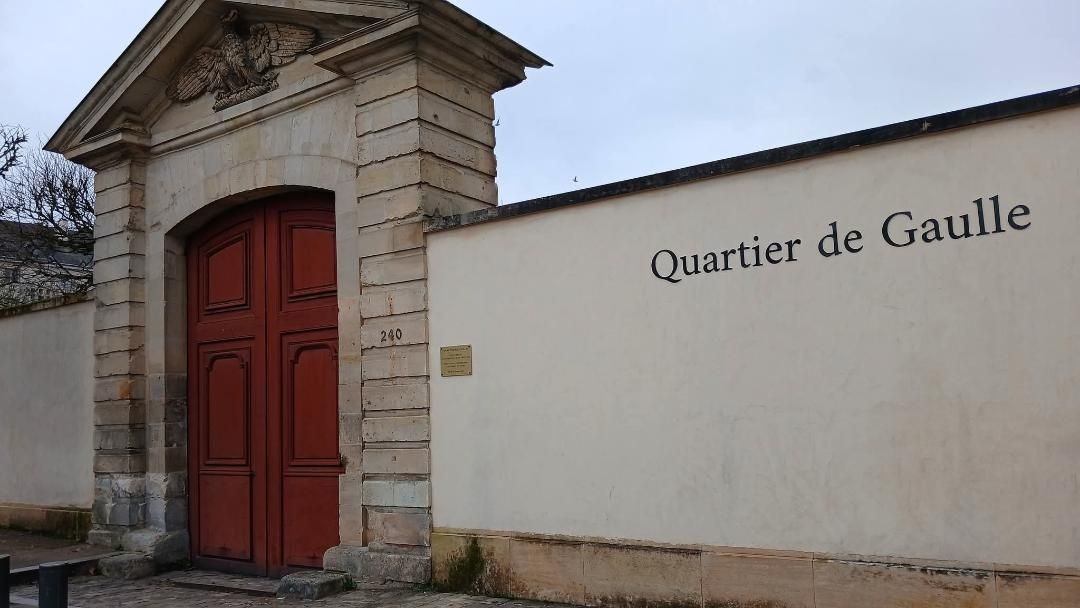
The Lycée Militaire de Saint-Cyr or Saint-Cyr military high school is one of the six Defence high schools of the French Ministry of the Armed Forces, located in Saint-Cyr-l’École, The high school buildings have a particularly rich historical past: indeed, they were preceded by the Royal House of Saint-Louis (1686-1793), the Val Libre hospital (1793-1796), the Prytanée Militaire (1801-1808) and the École Spéciale Militaire (1808-1940). The college became a military high school (since 1966); The Charles de Gaulle Military High School since September 2020 (see pic).
The end of King Louis XIV’s reign was marked by long and costly wars. The king therefore decided to create three institutions to accommodate the children of nobles who could not provide their descendants with an education befitting their rank: cadet companies to train the sons of impoverished noble families for the officer profession, and the Maison Royale de Saint-Louis or Royal House of Saint-Louis to house young women from needy noble families, with priority given to those whose fathers had died in battle. In 1684, the king, in a grand council and at the urging of his mistress, Madame de Maintenon, decided to establish “a house and community where a considerable number of young women, from noble families and particularly those whose fathers had died in service, would be housed. The Maison Royale d’éducation de Saint-Louis or Royal House of Education of Saint-Louis was established at Saint-Cyr from August 26 to September 2. In 1686, Madame de Maintenon declared: “May this establishment last as long as France, and France as long as the world.” The centenary of the Royal House of Education in 1786 was lavishly celebrated, but its survival was now solely due to the king’s sister, Madame Élisabeth. Indeed, Louis XVI never visited the site. The French revolution sounded the death knell for the Royal House. Louis XVI attempted to save the institution by issuing a decree on May 26, 1790, proposing that all daughters of officers, regardless of birth, be admitted. Like all religious institutions, on August 16, 1792, the Royal House of Saint-Louis, which had educated more than three thousand young ladies throughout its history, was abolished by decree of the Legislative Assembly. On October 1, it was evacuated and transformed into a military hospital called, like the town, Val Libre. The chapel underwent a complete conversion, now divided into two floors: one for the sick, the other for the wounded. In 1798, under the Directory, the hospital became a branch of the Hôtel des Invalides in Paris; it did not revert to being a place of worship until 1808. The tradition of educating young women was then taken up and perpetuated to this day by the Maison d’éducation de la Légion d’honneur (founded in 1805 and located in Saint-Germain-en-Laye for the collége or middle school section and Saint-Denis (see post office) for the Lycée or high school section).
In 1800, First Consul Bonaparte, a former artillery officer who knew the establishment because he had come to fetch his sister Élisa from the Royal House in 1792, shortly before the institution’s dissolution, restored Saint-Cyr to its educational vocation, but for boys, by establishing a division of the Prytanée français, a free school for men. sons of military personnel. The aim was to educate and raise, free of charge, the sons of those who had died on the field of honor. The main center, in Fontainebleau, was officially founded on January 28, 1802. The hospital was then evacuated, and the collège militaire de Saint-Cyr or Saint-Cyr Military College was inaugurated by the First Consul’s brother, Lucien Bonaparte, who paid tribute to Madame de Maintenon in his inaugural address. The Imperial Special School was transferred to Saint-Cyr, and the Prytanée Militaire (military academy) located there was moved on June 1, 1808, to La Flèche (see post). In 1808, Napoleon I had a riding arena built. In total, he visited the site about ten times, whether as First Consul or Emperor, alone or with Empresses Josephine and Marie-Louise.
During the Restoration, the new King Louis XVIII was determined to dissolve Saint-Cyr, a symbol of the Napoleonic era. He wanted to re-establish the Military School of Paris. However, he reversed his decision and attached the Cavalry School of Saint-Germain-en-Laye to Saint-Cyr. Since the students of the latter were part of the nobility of the Ancien Régime, the aim was to modify the spirit of Saint-Cyr, making it more royalist than Bonapartist. The final fall of the Empire led to the closure of the School on July 16, 1815, and its dissolution on September 6 by royal decree. The government of the Second Restoration then attached a second establishment to the Preparatory Military School of La Flèche, which was located in Saint-Cyr. The Saint-Cyr Preparatory School, or Petite École or Little School , opened on March 17, 1816, and trained 563 students, who would provide the army with 15 divisional generals and 18 brigadier generals, all from the highest nobility. This preparatory school, however, existed for only two years, becoming the l’École royale spéciale militaire or Royal Special Military School (ESM) thanks to two royal decrees of 1817 and 1818. The government of the First Restoration had chosen Paris, but King Louis XVIII ultimately opted for Saint-Cyr. In remembrance, the ESM took the nickname Grande École or Big School. The school then took on an even more pronounced royalist tendency and did not hesitate to demonstrate its support for the monarch: thus, in July 1830, students guarded the Château de Saint-Cloud and the Pont de Sèvres, while King Charles X faced a revolution; On the night of the 30th to the 31st, they escorted him into exile. Eager to project a more modern image, and in any case unpopular with the students due to his Orleanist ancestry, Louis-Philippe I briefly considered dissolving the École, which he viewed as a breeding ground for future opponents. It was ultimately maintained, but the July Monarchy deprived the Saint-Cyr cadets of the best officer positions, awarding them instead to Bonapartists who had fallen from grace after the collapse of the Empire. The students’ resentment towards the king led them to support the February Revolution of 1848, which proclaimed the Second Republic. In reality, they were hoping for the restoration of a Legitimist king.
Napoleon III became emperor in 1852 and took a great interest in Saint-Cyr. He had a cavalry barracks built there, along with two amphitheaters, a water tower to supply the upper floors, and gas lighting installed. He restored the imperial eagle as the emblem of the school. The foreign expeditions undertaken by the regime allowed students to travel the world, as evidenced by the names chosen for their graduating classes: Kabylie (1850-1852), Crimea (1854-1856), Solferino (1858-1860), and Mexico (1861-1863). Napoleon I’s nephew (Napoléon III) visited the school three times: in 1850 (as President of the Republic), in 1852, and in 1860. The French defeat in the Franco-Prussian War of 1870 led to the fall of the Second Empire. The school was occupied by the Prussians during the Siege of Paris. It was under the Third Republic that the school reached its zenith, continuing to train elite officers in the infantry, cavalry, and general staff, as well as colonial officers; it also continued to welcome foreign students, attracted by the prestige of the institution. In August 1914, many Saint-Cyr cadets were assigned to combat units. On July 30th, the graduating class, known as the “Cross of the Flag” class, was officially christened. The “Montmirail” class suffered 209 deaths, “Cross of the Flag” 290, and “The Great Revenge” 453. At the end of the war in 1919, the school reverted to its former motto from the Second Empire. On May 20, 1922, President Alexandre Millerand visited Saint-Cyr, accompanied by Minister of War André Maginot and Marshals Franchet d’Espèrey, Foch, and Pétain, to inaugurate a war memorial in the Wagram courtyard, created by Jean Boucher. The president added the Croix de Guerre to the school’s flag, which had already displayed the Legion of Honor since 1914. Saint-Cyr’s international prestige is growing: the school welcomes a significant number of foreign officer cadets, from Europe (Czechoslovak, Polish, Finnish, Lithuanian, or Romanian) and even Asia (Chinese or Siamese). It is also diversifying its training programs: a reserve officer cadet group was established in 1920.
France declared war on Germany on September 5, 1939. The second-year students (the 124th class, known as the Marne and Verdun class) were then integrated into the French armed forces, while the first-year students were sent to depots. Throughout its history at the Saint-Cyr site, the École Spéciale Militaire (Special Military School) has trained 40,000 officers, 8,000 of whom died for France. Thirty-seven generals have served as head of the institution. On May 8, 2002, the service road between Avenue Jean-Jaurès and the high school was renamed “Avenue de l’École Spéciale Militaire de Saint-Cyr.” The high school occupies number 240 there (see photo), a number that does not correspond to a logical numbering system but reflects a tradition within the institution, where this number holds particular symbolic significance. A bust of General de Gaulle, a former student and teacher, was unveiled on the same day in front of the entrance to the establishment, as the bicentennial ceremonies of the École Spéciale Militaire were being celebrated. In 1945, the school returned to mainland France. Marshal de Lattre de Tassigny then declared his desire to recreate “a single school for a united France” and decided to establish it, not at Saint-Cyr, but in Brittany, at Coëtquidan,(see post) a military site founded by King Louis-Philippe. It took the name École spéciale militaire interarmes or Special Combined Arms Military School.
The lycée or high school is located in the heart of the town of Saint-Cyr-l’École, adjacent to the grounds of the Palace of Versailles. The main entrance is at 240 Avenue de l’École Spéciale Militaire. It is served by the Saint-Cyr train station (Transilien lines N and U and RER line C). Two bus stops are located opposite the high school, along Avenue Jean-Jaurès; the Saint-Cyr-l’École airfield is located behind the school.
The official archives of the Yvelines dept 78 on the Lycée Militaire de Saint Cyr : https://lelabarchives.yvelines.fr/Lyc%C3%A9e_militaire_de_Saint-Cyr
The official Ministry of Defense of France on the Lycée Militaire de Saint Cyr : https://www.terre.defense.gouv.fr/lycee-militaire-saintcyr-ecole/presentation-du-lycee-militaire-saint-cyr
The City of Saint Cyr on its history/heritage : https://www.saintcyr78.fr/mon-quotidien/decouvrir-saint-cyr-lecole/histoire-et-patrimoine/
There you go folks, this was my memorable former area of first official home in France and always remember fondly, my nostalgic Yvelines the cradle of the kingdom of France and lovely towns all over with great architecture and history, Again, hope you enjoy this post on the Lycée Militaire de Saint Cyr !!! as I.
And remember, happy travels, good health, and many cheers to all !!!


