
So continuing with my road warrior indulgences in my beautiful Morbihan , and into the backwaters off the beaten paths this time came to a village with a nice waterfront on a canal. I found me pictures in my cd rom vault that should be in my blog for you and me, Therefore, let me tell you my take on this is Montertelot !! Hope you enjoy the post as I.
The village of Montertelot is located in my beautiful Morbihan department no 56 in my lovely Bretagne region, and in my belle France. The town’s territory is crossed by the N166 highway, the Vannes-Ploërmel road. The town is served by an interchange providing access, on the west side, to the D766a road towards the town center and La Ville Briend, and on the east side, towards Les Bruyères and Tressol. It is 7 km from Ploêrmel, 2 km from La Chapelle-Caro, Val d’Oust, 42 km from Vannes, and 68 km from my current home from where we came to see the ecluse but saw more, This was along the wooded curvy D16 road passing City center Locminé to connect with the N24 highway dir Rennes get off at exit Ploêrmel Est to connect with the D766E road thru a double roundabout to connect bearing left onto the N166 highway bearing left to connect with the D766A dir Montertelot then turn right onto Montertelot on the D144 road or Rue des Barres continue same road onto Rue de l’Oust and the church is on your left hand side with parking,
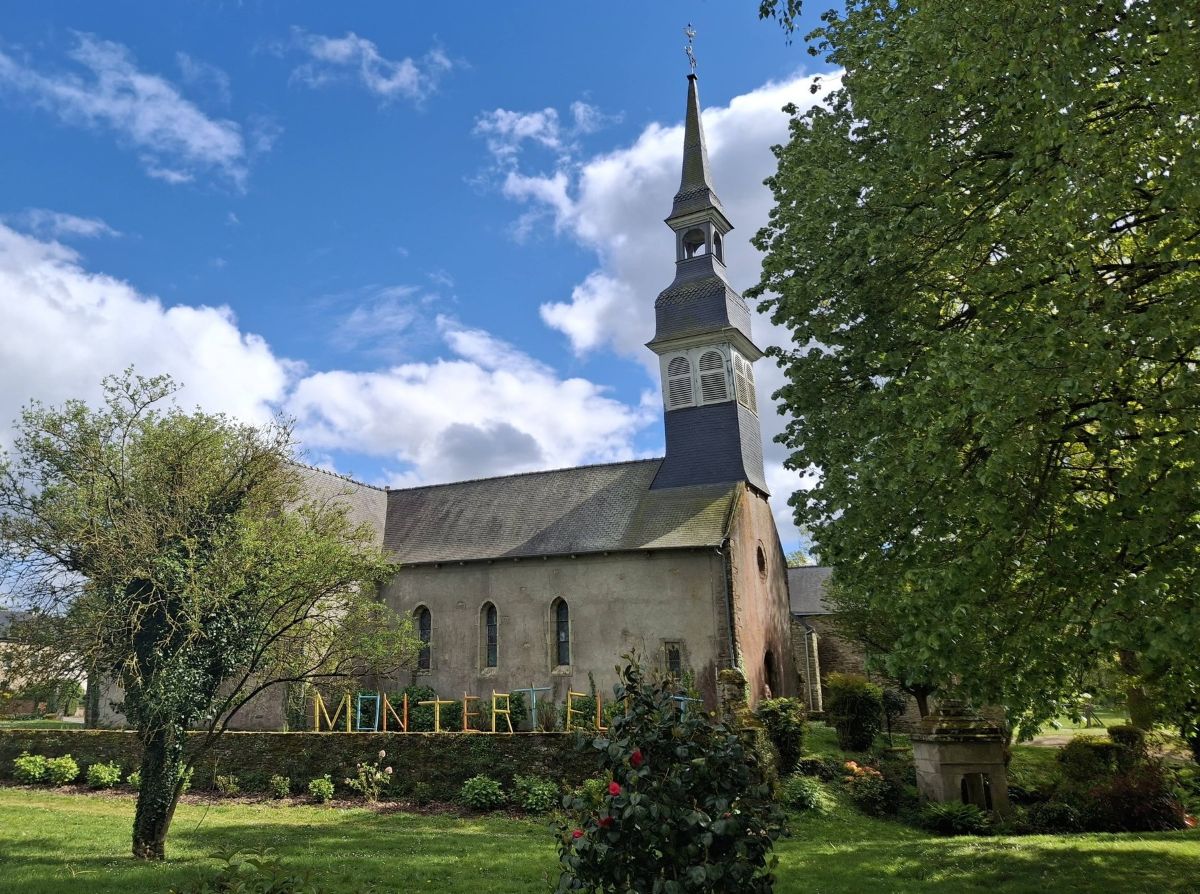
The parish Church Saint Laur, was originally just a barn. The rough stones attest to this on the nave, near the baptismal font. The first expansion work dates back to 1617. The church possesses many remarkable religious objects, including a painting of the Rosary. The first chapel in Montertelot was built between 1443 and 1454. In 1617, the small chapel was enlarged. Then, in 1851, the church underwent a major restoration with the creation of the south transept, raising of the walls, complete roof replacement, and relocation of the bell tower to its current position. It is a church in the shape of a Latin cross. Formerly, the side altars were dedicated to the Virgin Mary and the True Cross. Today, only one side altar remains, in the north transept, dedicated to the Virgin Mary. A curious small copper crucifix from the 15C is preserved there: this cross is 23 cm high and is believed to have come from the original chapel.
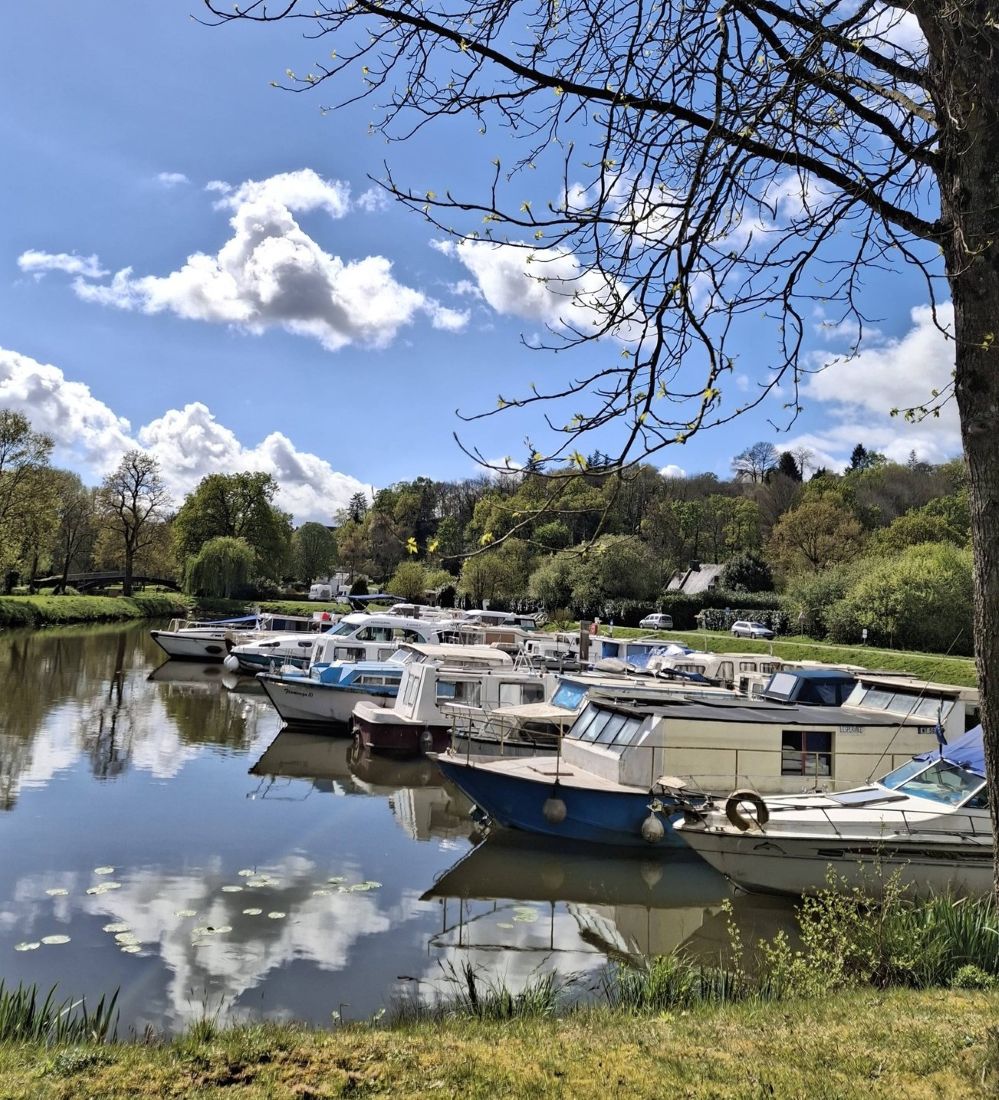
The Nantes-Brest Canal (see post) is a canal, channel, and estuary, and a natural waterway navigable for much of its length. 364 km long, it rises in the village of Nort-sur-Erdre and flows into the Loire river at Nantes. The canalized Oust forms a section of the Nantes-Brest Canal and is now used for tourist navigation. The towpath along the Nantes-Brest Canal is popular with eco-tourists: fishermen, hikers, cyclists, boaters, and campervan enthusiasts share the path; the lawn on the landing stage quay is a favorite spot for picnickers.
Other things to see here are the Saint Laur fountain (behind the church): created in 1885. A wooden applewood statue representing Saint Laur replaced the original statue. The Calvary and the wayside cross at La Ville-Briend, the Montertelot lock no. 29 on the Nantes-Brest Canal,.Of interest to know : the Oust river, 145 km long, rises in the village of La Harmoye and flows into the Vilaine river at Rieux, after crossing 46 towns/villages. The Oust forms the western boundary of the village of Montertelot, separating it from the village of Val d’Oust. It is drained by the Nantes-Brest Canal.
A bit of history I like tell us that Montertelot was a dependent parish of Guillac, but may have previously belonged to La Chapelle-Caro. The dependent parish of Montertelot comprised three lordships: Montertelot, Tressol, and La Ville-Brient. It was united with the parish of Guillac in the 16C and remained so until the French revolution. The parish of Montertelot formerly belonged to the diocese of Saint-Malo. In 1801, Montertelot was transferred to the diocese of Vannes. The mill was a dependency and lordship of Guillac, was a paper mill in the 18C, but its output was poor. In 1491, the parish priest of Montertelot, Bonno, refused to swear the oath of allegiance to the Civil Constitution of the Clergy, thus becoming a refractory priest. The village of Montertelot was created in 1793. The construction of a landing stage on the Nantes-Brest Canal within the village was declared a public utility in 1871.
The official village of Montertelot : https://montertelot.fr/
The Ploêrmel community of towns on Montertelot : https://www.ploermelcommunaute.bzh/montertelot/
There you go folks, a small village full of charm in back country for the real pleasures of France. For the adventurous and curious Montertelot is worth the detour, me think, Again, hope you enjoy the post on this is Montertelot !! as I.
And remember, happy travels, good health, and many cheers to all !!!


