
We have driven and walked in my eternal Paris, and would like to have an imprint in my blog on the wonderful family times we had there, There is so much to see , doing my best, and glad found me this picture in my cd rom vault ,which now transposing in my blog for you and me, This is an unusual post for me as this is a bank rather off the beaten path site but full of architecture and history that would worth the detour, me think, I thank you for your readership since 2010, and to bear with my rants! After all Paris is to rant, shout and yelled about, me think. Therefore, here is my take on the former Maison Dorée hq BNP Paribas bank in Paris !!! Hope you enjoy the post as I.
At 20 Boulevard des Italiens you can see the beautiful former Maison Dorée, on the corner of Rue Laffitte and Boulevard des Italiens, dates from 1839 according to the inscription on its façade; the exact date of construction of the Maison Dorée building is unknown. Originally, the restaurant was called “Le Restaurant de la Cité.” But due to its luxurious furnishings, paintings, mirrors, and gilding on the balustrades and balconies, the public gave it the name Maison Dorée. The restaurant was divided into two sections: one on the boulevard, reserved for the general public, and the other, on Rue Laffitte, for distinguished regulars, away from prying eyes, in luxurious private rooms. Novelists of the time set various dinners there: Honoré de Balzac with Lucien de Rubempré, for example. In Marcel Proust’s *In Search of Lost Time*, it is when Swann comes to the Maison Dorée looking for Odette and not finding her that he falls deeply in love with her. It was at the Maison Dorée that chef Casimir Moisson is said to have created the Tournedos Rossini for the composer Rossini, who was a regular. Several newspaper offices were located in the building. In 1853, Alexandre Dumas established the offices of his newspaper, *Le Mousquetaire*, on the ground floor. It was also at the Maison Dorée that the 8th and final Impressionist exhibition was held on May 15, 1886. Impressionism, which had begun at 35 Boulevard des Capucines in 1874, ended on the Boulevard des Italiens.
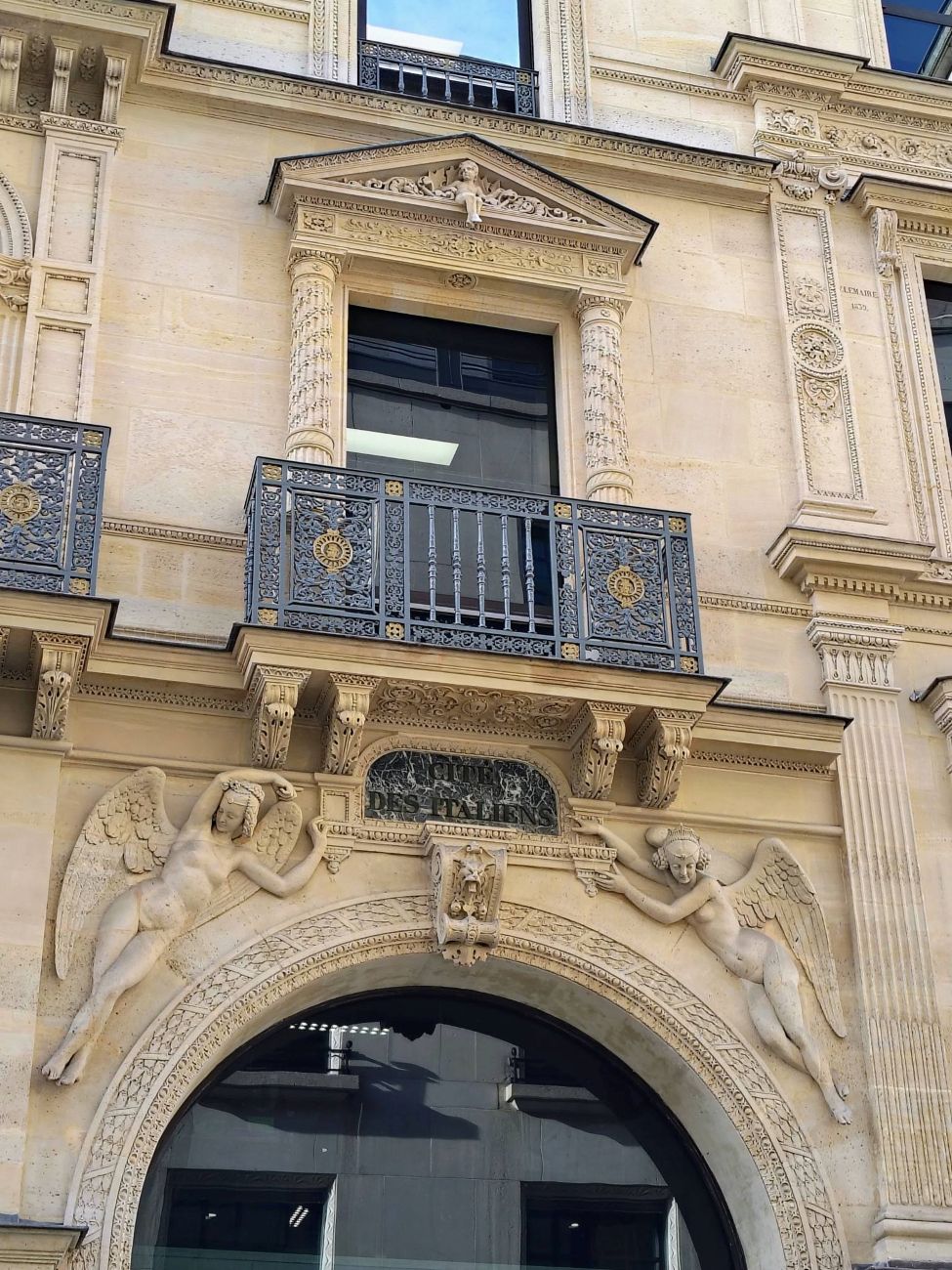
Let me tell you more always more in my eternal Paris of this venerable wonderful institution which I call my bank for the last 24 years ! In place of the Café Hardy, a popular establishment during the Empire and Restoration periods but destroyed in 1838, a vast neo-Renaissance complex, the “Cité des Italiens” (see name on front portal), was built, extending along Rue Taitbout. At the end of the French revolutionary period, the Hôtel de Choiseul-Stainville, which stood on the site of the current Maison Dorée, was demolished to make way for a restaurant, the Café Hardy, which was very popular during the Empire and the Restoration. It was sold in 1836 to the Hamel brothers, already owners of the Café de Chartres, at the Palais Royal, and destroyed in 1838. In its place, a vast complex in the Neo-Renaissance style, the “Cité des Italiens”, was built, extending onto Rue Taitbout, and where a new restaurant, founded by Louis Verdier, called Maison Dorée, was established in 1841. By erecting buildings on the side and rear of the Maison Dorée, he completed his “Cité des Italiens” in April 1844. Several newspaper offices were established in these buildings, including, in 1848, L’Événement, run by the sons of Victor Hugo and Paul Meurice, and, in 1853, the newspaper Le Mousquetaire, under the pen of Alexandre Dumas. In 1902, the Maison Dorée restaurant closed, The establishment was divided into several shops, and a brasserie, the Taverne Laffitte, replaced the restaurant. It closed a few years later and, in 1909, gave way to a post office, located at 22 Boulevard des Italiens. It closed in 1932. The site was left abandoned. After WWII, the building became an archive storage facility for the GAN insurance company (Groupe des Assurances Nationales).
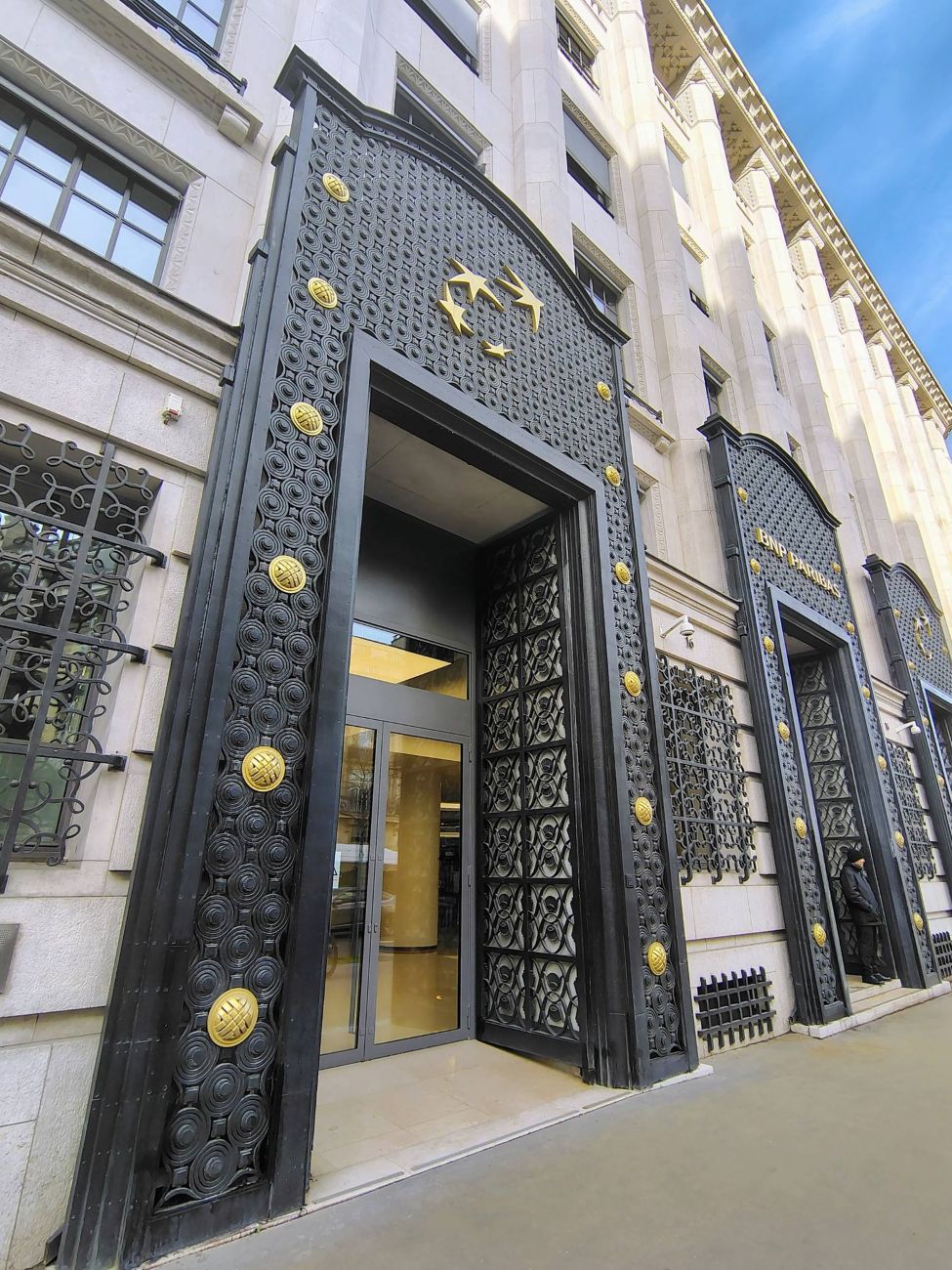
The BNP (banque national de Paris) bank, lacking space to house its teams, particularly its recently expanded international division, planned to acquire the block adjacent to its headquarters at 16 Boulevard des Italiens. This would allow it to centralize its various departments, currently scattered across different buildings and neighborhoods (Haussmann, Bergère, Vendôme). The building permit was granted on January 7, 1975: the plan called for the construction of a six-story office building with six basement levels, including two levels of meeting rooms. The building would have multiple addresses, spanning 22 Boulevard des Italiens, 1 & 3 Rue Laffitte, and 2, 4, 6, 8, and 10 Rue Taitbout. The first meetings in the new building were held as early as autumn 1976. This “Laffitte annex” was intended to be the showcase of BNP, bringing together the DTAI, the DRAFEX, and the international division. On May 19, 1972, BNP signed its first deed of acquisition from GAN for the block comprising 20-22 Boulevard des Italiens, 1-3 Rue Laffitte, and 2-4 Rue Taitbout. A second deed was acquired in June 1973 for the buildings on Rue Taitbout, thus obtaining the entire block that constituted the “Cité des Italiens.” Demolition of the buildings not to be preserved lasted five months, from September 1973 to February 1974. On January 7, 1975, plans were drawn up for the construction of a six-story office building with six basement levels, including two levels of meeting rooms. This building would have multiple addresses, spanning 22 Boulevard des Italiens, 1 & 3 Rue Laffitte, and 2-4-6-8 and 10 Rue Taitbout. In the building’s basement, in addition to 300 parking spaces, meeting rooms, the largest of which, seating 500, was nicknamed “The Aquarium” because of the blue hues of its armchairs and carpeting. The first meetings in the new building were held in the fall of 1976.
The Maison Dorée became the venue for international seminars and visits from foreign dignitaries and members of the French business community, a tradition that continued for many years. The trading floor, the first in Paris, opened in 1987, covering 1,200 square meters. It was fully booked by 1990 and proved too small despite its 110 desks. A new 1,100-square-meter room was opened in September 1994. The Maison Dorée became a venue for major cultural events. Concerts, exhibitions, competition launches under the patronage of French cultural figures, colloquia, film awards ceremonies and operatic evenings punctuate the life of the BNP Paribas bank, which has become an essential player in French and European economic life, and an active cultural conduit.
Now let me use this space to tell you about a street boulevard that I have cruised and walked many times and know it very well indeed, However, the information to be more precise is taken from Wikipedia,
The Boulevard des Italiens is located on the border of the 2éme and 9éme arrondissements of Paris. It is part of the chain of Grands Boulevards, which consists of the Boulevards de la Madeleine, des Capucines, des Italiens, Montmartre, Poissonnière, Bonne-Nouvelle, Saint-Denis, Saint-Martin, du Temple, des Filles-du-Calvaire, and Beaumarchais. It is served by metro lines 3, 7 and 8 of Opéra station, and metro lines 8 and 9 Richelieu – Drouot station. It owes its name to the Théâtre-Italien, now occupied by the Opéra-Comique,(see post) which was built there in 1783. The boulevard was created after the demolition decided in 1670 of the Louis XIII wall which had become obsolete, in front of bastion 4 aka bastion de Gramont of this rampart, through market gardens. At the beginning of the 18C, it was called “Boulevard Cerutti” during the French revolution, after a hotel on the boulevard where the writer Joseph-Antoine Cerutti had settled. Under the Consulate and the Empire, it was named “Boulevard de la Comédie-Italienne” for one part and “Boulevard d’Antin,” or “Boulevard de la Chaussée d’Antin” for the other. It was also called “Boulevard de Coblentz” or “Little Coblenz” under the Directory, because royalist émigrés returning to the country after a long stay in the Rhenish city of Koblenz (see posts) Germany, gathered there. Then, from 1815 to 1828, it was called “Boulevard de Gand” during the Second Restoration, in memory of the exile of King Louis XVIII to Ghent. the Hundred Days, before taking its current name of Boulevard des Italiens.
Notable buildings here are well see the intersection with Rue Laffitte offering a distant view of the Notre-Dame-de-Lorette Church (see post), and, in the background, the Sacré-Cœur Basilica of Montmartre (see post). This viewpoint can give the impression that the two monuments are superimposed despite their distance. No. 5 bis: Passage des Princes, inaugurated in 1860 under the name “Passage Mirès.” No. 8: From 1859, the luxurious studios of André Adolphe Eugène Disdéri, a fashionable photographer during the Second Empire, were located here, just above the Jean-Eugène Robert-Houdin theater. No. 16: The Art Deco headquarters of BNP Paribas, (see above) built between 1926 and 1933 for the National Bank of Commerce and Industry. Former site of the Café Riche (1791). No. 19: the headquarters of Crédit Lyonnais (see post), built from 1876 to 1913 in the Haussmannian style on the site of the Hôtel de Boufflers, over which the Galerie de Fer (Iron Gallery) had been built, leading from the boulevard to the Rue de Choiseul. The passage, destroyed by fire in 1828, was rebuilt the following year in iron. It was here that the first gas lighting experiments were conducted. No. 20: site of the luxury restaurant Maison Dorée (see above) Now occupied by BNP Paribas offices, which have retained the original façade . No. 28: site of the Théâtre des Fantaisies Ollier (aka the “Fantaisies Parisiennes” and “Folies-Ollier”). The hall housed the Théâtre des Nouveautés from 1878-1911. The Théâtre des Nouveautés (see post), inaugurated in 1878 at 26 Boulevard des Italiens, was demolished in 1911 to make way for the construction of Rue des Italiens. The current Théâtre des Nouveautés has been located at 24 Boulevard Poissonnière since 1921. The first Théâtre des Nouveautés, which stood opposite the Bourse (Stock Exchange) (see post), was also demolished in 1869.
The official BNP Paribas bank on the history of Maison Dorée : https://histoire.bnpparibas/la-maison-doree-du-rendez-vous-du-tout-paris-a-la-banque-tournee-vers-linternational/
The Paris tourist office on walks along the Grands Boulevards (see no 3 bd des Italiens :BNP Paribas) : https://parisjetaime.com/eng/article/glamorous-paris%20-a898
The Paris tourist office on Paris Centre (arrond 1-4) de Paris : https://parisjetaime.com/eng/article/explore-the-centre-of-paris-a846
The Paris tourist office on the 9éme arrondissement de Paris : https://parisjetaime.com/eng/article/explore-paris-s-9th-arrondissement-a828
There you go folks, a dandy city to explore and enjoy with the family, Memorable moments in my eternal Paris, driving and walking all over in my road warrior trails brings out sublime awesome spots with nice buildings full of architecture and history of yesteryear ,and always looking forward to be back, eventually. The text is taken mostly from Wikipedia, Again hope you enjoy the post on the former Maison Dorée hq BNP Paribas bank in Paris !!! as I.
And remember, happy travels, good health, and many cheers to all !!!


