
This is another wonderful religious monument of my eternal Paris ; on the off the beaten paths but worth the visit, These monuments are the ones that keeps the wonderful architecture and history of a city today, and Paris is no difference. I found additional pictures in my cd rom vault and from other posts that should be in my blog for you and me, One of my most pleasurable moments is to visit them in my walks in my eternal Paris. Therefore, here is my take again on the Church Melkite Saint Julien le Pauvre of Paris !! Hope you enjoy it as I
The Church Melkite Saint-Julien-le-Pauvre stands in the shade of the oldest tree in Paris, in the Square René Viviani. Located in the heart of the Latin Quarter, its construction began in the 12C, on the foundations of a 6C church. The church is considered to be one of the oldest in the city. Art lovers can admire the interior of this church ; the capitals of the southern columns decorated with harpies, a 1900 iconostasis from the Byzantine rite, and a slab from the ancient Roman road from Lutetia to Orléans. Large 12C butresses are visible from the outside. Since 1889, the church has been used for Greek Melchite Catholic worship, and is therefore dedicated to the Byzantine rite. Classical music concerts are regularly held in this unique setting.
The Church Melkite Saint Julien le Pauvre was completely enclosed within a block of buildings: it was accessed via the courtyard of no 11 rue Saint-Julien-le-Pauvre, or via the courtyard of no 33 rue de la Bûcherie. The façade itself is preceded, on the left, by the current sacristy, which projects considerably and extends almost to the street. The 1651 façade belongs to the late Renaissance style. The rectangular doorway is flanked by two pairs of Ionic pilasters, and its lintel bears a marble plaque with an inscription.
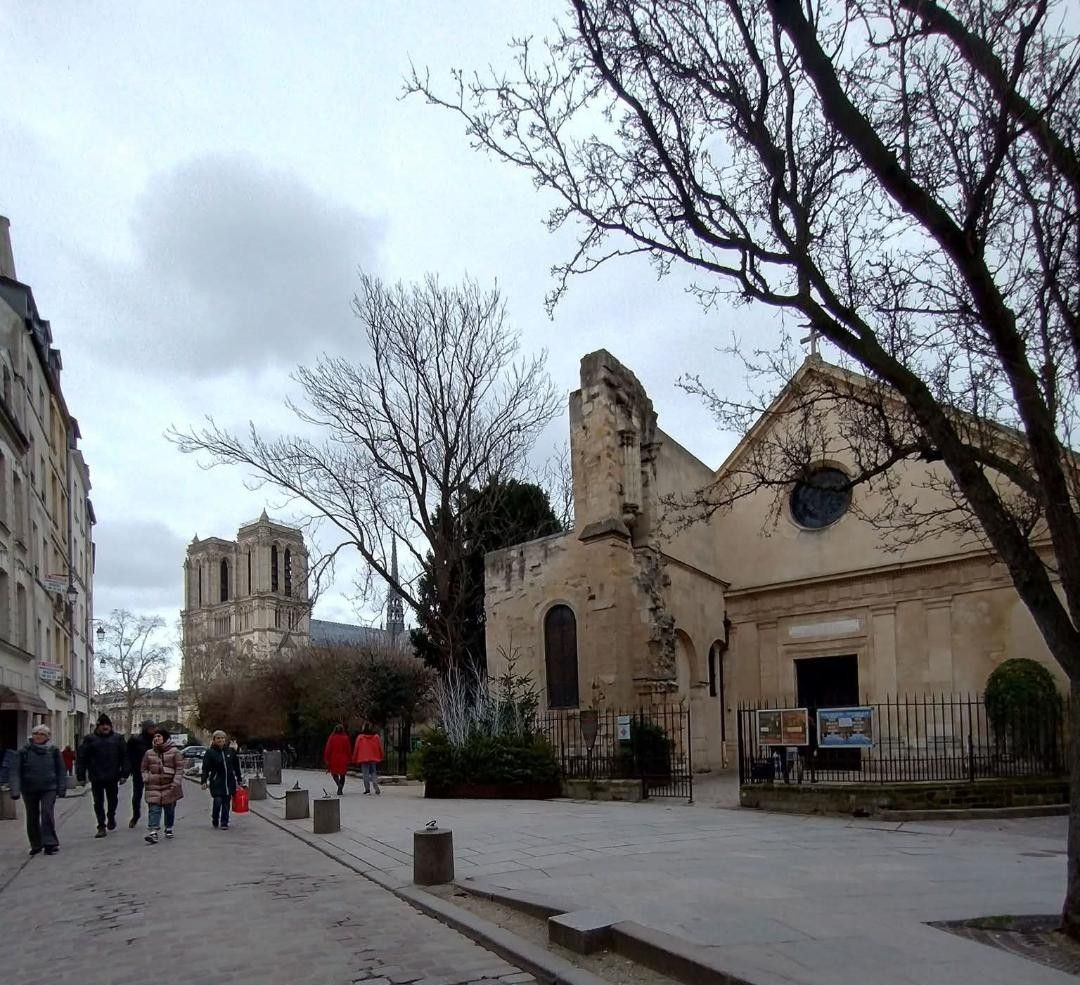
Its name refers to Saint Julian the Hospitaller, as a hospice welcoming pilgrims and poor travelers was associated with the church in the Middle Ages. However, it is not certain which saint was the church’s first patron saint, as it is one of the oldest in Paris, and its origins date back at least to the beginning of the 6C. Saint Julian of Le Mans and Saint Julian of Brioude are also considered patrons of the church.The original basilica was destroyed by the Vikings in 886. A second church was built and given to the Cluniac priory of Longpont-sur-Orge around 1125. The monks of Longpont repaired the church, established a priory, and began construction of a new church in 1160, which corresponds to the current church, At the beginning of the 17C, the priory fell into decline, and the church deteriorated ; despite an attempt at restoration and the construction of a new façade in 1651, the priory of Longpont resigned itself to ceding both the church and the priory to the Hôtel-Dieu hospital (see post) in Paris two years later. The priory ceased to exist, and the church became a chapel of the Hôtel-Dieu. The French revolution led to its conversion into a warehouse, a situation that lasted until 1826. Saint-Julien-le-Pauvre then became a chapel of the hospital once again, with a very limited spiritual life, before closing in 1873. From then on, Eastern Catholics had their own place of worship in Paris. The church remains the center of life for the Greek Melkite Catholic parish of Paris.
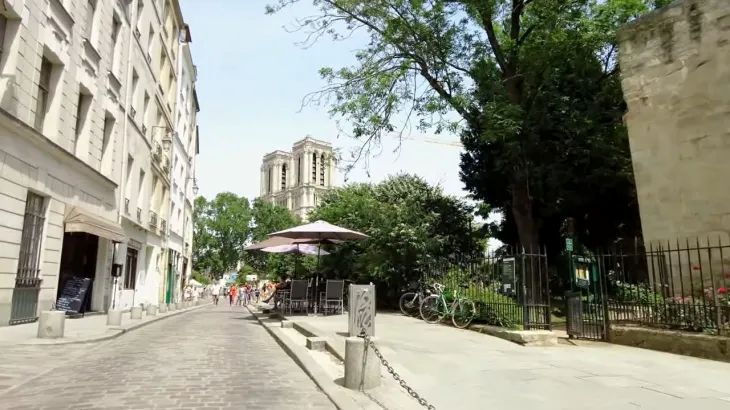
The Rue Saint-Julien-le-Pauvre is located in the quartier or neighborhood of the Sorbonne of the 5éme district or arrondissement of Paris. This street, which began at Rue de la Bûcherie and ended at Rue Galande, It was located in the former 12éme arrondissement of Paris. The street is accessible by metro line 10 at the nearby Maubert-Mutualité station, as well as the nearby Saint-Michel station. The street takes its name from the old road leading to the Saint-Julien-le-Pauvre Church, which was then located at No 11. It was located at the intersection of two Roman roads (one leading to Rome, the other to Orléans), this very old Parisian street takes its name from the old road leading to the Saint-Julien-le-Pauvre Church. It formed one of the boundaries of the Clos de Garlande fiefdom. In the 19C, the street numbers were black. The last odd number was 13 and the last even number was 16. In 1824, it took the simple name of “Rue Saint-Julien” before regaining its full name in the 20C. Notable buildings here are the Church of Saint-Julien-le-Pauvre, the former mansion of Isaac de Laffemas, French poet and playwright, civil lieutenant of the Paris provost court. Former residence of the Lieutenant General of Police of the Petit Châtelet. The pediment of the monumental portal features a representation of Justice. During the French revolution, the 14C cellar was used as a dungeon. The René-Viviani-Montebello square and its robinia tree. The Tea Caddy, one of the oldest tea rooms in Paris.
The official Church Melkite Saint Julien le Pauvre : https://sjlpmelkites.com/
The official Parish Melkite of the church : https://www.sjlp-paris.org/
The Paris tourist office on the church : https://parisjetaime.com/eng/culture/paroisse-saint-julien-le-pauvre-p1218
The Paris tourist office on the 5éme arrondissement de Paris : https://parisjetaime.com/eng/article/explore-paris-s-5th-arrondissement-a820
There you go folks, another dandy in my eternal Paris. This church is worth the detour, me think. Again, hope you enjoy this post on the Church Melkite Saint Julien le Pauvre of Paris !! as I.
And remember, happy travels, good health ,and many cheers to all !!!


