
Of course, I need to come back to the most beautiful avenue in the world and its in Paris ! I found some lost pictures in other posts that needed to be in one along on this wonderful avenue, me think. Therefore, this is my take again on the Avenue des Champs Elysées of Paris !!! Hope you enjoy the post as I.
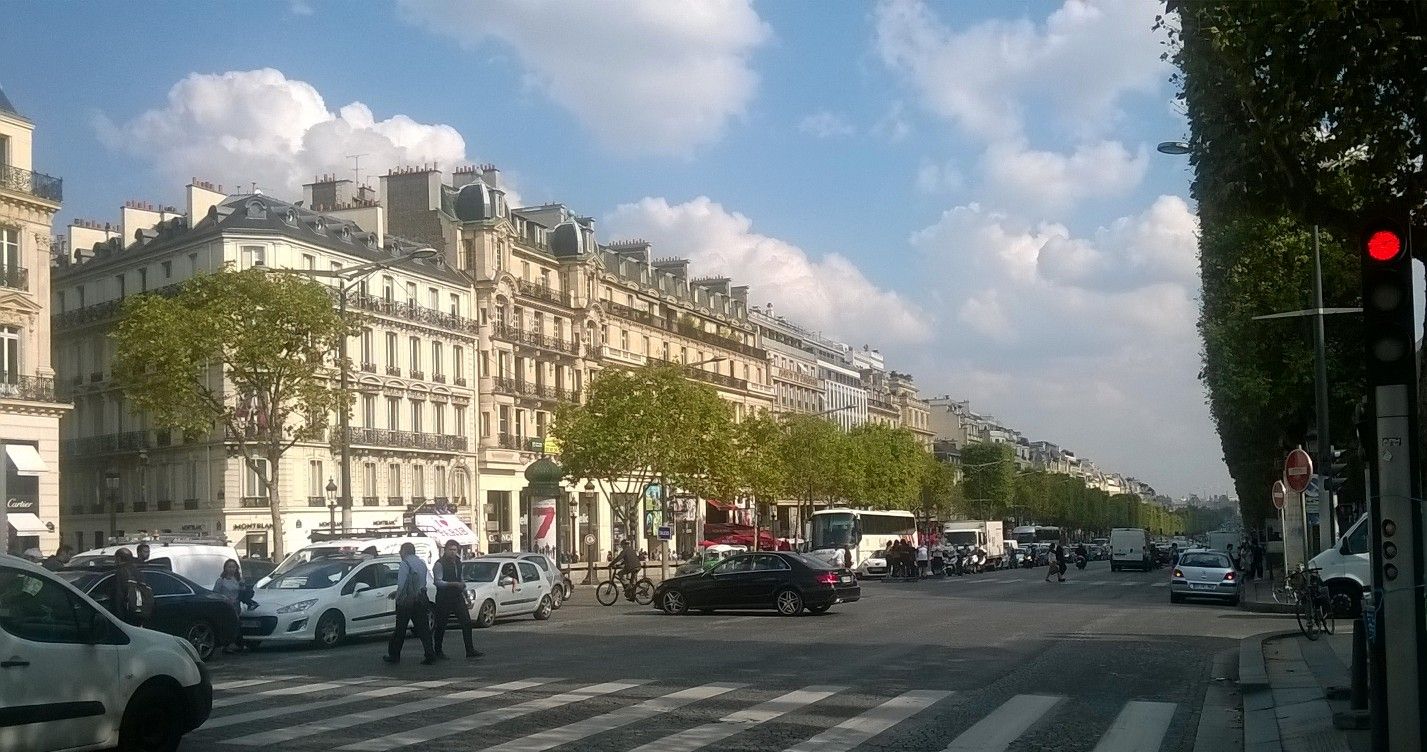
Everyone comes here need to visit it and they do in hordes of visitors, not to mention the poor souls who need to work here. So will tell you again what you can see here according to yours truly. Here you find the luxury of my belle France but also architecture and history to boot ! And my dear late wife Martine first went out here when girlfriend and than more so many memories forever on this avenue. How about looking at the avenue des Champs-Elysées !!! The Avenue des Champs-Élysées or locals call it simply Champs-Élysées, and even shorter for Champs is almost 2 km long linking the Place de la Concorde to the Place Charles-de-Gaulle in the 8éme district/arrondissement of Paris. It takes this name from the place of hell where the souls rest in the Greek mythology, so they tell me, The Avenue des Champs-Élysées is the most beautiful avenue in the world and of course in the most beautiful City in the world, Paris.
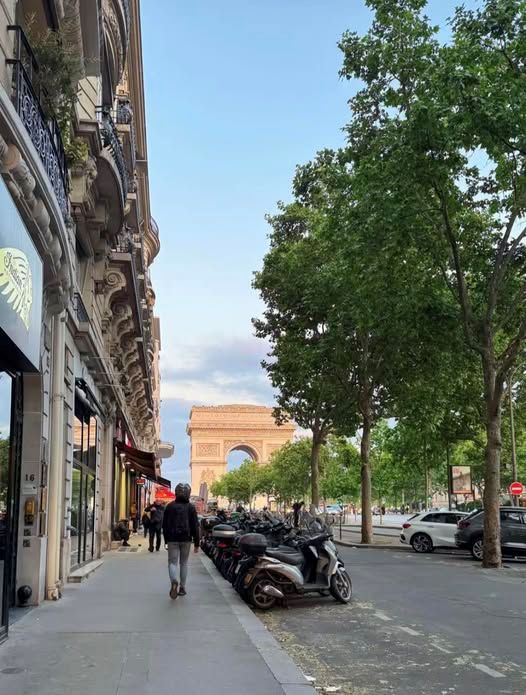
The avenue des Champs-Elysées is 70 meters wide, comprises a 30-meter-wide carriageway with four lanes of traffic in each direction and two 20-meter-wide sidewalks. In its lower section, east of the Champs-Élysées-Marcel-Dassault roundabout, the avenue is bordered by service roads called the “Promenade des Champs-Élysées,” which run alongside the Champs-Élysées gardens (see post). The avenue thus crosses the entire length of the gardens, a distance of 700 meters. You can access walking or by car with nice underground parking at Concorde and Arc de Triomphe, However, public transport is easy at the metro and RER stations : Concorde (lines 1, 8, and 12 -mine); Champs-Élysées – Clemenceau (lines 1 and 13); Franklin D. Roosevelt (lines 1 and 9); George V (line 1); Charles de Gaulle – Étoile (lines 1, 2, and 6). Charles de Gaulle – Étoile station (RER A line).
My list of favorites buildings here are at No. 25, Hotel de la Païva. This particular hotel, was built between 1856 and 1866 for Esther Lachmann, marquise de Païva, called La Païva , famous courtesan of the Second Empire. The hotel, famous for its interior decoration, is one of the best preserved examples of private architecture of the Second Empire. After the death of the Païva, the hotel was sold to a banker in Berlin and then, in 1895, to the restaurateur Pierre Cubat. Since 1904, it houses a private circle, the Travellers. No. 30: Home of the Earl of Monte Cristo in the novel by Alexandre Dumas. No. 37 (corner of rue Marbeuf): Residence of Beatrice Charlotte Antoinette Denis de Kérédern de Trobriand . She was the daughter of the Count Régis de Trobriand , a naturalized French aristocrat and general of the Union armies during the American Civil War, and Mary Jones, wealthy heiress, daughter of Mary Mason Jones, Grand-aunt of Edith Wharton. While her husband lived in New York, the Countess of Trobriand resided most of the time in Paris. The Countess lived separate from her husband after an episode of theft and corruption. This episode inspired Maurice Leblanc to do a chapter on the novel entitled “The Blue Diamond” of Arsène Lupin against Sherlock Holmes (1908). At Nos. 52-60: Originally built (1933) in the place of the Hotel de Massa for the American bank Citybank of New York, this building subsequently hosts a Virgin Megastore store (from 1988 to 2013), as well as a Monoprix. It is renovated from 2016 after the closure of the Virgin Megastore and now host a store of Galleries Lafayette. At No. 70: Vuitton Building (now the Marriott Hotel). Facade of late Art nouveau style built in 1914. At no 76-78; Arcades of the Lido. The building raised at this address has on the ground floor a shopping arcade which gives on one side on the Champs-Elysées and on the other on the rue Ponthieu. The arcades of the Champs-Elysées,of luxury shops, were built in 1925. The arcades were inaugurated in 1926. Some marble columns, coming from the old Hotel Dufayel, are used in the realization. The basement of the passage housed the Lido until 1976. Inaugurated in 1928, it was originally a beauty salon with a worldly swimming pool. Transformed into a cabaret in 1946, they were the origin of the current name of the passage, the “arcades of the Lido”. No. 92: During the Nazis occupation, the seat of the magazine Der Deutsche Wegleiter für Paris, intended for occupation troops. The building houses on the ground floor the famous brasserie Fouquet and, on the upper floors, the hotel Fouquet Barrière, inaugurated in 2006. At No. 103: Élysée-Palace. Hotel de Voyageurs built in 1898 for the company of sleeping wagons. This was the first of the great Hotels of travelers built on the Champs-Elysées. It was soon followed by the Hotel Astoria (1904) and the Hotel Claridge (1912). Th original decor was destroyed by the Crédit commercial de France, which acquired the building in 1919 to install its headquarters. At No. 114: Alberto Santos-Dumont , an aviation pioneer, inhabited this building in front of which he landed in 1903 his airship. At No 116 bis-118 was the seat of Radio-Paris under the Nazi occupation, in the building of the post office. In 1977 , it became the Cabaret Lido (that was before at No 78). At No 119 : Hôtel Carlton, built in 1907. In 1988 it was the HQ of Air France. At No 120 , James Gordon Bennett jr, owner of the New York Herald lived here. At No 122 , the Count Henry de La Vaulx a pioneer of Aviation lived here from 1898 to 1909. At No 124 (corner of 2, rue Balzac) mansion built before 1858 for Santiago Drake del Castillo, (French of Cuban origins) one of the rare examples of Second Empire mansions bordering the avenue. At No 133, the drugstore Publicis , was the first drugstore to open in Europe on October 16 1958 in a building from early 20C. It was destroyed by fire in 1972 and rebuilt in glass and steel. No. 138: William Kissam Vanderbilt’s hotel ; an American businessman and horse breeder, a member of the prominent Vanderbilt family. He assembled in the salons a priceless collection of paintings and objets d’art, but he only allowed a select few to admire it. No. 140: Hôtel du Baron Édouard de Rothschild in 1910. He was a French banker, Among the acquisitions of Baron Édouard de Rothschild was an admirable van Dyck which, thanks to the Baron’s heirs, became one of the jewels of the Louvre: the portrait of Henrietta Maria of France, daughter of Henry IV, who was to marry Charles I of England. At No 144 entrance to the Tunnel or tunnel de l’Étoile, connects the avenue de la Grande-Armée passing underneath the Arc de triomphe de l’Étoile. And onwards on the avenue….
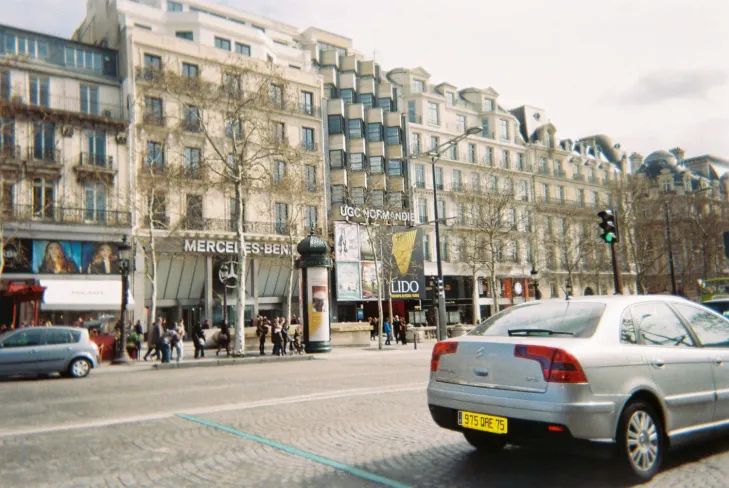
A bit of history I like tell us that the origins of the Champs-Élysées are simply a swampy area and not inhabited in ancient times; then came Marie de Médicis and decided to fix this even away from the former Palais des Tuileries, along the Seine river, with an area bordering on trees. This road was call the cours de la Reine (or road of the queen) taken inspiration from the promenade des Cascine in Florence opening in 1616. Later king Louis XIV, around 1670, ordered André Le Nôtre, the gardener of the Château de Versailles and the jardin des Tuileries, to continue the arrangement of lands there tracing an axis from the main central body of the Palais des Tuileries,from the current Place de la Concorde all to the current rond-point des Champs-Élysées-Marcel-Dassault, in the direction of the mountain or montagne du Roule that was at the current Place de l’Étoile (Charles de Gaulle). It was called the Grand Cours or big road to distinguished it from the cours de la Reine, or even the big alley of the Roule or grande allée du Roule , or the avenue de la Grille Royale (1678), or avenue du Palais des Tuileries (1680), and the Champs-Élysées, name that show up for the first time in 1694 but that it was given official name by 1709 as told in the Royal accounts.
By the 18C the new avenue went out further than that of the ramparts of king Louis XIII and reached the level of the current rue Marbeuf. The big sewer that followed this trace into a small stream going down to Ménilmontant and into the Seine river by the current Pont de l’Alma. This continue until what was called the étoile de Chaillot or the star of Chaillot finished in 1724. By 1774, it was time to enlarged the avenue to the west until the Seine river by the level of the Pont de Neuilly, on the current avenue de la Grande-Armée in Paris ,and avenue Charles-de-Gaulle in Neuilly-sur-Seine. To improve the security on the Champs-Élysées, a post of Swiss guards was set up in the barrier of Chaillot in 1777. There are four fountains almost identical at the entrance such as the fontaine des Quatre Saisons, aka fontaine du Cirque, done in 1839. Decorated with a group of four children, symbolizing the seasons. The fontaine de Diane , fontaine de Vénus aka fontaine des Ambassadeurs, both done in 1840, and the fontaine de la Grille du coq, without sculptures done also in 1840. Marly’s two horses, a pair of wild horses on wheels, are held by naked men. Ordered from 1739 by king Louis XIV done from 1743 to 1745 located at Place de la Concorde, at the entrance of the Avenue des Champs Elysées. Two other groups of horses held by men and gods are at the entrance of the Tuileries, ordered by king Louis XIV for the entrance to the watering-water of Marly, represent the fame and mercury straddling a winged horse, Pegasus. The original marble models have been replaced by cement statues in the Louvre museum.
It was here on the Champs-Élysées that the carriage was sent to bring the Royal family to Paris on October 5 1789. It was here also, that the Royal family was brought into Paris on June 25 1791 after trying to escape by Varennes. During the reign of terror ,the Place de la Concorde was the scene of executions by the unfamous guillotine. There are other more gentle fame to the Champs-Elysées , when dotted with elegant cafés such as the old Café des Ambassadeurs,of which plans drawing was done by none other than Jean-Jacques Rousseau, rebuilt in 1841, this cafe developped to welcome from 1897 spectacles reviews until finally demolished in 1929 to be replaced by the Theater or Théâtre des Ambassadeurs , and the restaurant of same name;; today the Espace Cardin (theatre de la ville de Paris) ,(see post). There were others like the traiteur Dupe, opened in 1800 atracting all the celebraties of the day starting by Paul de Barras,located in a pretty white house with green awnings that todayis the famous itself Ledoyen. The Champs-Élysées becomes an elegant street , passage point to take some air in the country towards Longchamp (bois de Boulogne). Emperatrice Marie Louise d’Austria, makes her entry by here in 1810 and also her exit in 1814. The parade on allied troops have the visits thereafter of the Tzar of Russia Alexandre Ier, king of Prussia, Frédérick-Guillaume III ,and the Prince of Schwarzenberg near the Palais de l’Élysée. It was king Louis XVIII that renovated this area and opened the Avenue Gabriel; where the USA embassy is today.
In 1848 a great banquet is held at the Champs-Élysées, that would the start of the 1848 revolution. During the Universal Exposition of 1855, the Champs-Élysées became a model and during the Second Empire a period of great events and splendor. The avenue bordered with luxury mansions, becomes the high of the Parisian elegance. To prepare for the Universal Exposition of 1900, the Palais de l’Industrie, destroyed in 1896 to leave the space to built the Petit and Grand Palais. This allows the linkage of the Hôtel des Invalides to Palais de l’Élysée by the pont Alexandre-III. On August 26 1944, after the liberation of Paris, Gen Charles de Gaulle comes here followed by the tanks and armored vehicules of the 2nd Armored Division of Leclerc.
My anecdotes on cinema : The street vendor Jean Seberg in Breathless (1960); Is Paris Burning?, directed by René Clément in 1966; Fantomas by André Hunebelle (1964). In 1969, singer Joe Dassin performed “Les Champs-Élysées,” a song adapted by Pierre Delanoë, telling the story of a romantic encounter on the avenue. Paintings : Distribution of Wine and Food on the Champs-Élysées, 1822, by Louis-Léopold Boilly, oil on canvas, now at the Carnavalet Museum. The Gloppe Pastry Shop, 1889, by Jean Béraud, oil on wood, also at the Carnavalet Museum. The two horses of Marly, a pair of wild, rearing horses, are restrained by naked men. Commissioned in 1739 by Louis XIV from Guillaume I Coustou, they are located in the Place de la Concorde, at the entrance to the Avenue des Champs-Élysées. Two other groups of horses restrained by men and gods are located at the entrance to the Tuileries Gardens. Commissioned by Louis XIV from André Coysevox for the entrance to the Marly watering trough (see post), they represent Fame and Mercury riding a winged horse, Pegasus. The original marble models, which are in the Marly courtyard of the Louvre Museum, have been replaced by cement statues.
The Paris tourist office on the Champs-Elysées: https://parisjetaime.com/eng/article/all-you-need-to-know-about-the-champs-elysees-a708
The Committee on the Champs-Elysées to showcase and support businesses of all sorts on the avenue: https://comite-champs-elysees.com/
The Paris tourist office on the 8éme arrondissement de Paris : https://parisjetaime.com/eng/article/explore-paris-s-8th-arrondissement-a826
There you have it a bit more on the Avenue des Champs-Elysées! A must at least once to get the frenzy feel of Paris. Again, hope you enjoy this post on the Avenue des Champs Elysées of Paris !!! as I.
And remember, happy travels , good health, and many cheers to all !!!


😍🤩🥳😎🙌🏼
LikeLiked by 1 person
Thanks for stopping by Cheers
LikeLiked by 1 person
The photos you show remind me of a different era; the Champs have started to become more pedestrian-friendly in the meantime.
LikeLiked by 1 person
Yes as most nowdays is not the same sadly. Thanks for stopping by Cheers
LikeLiked by 1 person