
I have written many post on this area dear to me as once was part of Bretagne/Brittany, and found me some pictures in my cd rom vaults ,not yet in my blog, and they should be. Nice experiences which had made us come back regularly. Therefore, let me tell you a bit more of this is La Plaine sur Mer !!! Hope you enjoy the post as I,
The town of La Plaine-sur-Mer is located in the Loire-Atlantique department no 44, in the Pays de la Loire region of my belle France. The town was part of historical Brittany, within the traditional Pays de Retz and the historical Pays Nantais. It occupies the northern three-quarters of the Saint-Gildas peninsula, situated at the westernmost tip of the Pays de Retz by the Jade Coast, ending at Pointe Saint-Gildas. It is 26 km from Saint-Nazaire, 8 km from Pornic, 3 km from Préfailles, 58 km from Nantes, and 140 km from my current home from which we came along the D768, N165 dir Nantes, but by exit/sortie 11,1 on Pontchâteau continue D33 after roundabout continue on D773 road dir Saint Nazaire/La Baule then bear right onto the N171 highway dir Saint Nazaire/La Baule ,then bear right onto the D213 road dir Noirmoutier/La Rochelle and continue crossing the Pont de Saint Nazaire bridge ,big beautiful bridge, continue turning right on the Rue des Gatineaux, and short left onto Route de la Plaine or D96 road continue same road with different street names to City center La Plaine sur Mer and the church,
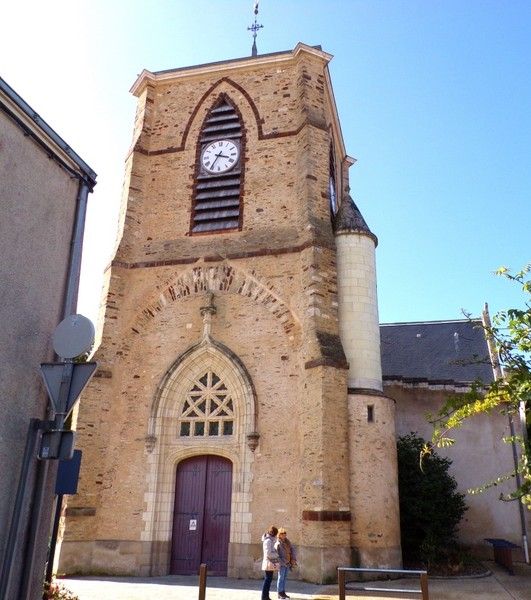
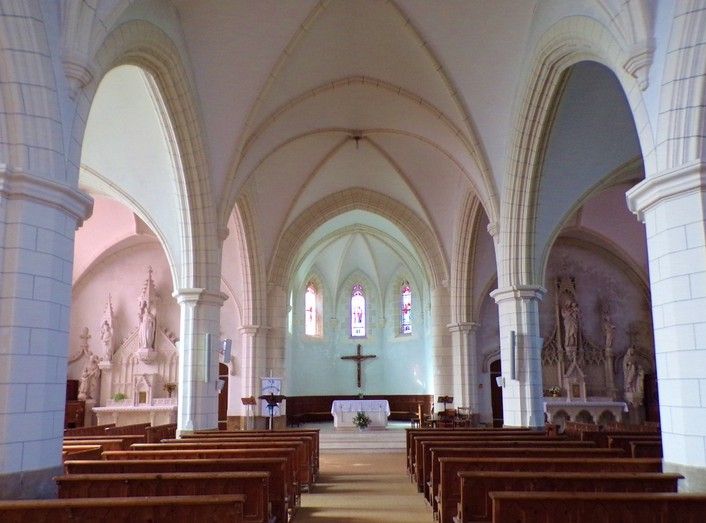
The Church Notre-Dame-de-l’Assomption or Our Lady of the Assumption was the first religious building in town, was built around the year 1000 by the monks of Geneston. This church was then under the jurisdiction of the Abbey of Sainte-Marie de Pornic. The church has been remodeled several times to give it its current appearance. One of its distinctive architectural features is its square bell tower. Built on a natural protuberance, its spire served as a seamark for centuries. Then, on March 28, 1836, a hurricane completely destroyed the bell tower and weakened the rest of the structure. The church was rebuilt in 1845 at the expense of the State. The base of the bell tower was widened, and its spire no longer exists. A black marble holy water font, dating from 1611, is located inside the church.
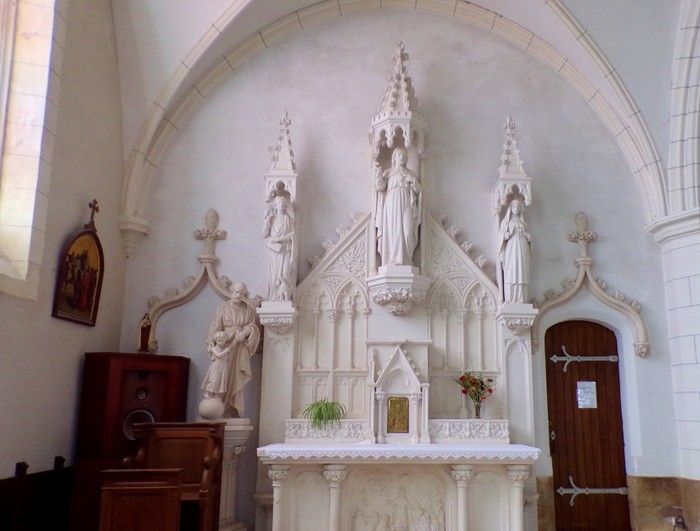
The first statue depicts a man holding a child by the hand. This is the statue of Saint Joseph, husband of the Virgin Mary. The second statue represents Saint John, the Evangelist. He is primarily recognized by the eagle at his feet. This eagle, a symbol of Saint John, is attributed to him because he is considered to have reached the heights of doctrine, just as the eagle reaches the mountain peaks. Furthermore, the eagle is often seen as a symbol of the resurrection, and John is an important witness to the resurrection of Christ. The central statue and the one on the right are connected. The central statue represents Jesus showing his heart to Margaret Mary, who is the one on the right. Margaret Mary’s vision of Jesus’s heart and her subsequent spread of Jesus’ message are the origin of the devotion to the Sacred Heart.
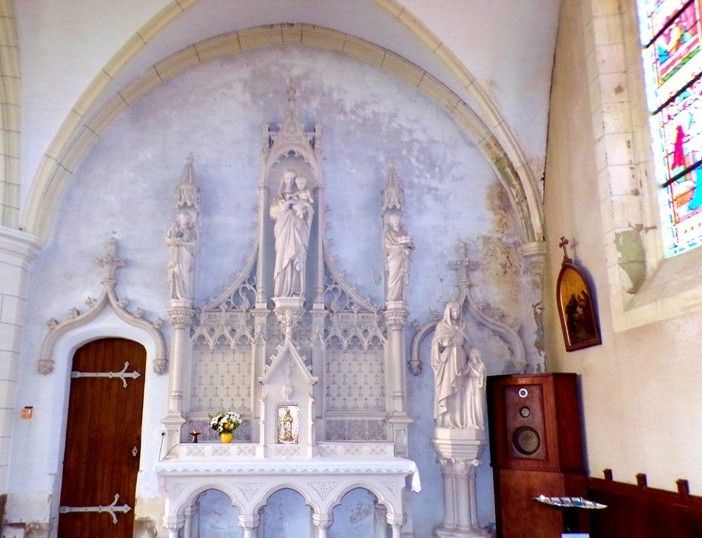
In the center, the Virgin Mary is depicted with Jesus in her arms and surrounded by two angels. One holds a crown and the other a wreath of flowers. On the right, Saint Anne, mother of Mary. It is interesting to note that both altars were surrounded by the ermines of Brittany, .
A bit of history I like tell us that by the Treaty of Angers in 851, the lordship of Rais ,to which the village belonged was incorporated into the Duchy of Brittany. In 1759 ,the Battle of Quiberon Bay or Battle of the Cardinals pitted the fleet of Louis XV against the English off the coast of Plaine. The wreck of the Juste bears witness to this epic story. On March 27, 1793, the citizens of La Plaine fought at Pornic alongside the Republican Guard to counter the Vendée royalist armies led by François de Charette, who had come to support a British invasion. This is part of the disastrous wars of Vendée or wars of the West of France to fight the French revolution, In 1908, following various political, economic, and religious disputes, the law of February 19th organized the division of the town of La Plaine to allow for the creation of the town of Préfailles. The town of La Plaine became La Plaine-sur-Mer by decree on April 18, 1920. The town was occupied by the nazis army. Located in the heart of the Saint-Nazaire pocket, near the anti-aircraft batteries of Pointe Saint-Gildas and the Saint-Nazaire submarine base, at the end of WWII, due to the existence of the Saint-Nazaire pocket, the nazis occupation of La Plaine-sur-Mer, as well as all the neighboring towns along the estuary, continued for nine more months from August 1944 to May 11, 1945. The pocket was effectively surrendered three days after Germany’s capitulation. The liberation of La Plaine sur Mer so was finally done on May 11, 1945,
The town of La Plaine sur Mer on its history/heritage:https://www.laplainesurmer.fr/transitions/decouvrir-la-plaine/
The Parish Notre Dame de la Côte de Jade on the church : https://www.paroisses-cote-de-jade.fr/eglise-de-la-plaine-sur-mer/
The Pornic tourist office on La Plaine sur Mer : https://en.pornic.com/la-plaine-sur-mer-la-plaine-pornic-destination.html
The Loire Atlantique dept 44 tourist office on Vélocéan bike paths passing by La Plaine sur Mer : https://www.francevelotourisme.com/itineraire/velocean
The Pays de la Loire region tourist office on activities in La Plaine sur Mer : https://www.atlantic-loire-valley.com/suggestions/la%20plaine%20sur%20mer
There you go folks, another dandy in my neighbor to the south in old Brittany now Loire Atlantique, never enough time to see it all. These memorable spots that should be visited, me think. Again, hope you enjoy this post on this is La Plaine sur Mer !!! as I,
And remember, happy travels, good health, and many cheers to all !!!


