
I am again to tell you about more streets of my eternal Paris. I have many many posts on Paris and several on the streets of the most beautiful city in the world. I have come up with pictures from cd rom vault that should be here for you and me. As always thank you for following my blog some since Nov 26, 2010. Therefore, here is my take on the Cours Albert 1er of Paris !!! Hope you enjoy it as I.
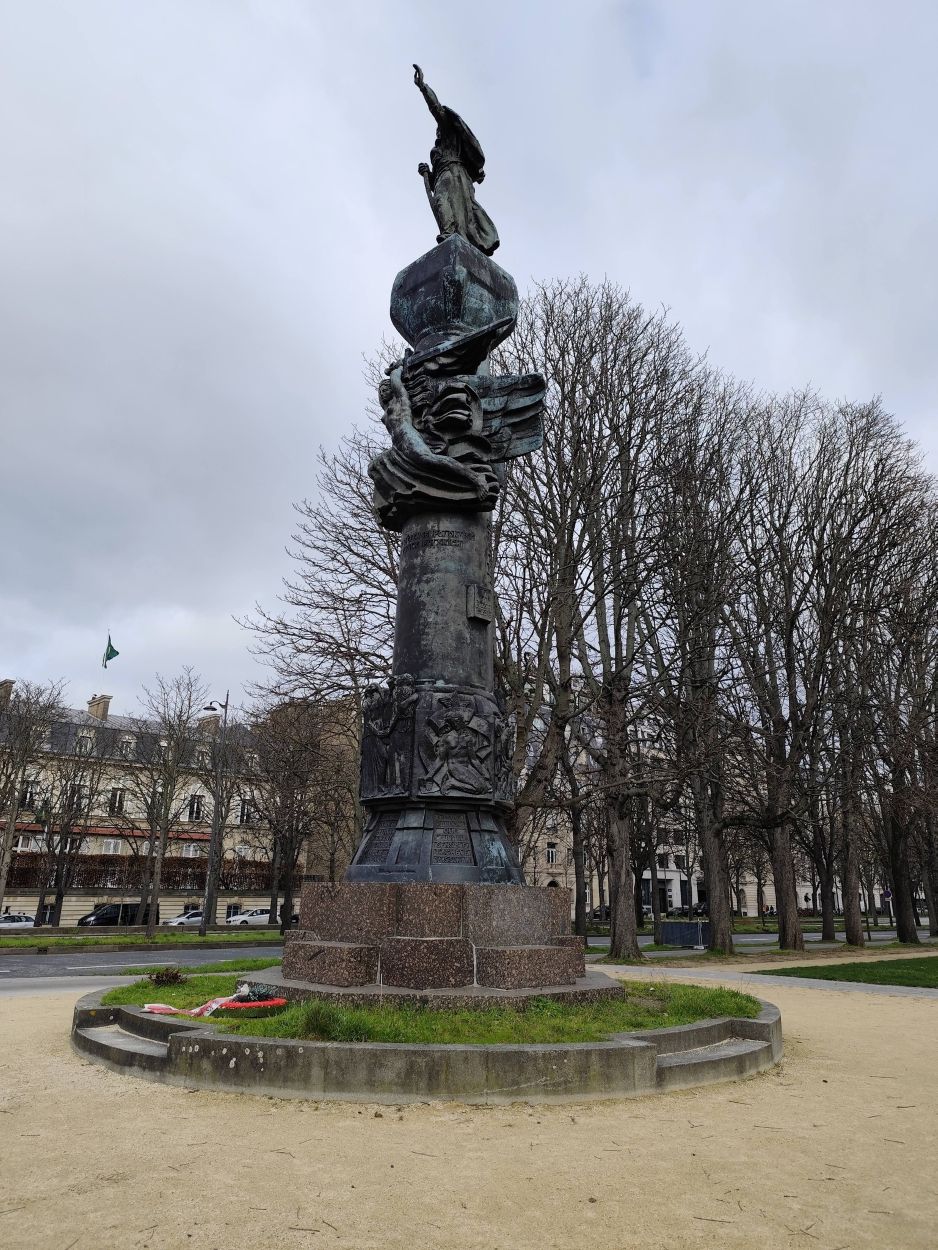
The Cours Albert-Ier is located between Place du Canada and Place de l’Alma in the 8éme arrondissement of Paris. The area is served by metro line 9 at the Alma-Marceau station. It intersects the following streets, in ascending order of number: Avenue Franklin-D.-Roosevelt, Rue Bayard, Rue Jean-Goujon, and Avenue Montaigne. A section of the elevated expressway, the Voie Georges-Pompidou, runs through the center of the Cours, emerging from the Alma tunnel and entering the Cours-la-Reine tunnel. Along the Seine is the Esplanade d’Arménie, named after King Albert I of Belgium. Running parallel to the street along the Seine, a median strip is adorned with a monument at each end: a bronze statue representing Reverend Father Komitas, created in 2003 and installed in homage to the victims of the 1915 Armenian Genocide; Monument to Mickiewicz, (see pic below) by Antoine Bourdelle, inaugurated in 1929 in the Place de l’Alma and then moved to this location in 1956. This space, planted with two rows of trees and covered in grass, was named “Yerevan Garden” in March 2009. At its western end stands the statue “The Seine” (1962).
The Jardin d’Erevan or Yerevan Garden is a green space stretching along the right bank of the Seine between the Pont des Invalides and the Pont de l’Alma on the Cours Albert-Ier. The garden occupies this section with planted areas, trees, and landscaping that blends into the urban environment. Named after the Armenian capital Yerevan, the garden contains a commemorative plaque dedicated to Armenian women and is adjacent to the Komitas Monument. These elements bear witness to the historical ties between France and Armenia. The garden located along the Seine, it is easily accessible by metro lines 1 and 13 with a short walk from the station. Its riverside location makes it a pleasant place to pause during longer walks in the city center.
Notable buildings: No. 8: see No. 1, rue François-Ier. No. 12: when the United States Embassy was located at 5, rue François-Ier, it had a secondary façade on this site. No. 16: the François Ier House, which gave its name to the neighborhood, was built on this site. No. 18 (and 1, rue Bayard): a brick and stone Louis XIII style mansion built for Charles Ferry, a former senator, where his brother, Jules Ferry, died in 1893. Nos. 34 and 34 bis: the Hôtel de La Ferronnays, also known as the Hôtel Schneider. This large private mansion, with a footprint of 623 square meters, built on a plot of 1,859 square meters, was constructed in the first half of the 19th century. On July 16, 1971, Brazil established the chancery of its embassy in Paris there. No. 36: the Hôtel de Brissac. It was the residence of Pierre de Cossé Brissac, 12th Duke of Brissac, and the Duchess, née May Schneider. During the Occupation, the couple led a glamorous life there, entertaining the Parisian elite of the collaborationist movement (Arletty, Sacha Guitry, Coco Chanel, Paul Morand, Josée Laval, and Pierre Drieu la Rochelle). No. 38 bis: a neo-Louis XIII style townhouse; former headquarters of Madeleine de Rauch’s couture house. No. 40: the Hôtel Lalique (1903), built for the glassmaker and jeweler René Lalique and based on his designs. The glass door is by Lalique himself. The townhouse was designed to house a complete jeweler’s workshop and showroom, as well as four rental apartments. The reception rooms and living quarters, overlooking the courtyard, were located on the façade. The townhouse included an elevator and a freight elevator; it was heated with hot water and lit by electricity. No. 42 (corner of Rue Jean-Goujon): In 1788, this site housed the office of the Carabas, stagecoaches that traveled to Versailles in six hours. Later, a beautiful private mansion stood here, featuring a rotunda supported by columns and two stories topped by an attic. It was inhabited by Princess Victorine de Broglie, wife of Duke Charles-Alphonse de Berghes-Saint-Winock, daughter of Prince Amédée de Broglie. This mansion now hosts exhibitions of the Société Artistique des Amateurs (Artistic Society of Amateurs). It was demolished in 1907 to make way for a handsome apartment building, constructed in 1907-1908.
Created in 1618 by Marie de Medici on former market gardens, this promenade, fashionable during the Fronde, stretched from the Tuileries Gardens to a semicircular area located on the site of the present-day Place de la Reine-Astrid (Queen Astrid’s daughter-in-law), at the beginning of Avenue Montaigne. This semicircular area, like the roundabout that stood on the site of the current Place du Canada, allowed cars to turn around. The road was replanted in the 18C by the Duke of Antin. Cours Albert-Ier is an extension of Cours la Reine, of which it is a subdivision dating back to a municipal resolution of July 14, 1918.
Commissioned by the Franco-Polish Committee, whose creation, chaired by Lafayette, dates back to 1831, the Monument to Adam Mickiewicz is a sculpture by Antoine Bourdelle. The first model dates from 1909, but Antoine Bourdelle lived to see the inauguration of this project, in the Place de l’Alma, twenty years later on April 28, 1929, a few months before his death. Subsequently, the monument was moved to Cours Albert-Ier at the western end of the median strip along the Seine; this space was named the Jardin d’Erevan in March 2009. This monument is a gift from Poland to France. Six bas-reliefs decorate the base of the column: Wallenrod, the Captives, Dziady, Aldona, Old Halban, and the Three Polands. In the upper section is the high relief of The Polish Epic. Finally, the column is surmounted by the Statue of Mickiewicz.
Adam Bernard Mickiewicz of Poraj was born in 1798 in Navahroudak (Nowogrodek in Polish, now in Belarus), in what was then the Polish-Lithuanian Commonwealth, and died in Istanbul in 1855. He was a Polish poet and writer. Above all, he was a prolific creator, one of the greatest European Romantic poets, and an intellectual; his lectures at the Collège de France are remarkable for their fresh perspective. He is celebrated in his native country as the spiritual father of modern Polish literature.
The City of Paris on the promenade Cours Albert 1er : https://www.paris.fr/lieux/promenade-du-cours-albert-1er-2490
The Paris tourist office on the 8éme arrondissement de Paris : https://parisjetaime.com/eng/article/explore-paris-s-8th-arrondissement-a826
There you go folks, another dandy beautiful set of glorious streets of my eternal Paris. I have criss cross them many and have many in my blog already, Again, hope you enjoy this post on the Cours Albert 1er of Paris !!! as I.
And remember happy travels, good health, and many cheers to all !!!


