
I am again to tell you about more streets of my eternal Paris. I have many many posts on Paris and several on the streets of the most beautiful city in the world. I have come up with pictures from my cd rom vault that should be here for you and me. As always thank you for following my blog some since Nov 26, 2010. Therefore, here is my take on the Rue Monsieur le Prince of Paris !!! Hope you enjoy it as I.
The Rue Monsieur-le-Prince is located in the quartier or neighborhood of Odéon of the 6éme district or arrondissement of Paris. It is served by the Odéon metro station on lines 4 and 10. The street intersects the following streets, in ascending order of number: Beginning: Odéon intersection, Rue Dupuytren, Rue Antoine-Dubois, Rue Casimir-Delavigne, Rue Racine, Rue de Vaugirard;and ends at Boulevard Saint-Michel. This area is served by the Luxembourg RER C station. It is named for its proximity to the Hôtel du Prince de Condé, the residence of the first Prince of the Blood of France (legitimately descended through the male line from a grandson of the French monarch). The Rue Monsieur-le-Prince was originally a path running alongside the city walls of Paris. In the section between Boulevard Saint-Michel and Rue de Vaugirard, it successively bore the following names: “Chemin de Dessus les Fossés” (1419); “Chemin allant à la Porte Saint-Michel” (1510); then “Rue des Fossés Saint-Germain” (1559 to 1582); and finally “Rue des Fossés Monsieur le Prince,” which became “Rue de la Liberté” during the revolutionary period, from 1793 to 1805. The Hôtel du Prince de Condé extended as far as the moats. In 1770, the King acquired from the Condé family the land on which the hôtel particulier had stood. This property, bordered by the rue de Vaugirard, the rue Monsieur-le-Prince, and the rue de Condé, allowed the city to build the Comédie-Française theater, which later became the Théâtre de l’Odéon.(see post), On the remaining land, the city developed a housing estate whose buildings became highly sought after by actors and artists. The buildings at numbers 2 to 10 and 9 to 21 on the street are among these late 17C constructions. In 1804, General Charles Pichegru and Georges Cadoudal, an emblematic figure of the Chouan uprising,(against the French revolution) organized a plot against the First Consul,(Napoléon) aiming to kidnap him. After Pichegru’s arrest, Cadoudal was arrested on March 9, 1804, on Rue Monsieur-le-Prince, after a chase and after killing two officers. He was guillotined on June 25, 1804.
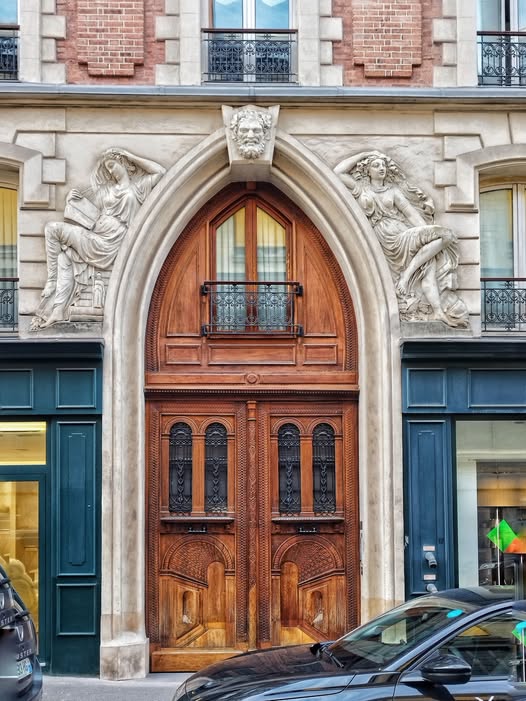
Notable buildings here are at No. 2, a building has three facades, facing Rue de l’Odéon, the Odéon intersection, and Rue Monsieur-le-Prince. It is part of the development built at the end of the 17C on land freed up after the demolition of the Hôtel du Prince de Condé. It was at this address that the painter Théophile Vauchelet, who had his studio and living quarters there, died on April 22, 1873. The sociologist Albert Bayet lived there from 1910 to 1961. No. 4: known as the Hôtel de Bacq or Hôtel de Darlons, the original building, of which only the gateway and window remain, was built in 1750 on the site of the Prince of Condé’s stables for Pierre Darlons, the Prince of Condé’s secretary. It has a monumental, sculpted, semicircular arched doorway, flanked by two pilasters and surmounted by a window with sculpted wings featuring bas-reliefs of plants and birds. No. 10: Auguste Comte lived on the second floor of this late 18C building from 1841 to 1857. He received members of the Positivist Society in his apartment and wrote the last volume of his Course of Philosophy there, which was devoted primarily to sociology. The apartment has been restored and transformed into a museum. It has been reconstructed as it existed at the time of Auguste Comte’s death. No. 14 (see pic), this four-story building plus attic, constructed of brick and stone in the Neo-Louis XIII style, features a carved wooden doorway with a lancet arch, flanked by two female sculptures, one representing a libertine and the other a studious woman. A mascaron adorns the tip of the lancet. The wooden tympanum has a window with a wrought-iron sill. The composer Camille Saint-Saëns lived in this building from 1877 to 1889, as did the physician and writer Adolphe Piéchaud and the African-American writer Richard Wright from 1948 to 1959. No. 15: L’Escale, the oldest Latin bar in Paris. A meeting place where, during the 1950s and 1960s, legends of Latin (Hispanic ) music performed in its cellar. It was in the Latin American effervescence surrounding this cabaret (sometimes renamed “peña” for the occasion, like the Latin Quarter renamed “Barrio Latino”) that groups like Los Incas, Los Calchakis, and Los Machucambos were born, who, along with a few others, were at the origin of the extraordinary revival that Latin music experienced in France and Europe in the second half of the 20C.
No. 16: French Poets Society. No. 22: This old house includes a tree-lined and decorated courtyard. It was in his studio, located in this former 1821 building, that the painter Antonio de La Gandara died of a heart attack on July 1, 1917. His studio had become a fashionable salon where the intellectual elite of the time gathered. The painter Yves Brayer lived in this building from 1936 until his death in 1990. The writer Frédéric Beigbeder and his brother Charles also spent part of their childhood here in the 1970s, as evidenced by numerous passages in the book *Un roman français* (2009) written by the former. No. 26: The esoteric poet Victor-Émile Michelet lived here from 1908 until his death in 1938. No. 28: Birthplace of Pierre Boudreaux, philologist and member of the French School in Rome. No. 36: The first Parisian apartment of singer Charles Aznavour , where he lived until adulthood. He mentions the street in his song “Autobiographie” (1980): “I opened my eyes to a sad furnished room / Rue Monsieur-Le-Prince in the Latin Quarter.” On the occasion of the 95th anniversary of his birth, May 21, 2019, a plaque was unveiled on the building’s facade. In the same neighborhood, a bust of the singer was installed in 2021 at the Odéon intersection. No. 41: The Polidor restaurant is one of the oldest Parisian bistros. Founded in 1845, it has borne its current name since the beginning of the 20C. The interior has, on the whole, retained its style from a century ago, and its restrooms are described as “legendary.” It was at the Hôtel d’Orient, located above the restaurant, that Arthur Rimbaud stayed in 1872, upon his return from Charleville. He did not remain there very long, for in November he moved to the Hôtel des Étrangers, located at the corner of Boulevard Saint-Michel and Rue Racine. No. 51: H. Samuelian Oriental Bookstore, founded in August 1930 by Hrant Samuelian and an important center for the Armenian diaspora in France. No. 54: On October 1, 1654, Blaise Pascal moved to this address, then Rue des Francs-Bourgeois-Saint-Michel. He remained there until June 29, 1662, when, ill, he was taken to his sister’s home at 67 rue du Cardinal-Lemoine. On November 23, 1654, Pascal experienced “the night of fire,” which he recounts in the Memorial. No. 60: former Zodiac bookstore of the poet Pierre Béarn. No. 67: the Les 3 Luxembourg cinema, a Parisian landmark of art-house cinema, was inaugurated at No. 67 on December 16, 1966.
The Paris tourist office on the 6éme arrondissement de Paris: https://parisjetaime.com/eng/article/explore-paris-s-6th-arrondissement-a823
There you go folks, another dandy beautiful set of glorious streets of my eternal Paris. I have criss cross them many and have many in my blog already, Again, hope you enjoy this post on the Rue Monsieur le Prince of Paris !!! as I.
And remember happy travels, good health, and many cheers to all !!!


