
We have driven and walked in my eternal Paris, and would like to have an imprint in my blog on the wonderful family times we had there, There is so much to see , doing my best, and glad found me this picture in my cd rom vault ,which now transposing in my blog for you and me, This was my former worked city, so glad to post more memorable spots on it, I thank you for your readership over the years and to bear with my rants! After Paris is to rant, shout and yelled about, me think. Therefore, here is my take on the medieval at Rue des Barres of Paris !!! Hope you enjoy the post as I.
The Rue des Barres is located in the Saint-Gervais neighborhood or quartier, on the Saint-Gervais hill, beginning at 62 Rue de l’Hôtel-de-Ville and ending at 14 Rue François-Miron, all in the 4éme district or arrondissement of Paris, The street is 130 meters long and 10 meters wide. It is joined on its east side by Rue Grenier-sur-l’Eau (see below), between nos, 12 and 14. The southern section of the street consists of steps. The neighborhood is served by metro line 7 at the Pont Marie station and by metro line 1 at the Saint-Paul station. It owes its name to the Hôtel des Barres, built there around 1250, and to the place called “des Barres,” which was mentioned from 1152 onwards and where mills were located on the Seine. In 1250, this street was called “Ruelle aux Moulins-des-Barres” (Alley of the Mills of Barres), because of the mills located on the Seine at the place called “les Barres.”In 1293, it was called “Alley of the Temple Mills,” because at that time these mills belonged to the Knights Templar. In 1362, in a legal document passed during the reign of Charles V, it was given the name « rue qui-va-de-la-Seine-à-la-porte-Baudet » (Street that goes from the Seine to the Baudet Gate), In 1386, it was called « rue du Chevet-Saint-Gervais » (Saint-Gervais Bedside Street,) and sometimes « rue des Barres » (Bars Street). The Hôtel des Barres was inhabited at the end of the 14C by Louis de Boisredon, who in 1417 was the lover of Isabeau of Bavaria, Queen of France. Charles VI had him arrested, put in a sack, and thrown into the Seine with this inscription on the sack: “Let the King’s justice pass.” In the 16C, from the rue de la Mortellerie to the Seine, it was called “rue Malivaux”. This name came from the Malivaux mills, located on the river opposite this street. It is listed on one of the oldest maps of Paris, the Truschet and Hoyau map of 1550, on which it appears under the name “r. des Bares”. It is cited as “rue des Barres” in a manuscript from 1636. In the 17C, along its entire length, it bore the name “rue des Barres” or « rue des Barrés ».
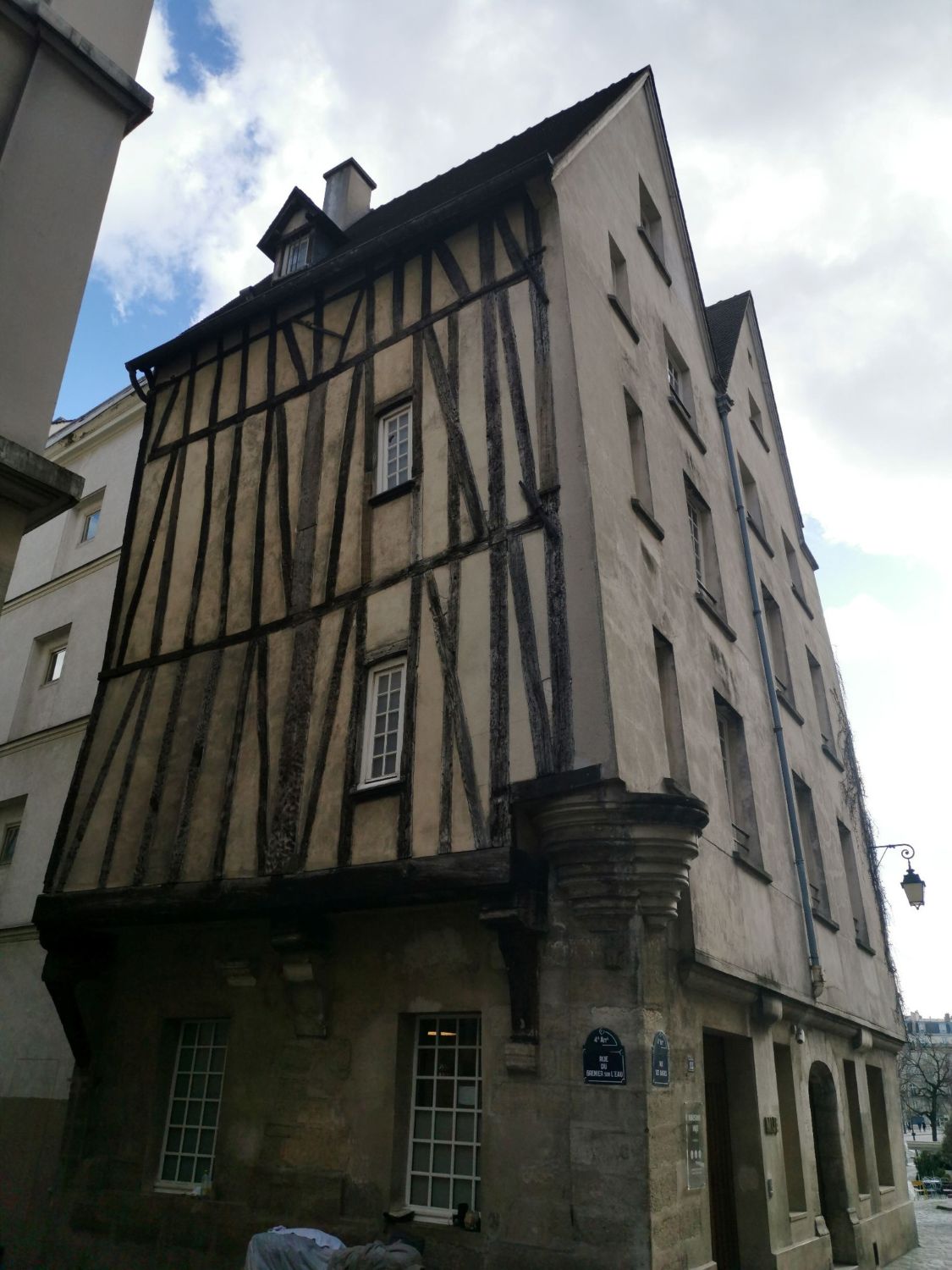
Notable buildings here are at the mouth of the Seine: site of the former wine port and wheat port. Nos. 2 and 62, rue de l’Hôtel-de-Ville: 19C building retaining the frontage of a former bakery; Nos. 2 to 10: site of the Hôtel des Barres, built in 1250, which became the Hôtel de Charny in the 17C. It was the residence of Louis de Boisredon, lover of Isabeau of Bavaria ,Queen of France in 1417. The buildings on this site, set back from No. 12, were built around 1840 following the opening of rue du Pont-Louis-Philippe. Louis and Félix Lazare lived at this address until 1826. They are particularly known for co-authoring the Administrative and Historical Dictionary of the Streets of Paris and its Monuments, published in 1844 to provide a very precise overview of the Parisian urban fabric just before Haussmann’s works. No. 11: apse of the Church of Saint-Gervais-Saint-Protais (see post); No. 12: (see pic) site of the town house of the nuns of Maubuisson Abbey, rebuilt in 1540 using corbelled construction and called the « couvent des Filles de la Croix » (Convent of the Daughters of the Cross). Located on the corner of Rue du Grenier-sur-l’Eau, this half-timbered house now houses a youth hostel. Nos, 13-15 are houses built in 1626 for the parish of Saint-Gervais above the “new charnel house,” a gallery that housed private burials adjoining the Saint-Gervais cemetery. Behind the gates, one can see the arcades of this gallery and the garden laid out after 1945 on the site of the former cemetery. Nos, 18-24 are Square Couperin. The site is located between the buildings at nos 14 and 16 Rue des Barres. The square pays homage to François Couperin le Grand, organist of the Royal Chapel.
The half-timbered houses have almost disappeared from the Parisian landscape. The half-timbered houses, whose architecture is typical of northern France, were remodeled and covered with plaster from the 17C onwards to reduce the risk of fire. Then they were demolished in the 19C under Haussmann. Only a few traces remain at No 12 rue des Barres (see above pic) at the corner of rue du Grenier-sur-l’Eau. The current youth hostel was the town house of Maubuisson Abbey, a religious establishment in northern Paris (Val-d’Oise dept 95). Because the area was highly prized by religious orders, keen to be close to the central government: a dozen abbeys thus had a foothold in the neighborhood. Behind the apse of Church Saint Gervais Saint Protais (see post), the Rue des Barres offers a pleasant pedestrian walk to the banks of the Seine and to lose oneself in the Marais quartier or neighborhood. There, at the corner with the Rue du Grenier sur l’Eau, a house with medieval architecture stands out. This space behind Church Saint Gervais Saint Protais was in the past the residence of numerous religious orders. In this house, the nuns of the Daughters of the Cross from the Maubuisson Abbey had a residence since 1664. It was a base in the center of Paris, as the abbey had its main establishment near Pontoise. In the cellars of the house, the nuns had left behind columned chapels. Nearby, the monks of Saint Maur long operated watermills. They owned the Hôtel des Barres, dating from the time of Saint Louis, where these mills had been installed. The hôtel was later acquired by the lords of Charny. The buildings were largely demolished when the Rue du Pont Louis Philippe was built in the 19C. The medieval house on Rue des Barres retains this corbelled section on the first floor. On the upper floors, the corbels were removed to prevent the spread of a potential fire.
The Rue du Grenier-sur-l’Eau is located in the Saint-Gervais and Marais quartiers/neighborhoods in the 4éme district or arrondissement of Paris. The street roughly follows the crest of the Saint-Gervais hill, is 30 meters long and begins at 11 Rue du Pont-Louis-Philippe and ends at 17 Rue des Barres (see above). It is notable for its steps. It owes its name to a Parisian bourgeois, a landowner named Garnier or Guernier, who lived in the area near the water. The street’s name was later corrupted, Garnier becoming Grenier. In 1241, a landowner named Garnier or Guernier donated several houses near the Saint-Gervais Church to the Knights Templar, on the very spot where this street is located. It is referred to as “rue Garnier-desus-l’Yaue”. It was later named “rue Garnier-sur-l’Iauë”, “rue Guernier sur l’Eau”, and then “rue du Grenier-sur-l’Eau”. In the 19C, this 100-meter-long street, located in the former 9éme arrondissement, the Hôtel-de-Ville quartier/neighbohood, began at 21-23 rue Geoffroy-l’Asnier and ended at 14-16 rue des Barres. In 1943, the block adjoining the Impasse Putigneux, on the odd-numbered side, disappeared. This section ran alongside the Convent of the Daughters of the Cross located on rue des Barres. By municipal decree of July 17, 2000, the part of the rue Grenier-sur-l’Eau located between the rue Geoffroy-l’Asnier and the rue du Pont-Louis-Philippe took the name of “allée des Justes”, only the part located between the rue du Pont-Louis-Philippe and the rue des Barres remains under the name of rue du Grenier-sur-l’Eau.
The Paris tourist office on Paris Centre (Arrond 1-4): https://parisjetaime.com/eng/article/explore-the-centre-of-paris-a846
There you go folks, a dandy city to explore and enjoy with the family, Memorable moments in my eternal Paris, driving and walking all over in my road warrior trails brings out sublime awesome spots with nice memorable family visits of yesteryear always remember and always looking forward to be back, eventually. Again hope you enjoy the post the medieval at Rue des Barres of Paris !!! as I.
And remember, happy travels, good health, and many cheers to all !!!


