
I ,again, found nice pictures in my cd rom vault and they should be in my blog for you and me, This is one of the emblems of my eternal Paris ,yet remains in the off the beaten path to many, do not know why, The Palais Royal sits in an area that I passed by for several years as worked nearby! This is one to be seen more and glad I did. Let me tell you about the Palais Royal and Mr Buren of Paris, part II !!! Hope you enjoy it as I.
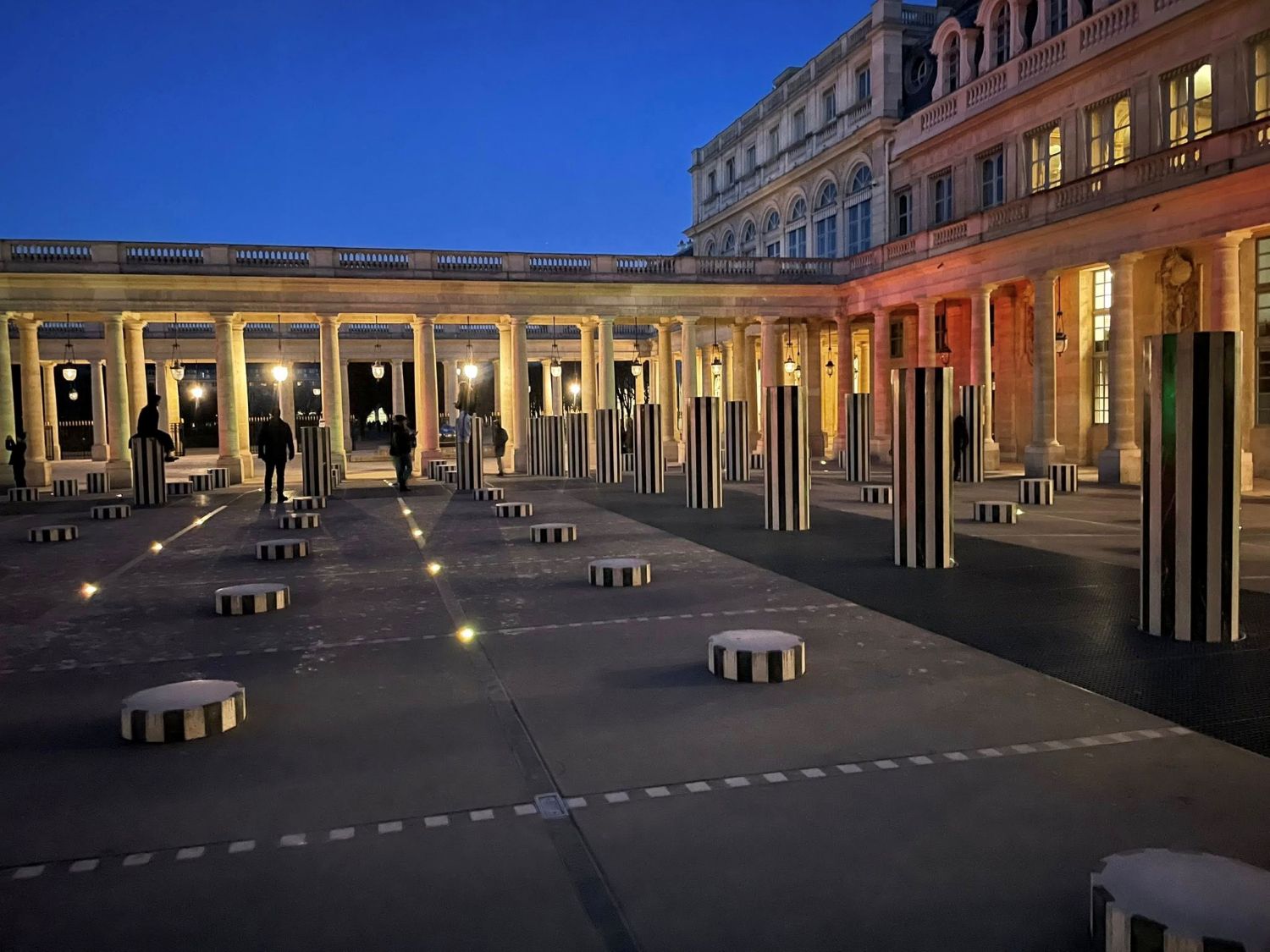
The Two Plateaux, aka the Buren Columns, is an artwork by Daniel Buren, created with the assistance of Patrick Bouchain, in the main courtyard of the Palais-Royal in Paris, in the immediate vicinity of the Ministry of Culture, the Council of State, and the Comédie-Française. The work, which occupies 3,000 m2 of the courtyard, consists of a 13 x 20 = 260 truncated columns of white marble with black and white stripes, each with a single width of 8.7 cm. The cylinders are dynamically introduced into this space, with three heights varying from 8.7 to 62 cm. Indeed, the two scales symbolize the scales of Ma’at, the sacred instrument used to weigh souls in the judgment of the dead. According to this ancient tradition, when the heart of the deceased, placed on one scale, was lighter than an ostrich feather placed on the other, the soul entered eternal life. In 1986, under the presidency of François Mitterrand, the Ministry of Culture commissioned Daniel Buren, to create a 3,000 m² sculpture in the main courtyard of the Palais Royal.
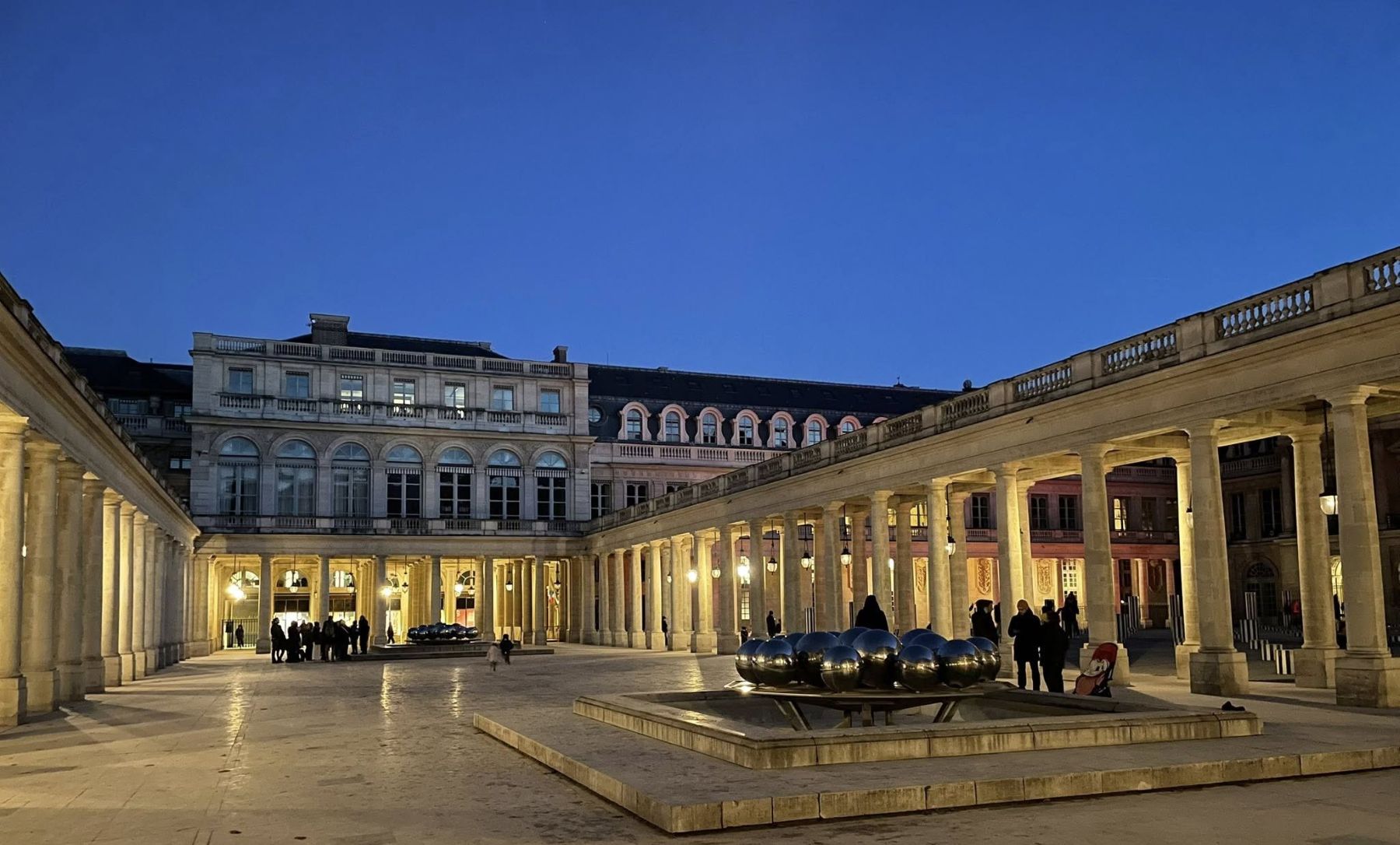
Pol Bury’s two horizontal fountains of slowly moving metal spheres were installed in 1985 in the courtyard of the cour d’Orléans courtyard, between the Constitutional Council and the Ministry of Culture in Paris, around the same time as Daniel Buren’s columns. Pol Bury, a Belgian artist, joined the Surrealist group of Hainaut in 1939 and settled in France in 1961. He installed fountains at venues ranging from the University of Iowa (1969) to the Maeght Foundation (1978) and the Seoul Olympics (1988), also creating monumental works such as magnetic drums on which 12,000 marbles drift (1971) or, as at the 1999 FIAC art fair (Louis-Carré Gallery), a fountain composed of fourteen polished steel spheres.
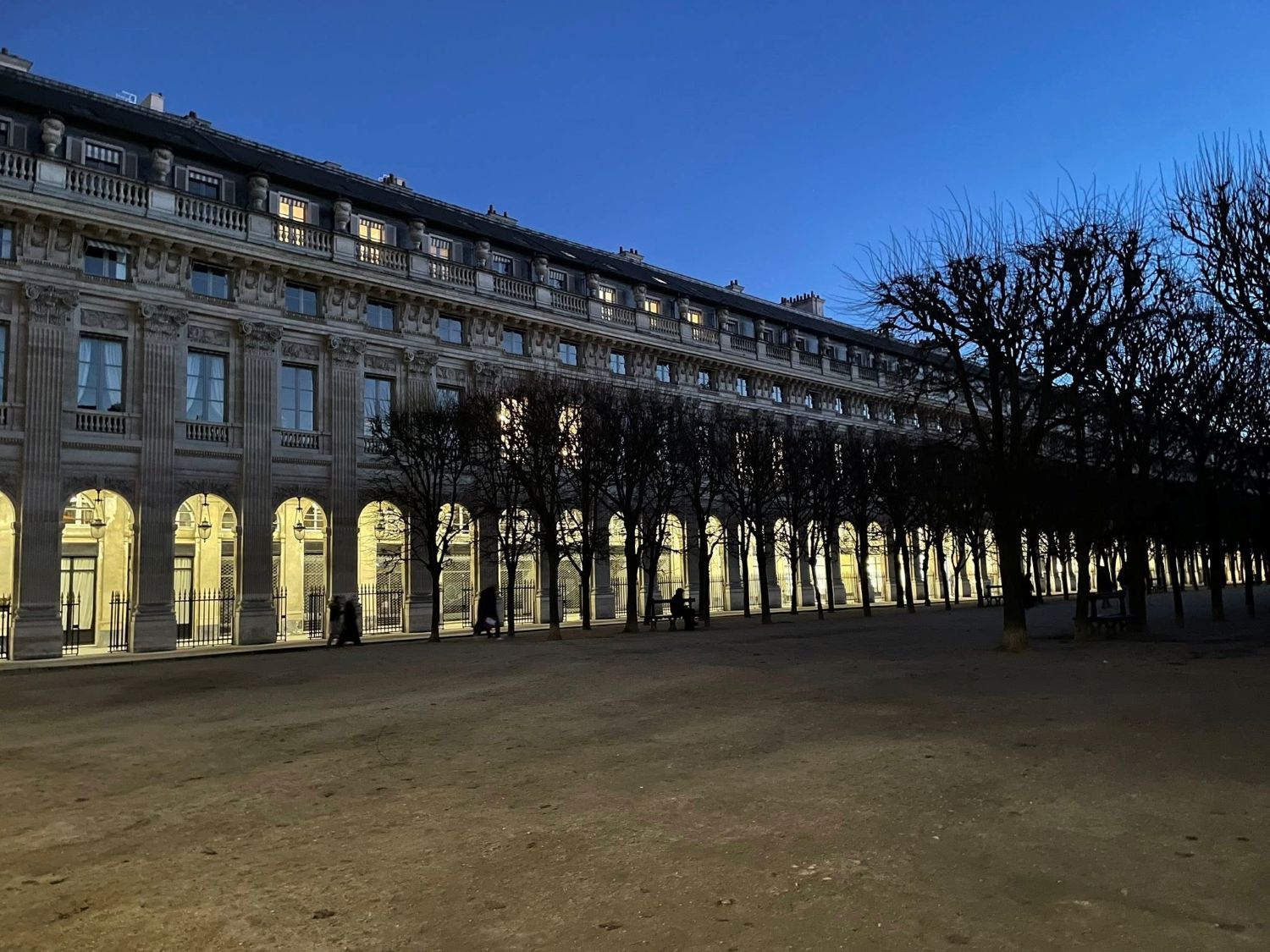
A bit of history of the Palais Royal tell us that Cardinal Richelieu, wishing to live near the Louvre Palace, acquired several private mansions between 1624 and 1632, including the Hôtel de Rambouillet. He entrusted the architect Jacques Lemercier with the task of enlarging and transforming the mansion into a palace. Richelieu ceded the palace to King Louis XIII in 1636. The king’s widow, Anne of Austria, chose to live there from 1642 onwards, where she raised her son, the future Louis XIV. From then on, the Palais Cardinal was called the Palais Royal, and the Place du Palais Royal was created in front of its main entrance. Upon moving to Versailles, Louis XIV gifted the Palais Royal to the Orléans family, specifically to his brother Philippe d’Orléans. The buildings, confiscated from the monarchy, were finally returned to the Orléans family by Louis XVIII in 1814, and remained their property until 1848. The Palais was looted during the July Monarchy in 1848, then partially destroyed during the Paris Commune in 1871. It was restored in 1873 and became the headquarters of the Council of State in 1875. The Palais Royal also houses the Ministry of Culture and the Constitutional Council.
The Théâtre du Palais-Royal is located within the Palais-Royal, between the Rue de Montpensier and the Jardin du Palais Royal. The building was originally constructed between 1786 and 1790 by Victor Louis, incorporating the Palais-Royal gallery, and was later rebuilt in 1830 by Louis Regnier de Guerchy. In 1880, the theater was transformed by the architect Paul Sédille. The auditorium was redecorated in an extremely ornate and gilded Neo-Louis XV style, featuring sculptures by Dalou. He also installed a fire escape on the facade, consisting of metal walkways covered in mosaic.
The Paris tourist office on the Domain National du Palais Royal :https://parisjetaime.com/eng/culture/domaine-national-du-palais-royal-p991
The official Daniel Buren on the columns : https://www.danielburen.com/images/artwork/1208
The official National Heritage Center of France on the Palais Royal: https://www.domaine-palais-royal.fr/
The official Theater of the Palais Royal: https://www.theatrepalaisroyal.com/
There you go folks another sublime monument of my eternal Paris, so much beauty all around you , and this Palais Royal is one of them, a masterpiece of France. Again, hope you enjoy the post on the Palais Royal and Mr Buren of Paris, part II !!! as I.
And remember, happy travels, good health, and many cheers to all !!!


