
I found me pictures in my cd rom vault that combine with those in previous post galdly show in this post for you and me, This is wonderful coastal town just 30 minutes from my house and worth the detour me think. I come here often and other than the beautiful beach and bars , I need to tell you more in detail on the Mané-Rutual dolmen of Locmariaquer !!! Hope you enjoy the post as I
The Mané-Rutual dolmen aka Mané-Retual, Mané-Rethuel, is located in the coastal town of Locmariaquer, in my beautiful Morbihan department no 56 , and in my lovely Bretagne, and in my belle France,. Bronzo. It is 31 km from Vannes, 28 km from my current home from where we came along the D768 road dir Auray to connect with the N165 highway dir Vannes and got off at exit/sortie 32 dir Locmariaquer to connect with the D28 road continue going thru City center Crac’h on Rue de la Fontaine continue same road to roundabout of Chat Noir continue bearing left onto the D781 road continue entering territory of Locmariaquer on the Route d’Auray just before City center bear right onto the Route de Kerlogonan then quickly left onto Route du Bronzo ,the access is not marked as panel are on the opposite direction, but about no 13 of the Route du Bronzo get off and walk into the ruelle de Bronzo roadway into the field where the dolmen is located, OR as we have done too, walk from the port areat Place Dariorigum turn left on Rue de l’Yser then right on Rue de Verdun by the City hall continue onto Ruelle des écoles, then turn left onto Ruelle de Bronzo and see panel turning left onto the dirt roadway leading to the dolmen ,this is about a 700 meters walk according to google,
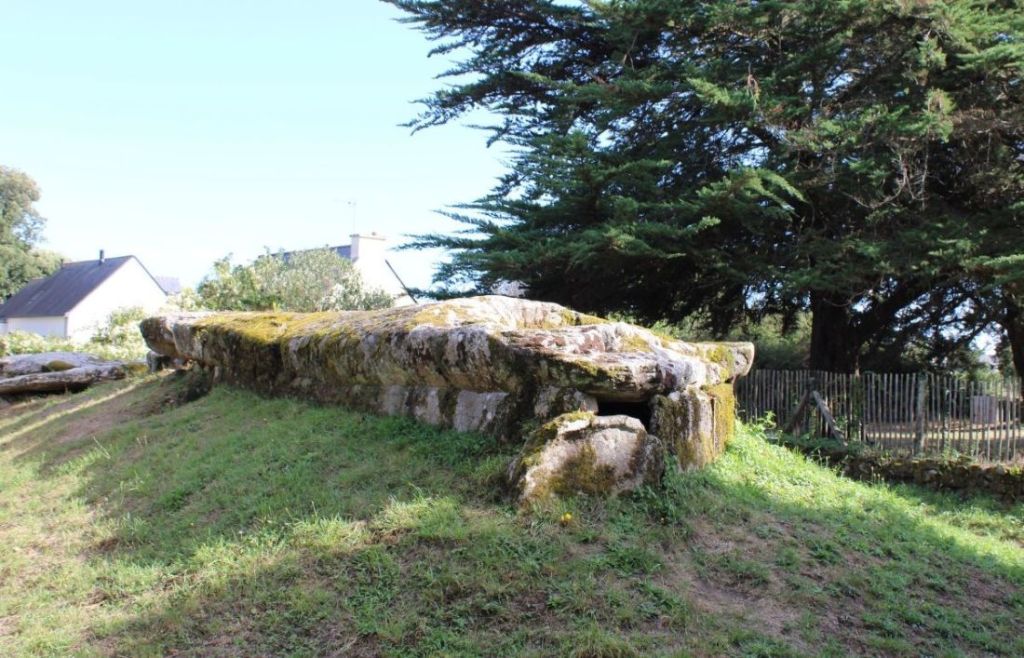
Taking text from wikipedia for ease of explanation the Mané-Rutual dolmen is a passage grave or passage dolmen with a total length of 16.45 meters. It consists of a passage, an antechamber, and a main chamber. The passage is defined by twenty-three orthostats (13 on the left, 10 on the right); it measures 9.40 meters in length, with an average width of 1.20 meters and an average height of 1.25 meters. It is roofed by four capstones. The antechamber is formed by six orthostats (three on each side) and measures 3.10 meters long by 2.40 meters wide, with an average height of 1.50 meters; it retains two capstones. The main chamber is ovoid in shape. It is defined by ten orthostats, measures between 3.50 and 3.90 meters in width, and has a height of 1.80 meters beneath the capstone. It is covered by a single, massive capstone (12 meters long by 4.30 meters wide) that extends significantly by more than 6 meters beyond the chamber walls on the north side. The presence of internal engravings on some of the dolmen’s slabs has been known since the early 19C.
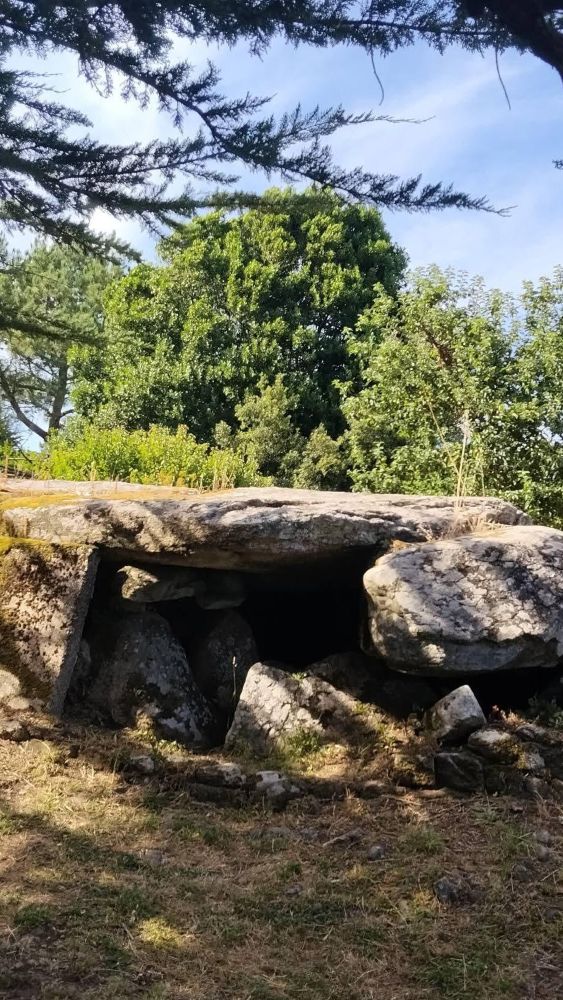
A bit of history I like tell us that Bonstetten and Galles recovered only a flint arrowhead fragment, coarse pottery shards, and small Roman-era artifacts (ceramics, a bronze coin of Constantine II, and fragments of whitish statuettes). The 1885 excavation and restoration project yielded a more abundant collection of archaeological artifacts dating to both the Neolithic and Gallo-Roman periods. The Neolithic assemblage consists of a large terracotta bead and primarily lithic artifacts: three quartz hammerstones, a diorite axe, about twenty flint flakes, a flint blade, and various stone spheres (granite, quartz) of undetermined function. These artifacts are housed in the collections of the Société Polymathique (Château-Gaillard, Vannes-see post). The Gallo-Roman assemblage comprises a large quantity of pottery and bricks, coins, and various metal, ceramic, and stone fragments.
The dolmen appears in the work by President de Robien, *Description historique, topographique et naturelle de l’ancienne Armorique* (Historical, Topographical, and Natural Description of Ancient Armorica), written in 1752, under the name “Gaulish tomb.” The Chevalier de Fréminville describes it in his book *Antiquité de Bretagne* (Antiquities of Brittany) as *Men-er-Groah* (the “Witch’s Stone”). It is mentioned as *Men-en-Ritual* in 1843 in the second edition of Ogée’s dictionary. M. de Bonstetten and L. Galles explored the structure in 1860 on behalf of the Société Polymathique du Morbihan. In a later publication, Galles referred to the monument as *Bergouh*. According to Davy de Cussé, the dolmen was excavated again in 1865 by “outsiders.” Following its acquisition by the State in 1885, the Société Polymathique conducted a full excavation and oversaw its restoration.
The town of Locmariaquer on its megaliths : https://www.locmariaquer.bzh/decouvrir-la-ville/presentation/patrimoine-historique/patrimoine-megalithique/
The official Megaliths of Locmariaquer: https://www.site-megalithique-locmariaquer.fr/decouvrir
The local Bay of Quiberon tourist office on the megaliths of Locmariaquer: https://www.baiedequiberon.co.uk/to-see-to-do/culture-and-heritage/megaliths/site-des-megalithes-de-locmariaquer
The local Gulf of Morbihan tourist office on the megaliths : https://www.golfedumorbihan.co.uk/explore/live-the-exceptional/cultuur/megaliths/
There you go folks, a dandy place to see with the whole family ; very educational indeed, One of the sights of our world ,a must to visit me think. Go see the Megaliths of Locmariaquer, indeed worth it, Again, hope you enjoy this post on the Mané-Rutual dolmen of Locmariaquer !!! as I.
And remember, happy travels, good health, and many cheers to all !!!


What a fun adventure!
LikeLiked by 2 people
Thanks for stopping by. Cheers
LikeLike