
We have driven and walked in my eternal Paris, and would like to have an imprint in my blog on the wonderful family times we had there, There is so much to see , doing my best, and glad found me these older pictures in my cd rom vault ,which now transposing in my blog for you and me, This was my former worked city, so glad to post more memorable spots on it, I thank you for your readership over the years and to bear with my rants! After Paris is to rant, shout and yelled about, me think. Therefore, here is my take on curiosities of Paris , part LVIII !!! Hope you enjoy the post as I.
The Fontaine de Charonne aka the Fontaine de Trogneux fountain, is located at the corner of Rue du Faubourg-Saint-Antoine and Rue de Charonne in the 11éme arrondissement of Paris. However, the main part and water flow is on Rue du Faubourg Saint Antoine, This fountain was part of a construction plan established by an ordinance of Louis XV, which included five fountains for the Saint-Antoine quartier or neighborhood. Only the Trogneux Fountain and the Petite-Halle Fountain remain today. The Trogneux Fountain was built between 1719 and 1721. It was later restored during the First Empire. It was initially supplied by the Notre-Dame pump and later by the Chaillot steam pump. It is believed to have acquired its name, “Trogneux,” from a local brewer. The fountain is built in line with the surrounding buildings, on a street corner, in the form of an imposing façade with pilasters and moldings, approximately twelve meters high, surmounted by a triangular pediment in a pure Louis XV style. The decoration consists of dolphins, volutes, and molded frames. Near the ground, two bronze lion-headed mascarons are responsible for spitting out water that flows into a grate in the ground.
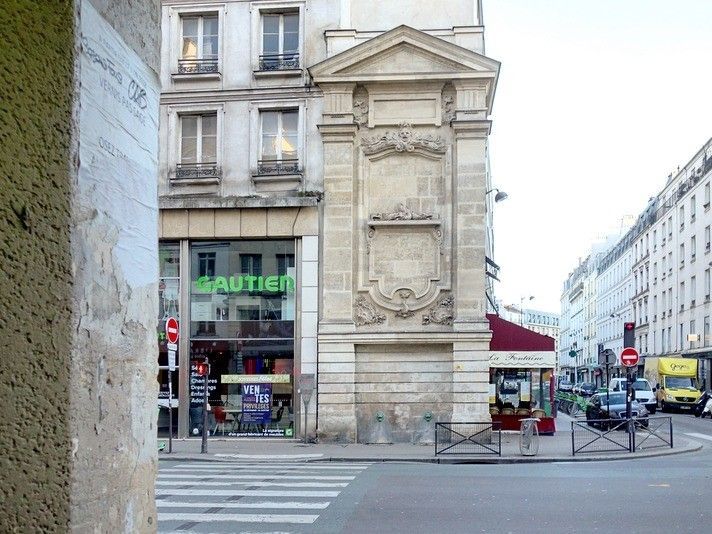
The Rue du Faubourg-Saint-Antoine forms the boundary between the 11éme and 12éme arrondissements of Paris. It connects the Place de la Bastille to the Place de la Nation. 1,810 meters long, the street varies in width from 17 to 30 meters. It is precisely this narrowness, combined with the labyrinthine nature of the adjacent streets, that made it an ideal location for erecting barricades throughout its history. Adjacent to the Place de la Bastille, it extends from the Rue de Charenton and the Rue de la Roquette to the Place de la Nation. This site is served by the Bastille metro station (lines 1, 5, and 8), Ledru-Rollin station (line 8), Faidherbe-Chaligny station (line 8), and Nation station (lines 1, 2, 6, and 9). The Rue du Faubourg-Saint-Antoine owes its name to the fact that it crossed the hamlet located outside the city wall that served the Abbey of Saint-Antoine-des-Champs, destroyed at the end of the 18C. The street has long been closely involved in the economic life of Paris. Since its medieval origins, it has been the artery of craftsmanship, and more specifically, cabinetmaking. During the storming of the Bastille (July 14, 1789), a large part of the rioters came from the Faubourg Saint-Antoine. It was from the Faubourg Antoine, temporarily renamed with this more secular name, that the bulk of the procession set out to assault the Palais des Tuileries on August 10, 1792. The great revolutionary days owed their success to the popular support of the Faubourg Saint-Antoine. Notable buildings: The odd-numbered addresses correspond to the north side of the street and belong to the 11éme arrondissement. At No. 1: opening onto the Place de la Bastille, at the corner of the Rue de la Roquette; The Passage du Cheval-Blanc also opens onto this corner. No. 5: La Bastille today the MK2 Bastille cinema. No. 63, at the corner of Rue de Charonne: Charonne fountain, aka the Trogneux fountain (see above). Opposite Nos. 211 and 213: Montreuil fountain, on the central median. No. 323: opening onto Place de la Nation. The even numbers correspond to the south side of the street and belong to the 12éme arrondissement. At No. 2: opening onto Place de la Bastille, at the corner of Rue de Charenton. Nos. 46-48: Barrio Latino bar (formerly Gouffé furniture store). The metal structure of No. 46 is by Gustave Eiffel. No. 262: Eugène-Napoléon Foundation and its garden. No. 280: opening onto Place de la Nation.
The Paris tourist office on the Rue Faubourg Saint Antoine : https://parisjetaime.com/eng/transport/faubourg-saint-antoine-p1876
The Paris tourist office on the 11éme arrondissement de Paris : https://parisjetaime.com/eng/article/explore-paris-s-11th-arrondissement-a829
The Paris tourist office on the 12éme arrondissement de Paris : https://parisjetaime.com/eng/article/explore-paris-s-12th-arrondissement-a824
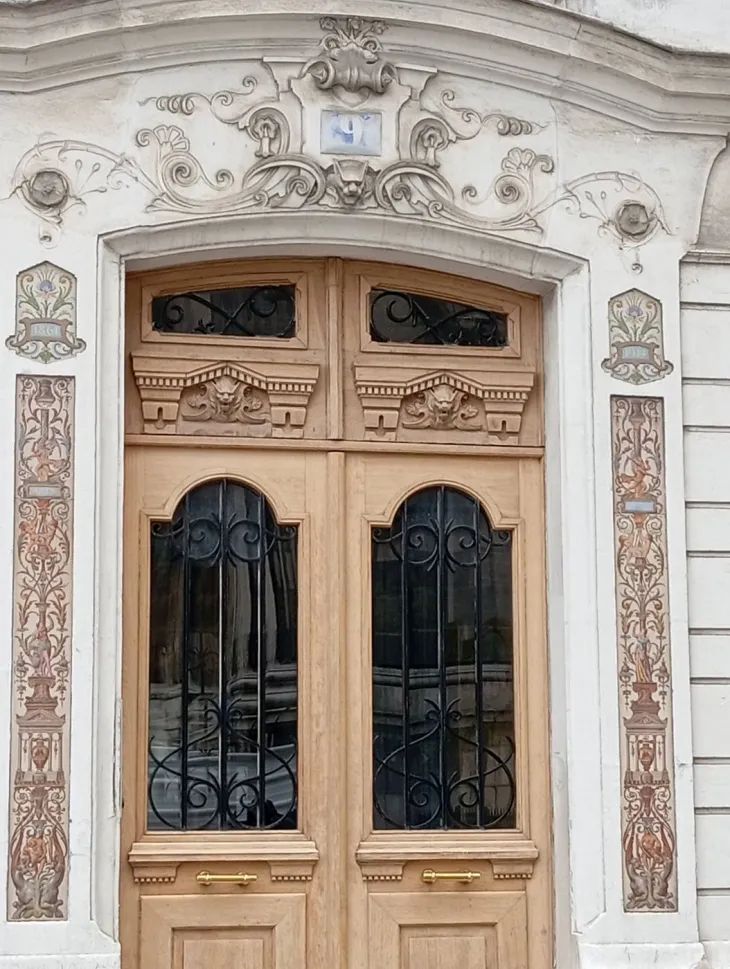
The Rue Fénelon is located in the 10éme arrondissement of Paris. It begins at Place Franz-Liszt and 2 Rue d’Abbeville and ends at 5 Rue de Belzunce, with a staircase connecting the different levels. It runs alongside the Church of Saint-Vincent-de-Paul.(see post), It is named after the French clergyman, theologian, educator, and writer, François de Salignac de La Mothe-Fénelon, known as Fénelon. The street was created during the subdivision of the Saint-Lazare enclosure, by decree of January 31, 1827. Notable buildings include: No. 9 (see pic), a building completed in 1858, which housed the workshop of François Gillet, inventor of reconstituted lava (1882); No. 11: Church of Saint-Vincent-de-Paul; and No. 17: the church’s rectory, built around the same time.
The Paris tourist office on the 10éme arrondissement de Paris: https://parisjetaime.com/eng/article/explore-paris-s-10th-arrondissement-a843
The Rue Monsigny is located in the Gaillon quartier/neighborhood of the 2éme district/ arrondissement of Paris. It is named after the French composer Pierre-Alexandre Monsigny. Situated near the former Ventadour theater, located between Rue Méhul, Rue Monsigny, Rue Marsollier, and Rue Dalayrac, has been converted into a building housing various social services of the Banque de France. It was in this theater that Victor Hugo’s Ruy Blas was first performed on November 8, 1838, by the Théâtre de la Renaissance company, and Rossini’s Stabat Mater on January 7, 1842. The street opened in 1825 as “Rue Neuve-Ventadour,” it has borne its current name since 1829. The section between Rue Saint-Augustin and Rue du Quatre-Septembre was opened in 1868, at the same time as Rue du Quatre-Septembre was built.
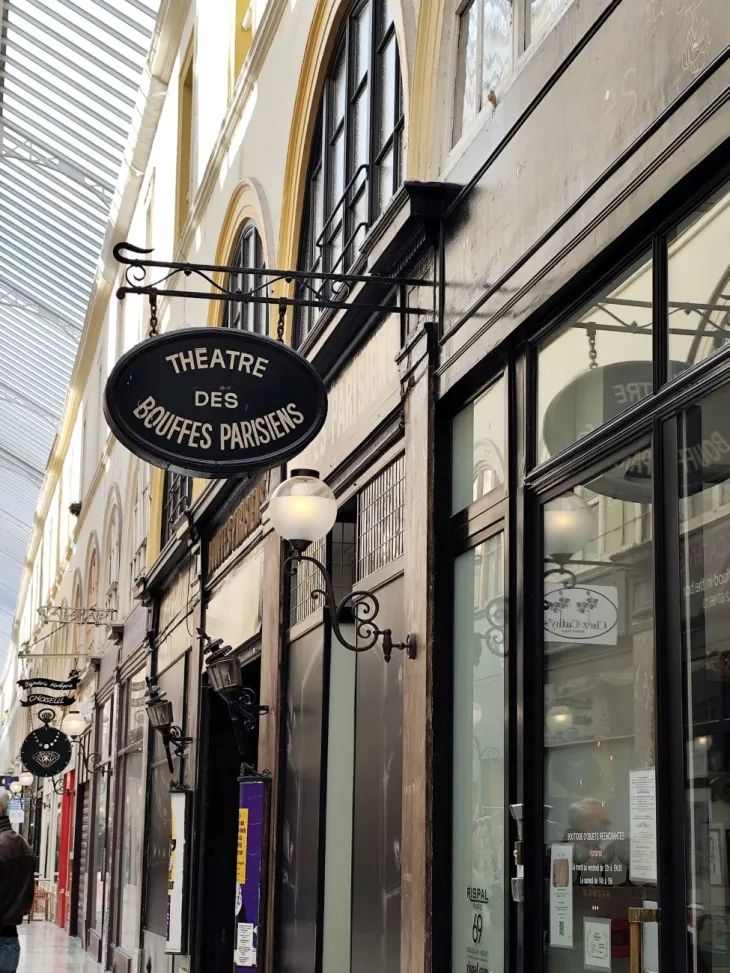
The Théâtre des Bouffes-Parisiens (see pic) is located at 4 rue Monsigny in the 2éme arrondissement of Paris. In 1826, the magician and ventriloquist Louis Comte had to leave the Passage des Panoramas, where he had established his Théâtre des Jeunes-Élèves. He then ordered build a new theater in the Choiseul quartier/neighborhood, which was undergoing redevelopment. With two entrances, one on the Passage Choiseul and the other on rue Neuve-Ventadour (now rue Monsigny), it was inaugurated on January 23, 1827. In 1855, Jacques Offenbach ,who had just inaugurated his Théâtre des Bouffes-Parisiens in the Salle Lacaze in the Carré Marigny on the Champs-Élysées was looking for a suitable venue for the winter season. He bought back the lease and opened the Bouffes d’Hiver (Winter Bouffes) on December 29, 1855 ,a reference to the Champs-Élysées theater, which became the Bouffes d’Été (Summer Bouffes). When Offenbach left the Salle Lacaze in 1859, the theater in the Passage Choiseul definitively took the name Théâtre des Bouffes-Parisiens. From 1958 onwards, the Théâtre des Bouffes-Parisiens shifted its focus more towards boulevard comedies performed by renowned artists: Maria Pacôme, Sophie Desmarets, Jean Poiret, Robert Hirsch, Pierre Mondy, Jean Le Poulain, Marthe Mercadier, and Jacqueline Maillan. In 2010, fifty private theaters in Paris, united within the Association for the Support of Private Theater (ASTP) and the National Union of Directors and Tour Managers of Private Theater (SNDTP), of which the Bouffes-Parisiens is a member, decided to join forces under a new banner: the “Théâtres Parisiens Associés” (Associated Parisian Theaters).
The Paris tourist office on theThéâtre des Bouffes Parisiens: https://parisjetaime.com/eng/culture/theatre-des-bouffes-parisiens-p1215
The official Portes St Martin on the theater: https://www.portestmartin.com/bouffes-parisiens-histoire
The official assoc Théâtres et Producteurs Associés on the Bouffes Parisiens theater: https://tpa.fr/salles-theatre-paris/bouffes-parisiens-73.html
The Pavillon Élysée was built in the 19C for the 1900 Universal Exhibition and located on the Avenue des Champs-Élysées in the 8éme arrondissement of Paris. Since 2018, the Pavillon Élysée Té (the new name) has been situated in the Champs-Élysées gardens (see post), directly opposite the Hôtel d’Évreux, now the Élysée Palace and the official residence of the President of the Republic. A concession of the City of Paris, the pavilion, was, after a period of neglect in the 1970s, successfully restored by Maison Lenôtre in 1984. The Pavillon Élysée Té combines technological modernity with Belle Époque elegance. State-of-the-art technology, combined with the venue’s modularity in terms of both size and capacity, allows for the organization of everything from the most intimate receptions to the most connected events. The venue is dedicated to private events, from weddings to seminars. It features five reception rooms, accommodating up to five hundred guests.

The Salle des Fresques or Fresco Room, a vast, modular lounge extended by an elegant rotunda conservatory, offers direct access to the terrace. While the Fresco Room retains its original moldings and paintings, it is now furnished with comfortable and functional designer furniture and state-of-the-art technical equipment., Surrounded by the greenery of the Champs-Élysées gardens, the glass rotunda of the Pavillon Elysées provides direct access to the terrace, perfectly suited for breaks and cocktails. Bathed in natural light, the glass rotunda combines the charm of original woodwork with contemporary furnishings. For your comfort, this space can be heated in winter and protected from the heat in summer thanks to its blinds. The Patio Terrace is a secluded spot, surrounded by greenery and boasting an exceptional location in the heart of the Champs-Élysées. Upstairs in the Pavillon Elysée Té, the 1900 Lounge offers breathtaking views of the Champs-Élysées and the Élysée Palace gardens. This space, ideal for business meetings and VIP events, guarantees a refined atmosphere. The Chefs’ secret garden, accessible only by VIPs. Enjoy intimate moments of conviviality around the stove for special meals. The Pavillon Elysée Té and Chef Thierry Marx welcome you to a signature menu. A mentor of Té since 2015, Chef Thierry Marx brings his exacting standards and unique sensibility to our conscious cuisine every day.
A bit of history tell us that from 1857 to 1895, the premises housed a modest establishment selling pastries and refreshments, with various tenants coming and going. Louis Auguste Paillard, already owner of the renowned Maire and Bignon restaurants, acquired it in 1895. In preparation for the 1900 Universal Exhibition, he had it replaced by a pavilion in the Neo-Louis XV style. Construction began in 1898 and was completed in 1899. From 1907 onwards, the property passed through several owners, and in 1984, the Lenôtre company (where I came to know it) took over management of the site through its dedicated subsidiary, the Société Nouvelle du Pavillon de l’Élysée. Outside, the sculptor Jules Coutan created the two stone figures adorning the sloping sides of the Marigny façade. The sculptor Jules Blanchard created the gilded cast-iron Cupid that crowns the turret’s dome. Inside, the plasterwork surrounding the ceiling painting in the main ground-floor room was crafted by Jean-Baptiste Hugues, winner of the Grand Prix de Rome for sculpture in 1875. Among its famous clients were Edward VII, Alfonso XIII, Dukes Vladimir and Alexis, Prince Ferdinand of Bulgaria, Prince Trubetskoy, Boni de Castellane, Arthur Meyer, Prince Henri d’Orléans, Henri de Toulouse-Lautrec, and James Gordon Bennett.
The official Pavillon Elysée traiteur : https://www.te-traiteur.fr/des-evenements-au-gout-du-jour/le-pavillon-elysee-te/
The jardins des Champs-Élysées or the Champs-Élysées gardens, (see post) is a place of entertainment, offer refined pleasures during the day: restaurants, promenades, concerts, and theaters. In the evening, a more bohemian atmosphere prevails, with balls, cabaret shows, dancing, and revues, attracting royalty and night owls, artists, and actors, much like Montmartre. The Champs-Élysées gardens are bordered by: Cours la Reine to the south; Avenue Gabriel to the north; Avenue Matignon, the Rond-Point des Champs-Élysées-Marcel-Dassault, and Avenue Franklin-D.-Roosevelt to the west; and Place de la Concorde to the east. They are also bisected by the lower end of Avenue des Champs-Élysées; Avenue du Général-Eisenhower and Avenue Winston-Churchill also pass through the gardens. The gardens’ current appearance dates from 1840, but their origins go back to the 17C. The most wooded section of the Champs-Élysées holds many delightful surprises for visitors: magnificent structures (statues, fountains, bandstand), must-see museums (Grand Palais, Petit Palais, Palais de la Découverte), theaters (Théâtre Marigny, Théâtre du Rond-Point, Guignol puppet theater), and restaurants (Pavillon Ledoyen, Restaurant Laurent). Nature lovers will discover magnificent trees and numerous flowerbeds. A must-see while in Paris, me think
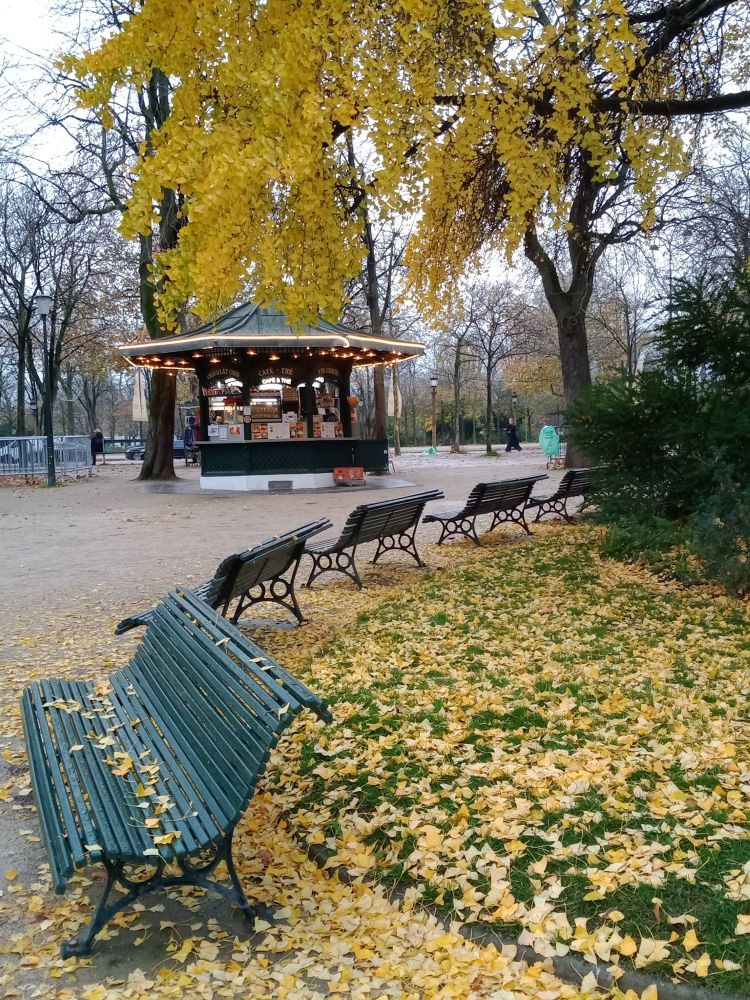
The allée Marcel-Proust is a pedestrian-only walkway, begins at Place de la Concorde at the start of Avenue Gabriel and ends at Avenue de Marigny, crossing the Champs-Élysées gardens parallel to the Avenue des Champs-Élysées on its north side. It is named after the French writer Marcel Proust. The walkway was officially named by a municipal decree on August 11, 1969, in reference to the playground of local children and students of the Lycée Condorcet, including Marcel Proust, who used to gather there between 1882 and 1886. These games in the Champs-Élysées gardens are reflected in his work, in the final part of Swann’s Way. See the quant nice octagonal pavilion-style kiosk with a counter selling soft drinks, crêpes, sandwiches, etc. part of the Champs-Élysées gardens.
The Paris tourist office on the Jardins des Champs-Élysées : https://parisjetaime.com/eng/culture/jardins-des-champs-elysees-p951
The city of Paris on the jardins des Champs-Élysées : https://www.paris.fr/lieux/jardins-des-champs-elysees-2471
The Paris tourist office on the 8éme arrondissement de Paris : https://parisjetaime.com/eng/article/explore-paris-s-8th-arrondissement-a826
The Paris tourist office on the world famous Avenue des Champs-Élysées : https://parisjetaime.com/eng/article/all-you-need-to-know-about-the-champs-elysees-a708
There you go folks, a dandy city to explore and enjoy with the family, Memorable moments in my eternal Paris, driving and walking all over in my road warrior trails brings out sublime awesome spots with nice memorable family visits of yesteryear always remember and always looking forward to be back, eventually. Again hope you enjoy the post on curiosities of Paris, part LVIII !!! as I.
And remember, happy travels, good health, and many cheers to all !!!


