
This is great as found me pictures in my cd rom vault not included in my blog, and they should been for you and me. This is one of the most emblematic icons of Paris! It stuck on you, like anything in Paris does. And must say on the off the beaten path ,and should be visited more, Therefore, here is my take on the Opéra Comique of Paris !!! Hope you enjoy it as I,
The Opéra-Comique, aka Salle Favart, is a performance venue located on Place Boieldieu in the 2 éme arrondissement of Paris. This venue was the permanent home of the Opéra-Comique company from 1783 to 1801 and again from 1840 to 1971. The Opéra-Comique is often considered the equivalent of the Palais Garnier, but on a smaller, more human scale, closer to its audience, particularly from the artists’ perspective. At the heart of the building, the auditorium has retained its original dimensions. Above it is a rehearsal room, known as the petit théâtre or small theater. The costume workshop remains within the theater. The scenery store, formerly located in Square Louvois, is now situated on Boulevard Berthier. The Salle Favart room showcases electric light through a profusion of chandeliers and gilded bronze wall sconces. This site is served by the metro lines 8 and 9 of Richelieu-Drouot station.
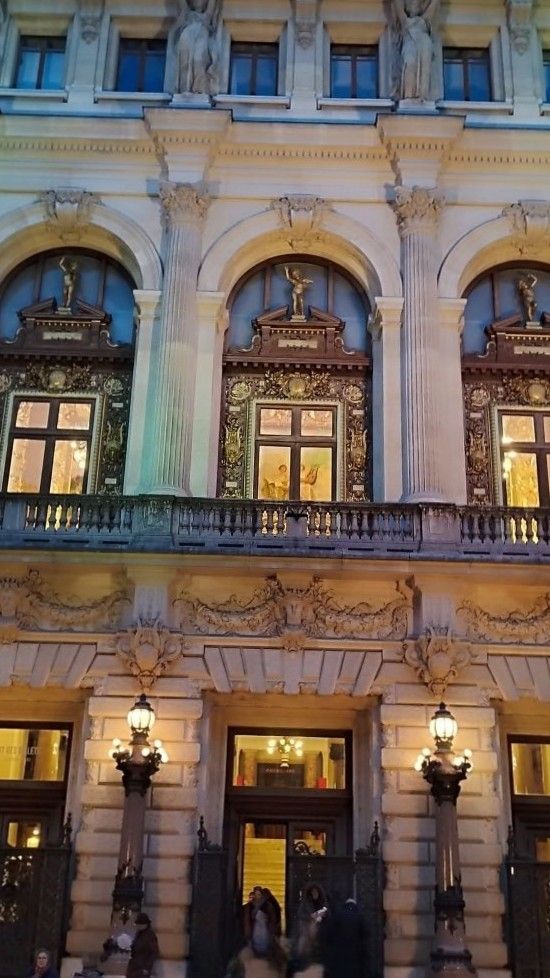
The façade features a six-step staircase punctuated by railings and candelabra. The ground floor is rusticated, rising to a smooth stone upper level. Three tall arched bays are framed by Corinthian columns. The attic is pierced by six windows alternating with six caryatids: those on the left by André-Joseph Allar, those in the center by Gustave Michel, and those on the right by Émile Peynot. The gutter is decorated with masks and acroteria bearing the emblem of the French Republic. Allegorical figures are depicted in the lateral rear wings: on the left, Music by Denys Puech, and on the right, Poetry by Ernest Charles Guilbert. The Boieldieu vestibule features the names of composers around the ceiling. Entrance to the Hall (Orchestra): Bust of Jules Barbier and Bust of Jules Massenet. Marivaux Staircase: Paintings by Luc-Olivier Merson : Song in the Middle Ages, Poetry; on the ceiling: Song, Elegy, and Hymn in Triumph. Favart Staircase: Paintings by François Flameng Greek Tragedy, Ballet; on the ceiling: Truth Emerging from the Well and Comedy Casting Down Vices.
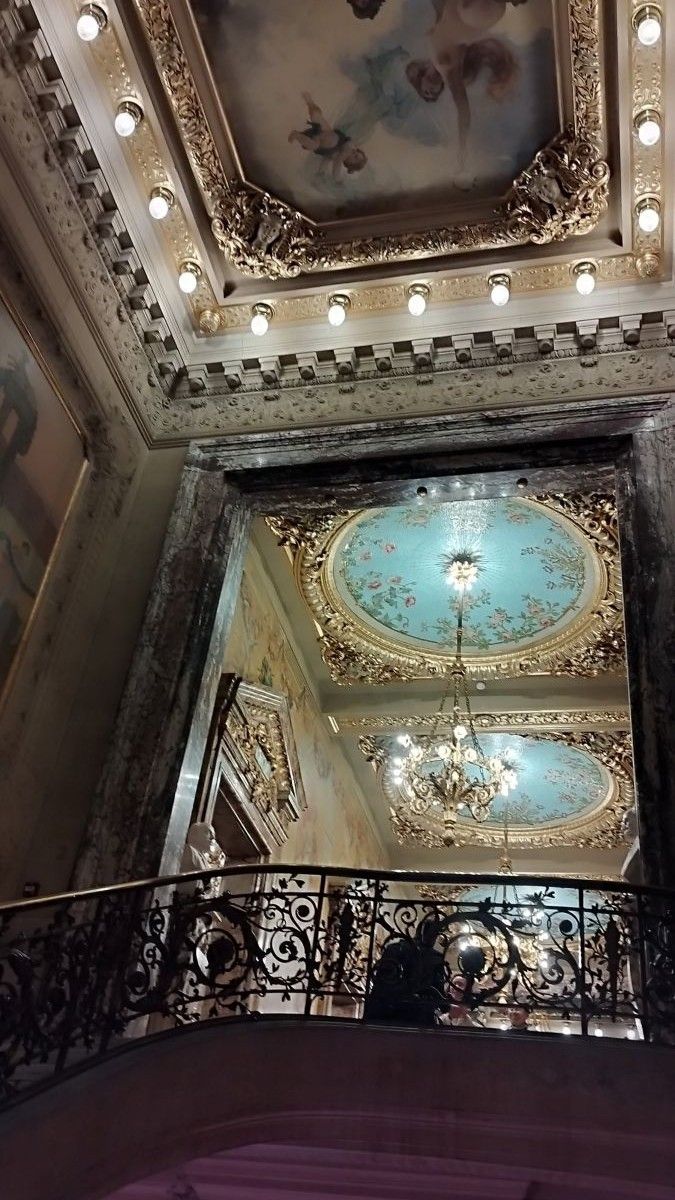
Forecourt: Ornamental painting by Dominique-Henri Guifard , Allegorical panels by Joseph-Paul Blanc. Glass mosaic ceiling by the Facchina workshop, gilt bronze railings and balustrades by the Christofle workshop. Bust of Benjamin Godard (composer of Dante and Beatrice in 1890) by Jean-Baptiste Champeil. Bust of Georges Bizet (composer of Djamileh in 1872 and Carmen in 1875), anonymous. The diversity of marbles in the 3rd Favart Hall is particularly evident in the foyer: the entire theater incorporates more than forty different types of stone, rock, marble, and granite.
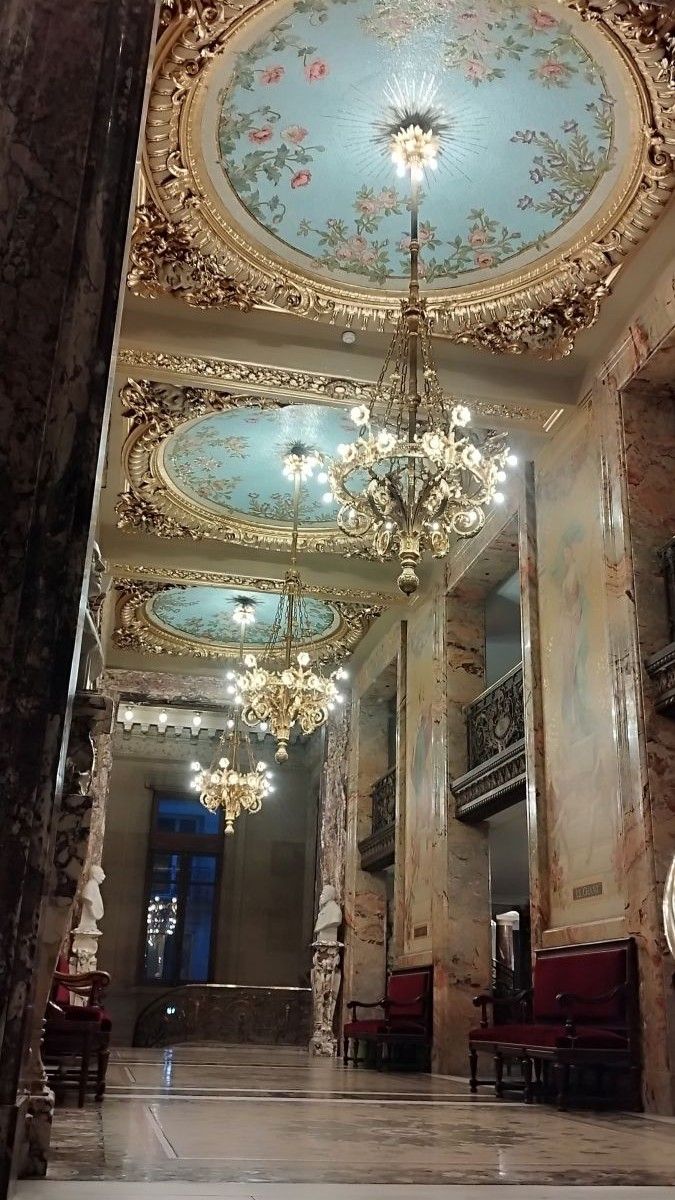
Foyer: paintings Paintings by Henri Gervex at the ends: The Queen’s Comic Ballet (a court ballet performed at the Louvre in 1581, marking the birth of French opera) and The Saint-Laurent Fair (featuring the Nicolet theater, where opéra-comique was born in the early 18C). Paintings by Albert Maignan in the rest of the foyer: on the ceiling, The Notes; on the back wall, The Wedding of Jeannette (1853) by Victor Massé on the left, Zampa (1831) by Ferdinand Hérold on the right; between the windows, the flautist plays an air from The Chalet (1834) by Adolphe Adam, and the genie’s motto is an air from The White Lady (1825) by François-Adrien Boieldieu. Foyer: Busts. Bust of Étienne-Nicolas Méhul (composer of Euphrosine ou le Tyran corrigé in 1790 and Stratonice in 1792), by Jean-Antoine Injalbert, Bust of Édouard Lalo (composer of Le Roi d’Ys in 1888) by Charles Perron. Bust of Ambroise Thomas (composer of Mignon in 1866; director of the Conservatoire from 1871 to 1896) by Émile-René Lafont . Bust of Fromental Halévy (composer of L’Éclair in 1835, Les Mousquetaires de la Reine in 1846, and Le Val d’Andorre in 1848; professor of composition at the Conservatoire from 1840 to 1862) by Gustave-Joseph Debrie. Bust of Claude Debussy (composer of Pelléas et Mélisande in 1902) by Marthe Spitzer. Bust of André-Modeste Grétry (composer of Le Huron in 1768, Zémire et Azor in 1771, L’Amant jaloux in 1778, Richard Cœur-de-Lion in 1784, and Guillaume Tell in 1791) by Henri-Édouard Lombard , Foyer: Medallions of Librettists, Composers, and Prominent Singers of the Opéra-Comique Company in the 19C.
Salle Marivaux Room: Paintings by Raphaël Collin: Inspiration, Ode, and Romance; on the ceiling, Truth Animating Fiction. Busts: Emmanuel Chabrier (composer of The King in Spite of Himself in 1887) by Auguste Musetti after Constantin Meunier. Alfred Bruneau (composer of The Dream and The Attack on the Mill, based on Émile Zola, and of The Hurricane and The Child King with Zola, created between 1891 and 1905) by Alexandre Descatoire. André Messager (composer of *La Basoche* in 1890 and *Fortunio* in 1907, musical director of the Opéra Comique from 1898 to 1904) by Joe Descomps, known as Joseph Emmanuel Cormier. Gabriel Fauré (professor of composition in 1896, then director of the Conservatoire from 1905 to 1920) by Pierre-Félix Masseau, known as Fix-Masseau Salle Favart Room : Paintings by Édouard Toudouze : *Le Jeu de Robin et de Marion* (the first comic opera, by Adam de la Halle, performed in the 13C), *La Danse* and *La Musique*; on the ceiling, *Glorification of Music*.Salle Bizet Room : The former atrium, which accommodated subscribers at street level, was renovated in 2007 to host concerts and conferences. Since 1900, it has been adorned with the Monument to Georges Bizet, sculpted by Alexandre Falguière. Originally intended for the entrance vestibule, the monument depicts the composer embraced by an allegory of music, with Carmen seated at his feet. A bust of Gounod by Gilly was added in 1943.
Salle Favart Room This hall is described as being in the French style: with few partitions, open to the central space, allowing for optimal visual communication and creating the impression of a large gathering. It had 1,500 seats in 1898 and 1,200 today. Boxes supported by ten caryatids by Jules-Félix Coutan . Mahogany doors and partitions. Movable orchestra pit, 2.58 meters high, partially concealed beneath the proscenium, with a capacity of up to 60 musicians. Enlarged in 1944. Harlequin costume adorned with flying figures by Laurent-Honoré Marqueste. Ceiling: Glorification of Music by Jean-Joseph Benjamin-Constant .In the enamel mosaic, masks alternate with ten genii, signed by Lombard, supporting cartouches bearing the names of composers: Adolphe Adam, Hector Berlioz, Fromental Halévy, Henri Berton, Luigi Cherubini, Wolfgang Amadeus Mozart, Pierre-Alexandre Monsigny, and Giovanni Battista Pergolesi. Installed in 2007 to restore the acoustics, which had been disrupted by previous renovations, the chandelier was designed by Alain-Charles Perrot, Chief Architect of Historic Monuments for the City of Paris, based on an acoustic proposal by Federico Cruz-Barney.
A bit of history tell us that the Opéra-Comique was founded during the reign of Louis XIV, on December 26, 1714, by Catherine Baron and Gautier de Saint-Edme, from troupes described as “fairground” performers who appeared at shows during the annual Paris fairs. One of the troupes from the Saint-Germain Fair then adopted the name Opéra-Comique. The Opéra-Comique’s beginnings were difficult, with several periods of closure. In January 1762, the fairground Opéra-Comique merged with the Comédie-Italienne. It moved to the Hôtel de Bourgogne on February 3, 1762. In 1779, the Comédie-Italienne became the Théâtre-Italien, but the company no longer included any Italians. However, in 1780, the ensemble officially reverted to the name Opéra-Comique. Since January 1, 2005, the theater has been governed by the statutes of the Théâtre National de l’Opéra-Comique, thus becoming a public establishment of an industrial and commercial nature.
Nestled on a small square, sheltered from the bustle of the Boulevard des Italiens, the Opéra-Comique is one of Paris‘s best-kept secrets.It is one of the oldest theatrical and musical institutions in France. The place is symbolic: it is here that internationally renowned works such as Berlioz’s La Damnation de Faust, Delibes’ Lakmé, Offenbach’s The Tales of Hoffmann, Debussy’s Pelléas et Mélisande, Ravel’s L’Heure espagnole, and especially Bizet’s Carmen and Massenet’s Manon were created. Statues of these two rebellious heroines still greet audiences in the theater’s grand hall today.
The official Opéra Comique of Paris : https://www.opera-comique.com/fr/l-opera-comique
The Paris tourist office on the Opéra Comique: https://parisjetaime.com/eng/culture/theatre-national-de-l-opera-comique-p3600
The Île de France region tourist office on the Opéra Comique : https://www.visitparisregion.com/fr/opera-comique
There you go folks, as in Paris, all is sublime, the Opéra Comique is a masterpiece of France, and the world. To think, is not visited is a shame, worth the detour, me think. Again, hope you enjoy this post on the Opéra Comique of Paris !!! as I
And remember, happy travels, good health, and many cheers to all !!!

 Paris1972-Versailles2003