
We have driven and walked in my eternal Paris, and would like to have an imprint in my blog on the wonderful family times we had there, There is so much to see , doing my best, and glad found me these older pictures in my cd rom vault ,which now transposing in my blog for you and me, This was my former worked city, so glad to post more memorable spots on it, I thank you for your readership over the years and to bear with my rants! After Paris is to rant, shout and yelled about, me think. Therefore, here is my take on curiosities of Paris , part LVII !!! Hope you enjoy the post as I.
The Avenue Mozart is an avenue in the 16éme arrondissement of Paris. It begins at Chaussée de la Muette (nos. 1-11) and ends at the intersection of Rue La Fontaine (no. 110) and Rue Pierre-Guérin (no. 24). It is 1,180 meters long and 20 meters wide. It is a one-way street from Rue Poussin to La Muette. It should not be confused with two dead ends to which it provides access, having given them their names: Square Mozart and Villa Mozart. It is named after the composer Wolfgang Amadeus Mozart, The avenue is served by the Jasmin, Ranelagh and La Muette metro stations of line 9 of the Paris metro. This street was opened, under the name of “rue Mozart” by a decree of March 2, 1867, The part between the Chaussée de la Muette and the Rue Bois-Le-Vent was not completed until 1896, Moving from the Chaussée de la Muette to the Rue Jean-de-La-Fontaine, one can observe the following remarkable buildings: nos. 28-28 bis: square Mozart, private road; no. 35: J. Audé bookstore, founded in 1936. Its bookseller Nicolas Lefort has participated several times in the television program Télématin to share his literary discoveries, no. 61: from 1973 to its passing in 1994, the writer Michel Fardoulis-Lagrange lived at this address , no. 66 (see photo), this residence comprises 30 rooms, including grand reception rooms and a main staircase leading to the first floor. Located near the Jardin du Ranelagh, the house exemplifies Parisian Renaissance residential architecture. The monumental staircase connects several reception rooms, allowing the residence to function as both a private home and a refined venue for entertaining. At the beginning of the 20C, it housed the Salvadoran legation. The ornithologist Louis Magaud d’Aubusson, founding father of the League for the Protection of Birds, lived and died there, nos. 76-78: buildings built in 1896 ,a commemorative plaques pay tribute to Jackie Kennedy, while Jacqueline Bouvier, a student at the Sorbonne, stayed there between September 1949 and June 1950, where she stayed with two friends at the home of Countess Robert de Renty, a member of the Resistance whose husband had died in deportation. André Lanskoy, a painter of Russian origin, lived there after the war and set up his studio; Gennady Rozhdestvensky, Russian conductor, lived his last years there; Pierre-Louis Bourgoin, officer and politician, companion of the Liberation, lived there from 1944 to 1968. No. 120: Houyvet building with its entrance at 2, Villa Flore, built in 1927 by Hector Guimard, No. 122: Guimard hotel; (see post) private mansion built by the architect Hector Guimard, the major representative of Art Nouveau in France, who lived there from 1913 to 1930. The politician Élisabeth Borne grew up there in an apartment with her mother and sister. She is from May 16, 2022 to January 9, 2024. Prime Minister On December 23, 2024, she was appointed Minister of State, Minister of National Education, Higher Education and Research in the current François Bayrou government and thus made her return to the government.
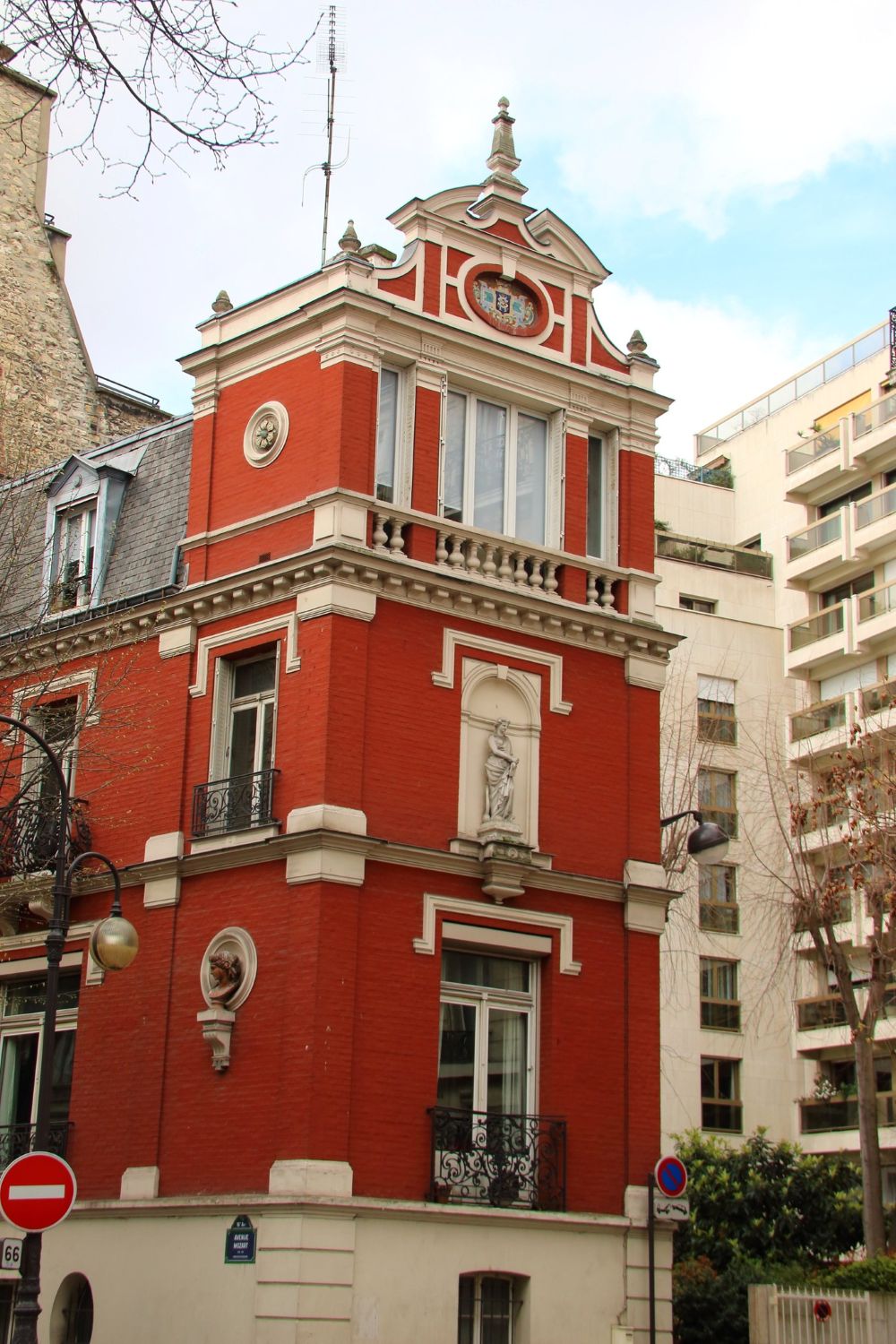
The above building at no 66 is at an angle with the rue de la Cure , This street, 6 meters wide and 118 meters long, begins at no 64 Avenue Mozart and ends at no 2 Rue de l’Yvette. It is primarily a residential street with no shops. It is named after an iron-rich spring in Auteuil, believed to have curative properties. The nearest metro is on Avenue Mozart on line 9 at the Jasmin station. Notable buildings are just two anecdotes as there were two springs once flowed along rue de la Cure. The oldest was located at the top of the street on the section now occupied by Rue Jasmin. The Auteuil springs, described as “three streams of cold water,” were discovered in 1628. Between nos 2 and 6, at the junction with Avenue Mozart, another spring flowed and was exploited in the 19C. It was discovered in 1842 by the archaeologist Jules Quicherat and “proclaimed sovereign for awakening the appetite, curing chlorosis and activating digestive functions.” It operated until 1894, then the construction of the metro led to its demise. At no. 20: building constructed in 1890, commissioned by a man named Schlumberger; a chemist of that name, Ernest Schlumberger, lived there and died there on December 20, 1938.
The Rue de la Pompe is located in the Muette and Porte-Dauphine quartiers/ neighborhoods of the 16éme district or arrondissement of Paris. As one of the longest streets in the neighborhood, it intersects Avenue Victor-Hugo and Avenue Henri-Martin.The street takes its name from the pump that supplied water to the Château de la Muette. The street is served by metro line 2 at the Victor Hugo station, and at its midpoint by metro line 9 at the Rue de la Pompe and La Muette stations, and at its end by RER line C at the Boulainvilliers train station. At the beginning of the 19C, the street was lined with buildings from the Grande Rue to the Rue du Moulin-de-la-Tour. Beyond that, it was a path leading to the Neuilly road. On September 4, 1839, it was classified as a major local road connecting Neuilly to Montrouge, via Passy. Before the annexation of the village of Passy to Paris, and by decree of July 25, 1851, this road was part of the D10 road.
Notable buildings: The British writer and illustrator George du Maurier spent his childhood on this street. He raised the main character of his first novel, Peter Ibbetson, here. No. 9: Huret bookstore, founded in 1973, specializing in antiquarian books, rare editions and manuscripts, as well as “historized covers” (books published after 1865 with a percaline cover), No. 10: The composer Alfred Bruneau lived here between 1910 and 1924. No. 11: On this level, in 1854, the writer Jules Janin had a two-story wooden chalet built. The land had just been separated from the park of the neighboring Château de la Muette by the construction of the Auteuil railway line on what is now Boulevard Émile-Augier. On the chalet’s facade, Jules Janin had inscribed the verses of Clément Marot: “May heaven preserve us in this world, here / From hunger, from an intruder, from cold, and from worry.” He entertained prominent figures there, including Abbé d’Auteuil Lamazou, the writers Lamartine and Nerval, the composer Hector Berlioz, and the politician Émile Ollivier. He died there in 1874. The chalet then passed to Colonel Mannheim. When the layout of Rue Gustave-Nadaud, which intersects with Rue de la Pompe, was redesigned, the chalet was demolished. No. 25: former Orève florist shop, opened after the building’s construction in 1911. The Art Nouveau facade, with three arcades clad in glazed bricks and mosaics depicting plant motifs on a gold background, remains unchanged; there is a winter garden upstairs. Greenhouses once stood at the rear of the shop. Orève closed in 1987 and became a restaurant, Bon, designed by Philippe Starck.Nos. 51 bis-53: Church of the Immaculate Heart of Mary (Spanish Catholic Mission), No. 52: Here, in 1897, the La Providence school was established, its origins dating back to the institution founded in 1816 by Madame Royale (first daughter of Louis XVI and Marie Antoinette) and the Sisters of Providence of Portieux in the parish of Saint-Roch. It had several addresses before moving to 28, rue des Marronniers in 1886, and then to rue de la Pompe. The new building, constructed in two years, included a chapel. The last nun to head the school left her post in 1981, and has since been succeeded by lay directors. However, Sisters of Providence still reside in adjoining buildings. In 2005, the school’s administration was transferred to the diocese. No. 89: The writer François Mauriac settled here in July 1913 and remained until 1931. His son, Claude Mauriac, also a writer, was born here on April 25, 1914. The actress Brigitte Bardot, as well as Jacques Attali, also lived here. The resistance fighter Pierre Brossolette ran a bookshop here between 1940 and 1942. No. 107: The writer Georgie Raoul-Duval, born Jeannie Urquhart, aka George Duval or George Daring, was a French writer of American origin who wrote in English and lived here. No. 115: Marshal Joseph Joffre lived here; the Russian novelist Irène Némirovsky also lived here after fleeing Bolshevik Russia in 1919; the Venezuelan legation was located here in the 1920s.No. 118: Lamartine bookstore, founded in 1926. It owes its name to the poet Alphonse de Lamartine, who lived in a now-demolished chalet located nearby, at numbers 107-113 Avenue Henri-Martin. In collaboration with Le Livre de Poche (a French paperback series), the Lamartine bookstore organizes an annual readers’ prize. No. 128: Charles Baudelaire stayed here briefly in 1852 with friends of General Aupick. No. 129 bis: Renoma men’s clothing store, opened by Maurice Renoma in 1963. In the context of the 1960s, when fashion was being reinvented from the strict codes that had prevailed until then, the store achieved rapid success, dressing both young men from bourgeois neighborhoods and celebrities such as Nino Ferrer, Bob Dylan, John Lennon, and Serge Gainsbourg. During the nazis Occupation, Resistance offices were set up on Rue de la Pompe, where Jean Moulin’s secretary, Laure Diebold, worked. On September 24, 1943, she was arrested by the Nazis. The next day, unaware of what had happened, Daniel Cordier went up to the apartment; he later recounted: “After I rang the doorbell, I didn’t hear Laure leave her office, her wooden shoes clattering on the parquet floor as she walked […]. Today, not a sound.” Suspicious, he didn’t stay. In 1919, Isadora Duncan bought the Beethoven room on the same street, which has since been demolished (number unidentified).
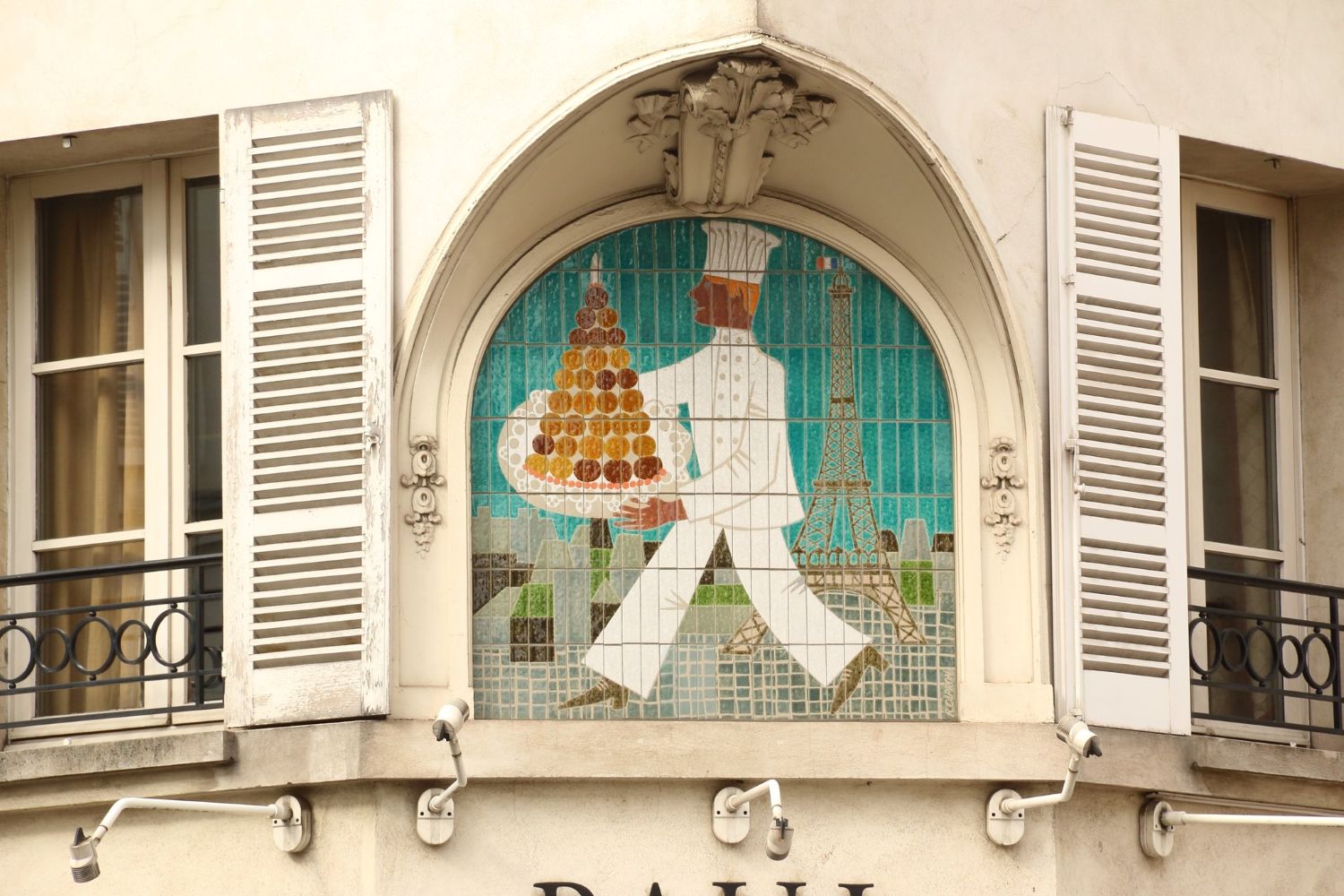
At the angle with Rue de la Pompe and Rue de la Tour you see the baker’s engraving on the wall of the Bien Epicerie Bio (see photo). There are a few private roads that are difficult to access. Nevertheless, I managed to get into the Villa Guibert. The Rue de la Tour begins in the Place de Costa-Rica at the intersection of 2 Rue de Passy and 1 Rue Vineuse, and ends at Place Tattegrain at the intersection of 62 Boulevard Émile-Augier and 97 Avenue Henri-Martin, In addition to these streets, Rue de la Tour is joined or crossed by several other streets.The street takes its name from a tower located behind the facade of the current no 86. This road in the former village of Passy is mentioned in 1605 and shown on Roussel’s 1730 map as the “Chemin des Moines” (Monks’ Road), leading from the Bonshommes de Chaillot convent to the Château de la Muette. At the end of the 18C, between the Rue de Passy and the Rue de la Pompe, the road became the “Rue du Moulin-de-la-Tour” (Mill-of-the-Tower Street). In 1840, the Rue de la Tour was extended to the Avenue de Saint-Cloud, as the current Avenue Victor-Hugo was then called; this segment of the avenue disappeared during the construction of the Avenue Henri-Martin. In 1858, the Rue de la Tour was extended even further west, to the Route Militaire, the current Boulevard Lannes. The street was officially classified as part of the Parisian street network by decree on May 23, 1863, shortly after the village was annexed to Paris. In 1896, the section located between the intersection of Avenue Henri-Martin and Boulevard Flandrin, and Boulevard Lannes, was detached to create Rue Adolphe-Yvon.
Notable buildings: No. 1: at this number there is a staircase dating from 1804 leading to the underground quarries of the 16th arrondissement. No. 8: The politician Jean Jaurès resided here until 1899 (the building was replaced by the Hôtel Régina de Passy, which would later become the Passy Eiffel). No. 9: Jean-Marie Le Pen lived here while studying law. No. 17: The American sculptor of Russian Jewish origin, Jo Davidson, had his studio here shortly before 1930. He hosted the photographer François Kollar. The five-story building dates from 1828-1830 and has retained, behind a garden, three studios, including one large one. No. 28: The singer Jane Birkin lived for a time with Jacques Doillon, Kate Barry, Charlotte Gainsbourg, and Lou Doillon in the first pavilion, after her separation from Serge Gainsbourg in 1980; Agnès Varda filmed scenes with her there for the film Jane B. par Agnès V. (1988). The publisher Jacques Arthaud and his wife lived in the second pavilion from 1958 onwards. Florence, daughter. No. 38 (formerly 34 to 42): Jacques and Bernadette Chirac lived here from 1954. No. 49: The writer Charles Du Bos lived here and regularly hosted André Gide and the painter Jacques-Émile Blanche. No. 86 was initially the summer residence of the academic Abel François Villemain, after 1831; the writer Louis-Aimé Martin also resided here. From 1860, the site housed a girls’ school. Thirty years later, a new establishment was founded by the Sisters of Saint Dorothy, then another, in 1901, by the Sisters of Saint Clotilde: this is the current Institute. The future actress Brigitte Bardot studied here. In 1987, the Institute became co-educational. No. 89: building where the aviator Georges Guynemer was born in 1894. He was one of the most famous French war pilots of the First World War. Nos. 141 and 146: the last numbers on the street since the renaming of its western section (rue Adolphe-Yvon since 1896) and the disappearance, in 1912, of the private mansion at no. 148. From 1904 to 1907, Édouard Vuillard lived, with or at his mother’s house, at the end of the current rue de la Tour, on the even-numbered side.
The Rue Boileau is located in the 16éme arrondissement of Paris. It begins at 31 Rue d’Auteuil and ends at 188 Avenue de Versailles. It is 975 meters long and 12 meters wide. The area is served by metro lines 9 and 10 at the stations Michel-Ange – Auteuil, Michel-Ange – Molitor, Exelmans, Église d’Auteuil, and Chardon-Lagache. It is named in honor of the French poet Nicolas Boileau, known as Boileau-Despréaux, a poet, translator, polemicist, and literary theorist, who bought a house on August 10, 1685, and lived it. This street, formerly part of the village of Auteuil and shown on Roussel’s map of 1730, was called “Rue des Garennes” in the 17C, a name derived from a place name that existed in the 15C. It began at the junction of Rue Molière and Grande-Rue, the latter of which formed the present-day Rue d’Auteuil. The street received its current name in 1792 and was officially designated a Parisian thoroughfare by a decree of May 23, 1863. Notable buildings here are at No. 12: the clinic where Maurice Ravel died on December 28, 1937, after his last-chance operation. Actress Corinne Luchaire also died here in 1950. A modern building was constructed at this address in 1969. No. 14: the site of the Auteuil village City hall between 1844 and the 1870s (the building burned down during the Paris Commune in 1871). No. 22: the headquarters of the NRJ Group. No. 26: Nicolas Boileau’s house was located at this address. No. 34: Hôtel Roszé, built in 1891 by Hector Guimard. No. 37: In the 1930s, the American dancer, painter, and sculptor Paul Swan, described as “the most handsome man in the world,” lived at this address. As of 2023, a 25-room tourist hotel occupies this address.
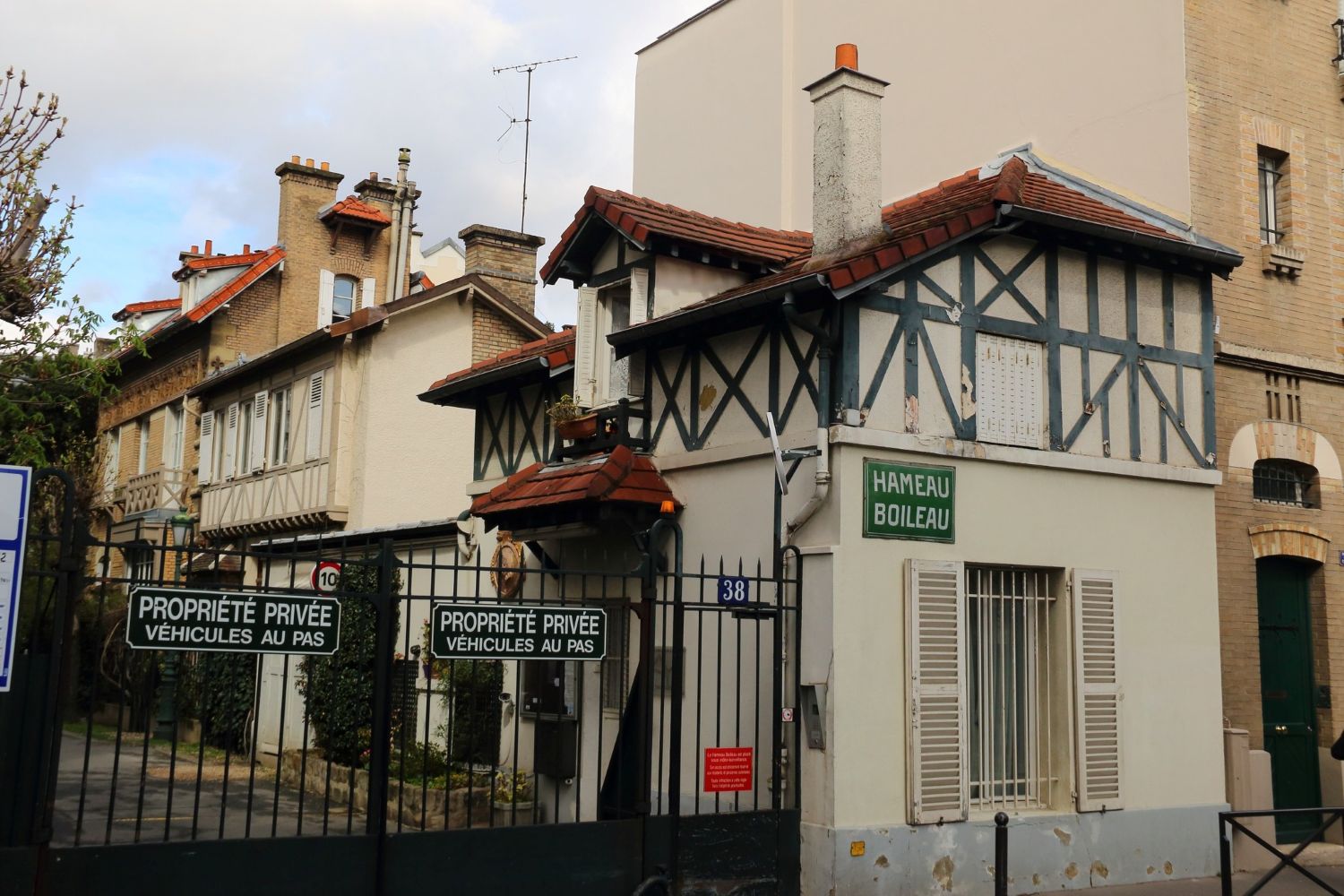
At No. 38: Entrance to the Hameau Boileau, a villa created in 1838 (private residence) in what was then a sparsely populated suburb of Paris. (See photo). The Hameau Boileau is a villa. The entrance to this private neighborhood is located at 38 rue Boileau. It is composed of five streets: Avenue Molière, Avenue Despréaux, Impasse Racine, Impasse Corneille and Impasse Voltaire, and has 60 addresses. It bears this name because of its proximity to the street of the same name, named after the writer Nicolas Boileau, who owned a house there, where he notably received Molière and Racine. Residents of the Boileau hamlet were Prince Pierre-Napoléon Bonaparte; the sculptor Jean-Baptiste Carpeaux, the sculptor Georges Muguet; the explorer Gabriel Bonvalot; Mr. and Mrs. Griffon, owners of the Griffon restaurant; No. 14 bis: the painter Amédée Julien Marcel-Clément was born there on September 15, 1873; No. 21: the sculptor Paul Moreau-Vauthier; No. 24: A neo-Gothic Norman manor house with a turret and half-timbering was the filming location for the movie Hibernatus starring Louis de Funès in 1969. The Kahn Jewish boarding school, where Paul Gavarni’s wife was assistant headmistress, is also located here. Actress Sarah Bernhardt is said to have studied there. The Algerian embassy building is also situated here. This is the Malek-Bennabi International Algerian School, whose entrance is at 40 rue Boileau. At the entrance to the hamlet is a bas-relief on a sculpted medallion. Around two figures depicted in profile are the inscriptions “Hubert Robert” and “Boileau-Despréaux.”
No. 67: Gustave Eiffel’s Aerodynamic Laboratory. Inaugurated in 1912 at the intersection with rue de Musset, it was one of the world’s first aerodynamic laboratories. In 1920, the engineer bequeathed it to the aeronautical technical services. In 1929, it was assigned to the Chamber of Aeronautical Industries. No. 84: Villa Cheysson (private residence). Villa Cheysson is part of a group of three small streets, called villas, which, along with Villa Dietz-Monnin and Villa Émile-Meyer, form an area known as Villa Mulhouse. Built from 1860 and completed in 1892, Villa Mulhouse comprises 67 pavilions. No. 102: the painter Maximilien Luce had his studio at this address from 1900 to 1920.
The Paris tourist office on the Village Auteuil (see hameau Boileau) : https://parisjetaime.com/eng/transport/village-d-auteuil-p2030
The Paris tourist office on the 16éme arrondissement or district: https://parisjetaime.com/eng/article/a-la-decouverte-du-16e-arrondissement-de-paris-a830
There you go folks, a dandy city to explore and enjoy with the family, Memorable moments in my eternal Paris, driving and walking all over in my road warrior trails brings out sublime awesome spots with nice memorable family visits of yesteryear always remember and always looking forward to be back, eventually. Again hope you enjoy the post on curiosities of Paris, part LVII !!! as I.
And remember, happy travels, good health, and many cheers to all !!!

 Paris1972-Versailles2003