
I am again to tell you about more streets of my eternal Paris. I have many many posts on Paris and several on the streets of the most beautiful city in the world. I have come up with pictures from cd rom vault that should be here for you and me. As always thank you for following my blog some since Nov 26, 2010. Therefore, here is my take on the streets of Paris, part XXXVII !!! Hope you enjoy it as I.
Fitting I will tell you a bit on the Rue Payanne as it follow the next two streets below but all on the same street, get it ! The Rue Payenne begins at No 20, Rue des Francs-Bourgeois, and ends at No 15, Rue du Parc-Royal. A quiet little street in the Marais, an extension of Rue Pavée, it is lined with private mansions and gardens. The street owes its name to Guillaume Payen, who was the notary in charge of the subdivision of the market gardens of the Convent of Sainte-Catherine-du-Val-des-Écoliers. He created the Sainte-Catherine Culture neighborhood and himself acquired a plot corresponding to the Hôtel de Marle. Notable buildings here are the first houses, nos. 1 and 3, occupy the site of the former convent of the Filles-de-la-Nativité-de-Jésus before 1687. At no. 5 is the house of the architect François Mansart (great-uncle of Jules Hardouin-Mansart), which he built and in which he died in 1666. The building was destroyed then rebuilt in 1844, before a positivist group bought an apartment there in 1903 to make it a chapel of Humanity. Opposite, at No. 6, behind a metal gate, you can see the back of the Lycée Victor-Hugo (former convent of the Filles-bleues). No 9 of the street shelters, behind gates that are sometimes open, the Lazare Rachline garden, the small French garden of the Hôtel de Donon, now the Cognacq-Jay museum (see post). At No 11 is the Hôtel de Marle, occupied since 1965 by the Swedish Institute. The residence, built from 1558, provided lodging to prestigious residents such as Yolande de Polastron, Duchess of Polignac, governess of the children of Louis XVI and Marie-Antoinette, the hotel is also called “Hôtel de Polastron-Polignac”, Opposite is the Square Georges-Cain, former private garden of the Hôtel Le Pelletier de Saint-Fargeau. No 13 is occupied by the Hôtel de Châtillon, pleasant with its paved courtyard and beautiful interior staircase. The hotel was first that of Henri de Daillon, Count of Lude, Grand Master of the Artillery of France, made Duke in 1675, then First Gentleman of the Chamber, Governor of the Châteaux of Saint-Germain and Versailles, and one of Madame de Sévigné’s loyal followers. Françoise d’Aubigné, future Madame de Maintenon, lived there. The buildings numbered 9, 11 and 13 occupy the grounds of the former Petit Arsenal of the town. The houses bearing numbers 18, 16, 14 were demolished in 1907. No. 18 was on part of the site of the Petit Arsenal of the town and later became the outbuildings of the Hôtel du Lude. No. 14 was built in 1773. The actor Floridor, as famous as Molière in his time, also lived on Rue Payenne. The street is mentioned several times in Restif de La Bretonne’s Les Nuits de Paris, ou Le spectateur nocturne (1788). It houses a private mansion where Count Octave, one of the characters in Honorine, a long short story by Honoré de Balzac, lives as a recluse.
The Square Georges-Cain main entrance by the 8 Rue Payanne is located in the Marais quartier or neighborhood , in the 3éme arrondissement or district of Paris. It is named after the painter and writer Georges Cain, who was the first curator of the Carnavalet Museum between 1897 and 1914. Access on Metro line 1 Saint-Paul , line 8 Chemin Vert , and by bus line 29 arrêt/stop Payenne. It was created in 1923, the square covers 2,128 m², bordered by the Carnavalet Museum (see post) or Hôtel Le Pelletier de Saint-Fargeau, and the its former orangery, and by the Lycée Victor-Hugo (high school), it is enclosed by a gate that opens onto Rue Payenne. Built on the site of extensive market gardening land known as the “Sainte-Catherine Culture” , owned by the canons of Sainte-Catherine-du-Val-des-Écoliers, the garden has been open to the public since 1931.This square is located on the grounds of the former garden of the Hôtel Le Peletier in Saint-Fargeau. It presents, in the open air, a selection of archaeological collections and monumental sculptures preserved at the Musée Carnavalet-Histoire de Paris.(see pic) Admire: L’Ile-de-France (1925), a bronze statue by Maillol , on the central flowerbed; the pediment of the clock pavilion of the former Tuileries Palace (burned down during the Commune in 1871); and a Neolithic polisher, evidence of the polished stone industry. The square is distinguished by the presence of a remarkable tree, a century-old fig tree, Ficus carica, and an ironwood tree, Parrotia persica, a species native to the Caucasus, so named because of the hardness of its wood. In the center of the garden, amidst a flowerbed, stands a bronze statue representing a young, nude woman standing, holding a scarf behind her back. It replaced an earlier sculpture by Philippe Magnier entitled Flora and Her Chariot. This “lapidary repository of the Carnavalet Museum” was nourished by the Civil War of 1871 and the dispersal of the collections of the first Museum of French Monuments, as well as some fragments of sculptures and pediments from the salt granary in Paris. There is also Heinz’s Nightingale, a sound creation by Erik Samakh. A MMA (Autonomous Acoustic Module) computer device powered by a solar sensor analyzes the climatic parameters that influence the behavior of a bird, and controls a compact disc player that broadcasts the song of a nightingale, recorded at the Château de Sauvigny in May 1990.

The Jardin Lazare Rachline entrance by 9 rue Payenne. Access via metro line 1, Saint-Paul , Chemin Vert line 8, and bus 29 arrêt/stop Payenne. It is also, located in the 3éme arrondissement of Paris, It faces the Hôtel Donon, which houses the superb Cognacq-Jay Museum (see post). The Lazare Rachline Garden is not accessible from the Cognacq-Jay Museum; you must therefore go around it to reach it, It was designed in the French style, the layout of this walled garden emphasizes the elegant lines of the Hôtel Donon. Méderic de Donon, the Comptroller General of the King’s Buildings, was a close friend of Catherine de Medici and the son-in-law of the sculptor Girolamo della Robbia. In 1575, he acquired several plots of land to build his residence. During the 19C and 20C, the Hôtel Donon was used for commercial purposes. The City of Paris acquired it in 1974. Since 1990, it has housed the collection of 18C artworks assembled by Ernest Cognacq, founder of the Samaritaine stores, and his wife, Marie-Louise Jay. The garden was created in 1990 and restored in 2010. The boxwood embroidery is enhanced with seasonal decorations that add a touch of color. Climbing roses and yew hedges mask the high walls. The name of this garden pays homage to Lazare Rachline, a Frenchman of Russian origin, a resistance fighter, industrialist, journalist, and co-founder, with Bernard Lecache, of the LICRA (International League Against Racism and Anti-Semitism). This is where you will discover the garden, a secret spot in Paris with incredible charm. This small garden, often shaded, is the ideal place for a quiet break, far from the hustle and bustle of the city. Formerly the garden of the Hôtel Donon, this beautiful green setting reveals a French garden surrounded by trees pruned into cones in the middle of which flowerbeds in delightful colors are revealed when the fine weather arrives.

The Rue des Blancs-Manteaux is located in the quartiers or neighborhoods of Saint Gervais and Saint Merri in the 4éme district or arrondissement of Paris. The 330-meter-long Rue des Blancs-Manteaux begins at 51 Rue Vieille-du-Temple and ends at 40 Rue du Temple. This site is served by the metro lines 1 and 11 Hôtel de Ville and line 11 Rambuteau stations. The street’s name comes from the fact that the mendicant order of the Servants of the Blessed Virgin, who settled on the site of a church today, wore a white cloak (see below). In the 13C, this road was known as “Rue de la Petite-Parcheminerie”, “Rue de la Vieille-Parcheminerie” or more simply “Rue de la Parcheminerie”, because of the establishments where the skin used to make parchments was prepared. It received its definitive name around 1289, due to the installation of the order of the servants of the Holy Virgin who settled in 1258 in the neighboring Blancs-Manteaux convent. In the 19C, the Rue des Blancs-Manteaux, which was located in the former 7éme arrondissement, Mont-de-Piété quartier, began at 53-55, Rue Vieille-du-Temple and ended at 22-24, Rue Sainte-Avoye. The street numbers were red. The last odd number was 43 and the last even number was 46. Notable buildings here are at No. 2: site of a house where the chemist Antoine-François Fourcroy lived. From Nos. 4 to 10: Sqaure Charles-Victor-Langlois, which is the site of a convent where Saint Louis established the order of the Servants of the Blessed Virgin, wearers of white cloaks, in 1258. They were replaced shortly after, in 1274, by the monks of the Order of Saint William. In the 17C, this convent housed a Benedictine priory of the Congregation of Saint-Maur. No. 10: former Guillemites fountain, located against the Notre-Dame-des-Blancs-Manteaux Church, No. 12: Notre-Dame-des-Blancs-Manteaux Church, last vestige of the convent. No. 15: Blancs-Manteaux theater. No 21 Le Clos des Blancs-Manteaux (see below), Juliette Gréco and the Jacques Brothers sang Dans la rue des Blancs-Manteaux, a song written by Jean-Paul Sartre and composed by Joseph Kosma. The song evokes the capital executions that took place there during the French revolution.
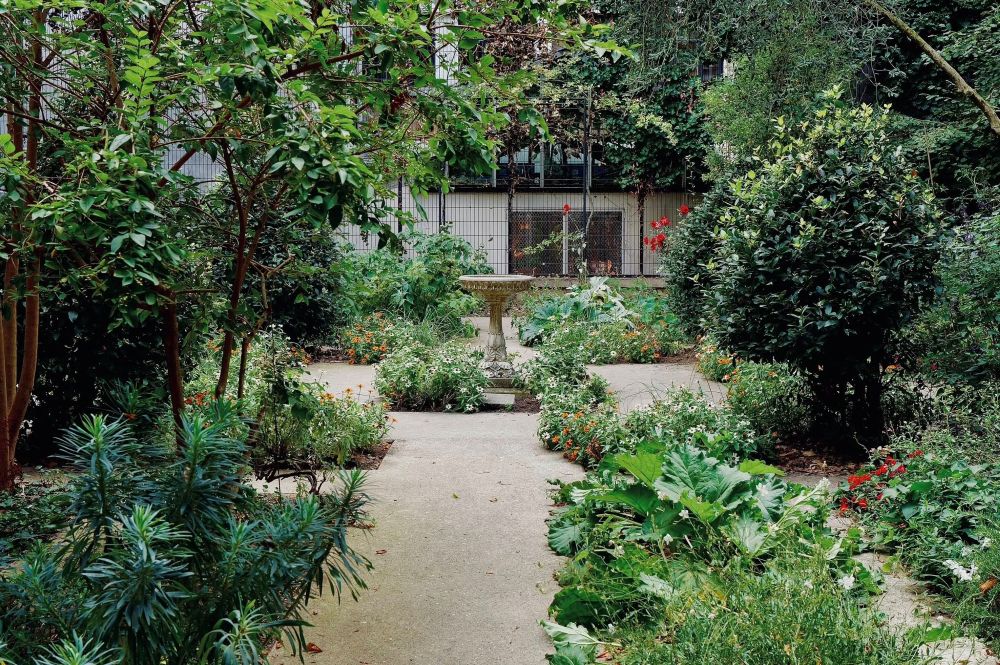
In 2001, the Clos des Blancs-Manteaux garden opened behind a nursery school. Located at 21, rue des Blancs-Manteaux in the 4éme arrondissement of Paris, Covering 1,000 m², this garden, located at the end of the courtyard of a former school, this green haven is inspired by medieval monastic gardens. Aromatic, condiment, and medicinal plants dot the cultivated squares. Two paths intersect around a fountain. inspired by medieval gardens, is home to more than 250 plant species: aromatic, condiment, and medicinal. The garden also has a vegetable garden cultivated as a shared garden by local residents. The garden also hosts various cultural events, from exhibitions to open-air concerts, offering an enriching experience in the heart of the city. On weekends, it is open to the public. The Clos des Blancs-Manteaux is dedicated to the memory of Lady Diana, Princess of Wales, who tragically died in Paris on August 31, 1997. To understand its name, we must go back to the 13C. In fact, around 1258, the Serfs of Saint Mary, a community of mendicant monks, founded their convent here at the expense of King Louis IX, the future Saint Louis. The long cloaks they wore were white, a color symbolizing Mary’s virginity. Despite the dissolution of their congregation in 1297, and the installation in their place of the hermits of Saint William the Guillemites, then to the Benedictines of the Congregation of Saint-Maur. This term now applies to a church, a street, a former market, and a theater in Paris’s Marais district. They wore black cloaks the neighboring church, the street, and this small garden have preserved the memory of their distinctive clothing.
The Paris tourist office on the Clos des Blancs Manteaux : https://parisjetaime.com/eng/culture/clos-des-blancs-manteaux-p931
The Paris tourist office on Paris Centre (incl arrond 1-4) : https://parisjetaime.com/eng/article/explore-the-centre-of-paris-a846
There you go folks, another dandy beautiful set of glorious streets of my eternal Paris. I have criss cross them many and have many in my blog already, Again, hope you enjoy this post on the streets of Paris, part XXXVII !!! as I.
And remember happy travels, good health, and many cheers to all !!!

 Paris1972-Versailles2003