
This is a landmark and just around the corner from a major site, walked all over and glad found me these pictures in my cd rom vaults, unbelievable indeed. Do walk the wonderful streets of Montmartre and encounter beauties like this one. Therefore, let me tell you a bit on the Church Saint Pierre of Montmartre in Paris, part II !!! Hope you enjoy it as I.
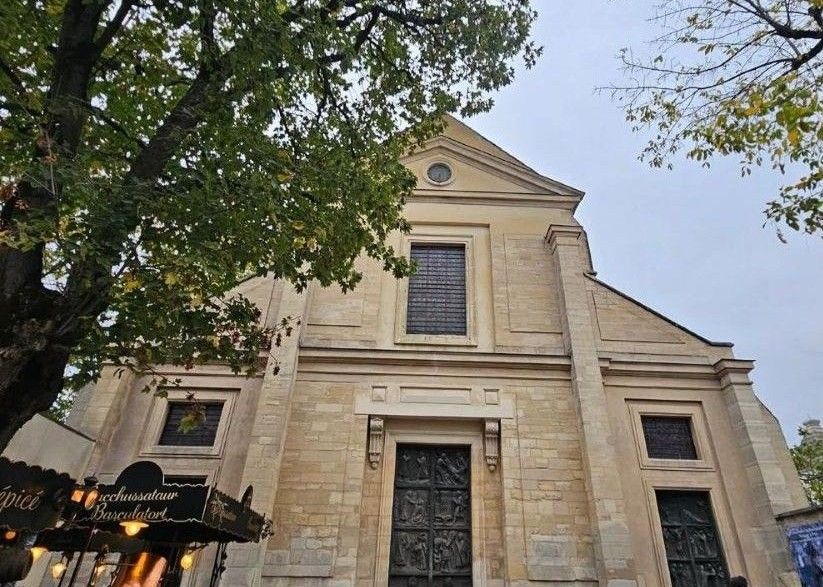
The Church Saint-Pierre de Montmartre is located in the 18éme arrondissement of Paris, at the top of the Butte Montmartre, at no 2 rue du Mont-Cenis, west of the Sacré-Coeur Basilica. Since the French revolution, it represents the oldest parish church in Paris after that of Saint-Germain-des-Prés. The Church Saint-Pierre de Montmartre is only accessible through one of the three portals on the west facade, which opens onto a small forecourt facing Rue du Mont-Cenis, almost opposite Place du Tertre. The apse and bell tower of the church are only partially visible from Rue du Cardinal Guibert, or from the heights of the basilica. Regularly oriented, the church has a cruciform plan and consists of a nave with four bays flanked by aisles; a transept slightly projecting to the north; a choir comprising a straight bay and an apse with a straight section and a semicircular apse; and two oriented chapels or apsidioles opening to the transept arms, without intercommunication with the choir. They reproduce the plan of the choir on a smaller scale. The bell tower rises above the straight bay of the northern apsidiole, which is the Chapel of the Blessed Sacrament. The southern apsidiole is the chapel of the baptismal font.In 1537, the baptismal font was inaugurated. The modern sacristy is located north of the last bay of the north aisle.
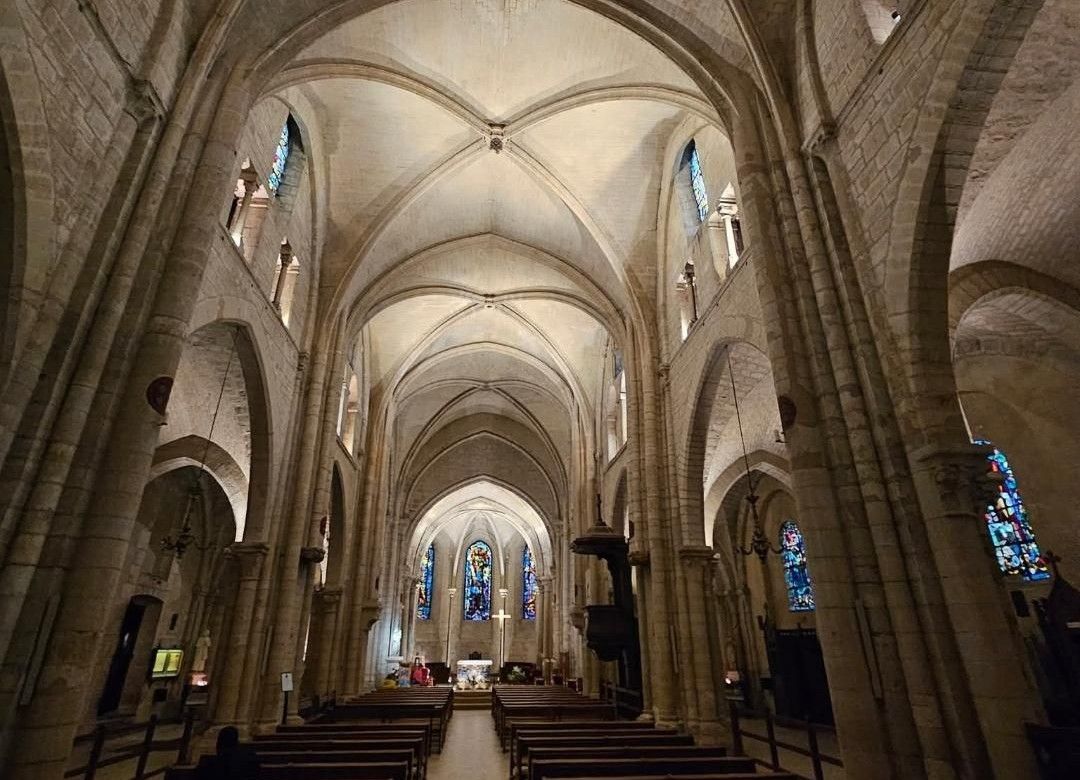
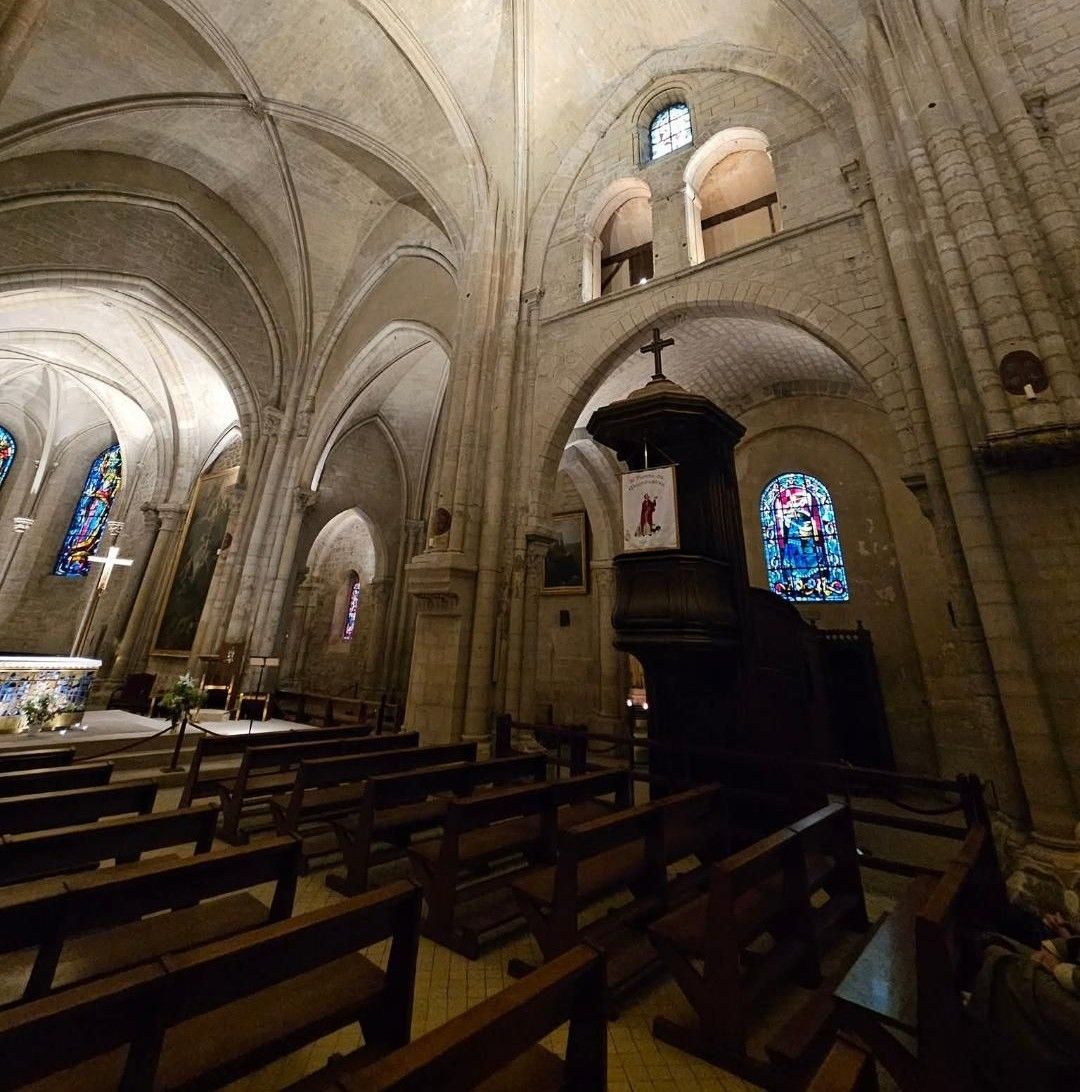
The nave comprises four large bays, only slightly wider than they are deep, contrary to the general practice which favors elongated bays. As a whole, the nave is already more Gothic than Romanesque. The transept crossing houses the high altar, consecrated on April 1, 1977, and is therefore at the center of the Eucharistic celebration, while the apse is unused. Due to its dimensions, the choir of the Church Saint-Pierre evokes a village church, and its modest size may be surprising considering the importance of the royal abbey of Montmartre and the splendor of the choir of Saint-Martin-des-Champs, a Cluniac and therefore also Benedictine priory. The chancel is shallow and low, with only one level of elevation and no windows. It was built around 1140, shortly after the apse chapel and the north transept arm, It is the only bay in the church that retains its original ribbed vault. The apse chapels, or at least the northern one, are often considered to have been part of the previous church; however, it is more appropriate to consider the northern apse chapel, which is more archaic, as the first part of the current church to be built. See the Chapel of the Blessed Sacrament. The pulpit has a classical style that would date it to the 18C or 19C.
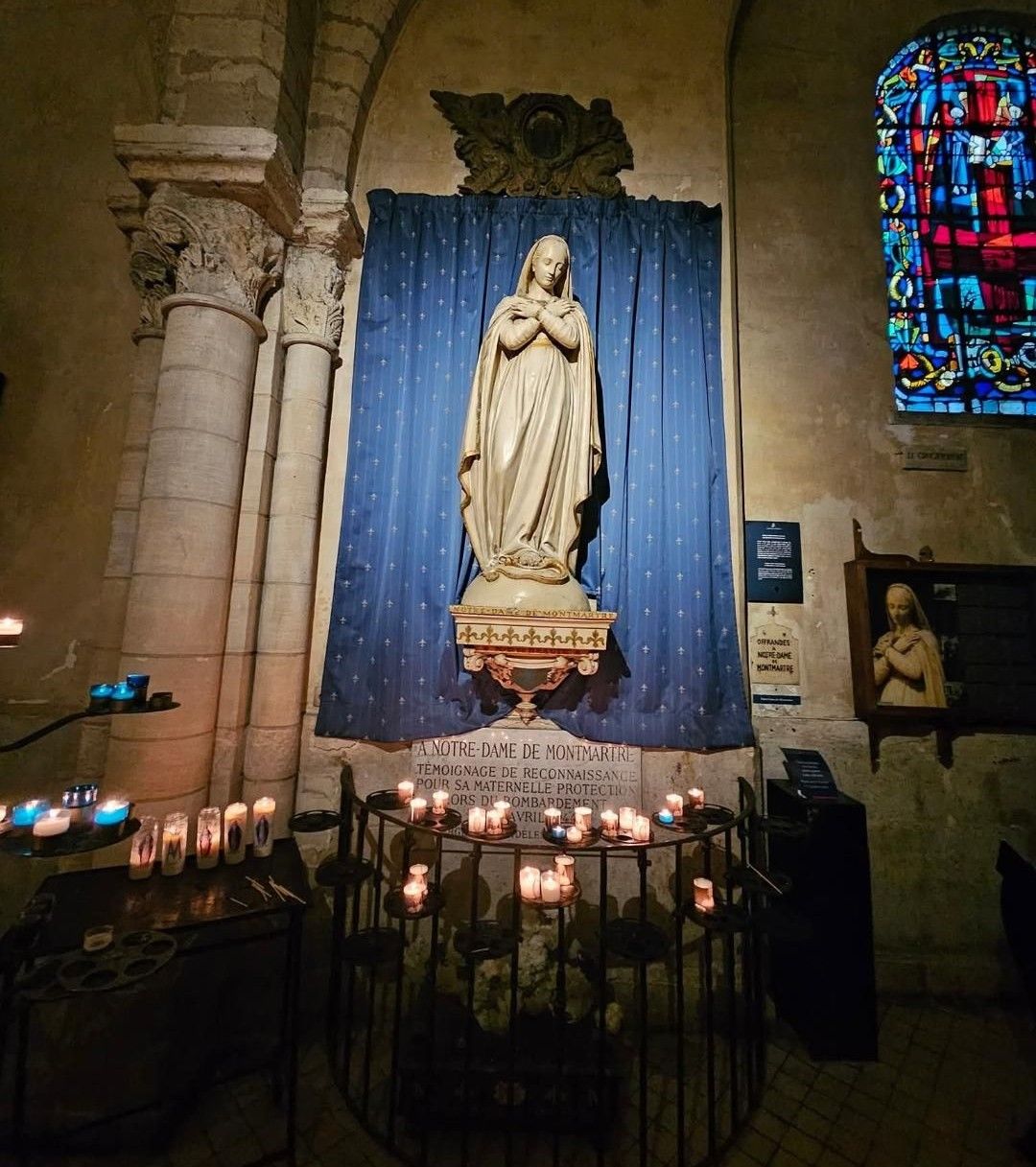
The Church Saint-Pierre de Montmartre possesses six oil paintings on canvas, three of which have adorned the walls of the chancel since the church reopened in 1905. The statue of Notre Dame de Montmartre, also known as Our Lady of Beauty, Queen of Peace, is the patron saint of the artists of Montmartre. It was donated in 1942 by a Montmartre painter, Prince Gazi, and has since been the object of an annual pilgrimage on November 11th, reviving an old tradition interrupted by the French revolution. The statue of Saint Pierre seated on the papal throne, in the second bay of the south aisle, is a copy of an original sculpture located in St. Peter’s Basilica in the Vatican. The great organ comes from the former Notre-Dame-de-Lorette church, demolished in 1840, and was installed around 1840, The late 17C organ loft, replacing an older instrument. The oak organ case, with three turrets, dates from the last quarter of the 18C.
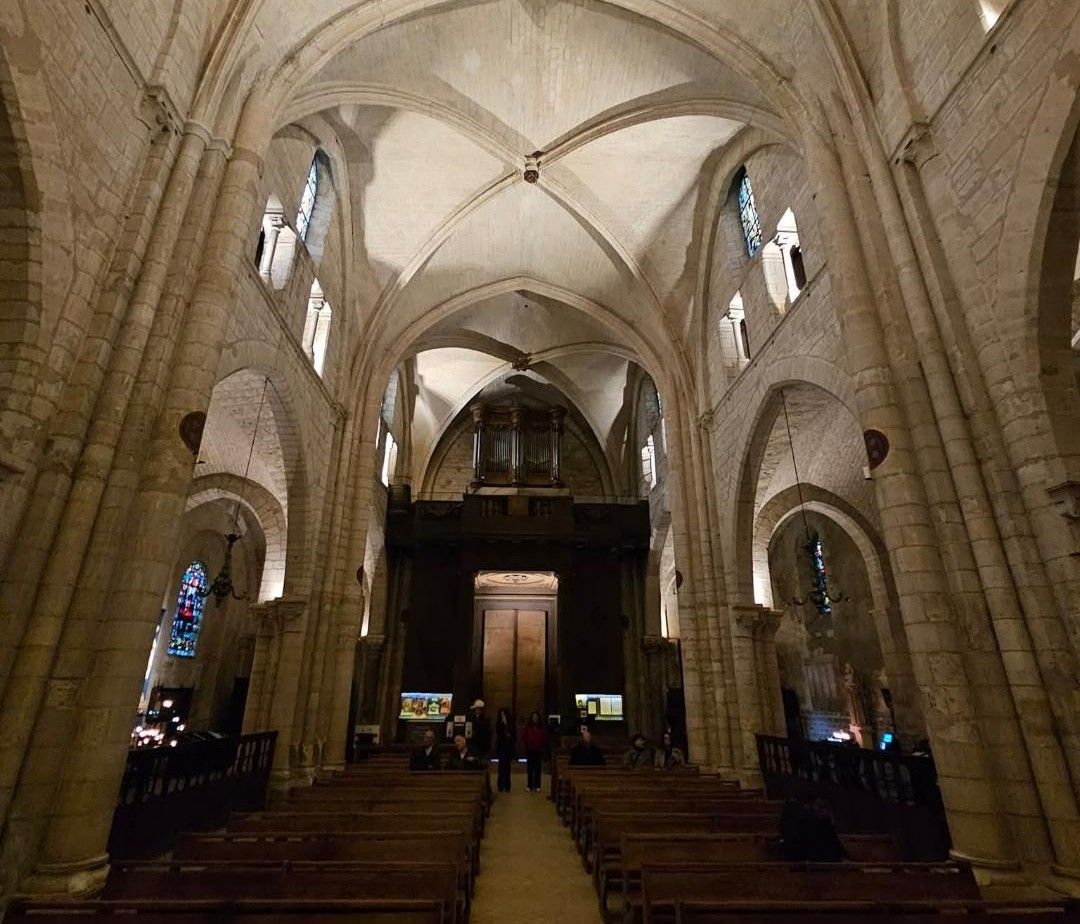
A bit of history I like tell us that it succeeded a Merovingian basilica dedicated to Saint Denis, five capitals and four marble columns of which were reused in the present church, the columns themselves originating from an ancient temple. The construction of the nave was not completed until after the middle of the 12C, and the apse was rebuilt in the early Gothic style at the end of the same century. The current vaults of the nave and the transept crossing are, however, Flamboyant Gothic and date from around 1470, when the church required extensive repairs following the Hundred Years’ War. The origins of the Church Saint-Pierre date back to the 6C, which is highlighted both by the five Merovingian capitals in white marble reused for the current church and by a large Merovingian cemetery around the church, discovered in 1875. The basilica itself may have replaced a temple dedicated to Mars or Mercury, mentioned respectively in the chronicle of Fredegar, in the 8C, and in the account of the Siege of Paris (885-887) by Abbots of Saint-Germain-des-Prés, at the end of the 9C. The church is considered the second Christian place of worship on the Montmartre hill. The first would have been the chapel dedicated to the Holy Martyrs, which was located further down the hillside. Montmartre is called the Mount of Martyrs and is designated as the place of the beheading of Saint Denis and his companions Saint Rusticus and Saint Eleutherius. Its first mention appears in a document from 1096. This document attests to the cession of the hamlet of Montmartre, with its chapel and cemetery, which were held as a fief by the knight Gauthier Payen and his wife, to the abbey of Saint-Martin-des-Champs. All visible traces of the Chapel of the Holy Martyrs have disappeared: it was demolished in 1790. Very dilapidated at the beginning of the 12C, the old basilica was acquired by King Louis the Fat in 1133, who had it replaced by a new Romanesque church, consecrated in 1147 by Pope Eugene III. Queen Adelaide of Savoy simultaneously founded an abbey of Benedictine nuns south of the church, known as the Royal Abbey of Montmartre. The church was therefore both a parish church and an abbey church. In 1686, the nuns moved to a new monastery near the Place des Abbesses, and the church has since been for the exclusive use of the parish, but remained the property of the Royal Abbey of Montmartre until its dissolution in 1792 during the French revolution. Two years later, the apse of the church was damaged by the construction of the Chappe tower above it. Consequently, the eastern parts of the church were not returned to religious use when it reopened in 1803. Restoration work was undertaken between 1900 and 1905, and Church Saint-Pierre ,then acquired its current appearance and is today a major center of Christian spirituality in the north of Paris.
During the French revolution, the royal abbey was required to declare its assets at the beginning of 1790. Seven nuns left the abbey before the end of the year; forty-five remained, including all categories. In 1792, all the buildings were confiscated, and the abbey was evacuated on Sunday, August 19, 1792. The abbey was desecrated and looted. Declared national property, the buildings of the lower abbey were sold at auction in several lots, and their buyers quickly demolished them. During the invasion of Paris by Russian troops in 1814, the church was requisitioned to serve as a food store, and bread ovens were built in the northern apse. The church was therefore temporarily deconsecrated for a second time. It certainly suffered damage. After WWII, a parishioner, Mr. Desmaret, decided, following the death of his wife, to donate stained-glass windows to the church. Twenty-seven in number, they were made by the master glassmaker Max Ingrand in 1952 and 1953. In 1980, the Italian sculptor Tommaso Gismondi donated six bronze panels for the three portals of the western facade. They were cast in Rome and blessed by Pope John Paul II on March 26, 1980, before their departure for Paris. Completely covered in bas-reliefs, they depict scenes from the lives of Saint Denis, Saint Peter, and the Virgin Mary. These are the three patron saints of the church and the parish. Also in 1980, Gismondi donated a gate for the Calvary cemetery, which is also made of bronze, but is openwork and in a different style. It illustrates the Resurrection of Christ.
The official Church Saint Pierre of Montmartre : https://www.saintpierredemontmartre.net/
The City of Paris on the Church Saint Pierre de Montmartre : https://www.paris.fr/lieux/eglise-saint-pierre-de-montmartre-19452
The Paris tourist office on the Church Saint Pierre de Montmartre : https://parisjetaime.com/eng/culture/eglise-saint-pierre-de-montmartre-p1266
There you go folks, get your highs while looking the beautiful scenes of Paris from the hill=butte, at night is sublime,and if clear day awesome. Its a must visit while in Paris or France. Again, hope you enjoy this post on the Church Saint Pierre of Montmartre in Paris, part II !!! as I.
And remember, happy travels, good health, and many cheers to all !!!


