
We have driven and walked in my eternal Paris, and would like to have an imprint in my blog on the wonderful family times we had there, There is so much to see , doing my best, and glad found me these pictures in my cd rom vault ,which now transposing in my blog for you and me, This was my former worked city, so glad to post more memorable spots on it, I thank you for your readership over the years and to bear with my rants! After all, Paris is to rant, shout and yelled about, me think. Therefore, here is my take on curiosities of Paris, part LV !!! Hope you enjoy the post as I.
The Rue des Francs-Bourgeois is located in the Marais quartier or neighborhood, marking the boundary between the 3éme and 4éme arrondissements or districts of Paris. It runs from Place des Vosges to the intersection of Rue Rambuteau and Rue des Archives. Its name comes from “alms houses” opened on this street for poor people who were exempt from taxes due to their indigence. This site is served by the metro line 8 at the Chemin Vert station, by metro line 1 at Saint-Paul station, and by lines 1 and 11 at Hôtel de Ville station. This street, which is attested from the 14C, is cited under the name of “rue des Francz bourgeois” in a manuscript of 1636. This old street, which partly ran along the wall of Philippe Auguste, was first called “rue des Poulies”, “rue des Viez Poulies” or “rue des Vieilles Poulies”, “rue Richard des Poulies”, “rue Ferri des Poulies”, because of its weavers’ trades. It took its current name after the foundation, in 1334, of “alms houses” whose occupants, exempt from taxes due to their low resources, were called “francs-bourgeois”, and one of which, which was called “maison des Francs-Bourgeois”, was a hospital for poor bourgeois.
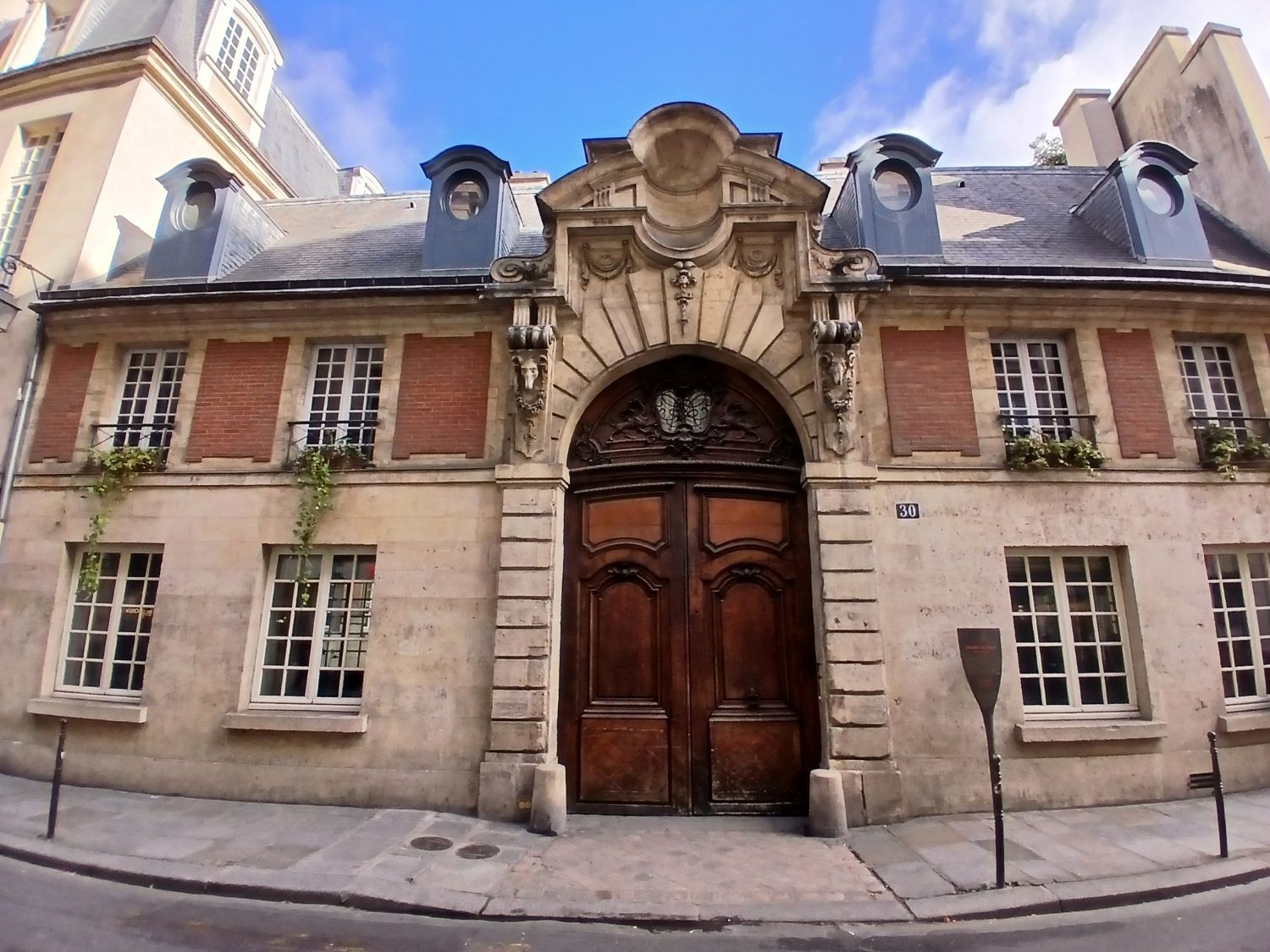
I have given you the history and other notable buildings here but this is a new find at No. 30 Rue des Francs-Bourgeois, the Hôtel d’Alméras was built between 1611 and 1613 by Louis Métezeau for Pierre d’Alméras, Lord of Saint-Rémy and La Saussaye (counselor and secretary of finance to King Henry IV). It is situated in the Marais quartier /neighborhood in the 3éme district/arrondissement of Paris, The plot of land on which the Hôtel d’Alméras, a superb private mansion, stands as the work by Louis Métezeau, architect to King Henry IV, It was acquired in 1598 by Jean de Fourcy, who resold it in 1600 to the king’s secretary, Jean de Guéribalde. He, in turn, sold it on December 19, 1602, to Jean Alméras, Lord of La Saussaye and court clerk of the chancellery, and to two of his sons-in-law: Claude Le Roux and Jean Duhamel. On January 28, 1611, the widow of Claude Le Roux, Madeleine Alméras, sold her portion of the plot to her brother, Pierre d’Alméras. The latter only became the owner of the entire plot in 1625. Paul de Barras, known as the Viscount of Barras, and later simply Paul Barras, resided at the Hôtel d’Alméras from 1814 to 1815, as did the film director Alain Corneau for nearly 40 years at the end of the 20C. In the 19C, like many hotels in the Marais neighborhood, the Hôtel d’Alméras was occupied by artisans: notably by a tannery and then by a chandelier manufacturer. In the 1930s, it was occupied by the Pointet & Girard pharmaceutical laboratories, whose headquarters later moved to 25 Boulevard de l’Amiral Bruix near Porte Maillot and subsequently closed. The building was then restored in 1983. The Hôtel d’Alméras is now divided into apartments. It is privately owned and not open to the public. The main building, constructed in brick and stone, is situated between the courtyard and the garden. On the courtyard side, it is flanked by two pavilions of different widths. The left pavilion extends into a wing towards the street-facing building; two arched dormer windows are grouped together and frame a niche housing a bust of King Henry IV. Inside, almost all of the original decorations have disappeared, with the exception of some Louis XV paneling. The grand staircase retains a highly original balustrade: it is punctuated by oval arches and stylized Ionic pilasters. Its astonishing Mannerist portal indicates the high social status of its owner. The arched portal is adorned with stepped stone voussoirs. It is surmounted by a curved pediment interrupted by a tabernacle niche. This pediment is supported by stone consoles decorated with ram’s heads and garlands of flowers. The elegant door panels date from the Regency period. The wrought-iron monogram RL, of Robert Langlois de la Fortelle, the owner at the time, is visible on them.
The Paris tourist office on walks in the Marais : https://parisjetaime.com/eng/article/exploring-the-marais-a1070
The Paris tourist office on Paris Centre (arrond 1-4) : https://parisjetaime.com/eng/article/explore-the-centre-of-paris-a846
The Paris tourist office on the rue Francs-Bourgeois : https://parisjetaime.com/eng/transport/rue-des-francs-bourgeois-p2039
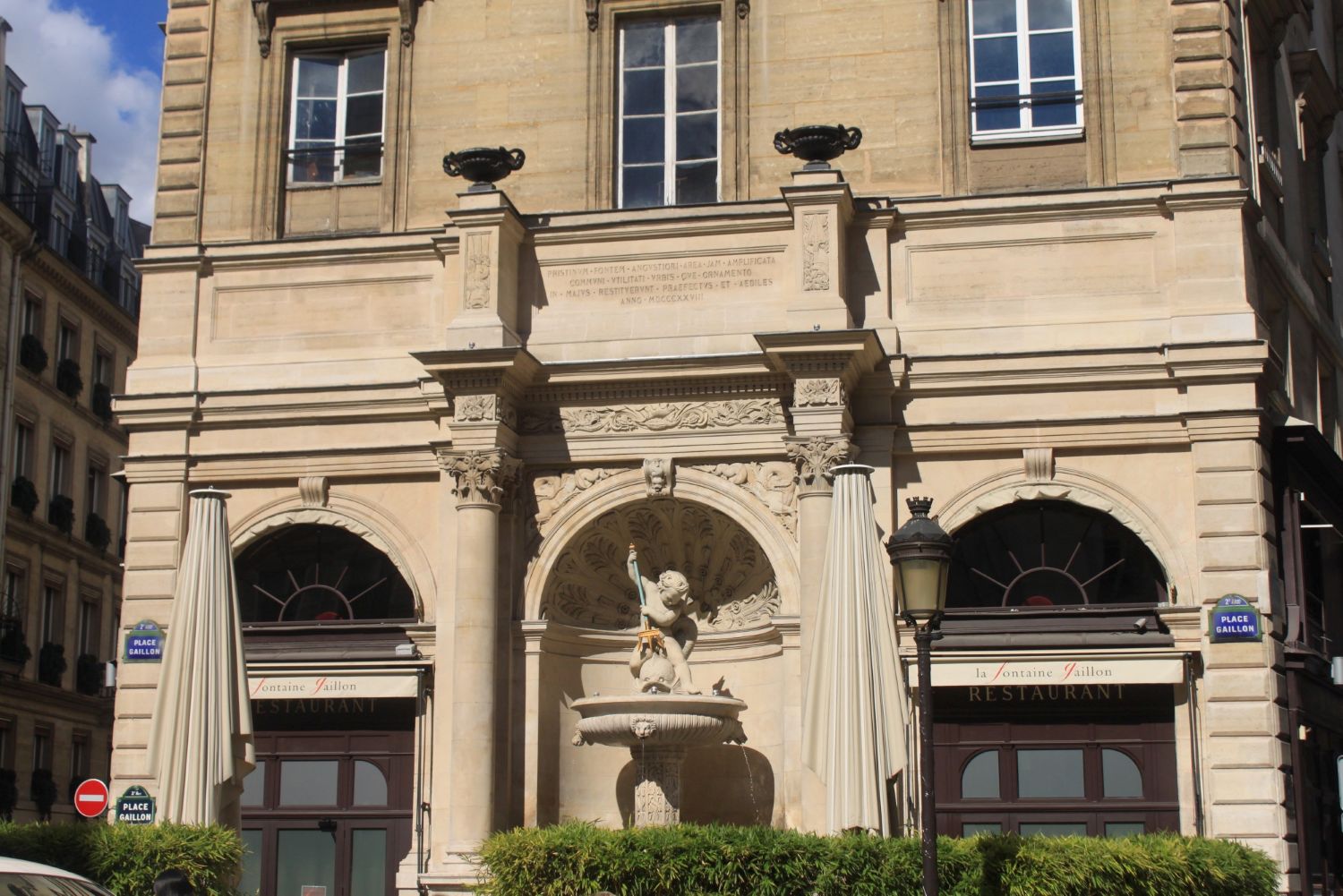
The Place Gaillon is located in the 2éme arrondissement of Paris. It is a roughly trapezoidal square, approximately 25 meters long and 15 meters wide. It is bordered by the Rue de Port-Mahon, the Rue de La Michodière, the Rue Saint-Augustin, and a building. The Rue Saint-Augustin continues, while the Rue de Port-Mahon and the Rue de La Michodière intersect this street at the square. The square opens onto a triangular intersection formed by the junction of the Rue Gaillon with the Rue Saint-Augustin. The area is served by metro lines 3, 7, and 8 at the Opéra station and by line 3 at the Quatre-Septembre station. Its name comes from the vicinity of rue Gaillon, which in turn derives its name from the former Hôtel de Gaillon, which was located on the current site of the Church Saint-Roch (see post). From 1700 to 1778, this square, which was simply the intersection of Saint-Augustin and Gaillon streets, was called « carrefour Gaillon ».or crossroads. The square received its current name in 1936. Notable buildings here are the Fontaine Gaillon (see pic) fountain occupies the center of the building’s facade facing the north side of the square. At nos 16-18 is the Drouant restaurant, the venue where the Goncourt Prize is awarded. In “Au Bonheur des Dames,” Émile Zola has his heroine, Denise, work in a department store located on Place Gaillon.
The Paris tourist office on Paris Centre (arrond 1-4) de Paris : https://parisjetaime.com/eng/article/explore-the-centre-of-paris-a846
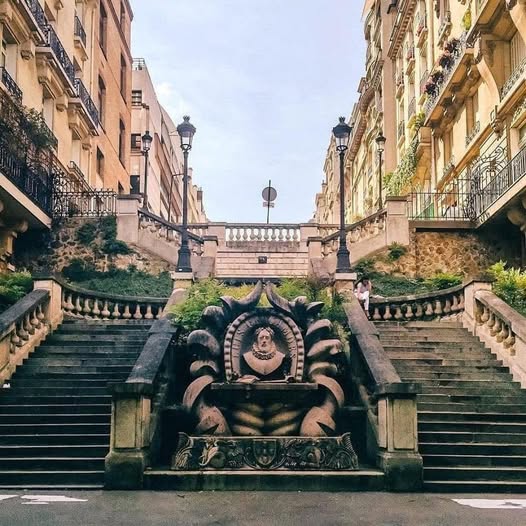
The Avenue de Camoëns is located in the La Muette quartier/neighborhood of the 16éme district/arrondissement of Paris. It begins at 4, boulevard Delessert and ends at 14, rue Benjamin-Franklin. Only 115 meters long, it is one of the shortest avenues in Paris. It is at the same level as rue Benjamin-Franklin but is connected to boulevard Delessert, below, by a large double-sided staircase with a difference in elevation of about 10 meters. The area is served by metro lines 6 and 9 at the Trocadéro station. This avenue owes its name to the Portuguese poet, a national literary figure, Luís de Camões, also called “Le Camoëns,” which explains the name of the avenue. The street, opened on the lands of Count Armand and Count de La Rochefoucauld-Bayers, was created and given its current name in 1904. Notable buildings here are at No. 5: secondary entrance to the Lycée Saint-Louis-de-Gonzague high school, with main entrance at rue Benjamin Franklin. The site was rebuilt in 1935 by the architect Viollet-le-Duc. No. 7: a Neo-Louis XV style building constructed by Albert Sélonier (a disciple of Viollet-le-Duc) in 1907. No. 10: a plaque commemorates that Alexis Leger, known as Saint-John Perse in poetry, Nobel laureate in literature in 1960, lived there from 1933 to 1940. While he had been stripped of his French citizenship by the Vichy regime, his apartment was ransacked by the Gestapo in 1940 and subsequently searched by the French police. However, the beauty here is the stairs! A double-sided staircase (see pic) connects it to Boulevard Delessert. Indeed, after climbing the immense staircase, with a height difference of about 10 meters, one discovers a splendid view of Paris and its famous Eiffel Tower. At the bottom of the stairs is a monument to the Portuguese poet Luís de Camões, made of monolithic pink marble and erected in 1987. This monument is dedicated to the Portuguese poet Luís Vaz de Camões, after whom the avenue is named. This work features the poet’s bust surrounded by a sword, a notebook, and a quill pen. The coat of arms of Portugal is also sculpted on the base. The current work replaces an older sculpture on a pedestal that dated from the beginning of the 20C and disappeared during the nazis Occupation. The story goes that on June 13, 1912, the Society for Portuguese Studies inaugurated this bust, which subsequently suffered an unfortunate mishap! It simply disappeared one day, without anyone knowing why. The culprit was eventually unmasked: it was a local councilor who considered the monument “very unsightly” and had it removed. This monument has been back in its original location since 1987.
The Paris tourist office on the 16éme arrondissement de Paris: https://parisjetaime.com/eng/article/a-la-decouverte-du-16e-arrondissement-de-paris-a830
There you go folks, a dandy city to explore and enjoy with the family, Memorable moments in my eternal Paris, driving and walking all over in my road warrior trails brings out sublime awesome spots with nice memorable family visits of yesteryear always remember and always looking forward to be back, eventually. Again hope you enjoy the post on curiosities of Paris , part LV !!! as I.
And remember, happy travels, good health, and many cheers to all !!!


