
This is again another dandy monument in my eternal Paris. I have done quite a bit of walking in Paris, and never stop amazing me of its abundance of architecture and historical sights that not only are known but also unknown to most. This is another beauty that was found on an unique event,,, I was to meet some Americans friends near who had an ice cream shop and passed by this church; took a peek and was impressed as to choices went on and only have a post on its history, It really needs to be seen more, me think ; very much a historical church in Paris with America connections,,, I am glad and knew it have found new pictures in my cd rom vault that should be in my blog for you and me, Therefore, here is my take on the Church Saint Roch Paris !!! Hope you enjoy it as I.
The Church Saint-Roch is located at 296 rue Saint Honoré in the crossing of the rue Saint Roch, in the 1er arrondissement of Paris, The church is one of the largest in the city. Its nickname, the “artists’ parish,” comes from the fact that many artists are buried there: André Le Nôtre, Pierre Corneille, and the painter Fragonard are buried there. Construction began in 1653, and Louis XIV laid the foundation stone! Due to a lack of funding, the work dragged on and progressed in several phases: the main part of the church was built until 1690, a chapel dedicated to the Virgin Mary was built by Jules-Hardouin Mansart in 1706, and the façade was erected in 1736! It has the distinctive feature of being made up of several chapels following one another. The painter Jean-Baptiste Pierre decorated the “Triumphant Virgin” on the dome.
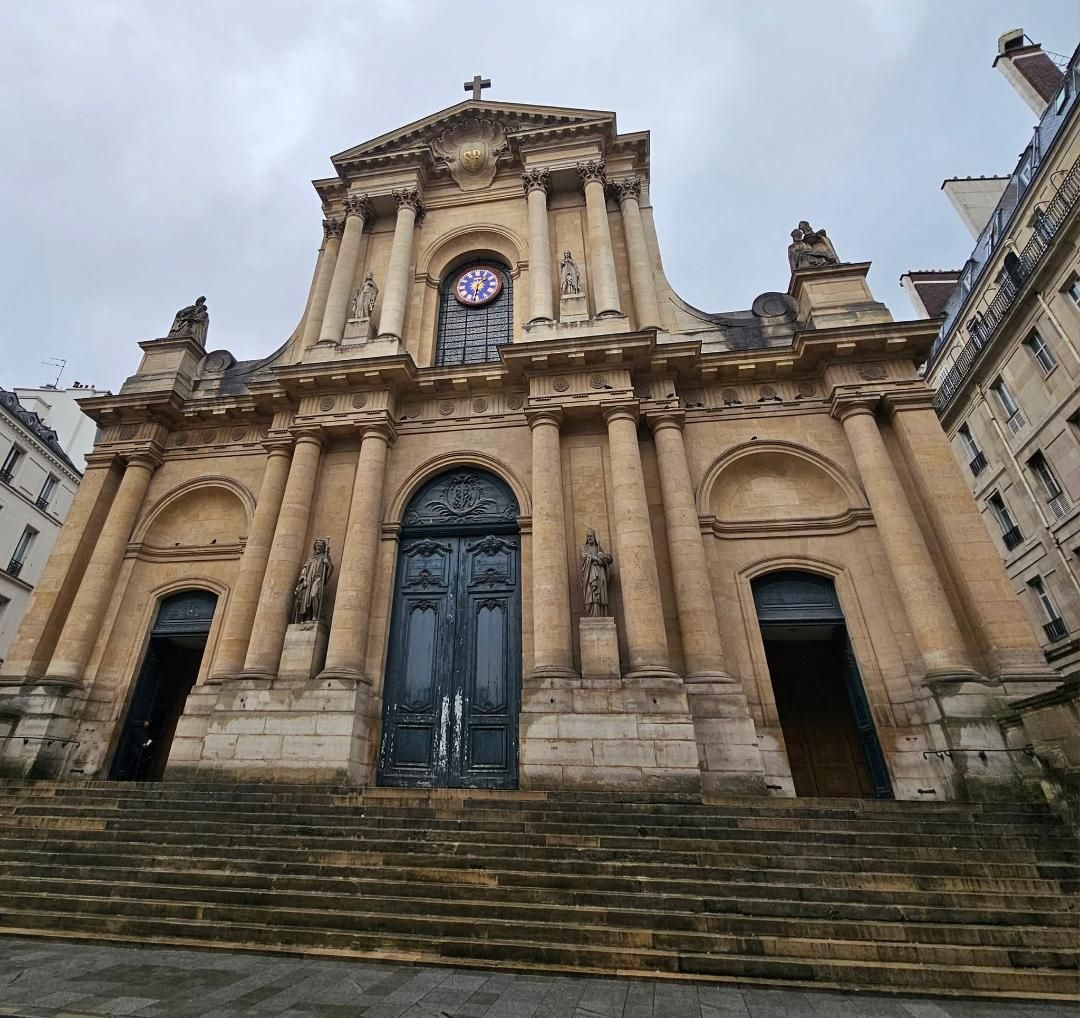
The church square was the scene of fighting during the royalist uprising of October 5, 1795. Plundered during the French revolution, the church recovered part of its heritage, as well as numerous works of art from other Parisian churches. The church unfolds into a succession of chapels whose effect is to manifest the divine. This enfilade is designed with altar effects that become lower and lower each time one advances, always with the perspective of the cross beyond the altar, this cross at the back illuminated by the zenithal light of the Resurrection. The pilasters are classical: Doric order with entablature, triglyph, and metope. The decoration of rosettes and interlacing on the doubleaux is characteristic of the early 18th century. It is the only one that appears to have been built in one go.
A brief description huge , with the help of wikipedia for easier translation, You have the Chapel of the Baptismal Fonts with on the left, Saint Philip, one of the first deacons of the Christian community, baptizes by immersion the minister of the Queen of Ethiopia who asked him for baptism. On the right, Saint Francis Xavier , a Jesuit missionary, baptizes by sprinkling those he led to Jesus Christ in India and Japan. He was one of the first companions of Saint Ignatius of Loyola in 1534, in Montmartre. The Chapel of Saint John the Baptist has a marble sculpture, “The Baptism of Jesus,”. This group comes from the old Saint-Jean-en-Grève church, destroyed between 1797 and 1800, and was donated to the church during the Restoration (1814-15), The Chapel of Saint Nicholas, Chapel of Compassion , See next the “deportation wall” inaugurated in 1949 by Geneviève de Gaulle-Anthonioz and Chancellor Konrad Adenauer. Earth and ashes were brought back from the camps and placed behind each plaque , Many people were buried in this church, particularly in the 18C. The clergy had their vault under the choir with an entrance protected by a black marble slab. This slab, still visible, bears a funerary inscription as well as various apotropaic sigils. The statue of Saint Roch (1946) is in the choir. The Chapel of the Holy Apostles, Chapel of the Souls in Purgatory, Chapel of Saint Stephen, Chapel of the second bay , Chapel of the first bay , Ambulatory there is a chapel dedicated to Blessed Charles I of Austria was inaugurated in April 2023 , Above a pre-existing side altar, a panel split into three parts has been installed: on the right is a portrait of Charles I of Austria, in the center a Christ on the cross as well as the coats of arms of the Austrian imperial family, while the one on the left currently remains empty and could accommodate the portrait of Zita, Charles’s wife , The Chapel of the Virgin extends the choir towards the north This chapel, mixing both Baroque and Classical styles, includes several remarkable elements. It has in particular a dome whose vault supports an Assumption painted between 1749 and 1756 by the first painter of the Duke of Orléans, Jean-Baptiste Marie Pierre, and restored in 1932. Since 1805, it has been surmounted by the Nativity of Val-de-Grâce (1665). This ensemble is completed by two other works, the Saint Jerome (1752) and an anonymous Saint Barbara (c. 1700), on either side of the altar. The Chapel of Communion, with this last chapel with the suffering Christ, a journey of three mysteries ended: that of the Incarnation in the Chapel of the Virgin, that of the Transubstantiation in the Chapel of Communion and that of the Redemption in the Chapel of Calvary built in 1754. Today, this chapel is accessed either by a door opening onto rue Saint-Roch, or from the ambulatory of the Chapel of the Virgin by a corridor surrounding the Chapel of the Communion,
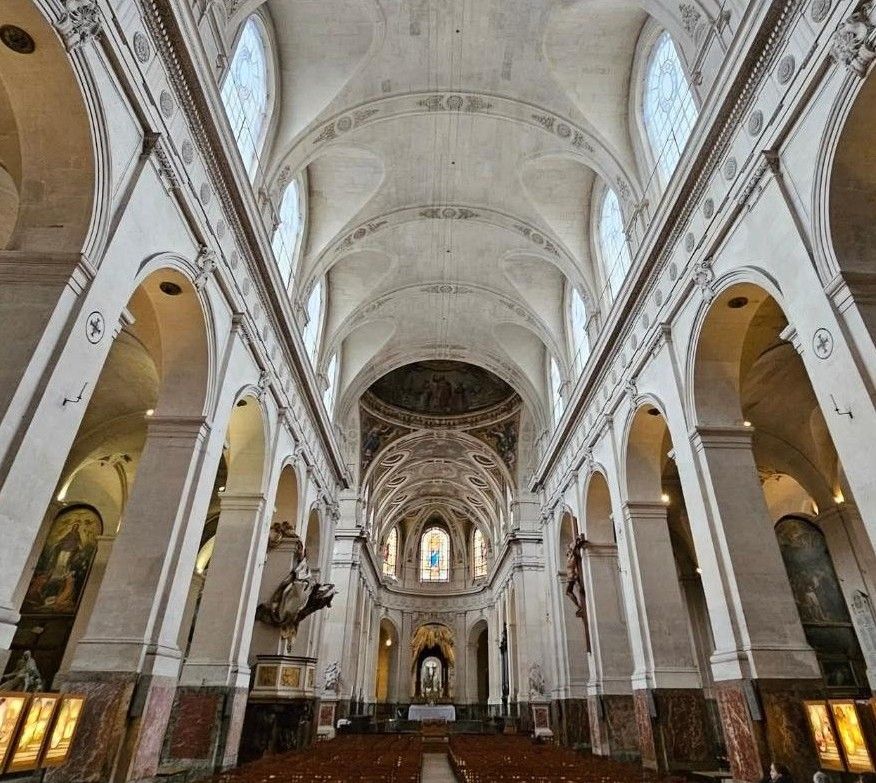
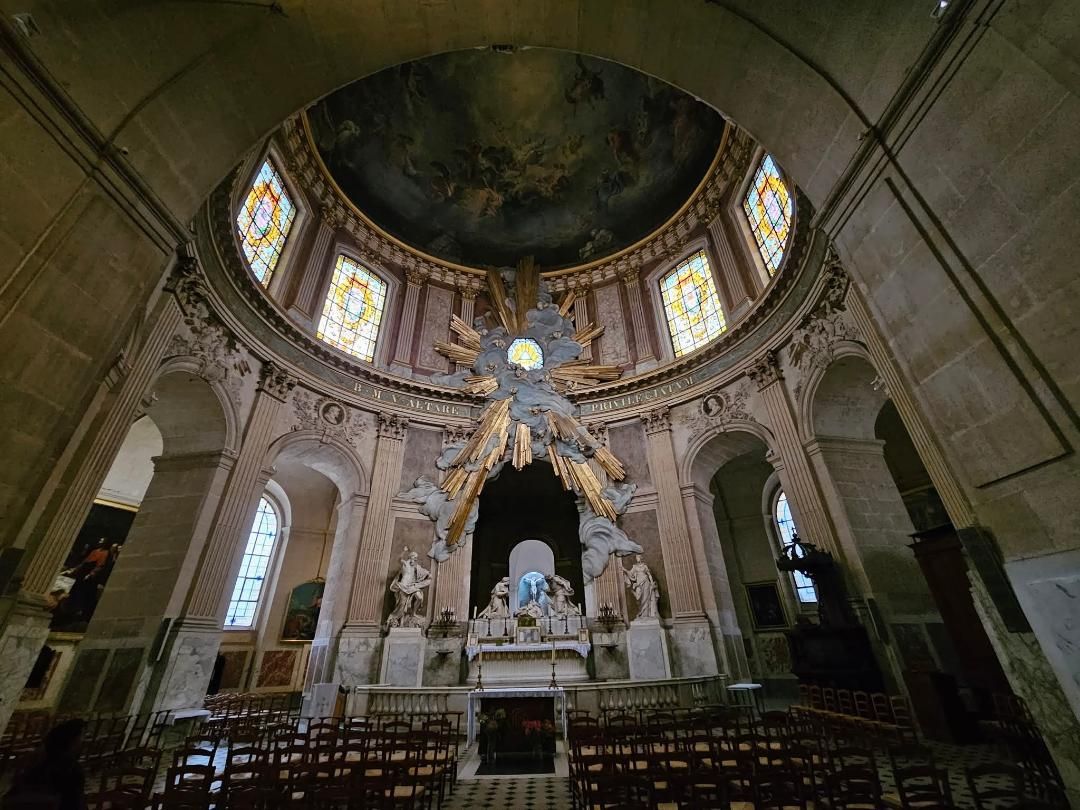
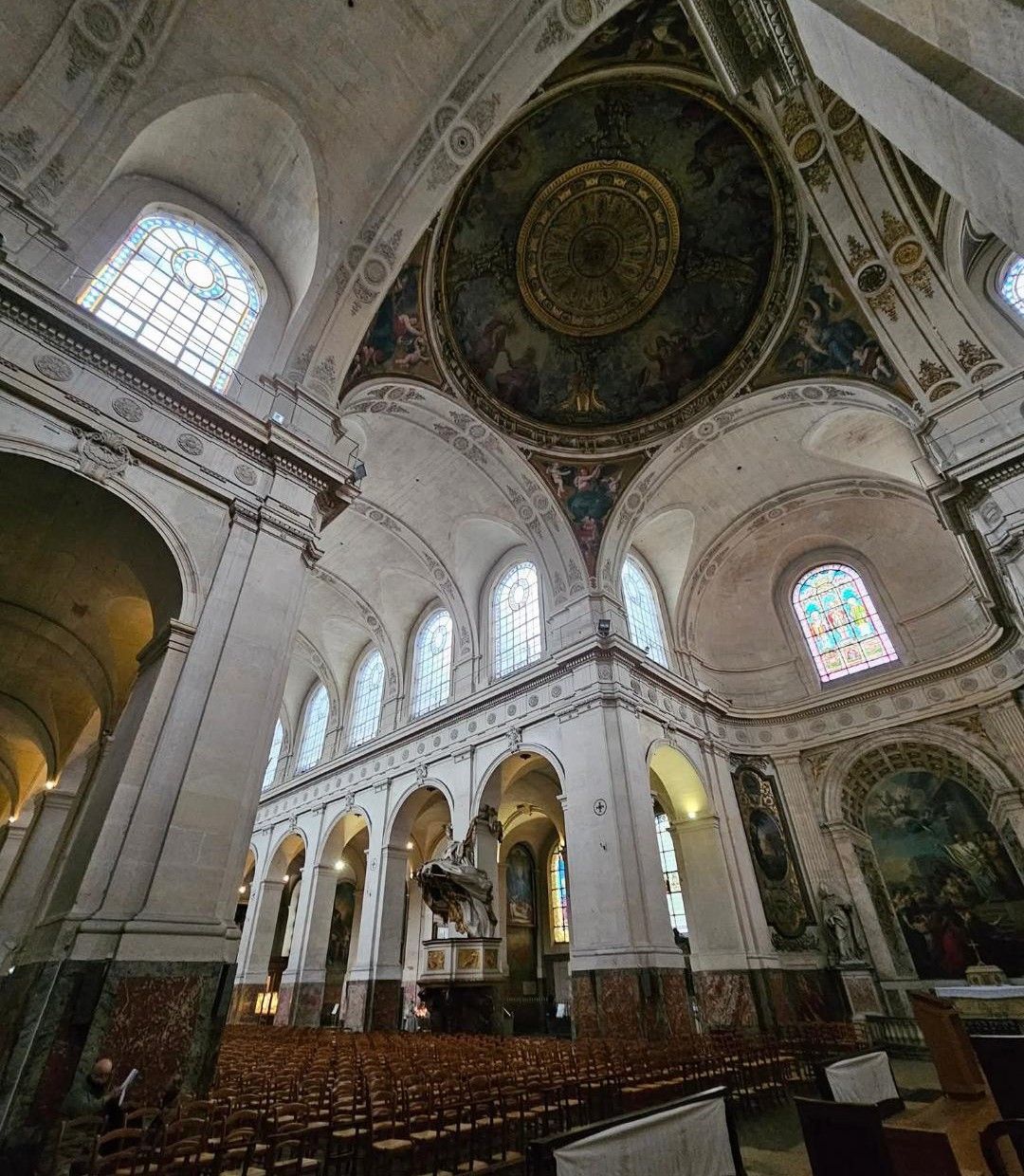
The great organ built between 1750 and 1756, this organ represents a synthesis between the French classical organ and the Romantic organ. The choir organ by organ builder Cavaillé-Coll, in 1865. It was modified by Mutin in 1913. The church preserves a collection of paintings by artists from the 17-18-19C, as well as numerous stained-glass windows from the 19C.
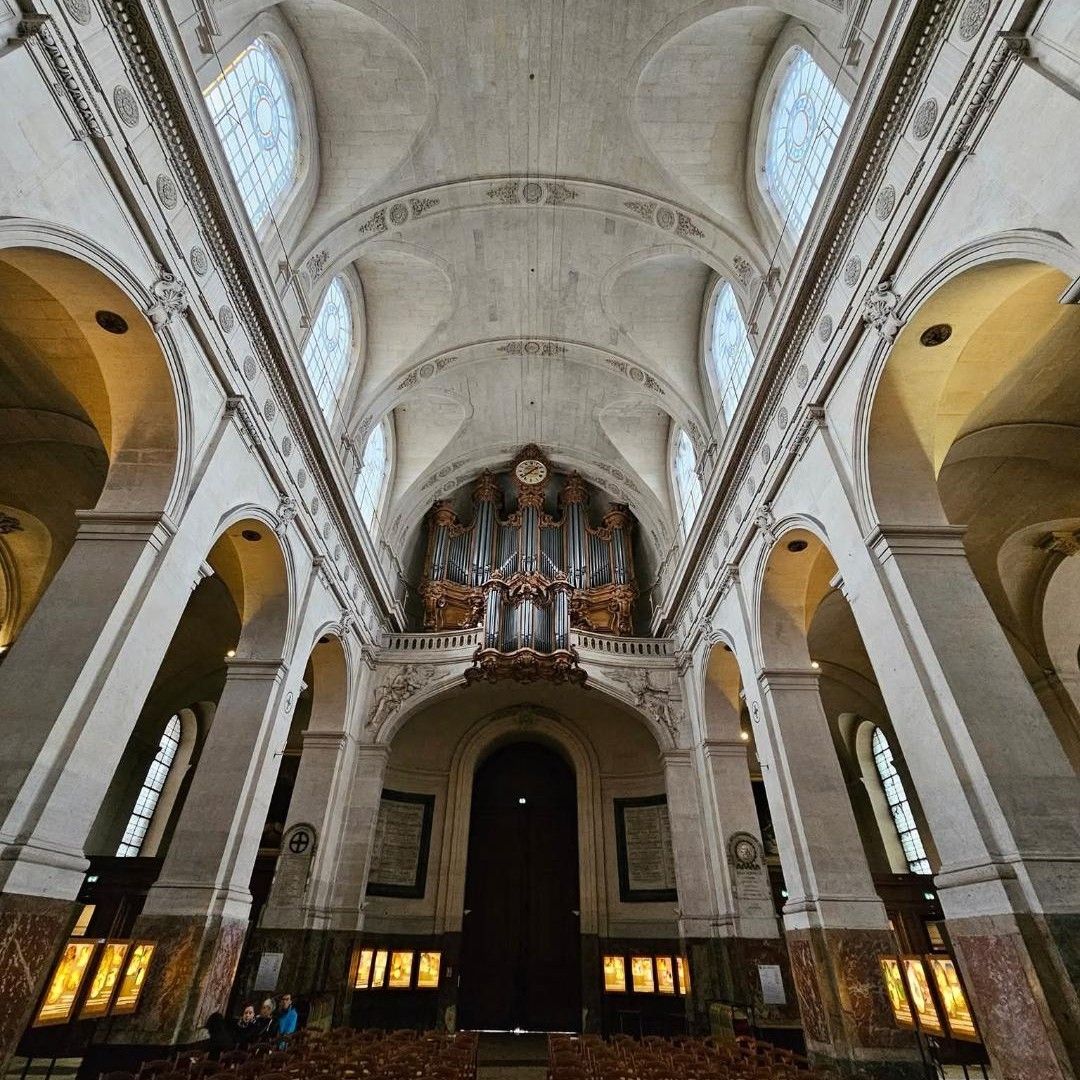
A bit of history tell us that in 1521, Jean Dinocheau, a Parisian merchant, had a chapel dedicated to Saint Susanna built in the Faubourg Saint-Honoré near Paris. In 1577, his nephew, Étienne Dinocheau, transformed the chapel into a large church and attributed Saint Roch as its patron saint. While the church had served as a branch of the Saint-Germain-l’Auxerrois Church (see post) for the inhabitants of the Faubourg Saint-Honoré for about fifty years, this church became the parish church on June 13, 1633. The foundation stone of the new church was laid by Louis XIV on March 23, 1653. Above the altar is a mural painting of Saint Susanna pursued by her persecutors. Looking up to heaven, she implores God’s help. By the 1690s, the choir, transept, most of the chapels, and bell tower were completed. The church had only a temporary wooden ceiling; the façade was not yet finished. Thanks to funding from a piety lottery in 1705, Jules Hardouin-Mansart took over the Saint Roch project and added the largest Chapel of the Virgin in Paris, consisting of an elliptical chapel inset within a circular Chapel of the Communion, an original way to utilize the limited space available. Finally, the Chapel of the Communion was moved beyond the Chapel of the Virgin, and the circular ring became an ambulatory. All work was completed in 1719. Between 1728 and 1736, Robert de Cotte added a tower to the right of the choir in the Passage Saint Roch. When a new façade without a bell tower was built, this tower would house the bells of Saint Roch. In 1754, beyond the Chapel of Communion, a chapel dedicated to Calvary, which was extensively remodeled in the mid-19C. In 1758, a pulpit was remodeled twice. Only the upper part of the original work remains, while a collection of paintings and sculptures remain in the transept. In 1849, the Chapel of Calvary was transformed into the Chapel of Catechisms.
During the French revolution, this church was at the center of the fighting, as evidenced by the shattered facade. Revolutionary groups, such as the Jacobin Club and the Feuillants Club, gathered in the cloisters on Rue Saint-Honoré. It was along this street that the vehicles that carried the condemned prisoners from the Conciergerie to the Place de la Concorde circulated, where they were executed. A stone’s throw away, at the Tuileries Palace,(now gone see post), where the Convention sat, General Napoleon Bonaparte put an end to the royalist rebellion. Saint-Roch was then consecrated a “Temple of Genius” by decree of October 27, 1798, and on January 7, 1815, the church was ransacked, with cries of “death to priests,” by demonstrators protesting the Church’s refusal to give Christian burial to the actress Françoise Raucourt.
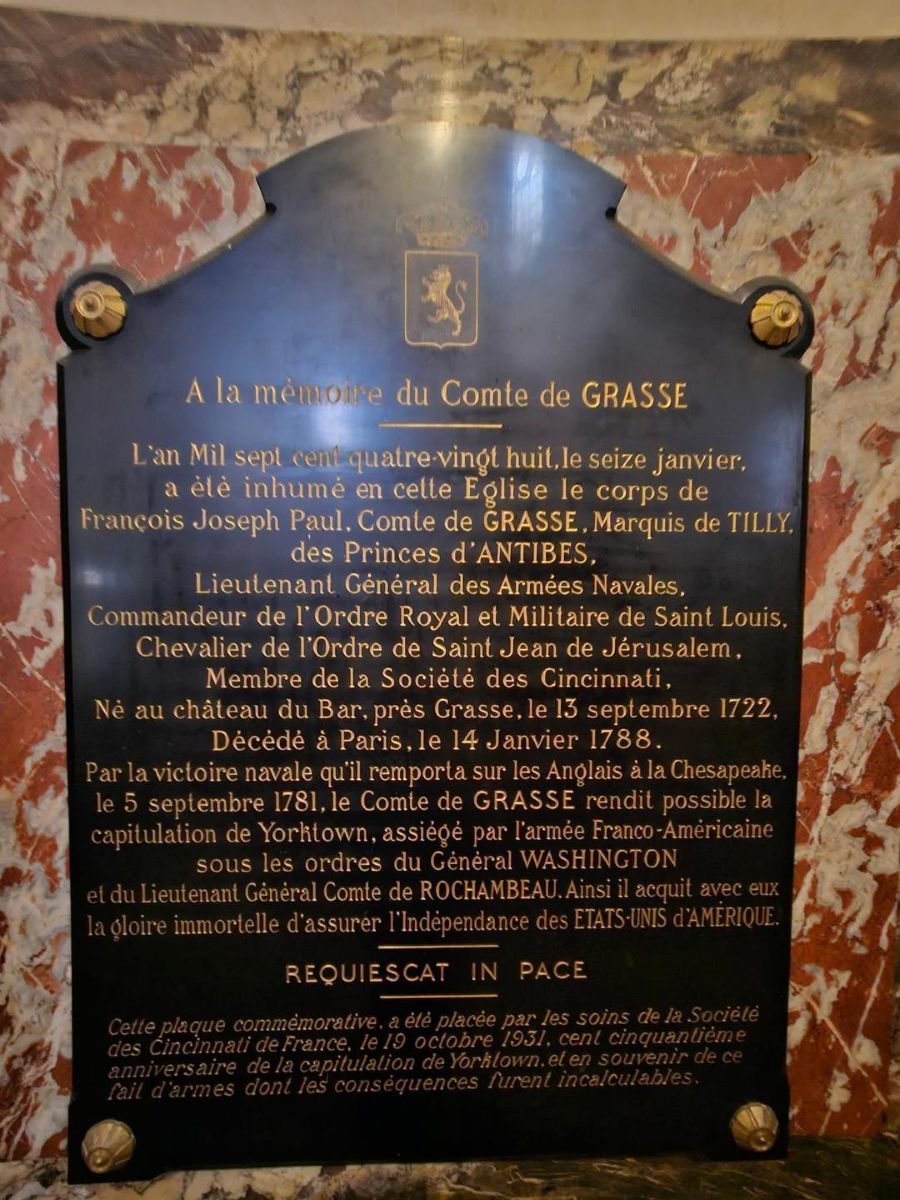
On June 8, 1691, Marshal Sébastien Le Prestre de Vauban married his daughter Jeanne Françoise there to Louis Bernin, Marquis de Valentinay, Lord of Ussé. Due to the many architectural transformations and especially the ransacking of the ossuary during the French revolution and the Commune of Paris rebellion, few tombs have survived, Some noted ones are of André Le Nôtre, September 16, 1700, Saint-André chapel, César de Vendôme, October 25, 1664, Pierre Corneille, 1684, Antoinette Des Houlières, better known as Madame Deshoulières, woman of letters born Antoinette du Ligier de la Garde, Antoinette Thérèse de la Font de Boisguérin Deshoulières, daughter of the previous one, nicknamed Mademoiselle Deshoulières, Françoise Langlois, wife of André Le Nôtre, 1707 Marie-Anne de Bourbon, Mlle de Blois, dowager princess of Conti, legitimized daughter of Louis XIV, 1739 Denis Diderot, August 1 1784, Jean Honoré Fragonard, 1806 François Joseph Paul de Grasse,Comte de Grasse, Marquis of Grasse-Tilly, January 6, 1788,,He is best known for his crucial victory over the Royal Navy at the Battle of the Chesapeake in 1781 during the American Revolutionary War. The battle directly led to the Franco-American victory at the siege of Yorktown and helped secure the independence of the United States. De Grasse responded to George Washington ,and Comte de Rochambeau (see post) Expédtion Particuliére when they appealed for his aid in 1781, setting sail with 3,000 troops from Santo Domingo, where the French Caribbean fleet was based, De Grasse landed the French reinforcements in Virginia. Immediately afterward he defeated a British fleet at the Battle of Chesapeake in September 1781. He drew away the British forces and blockaded the coast until Lieutenant General Charles Cornwallis surrendered at Yorktown, ensuring the independence of the new United States of America. Good to know nowdays,,, The plaque on the picture was given by the Society of Cinncinnati (OH) of which he was an honorary member, plaque of October 19, 1931,
The Paris tourist office on the Church Saint Roch : https://parisjetaime.com/eng/culture/paroisse-saint-roch-p1130
The Parish of Saint Roch on the church : https://www.paroissesaintroch.fr/presentation/
The City of Paris on the Church Saint Roch : https://www.paris.fr/lieux/eglise-saint-roch-3748
This is wonderful and worth the detour me think while in Paris. Do come to see this off the beaten path monument of my eternal Paris. Of many memories in my working life in Paris, Again, hope you enjoy this post on the Church Saint Roch of Paris !!! as I.
And remember, happy travels, good health, and many cheers to all !!!


