
It will be almost impossibel to recite all the streets of Paris even those known to me but there are some that brings back wonderful memories and merit to be in my blog, thanks to pictures found in my cd rom vault. This I passed by car and walked it A glorious spot in my eternal Paris ,where my family spent many times and in some I still do. So ,it has become sort of like a second home to me each time I visit Paris, Therefore, I like to tell you about the rue de Grenelle of Paris !!! Hope you enjoy the post as I.
The Rue de Grenelle is located in the 6éme and 7éme districts or arrondissements of Paris. It is 2,250 meters long, it crosses the following quartiers/neighborhoods: Saint-Germain-des-Prés; Saint-Thomas-d’Aquin ; Invalides ; and Gros-Caillou A one-way street, it begins at the Place de la Croix-Rouge and ends on Avenue de La Bourdonnais ,just a few meters before the Champ-de-Mars, to which it effectively provides access since the avenue is not built up at the intersection. It bears this name because it connected Paris to the former village of Grenelle, which itself probably derived its name either from the bird name garanus, meaning “crane,” or from a warren belonging to the Abbey of Saint-Germain-des-Prés. As early as the 14C, the street existed as a path, called the “New Path,” and is shown on the 1529 survey. It is also mentioned under several different names.
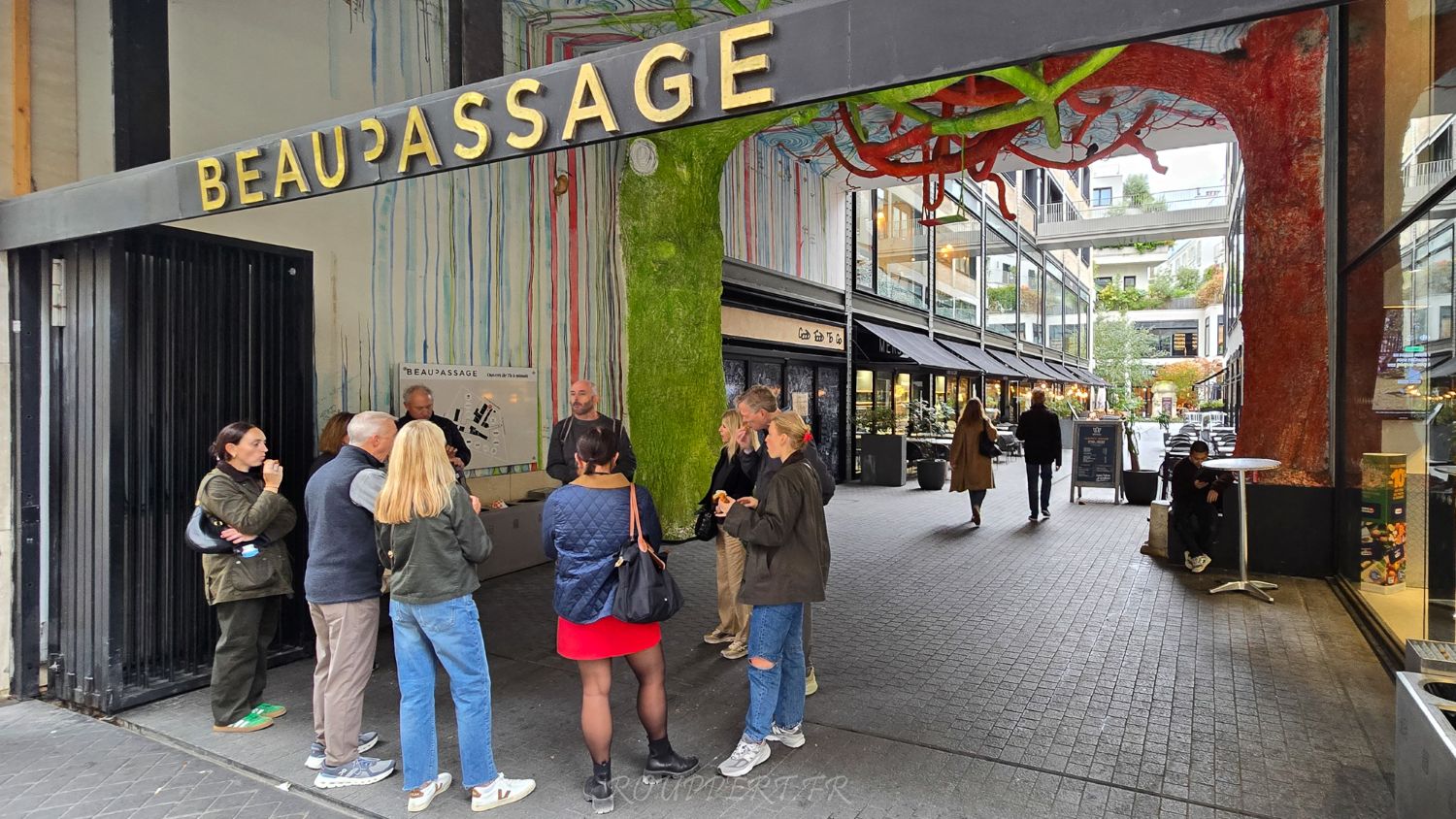
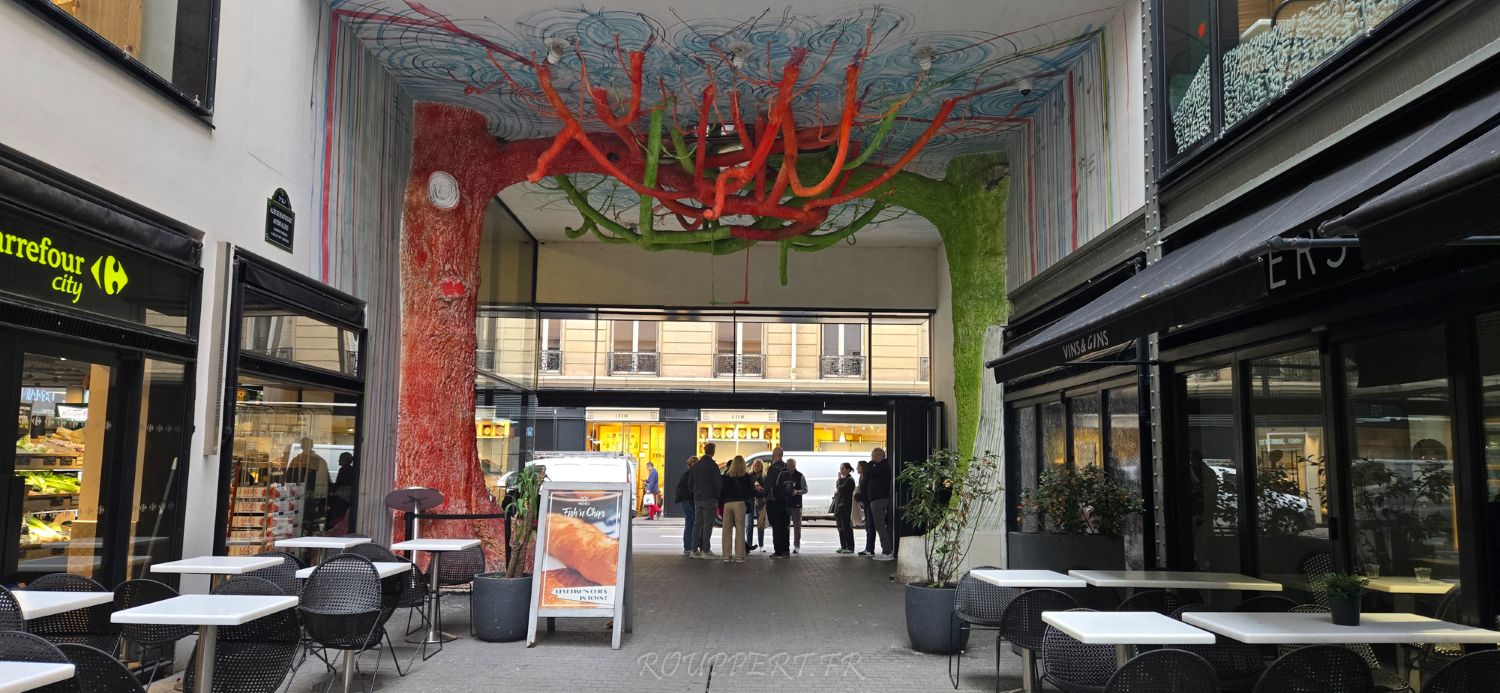
The entrance by nos. 53-55-57 nestled between the Rue du Bac, and closer to Boulevard Raspail, Beaupassage (see pics) is an open-air, pedestrian-only space dedicated to gastronomy. A bakery by Thierry Marx, a snack bar by Anne-Sophie Pic, a wine shop by Yannick Alléno, a café by Pierre Hermé, and more: a collection of undisputed stars of French cuisine and pastry, brought together with the most upscale food retailers in Paris (Alexandre Polmard for the butcher shop, Nicole Barthélémy for the cheese shop, etc.). In short, it’s the most sophisticated and glamorous example of a French-style food court that doesn’t compromise on excellence. Dine in or take away, indoors or on the terrace. This haven of peace and tranquility is adorned with contemporary works of art by artists such as Fabrice Hyber and Stefan Rinck, Closest Metro line 12 Rue du Bac station and bus lines 63, 68, 83,84, 94 arrêt/stop Charlotte Perriand. The fun part I was following a tour group explaining on the place lol !!! free info !
Other notable buildings here me think are at No. 6: location of the first Sonia Rykiel boutique, opened in May 1968. No. 15: Hôtel de Bérulle, built in 1775-1776 for Amable-Pierre-Thomas de Bérulle. The poet and novelist Louis Aragon housed the Surrealist Research Bureau (or Surrealist Central Office) there, founded on October 11, 1924, located on the ground floor of the building. No. 36: facade of “À la petite chaise,” a restaurant open since 1700. The establishment had a scandalous reputation: Philippe d’Orléans went there for libertine parties and Vidocq summoned his informants there. Later, Huysmans and Toulouse-Lautrec frequented the place.Between nos. 57 and 59: the Fountain of the Four Seasons, built in 1739-1745 by the sculptor Edmé Bouchardon, in the Neo-Palladian style. No. 59: Alfred de Musset spent almost his entire writing life in this building until 1839. Nos. 59-61: the Maillol Museum, opened by the Dina Vierny Foundation and dedicated to Aristide Maillol, which regularly hosts exhibitions of other artists. No. 79: Hôtel d’Estrées, built in 1711-1713 by Robert de Cotte, the king’s architect, for Madeleine-Diane de Bautru de Vaubrun, widow of the Duke of Estrées, formerly the Russian Embassy in France (today the residence of the Russian ambassador). Nos. 85 and 87: the Hôtels d’Avaray and de Beauffremont have notable sundials. The first, built in 1720 (today the residence of the Dutch ambassador). The fashion designer Hubert de Givenchy lived in the second, which was later bought by Xavier Niel. No. 101: Hôtel de Rothelin-Charolais, built around 1703 for the Marquis de Rothelin. In 1735, the building belonged to Louise-Anne de Bourbon-Condé, the scandalous Mademoiselle de Charolais, who gave it her name and bequeathed it in 1758 to the Count of La Marche (Prince of Conti in 1776), who made it his Parisian resid ence. Belonging to the State since 2020, it is occupied by the Ministry of Public Service. No. 102: Hôtel de Maillebois, built in 1660 and partially rebuilt around 1771. The Duke of Saint-Simon lived there. No. 103: building constructed in 1841 and topped by the telegraph tower (Chappe tower). Today, the building houses the New Zealand Embassy in France and the European Securities and Markets Authority. Nos. 104-106: former Penthemont Abbey, which belonged to the Cistercian order (known as the Bernardine Abbey of Penthémont) and settled on rue de Grenelle in 1671. It was both a retirement home and a school for young girls of the nobility. No. 116: city/town hall of the 7éme arrondissement, housing the Saint-Simon library since 1983, which offers more than 40,000 volumes. Nos. 118-120: small Hôtel de Villars, former outbuilding of the hotel of the Duke and Marshal of France Claude Louis Hector de Villars, located at no. 116; it now houses the middle school of the Paul Claudel-d’Hulst school. No. 122: location of a Carmelite convent which was transformed into a barracks during the French revolution. The Grenelle barracks housed the Consular Guard from 1800 onwards. No. 123: home of Pierre Brossolette from 1932 to 1944, a French journalist, politician and resistance fighter, Companion of the Liberation. No. 129: Hôtel des Invalides housing the Army Museum. No. 138: Hôtel de Noirmoutier, built in 1720-1723 for Antoine François de La Trémoille, Duke of Noirmoutier. The hotel was allocated as accommodation to Marshal Foch in 1919. He resided there until his death in 1929. It is now the residence of the Prefect of the Île-de-France region, Prefect of Paris. No. 142: Hôtel Chanac de Pompadour, also known as Hôtel de Besenval, built in 1704 and remodeled by Alexandre-Théodore Brongniart in 1767 for Pierre Victor de Besenval de Brünstatt, who purchased it from the Maréchale de Luxembourg (today the Swiss Embassy). No. 147: Saint-Jean Lutheran Protestant Church, a member of the United Protestant Church of France, inaugurated on February 26, 1911. No. 151: Art Nouveau building by architect Jules Lavirotte. No. 174: Address of the studio of painter Henri Goetz in 1959, a French painter and engraver of American origin. No. 188: Home of Jules Rimet during his youth, founder of the Football World Cup.
Some anecdotes tell us that in several novels of La Comédie humaine, Honoré de Balzac places the private mansions of the most refined aristocracy. Notably in Béatrix: “Béatrix de Rochefide had written to the Duchess of Grandlieu the story of Calyste,” as well as in Le Père Goriot where the Vicomtesse de Beauséant lives. Maupassant sets the action of his short story, Apparition, in a private mansion located on Rue de Grenelle.
The Paris tourist office on BeauPassage: https://parisjetaime.com/shopping/beaupassage-p2591
The Paris tourist office on Rue de Grenelle: https://parisjetaime.com/eng/transport/rue-de-grenelle-p2032
The Paris tourist office on the 7éme arrondissement de Paris: https://parisjetaime.com/eng/article/explore-paris-s-7th-arrondissement-a825
There you go folks, a dandy city to explore and enjoy with the family, Memorable moments in my eternal Paris, driving and walking all over in my road warrior trails brings out sublime awesome spots with nice memorable family visits of yesteryear always remember and always looking forward to be back, eventually. Again hope you enjoy the post on the rue de Grenelle of Paris !!! as I.
And remember, happy travels, good health, and many cheers to all !!!


This one rang a bell because of its foodie spots
LikeLiked by 1 person
Yes and i have friends there too. Thanks for stopping by Cheers
LikeLiked by 1 person