
This is again another dandy monument in my eternal Paris. I have done quite a bit of walking in Paris, and never stop amazing me of its abundance of architecture and historical sights that not only are known but also unknown to most. This is another beauty that needs to be seen more, me think ; glad to have found new pictures in my cd rom vault that should be in my blog for you and me, Therefore, here is my take on the Church of Saint-Denys-du-Saint-Sacrement of Paris !!! Hope you enjoy it as I.
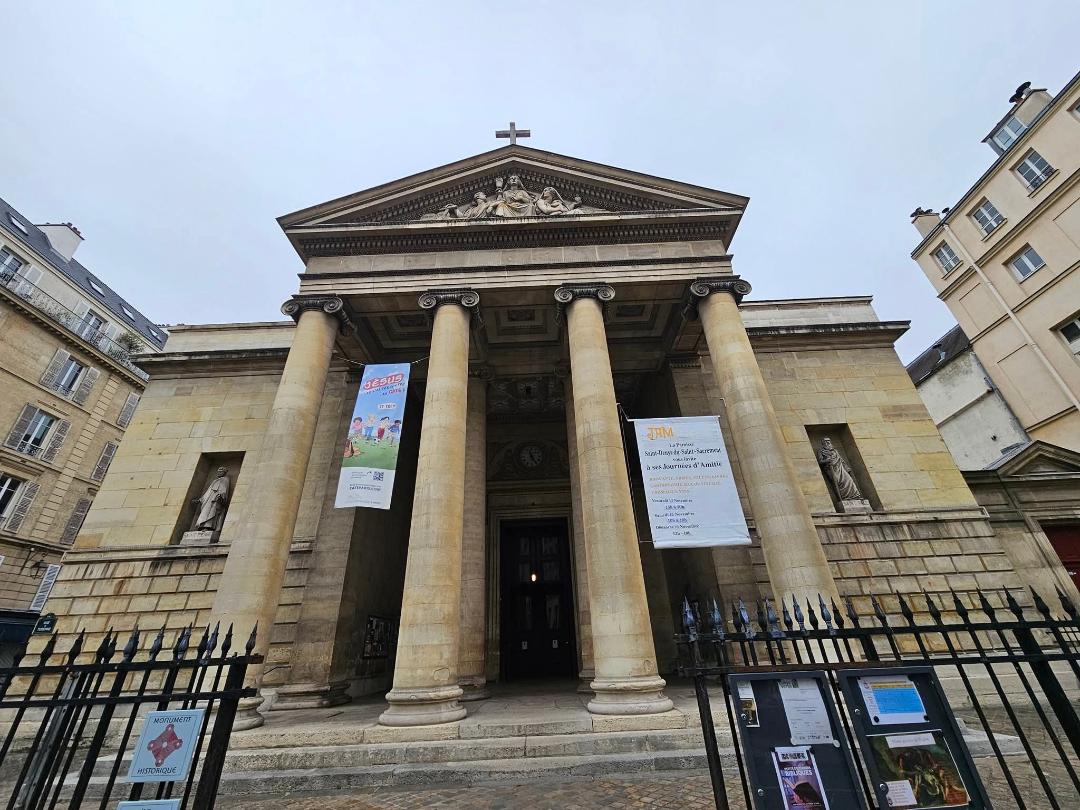
The Church of Saint-Denys-du-Saint-Sacrement is located at 68 ter, rue de Turenne, in the 3éme arrondissement of Paris. Its neoclassical architecture and decoration are typical of the early 19C. This site is served by metro line 8 at the Saint-Sébastien – Froissart station. It was named in memory of the first bishop of Paris, Saint Denis (retaining an older spelling of the name of this saint, called Dionysius in Latin), and in memory of the Benedictine nuns of the Perpetual Adoration of the Blessed Sacrament who had settled there at the time of the Catholic Reformation. The very simple facade features a prostyle portico in its center with four Ionic columns, surmounted by a triangular pediment decorated with a bas-relief representing the theological virtues: in the center, Faith holding up the chalice and the host (the Holy Sacrament), on the left, Hope resting the anchor on tablets recalling the Shema Israel, and on the right, Charity protecting a child and holding a burning heart towards the book where a phrase from Saint Paul’s hymn to charity is inscribed. On either side of the entrance are two niches with statues of Saint Paul and Saint Peter from 1849. Above the portal are the four cardinal virtues Prudence, Temperance, Fortitude, and Justice, bas-reliefs from 1865.
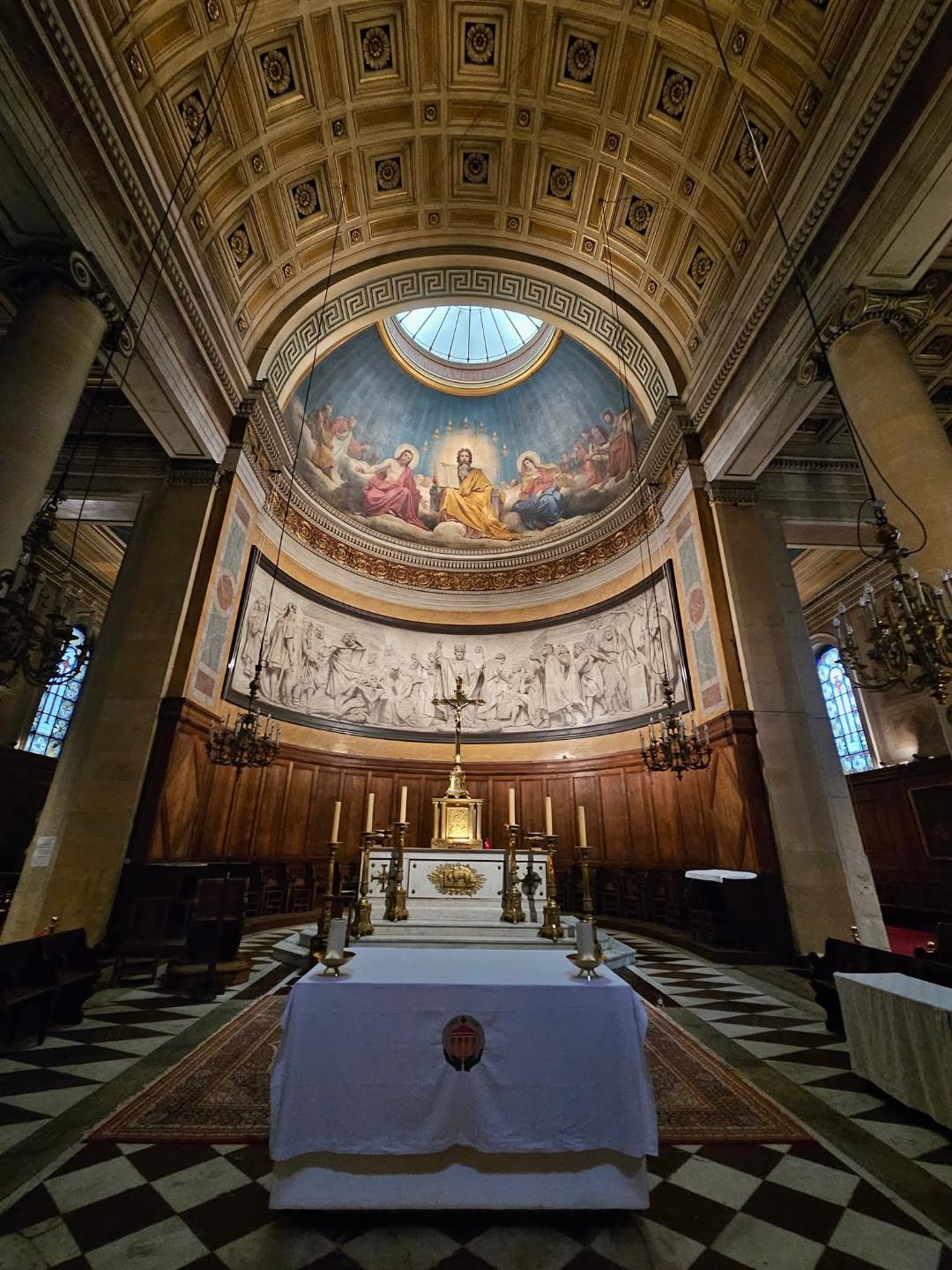
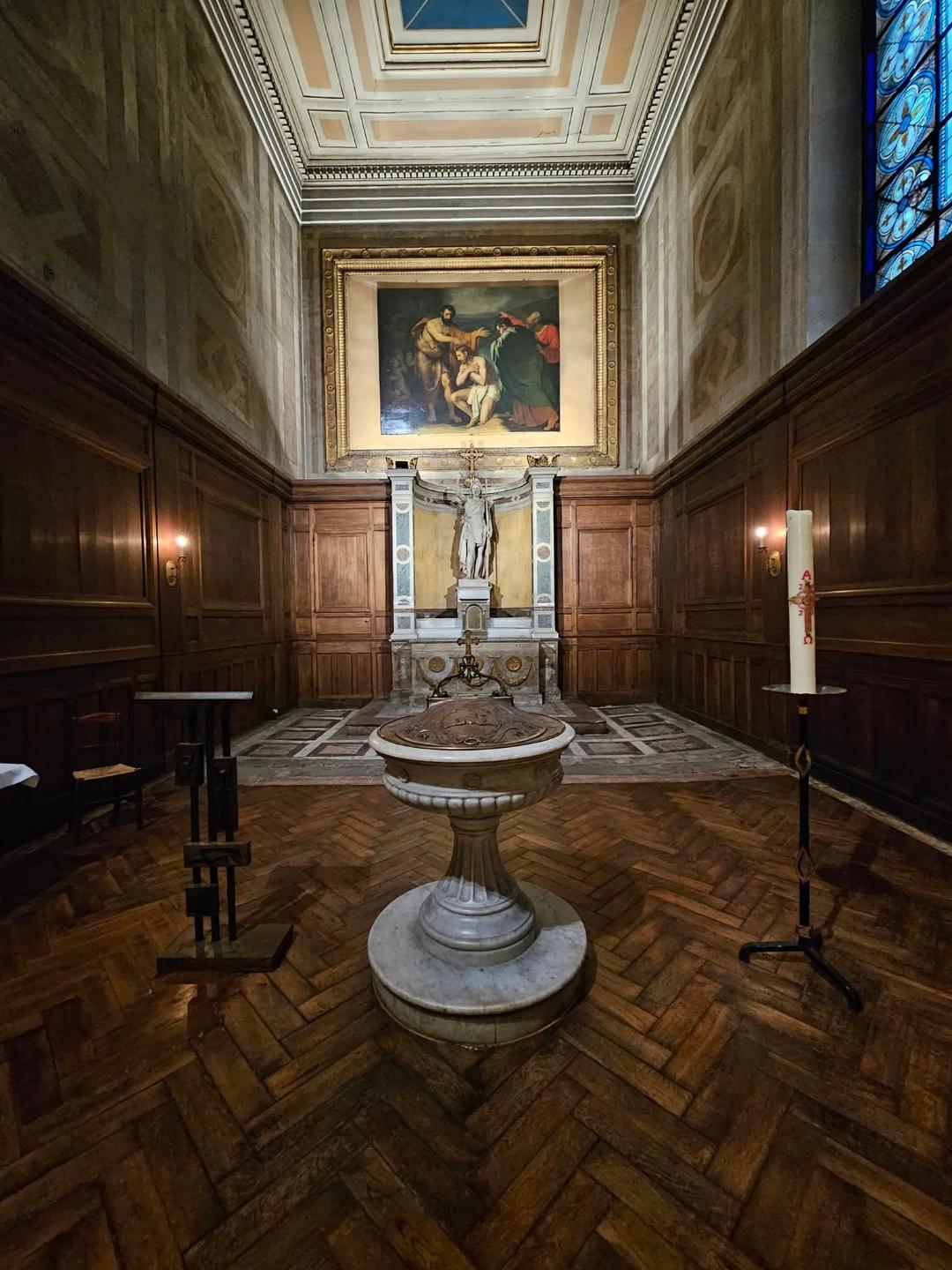
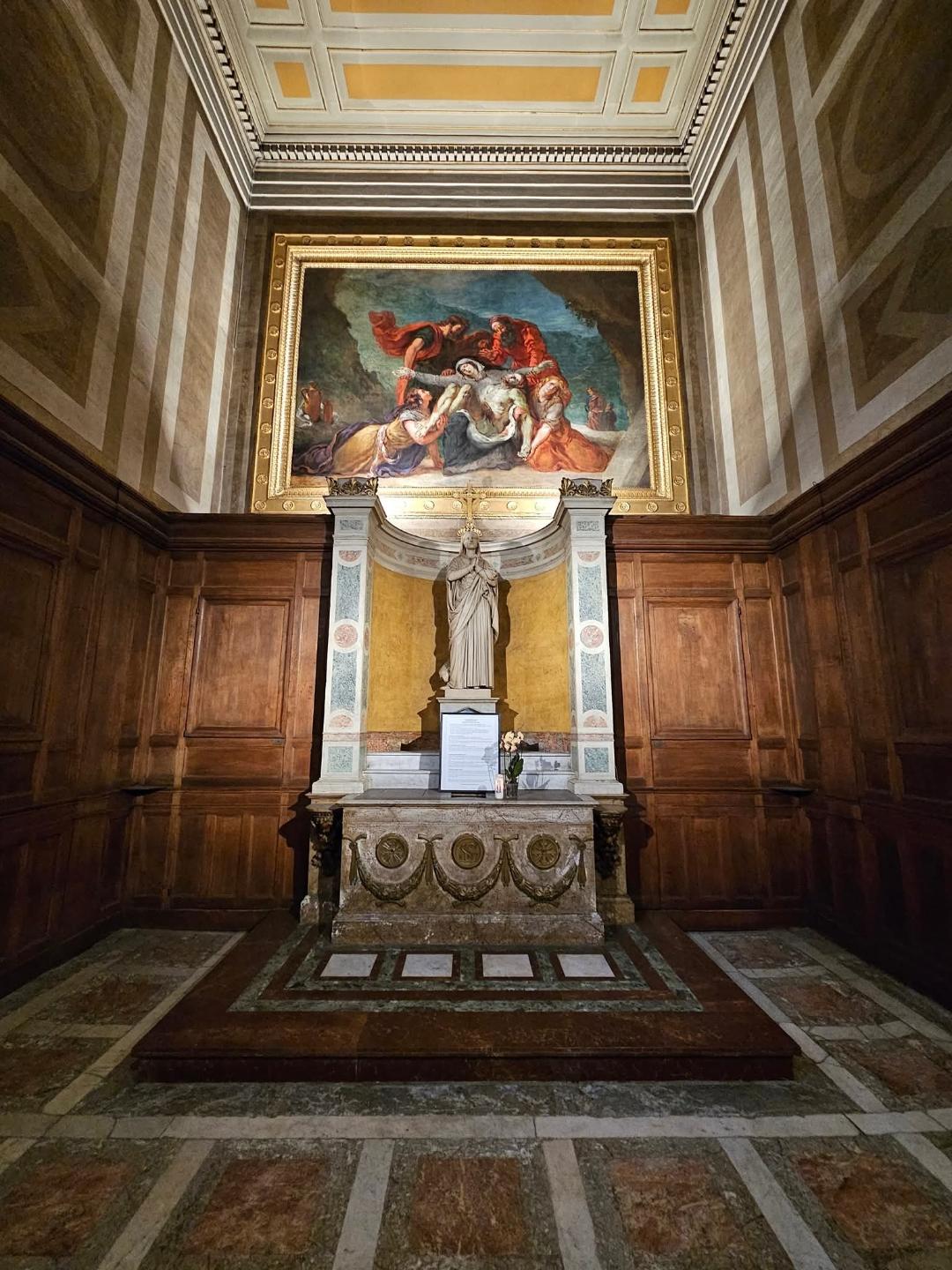
The Church of Saint-Denys-du-Saint-Sacrement features a rectangular nave without a transept or side chapels, supported by twelve columns that recall the number of the tribes of Israel and the apostles. It is extended by an apse with four columns. The style is basilical, The semicircular vault has a coffered ceiling. Above the choir rises a dome in the shape of a half-dome, illuminated by a zenithal oculus. The aisles end in four chapels: the chapel of the Virgin, of Saint Denis, of Saint John the Baptist, and of Saint Genevieve (see pics) Today, the church’s notoriety stems in part from the fact that it houses a Pietà inspired by Rosso Fiorentino, executed in 17 days by Delacroix in 1844. A large grisaille of a trompe-l’œil bas-relief in the form of a frieze, created in 1838, adorns the choir wall. A new altar has been installed there since 1995. A much older painting , dating from 1618 is signed by Madeleine Petit (a Benedictine nun of the Holy Sacrament): An angel holding the Holy Face between Saint Peter and Saint Paul. The Chapelle Saint Jean Baptiste houses a painting ,The Baptism of Christ from 1819.
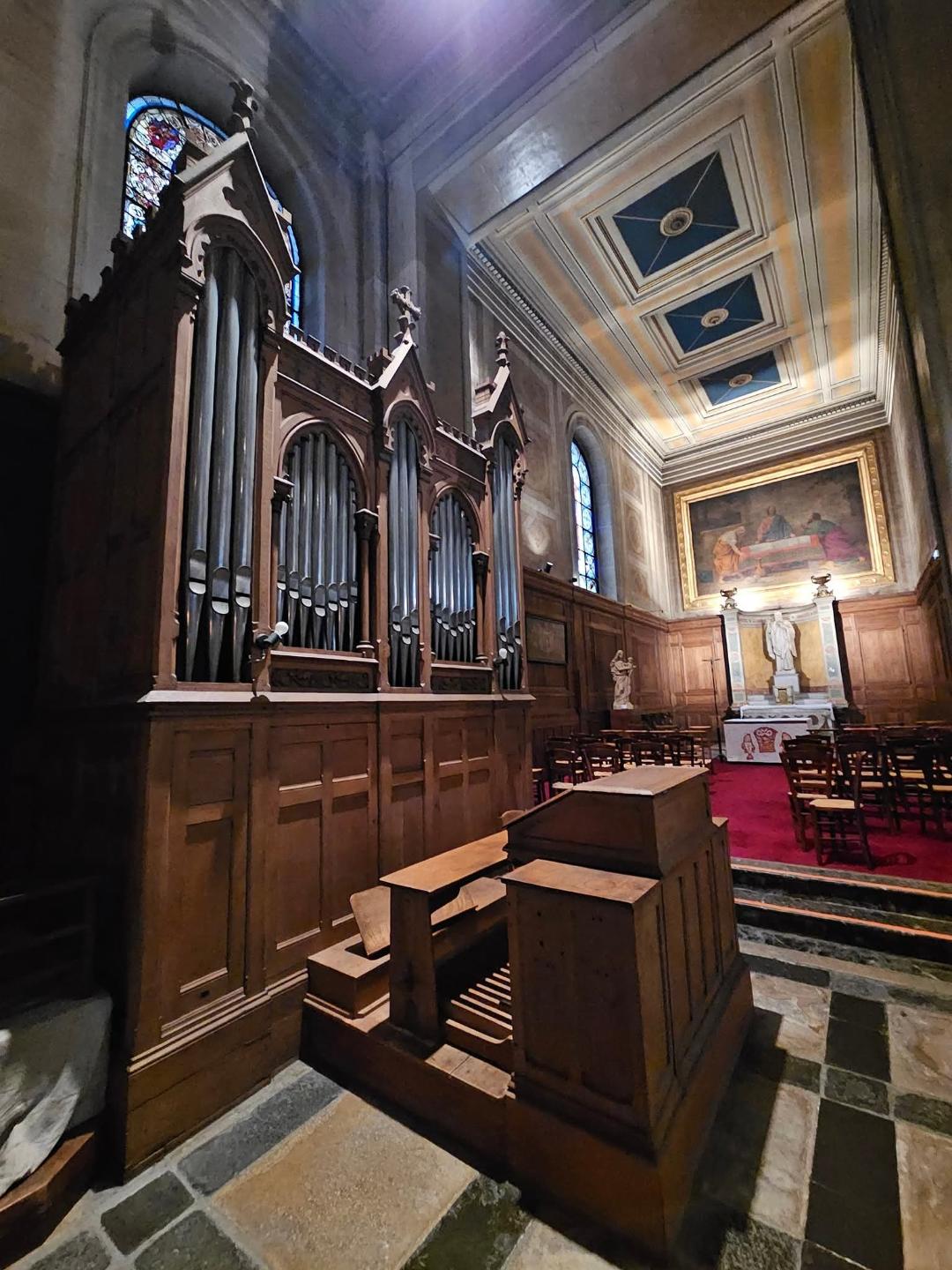
The church has two organs. The main organ in the west gallery was one of the first built by the Daublaine Callinet firm in 1839. The organ has since been restored several times. The choir organ was built by Cavaillé-Coll in 1869. It has mechanical action. In 1867, Alphonse Daudet and Julia Allard were married. The groom’s best man was Frédéric Mistral.
A bit of history tell us that in the heart of the Marais quartier/neighborhood, in the 17C, numerous sumptuous mansions were built, including the Hôtel de Turenne, at the corner of rue Saint-Claude and rue Neuve-Saint-Louis (now rue de Turenne). In 1684, the second monastery of the Benedictine Sisters of Perpetual Adoration of the Blessed Sacrament settled in this mansion. But this accommodation was too inconvenient for a community; and they were looking to buy another house when the Duchess of Aiguillon came to their aid. This lady, having learned of the difficulties faced by the Sisters of the Blessed Sacrament, donated the Hôtel de Turenne, located on rue Neuve-Saint-Louis in the Marais, which she had recently acquired from Cardinal de Bouillon in exchange for the land, lordship, and castellany of Pontoise. This happened in 1684. They made it their new monastery and acquired a small plot of land to complete it, on which they built their chapel with approximately 80 seats, with a main altar decorated with a painting by Hallé representing the breaking of bread. The Benedictine nuns were driven out by the French revolution in 1792. After the Concordat of 1802, the chapel became an annex oratory of the Minimes convent in Place Royale (now Place des Vosges). Having become a parish church in 1803, Bishop Jean-Pierre Jalabert, vicar of Paris, blessed it under the name of Saint-Denys-au-Marais in 1809. The City of Paris purchased the land and buildings with a view to building a new church. The foundation stone was laid on September 15, 1826: a medal by the engraver Ursin Vatinelle, bearing the effigy of Charles X and a drawing of the projected facade, commemorates the event. The main structure of the church was completed in 1835, the year of its consecration by Bishop Hyacinthe-Louis de Quélen, Archbishop of Paris. As there was no church dedicated to the first bishop of Paris, a martyred saint who was beheaded, this church was confirmed under the name of Saint-Denys.
The official parish of the Church Saint Denys du Saint Sacrement: https://www.saintdenys.net/
The city of Paris on the Church: https://www.paris.fr/lieux/eglise-saint-denys-du-saint-sacrement-19434
The Paris tourist office on Paris Centre (arrond 1-4): https://parisjetaime.com/eng/article/explore-the-centre-of-paris-a846
This is wonderful and worth the detour me think while in Paris. Do come to see this off the beaten path monument of my eternal Paris. Again, hope you enjoy this post on the Church of Saint-Denys-du-Saint-Sacrement of Paris !!! as I.
And remember, happy travels, good health, and many cheers to all !!!


