
We have driven and walked in my eternal Paris, and would like to have an imprint in my blog on the wonderful family times we had there, There is so much to see , doing my best, and glad found me these pictures in my cd rom vault ,which now transposing in my blog for you and me, This was my former worked city, so glad to post more memorable spots on it, I thank you for your readership over the years and to bear with my rants! After Paris is to rant, shout and yelled about, me think. Therefore, here is my take on curiosities of Paris, part LI !!! Hope you enjoy the post as I.
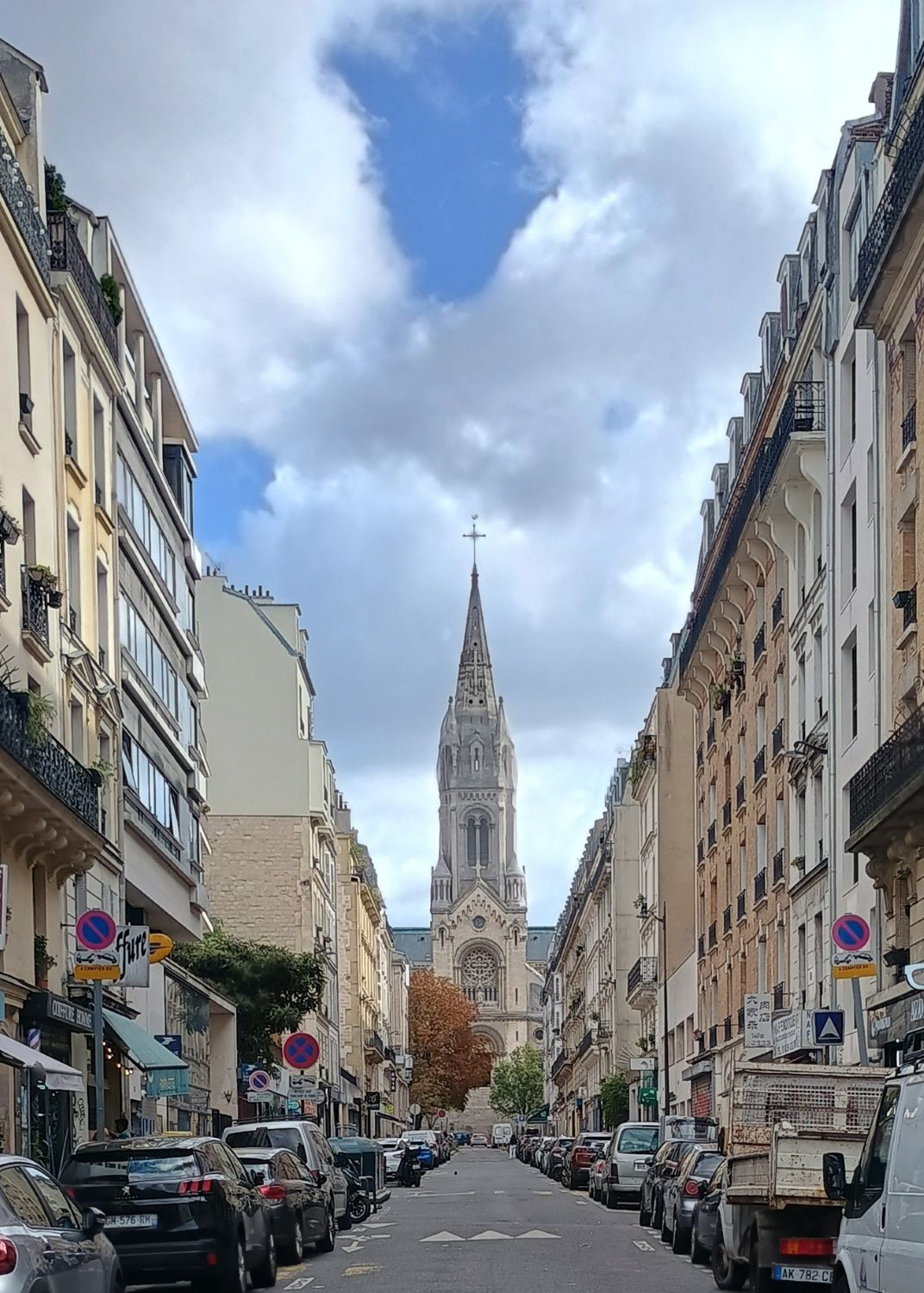
The Rue Étienne-Dolet is located in the quartier or neighborhood of Ménilmontant in the 20éme district or arrondissement of Paris. It leads to Place Maurice-Chevalier and the Notre-Dame-de-la-Croix de Ménilmontant Church (see pic). The street is best serve by metro line 2 at the Ménilmontant station. The street is named after the French writer, poet, printer, and humanist Étienne Dolet, who was strangled and then burned with his books in Place Maubert on August 3, 1546, for “heresy and atheism” after publishing a translated excerpt from Plato denying the existence of the soul. This name was given to it by the anticlericals of the Third Republic because it leads to a church. This road was opened by a decree of April 29, 1878 and took its current name by an order of August 16, 1879. The part which opened onto Rue du Liban was detached from the street to form, in 1978, Place Maurice-Chevalier.
The Paris tourist office on the 20éme arrondisement de Paris :https://parisjetaime.com/eng/article/explore-paris-s-20th-arrondissement-a834
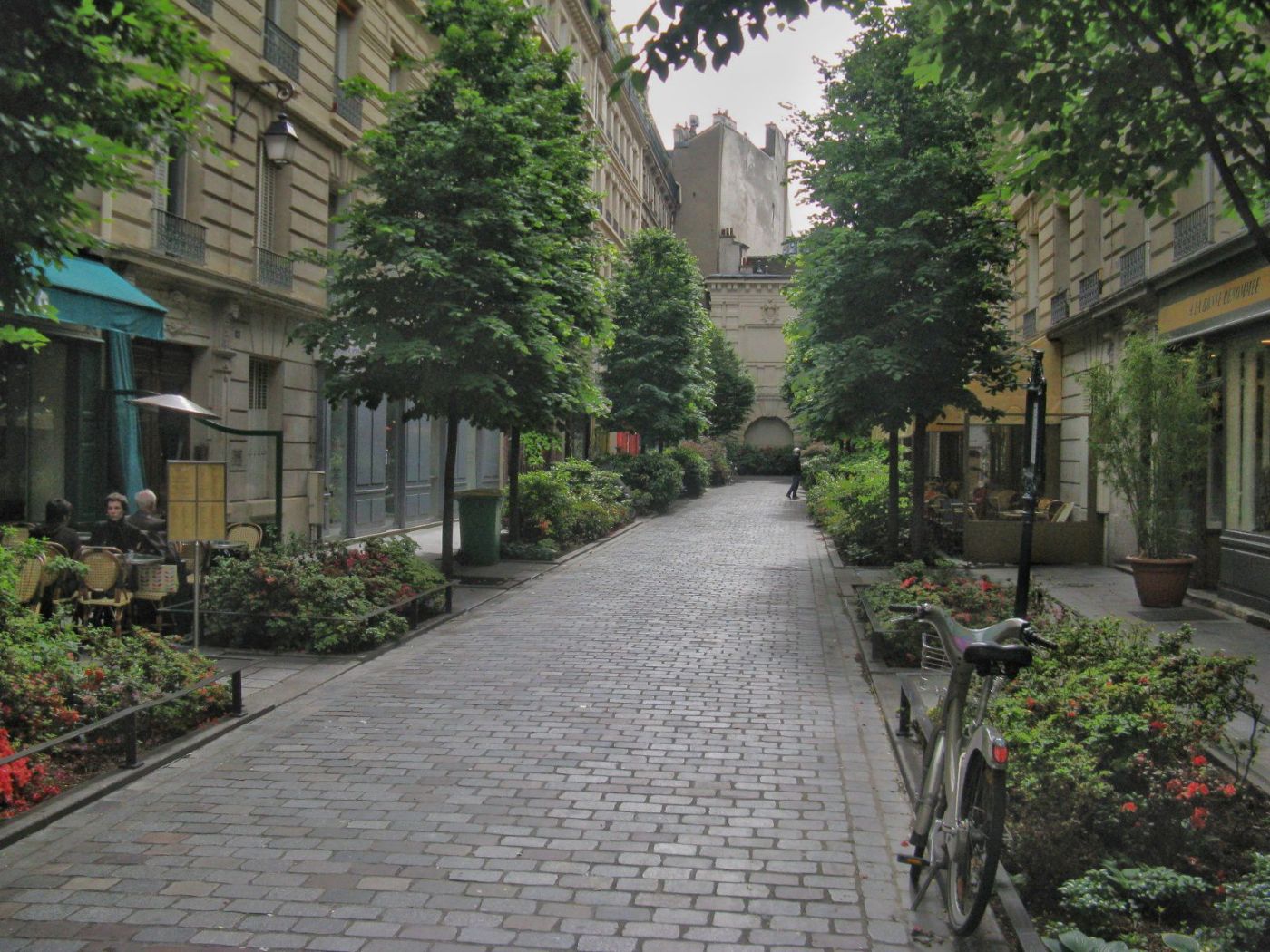
The Rue du Trésor is located in the quartier or neighborhood of Marais in the 4éme district or arrondissement of Paris, The street is a cul-de-sac that begins at 28 Rue Vieille-du-Temple and ends in a dead end with a now-unused fountain, known as the Treasure Fountain, dating from the 19C. The street, which was to connect Rue Vieille-du-Temple to Rue des Écouffes, was built on the site of the mansion of Marshal d’Effiat, the father of Cinq-Mars, a favorite of Louis XIII. In 1882, a copper vase containing gold coins from the 14-15C was discovered in the ruins of the mansion. In total, 7,822 coins from John II the Good, Charles V and some feudal coins. This treasure was put up for sale and the Carnavalet Museum acquired the vase and some samples. The street being dug was named Rue du Trésor in memory of the discovery, but the plan to join the two roads was abandoned and a fountain was placed where the housing estate ended: the Fontaine du Trésor.(see photo) The housing estate, built of typical Haussmannian buildings from the end of the 19C, contained a narrow interior passage, now closed, which allowed you to reach Rue des Écouffes on foot. A small, quiet street in the Marais, it is home to several restaurants, fashion, design and decoration boutiques as well as a startup.
The Paris tourist office on Paris Centre (former arrond 1-4) : https://parisjetaime.com/eng/article/explore-the-centre-of-paris-a846
The Rue de Turenne is located in the heart of the Marais quartier or neighborhood in the 3éme and 4éme districts or arrondissements of Paris. Over a km long ,the street connects Rue Saint-Antoine in the 4éme arrondissement to Rue Charlot in the 3éme arrondissement. This site is served by the metro line 1 Saint-Paul, line 8 for Chemin Vert, Saint-Sébastien – Froissart, and Filles du Calvaire ,and République lines 3, 5, 8, 9 and 11 stations, It received its current name by the decree of October 2, 1865 in honor of Henri de La Tour d’Auvergne, Viscount of Turenne, Marshal-General generally known as Turenne, who had his hotel (now disappeared) in this street, at nos 66 and 70 , The street was laid out inside the enclosure of Charles V on the cover of a sewer dug in 1412 on the orders of Charles VI, disturbed in his Hôtel Saint-Paul by the odors from the sewer of the Perrin bridge. The oldest section, successively called ruelle des égouts, rue des égouts, rue de l’égout Sainte-Catherine, rue de l’égout couvert, rue de l’égout Saint-Paul et rue du Val Sainte-Catherine, joins Rue Saint-Antoine and Rue Neuve-Sainte-Catherine . It was widened in 1914-1916 by moving back the even numbers, affecting the rear facade of the hotels on Place des Vosges. The part of the street located between, rue de l’Écharpe and Rue Neuve-Sainte-Catherine joined to the rue des Francs-Bourgeois in 1868, and, to the rue Saint-Gilles, dates from the construction of the place Royale ( today place des Vosges) and the convent of the Minimes around 1605. On February 18, 1851, a ministerial decision united the two northern parts, rue Boucherat and rue Saint-Louis, under the latter name. Rue Saint-Louis was joined to the rue de l’égout (part between the rue des Francs-Bourgeois and the rue Saint-Antoine) under its current name of Rue de Turenne by decree dated October 2, 1865.
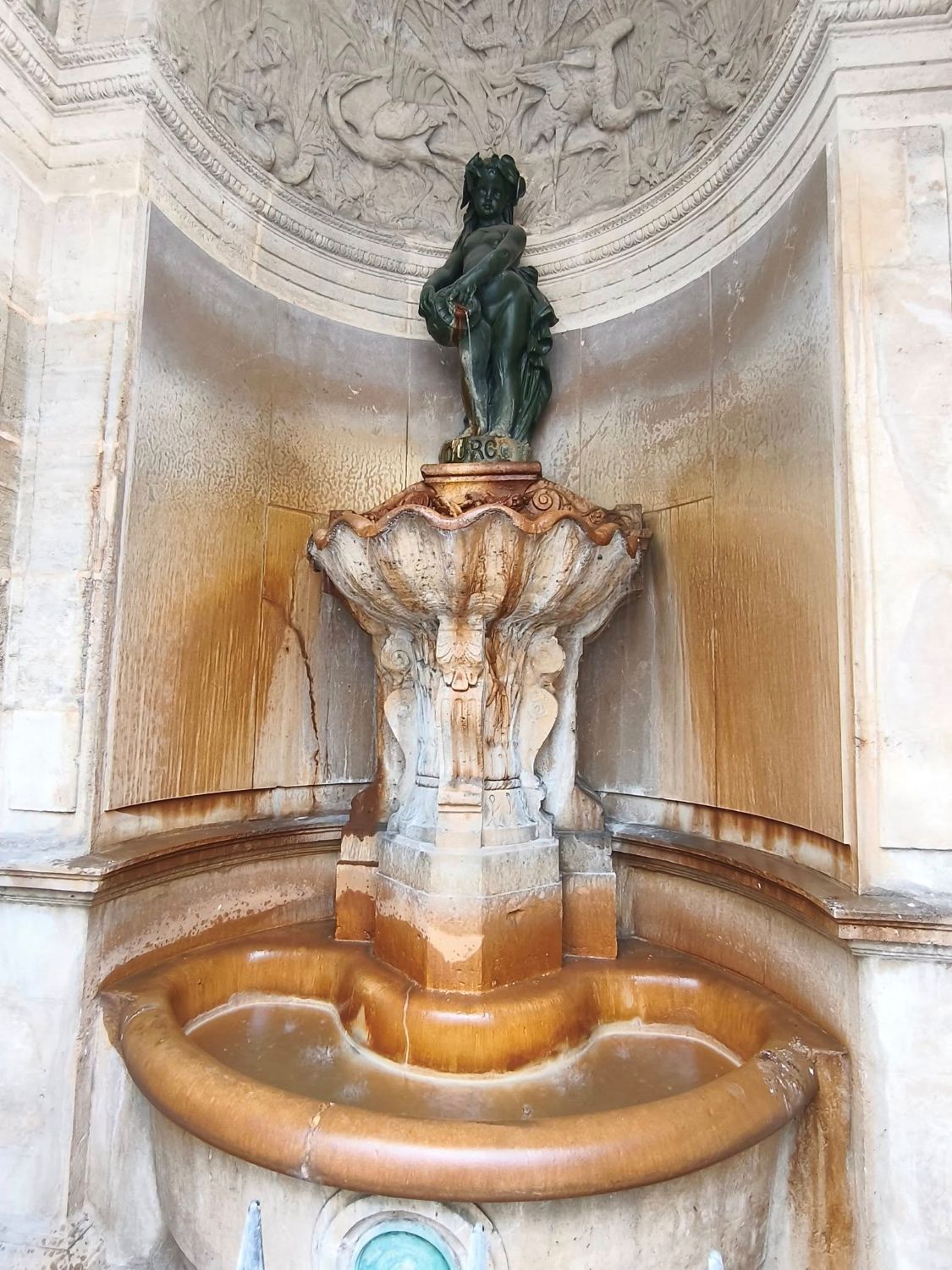
Notable buildings here are at No. 34: the home of Libéral Bruand, architect to King Louis XIV and one of the founding members of the Royal Academy of Architecture. After acquiring the land from the monks of the Minimes convent, Libéral Bruand built their two adjoining houses, now joined together, between March 1666 and July 1667, at the corner of Rue de Turenne and Rue des Minimes, with his father-in-law Michel Noblet. Nos. 37-39: this building housed the Lepitre boarding house where Honoré de Balzac studied for a year in 1814. No. 41 fontaine de Joyeuse (see photo): This was replaced in 1847 by the current fountain, fed by the Canal de l’Ourcq, and which was part of a City of Paris program establishing public fountains to provide water to the densely populated Faubourg Saint-Antoine quartier or neighborhood. and replaces a fountain called the Saint-Louis fountain, built following a 1671 decree promulgated by King Louis XIV ,The current fountain is made of stone, surmounted by the coat of arms of Paris, it consists of a half-domed apse housing a bronze sculpture of a young child holding a jug in his hand, the water of which pours into a shell-shaped basin. The vaulted ceiling of the niche depicts aquatic animals in bas-relief, herons, frogs and snakes. Located at nos. 52-54, the Hôtel de Montrésor is a double hotel built for Claude de Bourdeille, Count of Montrésor. This 17-18C mansion has an ornate double portal, one of which was later closed. This building is currently used as an elementary school (No. 54), while No. 52 houses a nursery school. At No. 58 a stone statue, surmounted by the head of an angel, is located at the corner of Rue de Turenne and Rue Villehardouin. Representing the Virgin, it is placed in a niche on the first floor of the corner building. She holds the infant Jesus in her arms. No. 56 (and 17 Rue Villehardouin): mortuary house of the writer Paul Scarron , which he himself named the Hôtel de l’Impécuniosité. In 1654, he moved in with his young wife, who would later become the Marquise de Maintenon, future wife of Louis XIV. Until his death, he saw the greatest names in France pass through his home, including the woman of letters Madeleine de Scudéry, the grammarian Gilles Ménage, the letter writer Madame de Sévigné, and the writer Cyrano de Bergerac. In the poet’s room hangs a painting by Nicolas Poussin, The Rapture of Saint Paul, a work commissioned by Scarron himself and now in the collections of the Louvre Museum. A few decades later, the playwright Prosper Jolyot de Crébillon, Crébillon père, also settled at this address and hosted the Italian adventurer and writer Casanova there for a whole year, around 1750, to whom he gave French lessons. No. 60 Hôtel d’Ecquevilly, known as the Grand-Veneur;this private mansion was built in 1637. It belonged to Chancellor Louis Boucherat, from 1686, then to Hennequin, Duke of Ecquevilly, captain general of the king’s hunting, responsible for organizing the hunts, hence its name. Until the end of 2007, the hotel was used as showrooms for the Jacob Delafon bathroom manufacturer. Previously, the entire building was the headquarters and warehouse of the Société Anonyme des Magasins Réunis, founded by Eugène Corbin. Located at no, 65, the so-called Hôtel de Pologne, built in 1662, is remarkable for its facades with balcony, ironwork, pediment, and roof, as well as for its interior staircase decorated with a beautiful wrought iron railing. Initially owned by Louis Doublet, Lord of Ollot, secretary to the king, it was made available to the Minister of the Interior to house the most distinguished artists of the mechanical arts free of charge in 1800. No. 62: Hôtel de Hesse ,built around 1630 for Antoine de Campreny, it was acquired in 1660 by Chancellor Louis Boucherat and rented in 1722 to Joseph Pâris Duverney. Its street facade was replaced by a building during the Second Empire, but its other facade, redone in a 17C style, is visible in the Square Saint-Gilles – Grand-Veneur – Pauline-Roland, accessible via the rue de Hesse. No. 70 Church Saint-Denys-du-Saint-Sacrement (see post); this church is in a very sober neoclassical style. It was built in 1835. The church is mainly visited for the painting by Delacroix representing a Pietà. Nos. 80-80 bis Hôtel de Voysin located at the back of the courtyard, behind a neoclassical building, At Nos. 88 to 94: site of the convent of Notre-Dame du Calvaire, also called the convent of the Filles-du-Calvaire, on which the Froissart and Commines streets were built. No. 92: at the beginning of the 20C, the Feron & Lossow watch parts factory was located at the corner of 92 rue de Turenne and 1 rue Commines. In 2022, the oldest shop in Paris specializing in workwear (founded in 1905): A L’Ouvrier moved to 92 rue de Turenne and redesigned the shop, respecting the layout of the space as it was at the beginning of the century during the time of the watch parts factory. No. 95: Corner house built in 1780 for Charles Termellois which includes a courtyard opening onto the street called “redans” , At No. 116, two bas-reliefs representing two women in profile frame the central window of the first floor. Located at the corner between rue Charlot and rue de Turenne, on this Boucherat fountain ,the names of rue Charlot and rue de Boucherat (former name of this part of rue de Turenne) are engraved on both sides of the fountain. The no 14 engraved below the street names corresponded to the district as defined by the police ordinance of July 30, 1729. Rue de Boucherat took its name from Louis Boucherat, Chancellor of France, who implemented the edict on the revocation of the Edict of Nantes, signed by his predecessor.
The Paris tourist office on Paris Centre (arrond 1-4) : https://parisjetaime.com/eng/article/explore-the-centre-of-paris-a846
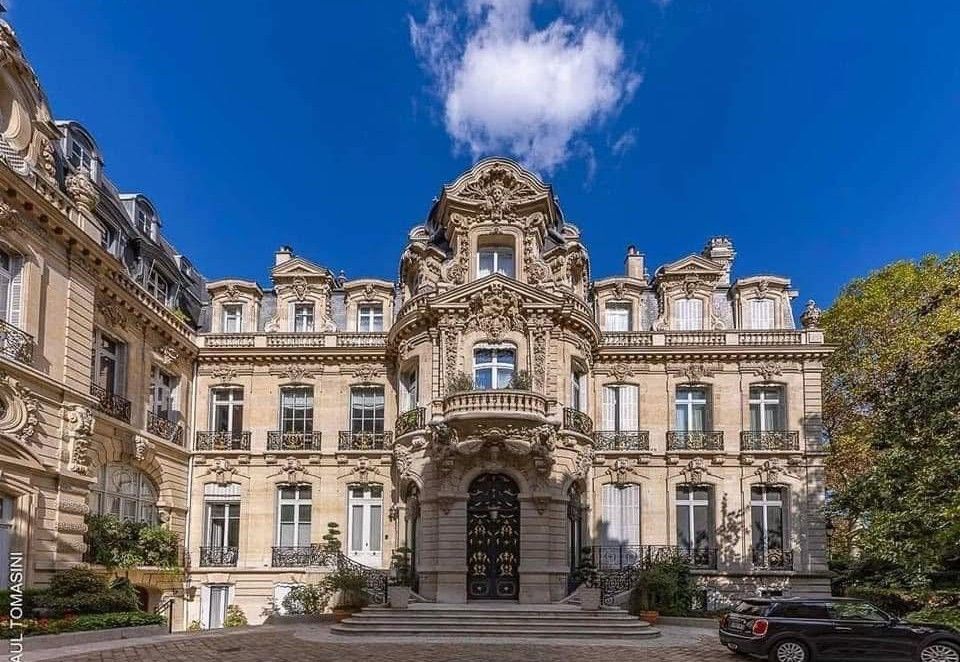
The Avenue Van-Dyck is located in the 8éme arrondissement of Paris. It begins at Place du Général-Brocard, at the intersection of Rue de Courcelles, Rue Alfred-de-Vigny, and Avenue Hoche, and ends at Parc Monceau. This site is served by the metro line 2 at Courcelles. It takes its name from the famous Flemish painter Anthony Van Dyck. The avenue was opened in 1861 and received its current name by a decree of September 11, 1869, Notable buildings here are at No. 4: Hotel acquired in 1902 by the Duchess of Uzès to house part of her large family. The hotel now belongs to the Maison de Clermont-Tonnerre. No. 5: Hôtel Menier (see photo). Second Empire-style hotel built in 1867 by Henri Parent for the chocolate manufacturer Émile-Justin Menier, whose sculpted facade is attributed to Jules Dalou. It is now a private condominium residence. No. 6: Hotel of Joseph Reinach, a French journalist and politician, best known for his involvement in the Dreyfus Affair. It was then the residence of the Maharajah of Baroda, Sayajî Râo III Gâekwâr, a sumptuous figure, who drove a mauve Rolls-Royce. According to his Carnets d’enquêtes, the writer Émile Zola was inspired by the Hôtel Menier, to imagine the private mansion in La Curée, a novel published in 1871. The Hôtel Menier also served as a model for Philippe Hériat for his literary series Les Boussardel (1944).
The Paris tourist office on the 8éme arrondissement de Paris : https://parisjetaime.com/eng/article/explore-paris-s-8th-arrondissement-a826
There you go folks, a dandy city to explore and enjoy with the family, Memorable moments in my eternal Paris, driving and walking all over in my road warrior trails brings out sublime awesome spots with nice memorable family visits of yesteryear always remember and always looking forward to be back, eventually. Again hope you enjoy the post on curiosities of Paris , part LI !!! as I.
And remember, happy travels, good health, and many cheers to all !!!


