
A passion for me once in town to walk its streets sometimes for kms ,yes !! Of course , working in Paris allow me to do so a lot in addition to drive inside of it yes !! One particular area dear to me for the nights and plain sightseeing was the Place de la Bastille area, Therefore, let my legs do the walking and soak in the architecture and history of my eternal Paris with this post on the Place de la Bastille of Paris !! Hope you enjoy the post as I.
The Place de la Bastille is a symbolic square of the French revolution, where the old fortress of the Bastille was destroyed between July 14, 1789 and July 14, 1790. Clockwise starting opposite the angel of the column you have the streets of Rue Saint-Antoine, continuing with Rue de Rivoli which passes by the Hôtel de Ville and the Châtelet and leads to Place de la Concorde; Rue de la Bastille; Boulevard Beaumarchais ,leading to Place de la République; Boulevard Richard-Lenoir extended by Boulevard Jules-Ferry, then Quai de Valmy, continuing with Canal Saint-Martin which leads to Stalingrad; Rue de la Roquette, passing through Place Léon-Blum and leading to the Père-Lachaise Cemetery; Rue du Faubourg-Saint-Antoine, leading to Place de la Nation; Rue de Charenton, leading to Porte de Charenton; Passage du Cheval-Blanc; Rue de Lyon, leading to Gare de Lyon; Boulevard de la Bastille and Boulevard Bourdon, both running along the Port de l’Arsenal to the Seine; and Boulevard Henri-IV. The Place de la Bastille is served by RATP bus lines 29 69 76 86 87 and 91, as well as metro lines 1, 5, and 8. The redeveloped square was inaugurated in January 2021, and features 6,620 m2 of additional pedestrian space, a new access staircase to the Arsenal basin and 350 meters of two-way cycle paths. Memorable spot as it was/is very much appreciated by the young crowd especially on Fridays and Saturdays with several cafés, restaurants, cinemas and nightclubs !
The Gare de la Bastille or Gare de Paris-Bastille was a former Parisian railway station, open from 1859 to 1969. It was the head of the line connecting Paris to Verneuil-l’Étang, called the “Vincennes line” to indicate that its construction was contemporary with that of the Fort de Vincennes. After the cessation of railway activity, the passenger building of the Gare de la Bastille served as a venue for art exhibitions until its demolition in 1984, when the Opéra Bastille was built on its site. Of course the Opéra Bastille is a modern opera house located on the Place de la Bastille. With its 2,703 seats, the Grand Salle is one of the most important in the world in terms of capacity.
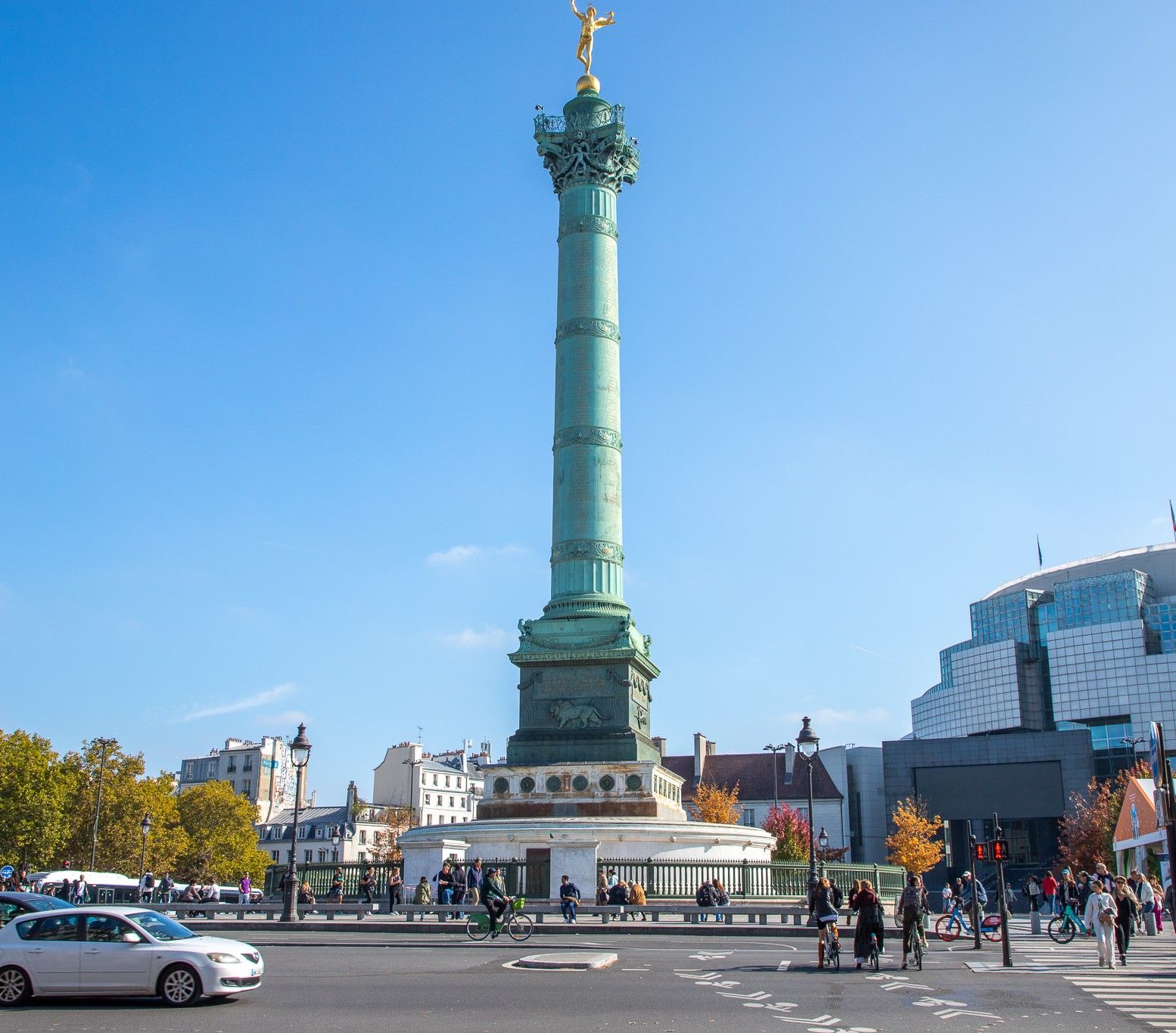
The colonne de Juillet or the July Column was erected on the Place de la Bastille between 1835 and 1840 in commemoration of the three days of the July Revolution in 1830, known as the Three Glorious Days, which led to the fall of Charles X and the Restoration regime, then the establishment of the July Monarchy, with the reign of Louis-Philippe I, Duke of Orléans, who became King of the French. On February 25 during the Revolution of 1848, Parisians, after the flight of King Louis-Philippe, carried his throne from the Tuileries to the Bastille where it was finally burned at the foot of the July Column. 196 bodies of the victims of the riots that overthrew Louis-Philippe were added. The shaft of the column bears the names of the victims of the revolutionary days of July 1830, and the top is adorned with a gilded bronze sculpture, The Genius of Liberty, representing “Liberty taking flight, breaking its chains and sowing light.” She is naked, her left foot resting on the sphere, her right leg raised, her wings spread, and a star on her forehead. She holds a broken chain in her left hand, and in her right, the torch of civilization. Finally, the column is built above a necropolis containing the bodies of revolutionaries who fell during the July Days. The July Column is of the Corinthian order; inscriptions, palms, wreaths of immortelles, oak branches, the arms of the City, the Gallic rooster and the lion, astronomical symbol of the month of July, adorn the pedestal.
Other than the above notable monuments you have here the Arsenal port,(see post) where the Canal Saint-Martin (see post) flows into. At No. 6: site of a tavern, À la Tour d’Argent, in the first half of the 15C. It owes its name to its proximity to the Treasury tower of the Bastille. In the 18C, it was transformed into an inn, then into a wine shop, the sign of which is preserved in the Carnavalet Museum. Since the beginning of the 20C, various restaurants have succeeded one another there.
A bit of history I like tell us that the provost of the merchants of Paris, Étienne Marcel, had a fortified gate built to defend the rue Saint-Antoine and which was flanked by a small bastion, a “bastille”. This fortress originally had only two towers; two more were quickly added, then around 1383, Charles VI had four new ones built, joined by thick walls and surrounded by a moat. Under Henry II, in 1553, new fortifications were erected and completed in 1559. These works consisted of a curtain wall flanked by bastions, bordered by wide ditches with a basin bottom. The contours of the fortress’s eastern walls are marked today by special paving visible on the western side of the square. This bastille, which was built to protect the city from attacks by the Burgundians and the English, served as a prison under Louis XI. Louis of Luxembourg, Count of Saint-Pol, Constable of France, was imprisoned in the Bastille on November 27, 1475, and was beheaded in the Place de Grève (today place de l’hôtel de ville) on December 19 of the same year. Transformed into a state prison by Richelieu, the Bastille was stormed on July 14, 1789, by the population of the Faubourg Saint-Antoine, which is generally considered the first act of the French revolution.
The City of Paris on the renovated place de la Bastille : https://www.paris.fr/pages/bientot-une-nouvelle-place-de-la-bastille-6093
The Paris tourist office on the Bastille district sights : https://parisjetaime.com/eng/convention/article/spotlight-on-the-bastille-district-a1410
There you go folks, this is a nice walkable area with plenty to see and do, especially night outs in my eternal Paris. The areas around Place de la Bastille are very nice indeed. Again,hope you enjoy this post on the Place de la Bastille of Paris !!! as I,
And remember, happy travels, good health, and many cheers to all !!!


