
I am taken you back to Paris, yes a never ending story, The eternal city never stop amazing me of its beauty and things to see even if worked in it for almost 10 years while visiting zillion times living nearby in Versailles, Once again, found me older pictures in my cd rom vault ,that should be in my blog for you and me, These are wondertful architecture and historical gems glad to have them here. Therefore, here is my take again on the Church Saint Etienne du Mont of Paris !!! Hope you enjoy the post as I.
The Church Saint-Étienne-du-Mont is located on the Sainte-Geneviève hill, in the 5éme arrondissement of Paris. The western facade of the Church Saint Etienne du Mont was erected between 1610 and 1622. It was restored by the architect Baltard during the Second Empire. The choir, flamboyant Gothic period, was completed in 1537; The following year, it was the frame to be laid. Jube is built around 1530-1535. The nave, from Renaissance period, was not vaulted before 1584. The foundation stone of the facade was laid in 1610 , the church was dedicated on February 25, 1626 by Jean-François de Gondi, first archbishop of Paris, uncle of Cardinal de Retz The attractive church, named for Saint Stephen (Saint Etienne) but still devoted to Sainte. Geneviève. The interior of the church is Gothic, an unusual style for a mostly 16C church. Along with the patroness of Paris, such illustrious men as Pascal and Racine were entombed here.
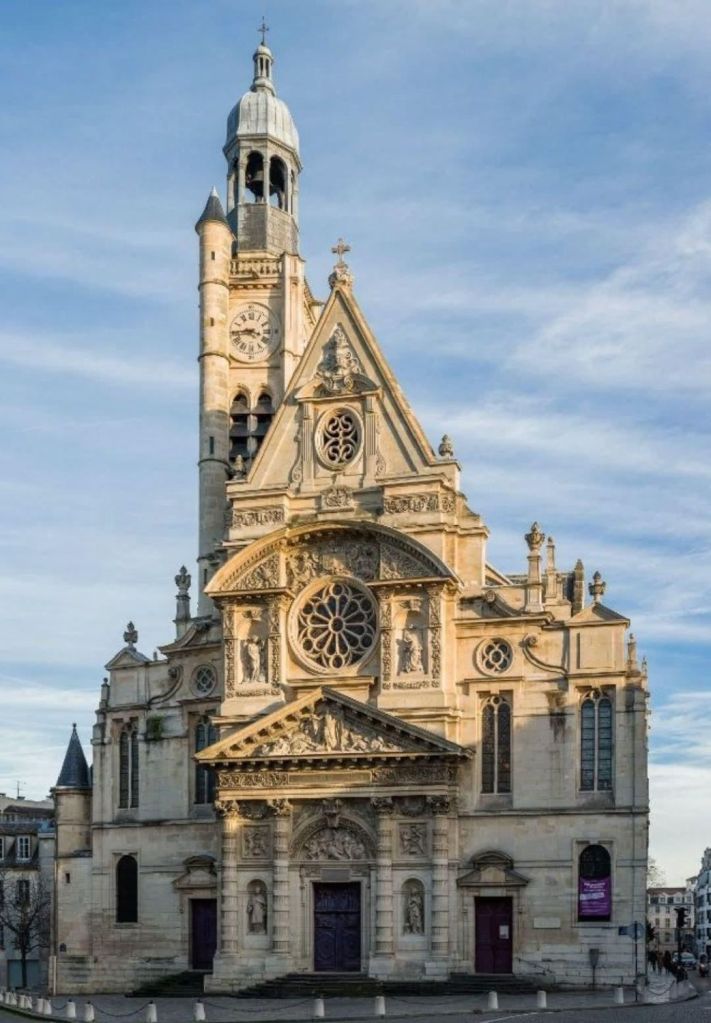
The Church Saint-Etienne-du-Mont is remarkable for several things such as a finely sculpted stone roodle (one of the last existing in Paris), dating from around 1530 and mixing with a perfect elegance the late Gothic vocabularies and Renaissance, A chair drawn by Laurent de la Hyre and sculpted by Claude Lestocart, as well as an organ buffet (1631), the oldest in Paris. The church also contains the shrine which contained the relics of Saint Geneviève until 1793 (date on which they were thrown at the sewers, only a piece of bone left), the tomb of Blaise de Vigenère, of Blaise Pascal , of Louis Nivelle, Racine, and Mgr Sibour. Huysmans described it on the way in 1895 as one of the prettiest churches in Paris. The Church , also welcomes the remains of Pierre Perrault, father of the author of the Tales of Charles Perrault, the painter Eustache Le Sueur and Pascal. Those of Racine and Isaac Lemaistre de Sacy are also transferred in 1711 from Port-Royal to Saint-Étienne.
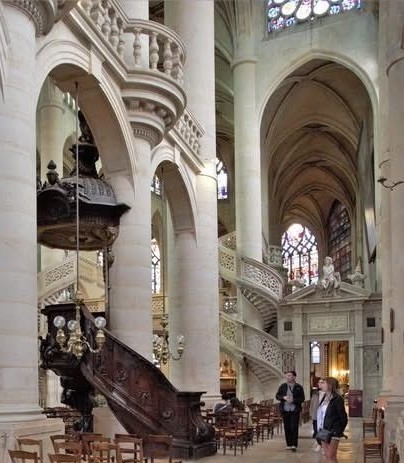
The interior of St-Etienne-du-Mont is Gothic, an unusual style for a mostly 16C church. Along with the patroness of Paris, such illustrious men as Pascal and Racine were entombed here. Ste. Geneviève’s tomb was destroyed during the French revolution, but the stone on which her coffin rested was discovered later, and her relics were gathered for a place of honor at St-Etienne. The church possesses a remarkable early-16C rood screen. Dramatically crossing the nave like a bridge with spiral staircases on either side, it’s unique in Paris and beloved by many . Also notable is the wood pulpit, supported by Samson with a jawbone in hand and slain lion at his feet. The fourth chapel on the right from the entrance contains impressive 16C stained glass. The arches of the apse and the steeple are built in 1492, the heart of flamboyant Gothic style up to the transept in 1537. The grave, sculpted group in terracotta composed of eight characters which dates from the end of the 16C the carved wooden pulpit, made around 1640 its periphery is adorned with seven allegorical statues representing the cardinal virtues (prudence, justice, temperance, Force) and theologales (hope, faith, charity), separated by bas-reliefs carved on the panels telling the story of Saint Etienne The pulpit is supported by a standing character on an extended lion, holding in his right hand a jaw of donkey: it is therefore Samson, a biblical character endowed with a legendary force, who struck a lion , and killed a thousand Philistines with a donkey jaw . The Virgin and Child between Saint Peter and Saint Lucie, by Pier Ilario Mazzola, commanded in 1518 for a church of Parma; The Christ on the cross, accompanied by Saint John, King Louis XIII and Aristotle, of an anonymous early 17C. Saint John in Pathmos, dated 1693,
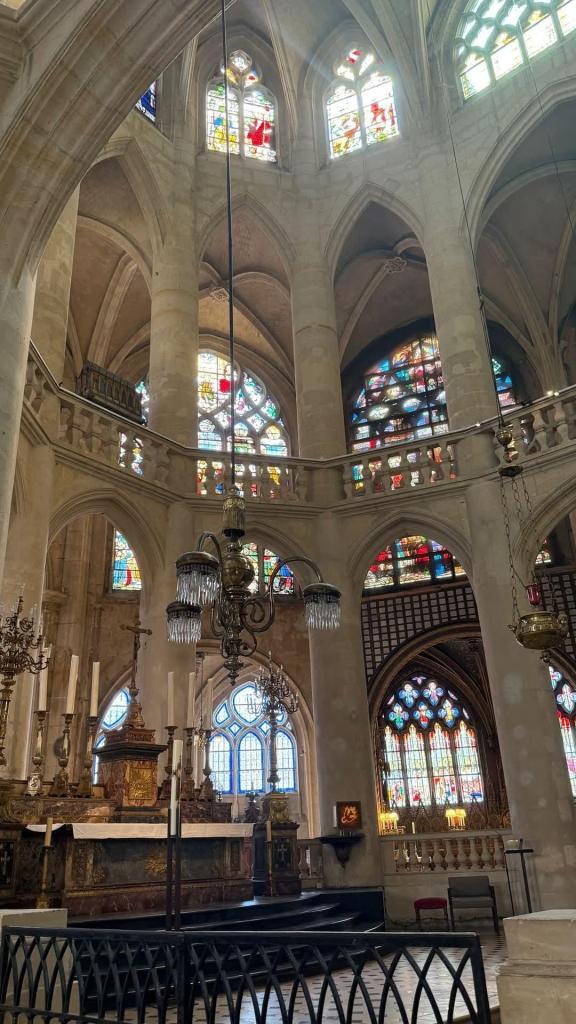
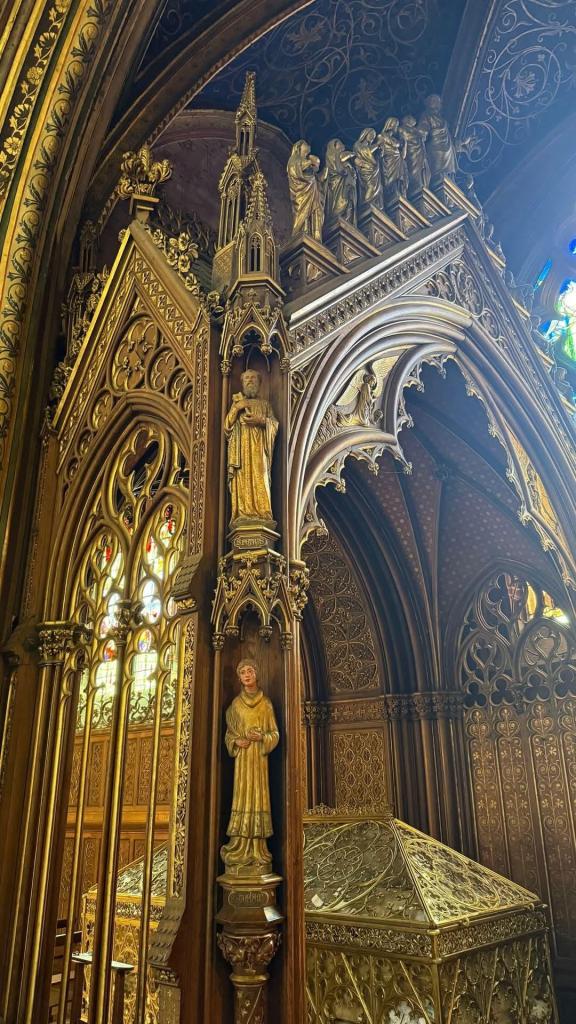
The Chapel of Saint Genevieve is worth alone the visit to the church, During the terror of the French revolution, the saint’s relics were burned and the shrine was melted down. This chapel ,therefore houses the relics that survived in other churches. Its artistic style differs completely from that of the other chapels: the decoration was renewed in 1855 based on a neo-Gothic program established by the Jesuit Arthur Martin, Of particular note is the sumptuous altar dedicated to the saint, organized around a statue of Achille Valois. Also noteworthy are three modern stained-glass windows. One of the most interesting is the one created in 1882. It illustrates the procession of the shrine, inspired by a 17C drawing. It shows the two churches (abbey and parish) side by side. The other two, in the 15C style, depict the life of Saint Genevieve. The Sainte Geneviève’s tomb was destroyed during the French revolution, but the stone on which her coffin rested was discovered later, and her relics were gathered for a place of honor at the Church Saint-Etienne du Mont. The Shrine of Sainte Geneviève,patron saint of Paris empty of its relics since the French revolution in 1793 (when thrown in the sewers) with only one piece of bone remaining, as well as the stone of her coffin is now preserved there.
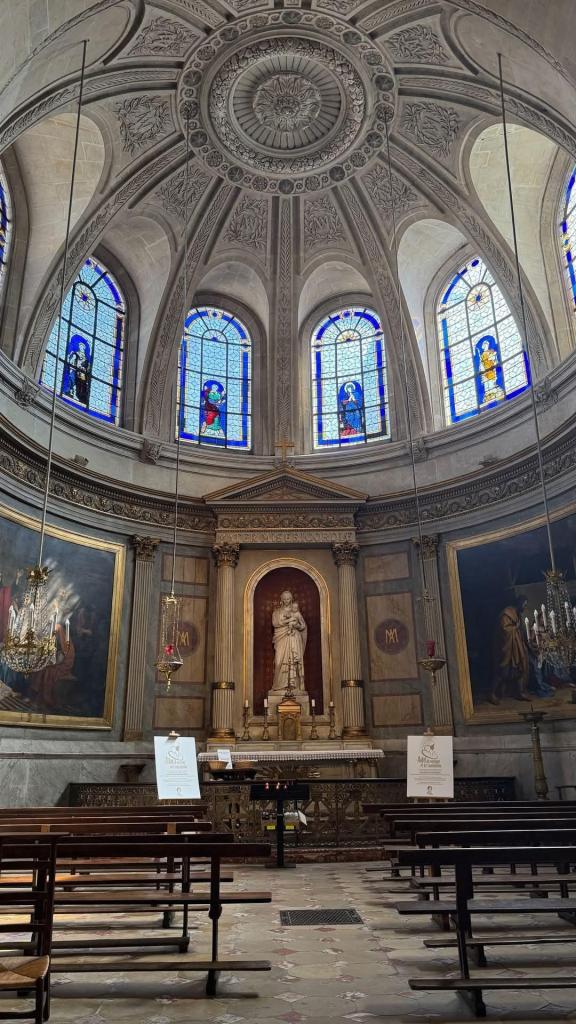
The Chapel of the Virgin, the axial chapel of the church, when it was first opened in 1540, it occupied only two bays. It was rebuilt in 1655 according to an expanded plan: encroaching on the small cemetery, and raising its opening onto the ambulatory. Further rearrangements were noted in 1738, in 1824, and finally in 1853. Four mounted canvases by Alexandre Caminade relating to the life of the Virgin can be seen there. Among these, a Visitation and an Annunciation are displayed at the entrance. Two large canvases adorn the interior of the chapel: an Adoration of the Magi and a Dormition. Through the gestures of the figures and the muted colors, his paintings exude gentleness and tranquility. Above the altar, the marble statue of the Virgin and Child, created in 1863 by Denis Foyatier, completes the chapel’s peaceful atmosphere. The six stained-glass windows under the dome bear the hallmark of Victor Baltard. He opted for a neoclassical design and commissioned to create six stained-glass windows from disparate old panels, ensuring the overall consistency through the uniformity of the frame and its borders. These include a Saint Anne and the Virgin, a Saint Andrew and his cross, Saint Stephen with one of the stones of his martyrdom on his head , a holy archbishop, and a Virgin on Calvary made around 1550. Finally, at the entrance to the chapel, two inscriptions mark the location of the tombs of Pascal and Racine. The dome dates from 1655.
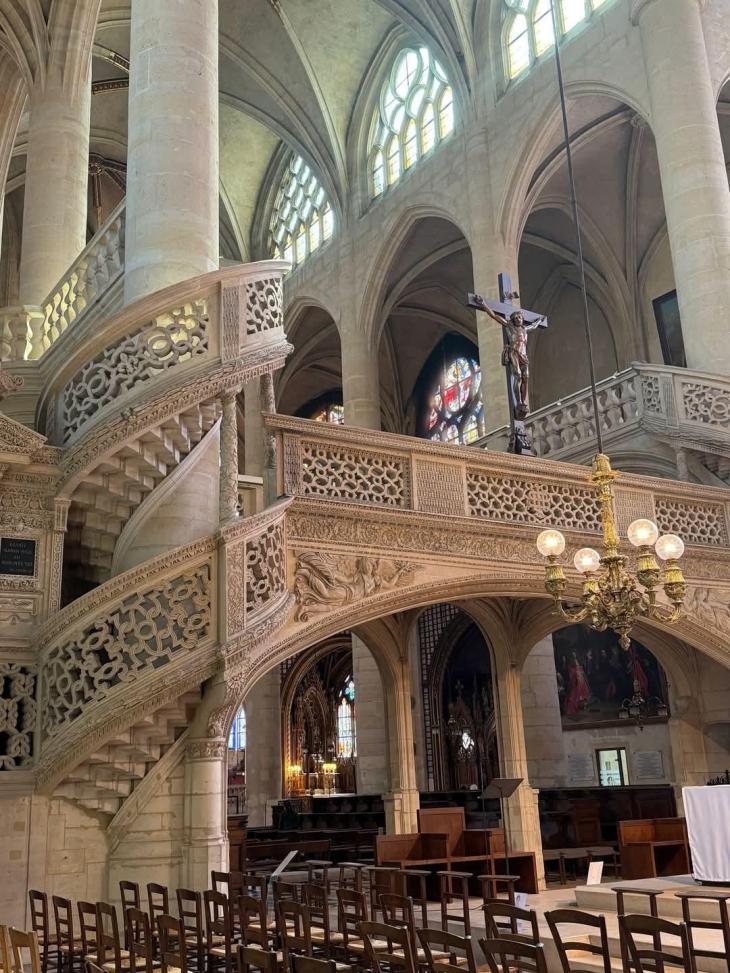
The rood screen of the Church of Saint-Étienne du Mont is the only one remaining in Paris. Its design dates from the early 1530s, and the north and south staircases from the 1540s. The side doors and statuary are from the 17C. The gallery, nine meters long, is supported by a basket-handle vault that reaches a height of four meters. Typical early Renaissance ornamentation is combined with the classical Gothic style of the balustrade and staircases, a style not devoid of Moorish influence. The authors are still unknown, Over the course of its history, the rood screen has been remodeled according to the whims of the times and decorative fashions. Under Louis XVI, the gallery supported only a crucifix, and the two north and south pillars each housed an altar. During the French revolution, all the statuary disappeared. In the spandrels of the gallery, the angels carrying the instruments of the Passion gave way to pagan figures holding palms, branches, or crowns . After the Concordat of 1801, a Christ of Mercy and two angels were placed on the gallery. Since 1851, a large Christ on the Cross from the chapel of the École Polytechnique has stood there. It was sculpted in the 1820s by the Austrian artist Ulrich de Grienewald, following a commission from the Duke of Angoulême, the official patron of the school since 1816. One of the most curious and remarkable rood is in the Church of Saint-Étienne-du-Mont, the only one surviving in Paris. This rood conjugates a Gothic structure with Renaissance ornamentation.
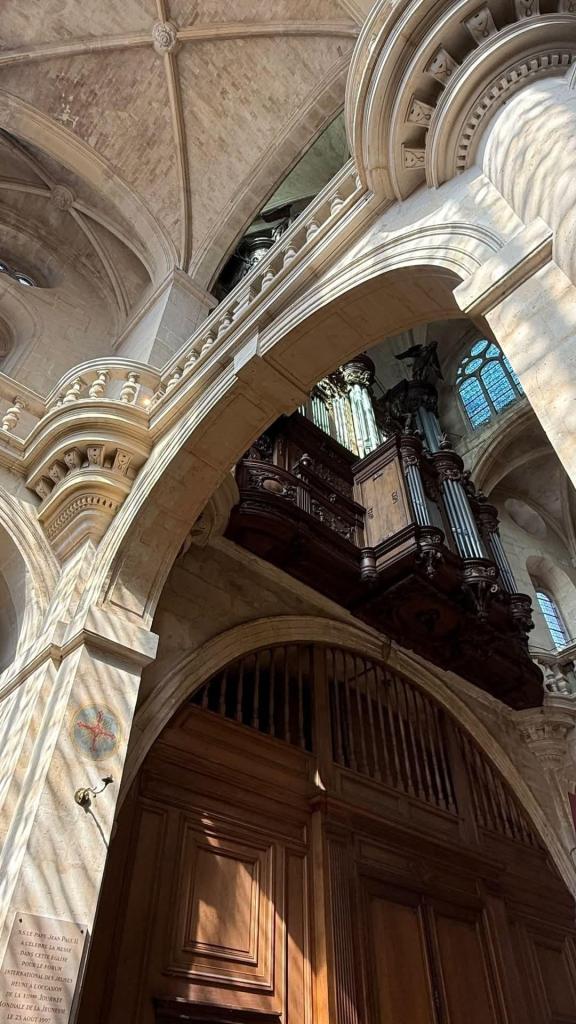
The gallery organ is one of the masterpieces of the Church Saint-Étienne du Mont, one of the most beautiful in Paris, and the oldest fully preserved. The construction specifications date back to 1631, The beauty of the organ is evident to all visitors. Harpies, crouching angels, musician angels, cherubs, and the resurrected Christ contribute to this display of splendor, further accentuated by the bas-reliefs on the positive level. In 1760, it fell victim to a fire, and organbuilder Nicolas Somer undertook its restoration in 1766. In 1772, François-Henri Clicquot transformed it into a grand instrument that embodies all of late French classicism. In 1862, Cavaillé-Coll undertook another project without the agreement of the organist, who lacked resources. Finally, in 1929, the young composer and organist Maurice Duruflé arrived. Under his leadership, the city of Paris commissioned the Gonzalez firm in 1934 to carry out a thorough restoration. Interrupted by the WWII, the restoration was resumed under the leadership of the Beuchet-Debierre factory. Thus, in 1975, the Gonzalez firm, once again in charge, carried out a complete re-voicing. To this day, it is the organ builder Bernard Dargassies who maintains the instrument, presented as a neoclassical organ.
A bit of history I like tell us that the Church Sainte Etienne du Mont stands on the site of an abbey founded by Clovis, King of the Franks (466-511) and later dedicated to Ste. Geneviève, the patroness of Paris. St. Geneviève was so popular in the Middle Ages that the abbey had to be enlarged to accommodate all the pilgrims.The abbey traces its origins to the Church of the Holy Apostles Peter and Paul, founded by Clovis around 508 atop what is now the Montagne Sainte-Geneviève. The abbey housed the relics of the saint and Clovis and, as such, became the city’s most important pilgrimage site. At the beginning of the 13C, Philip Augustus commissioned the construction of a new wall to encircle Paris. A parish church was then built, dedicated to Saint Stephen (St Etienne). It is integrated into the cloister and the monks retain control over its management. Construction on the present abbey church began in 1492 and encountered numerous delays before it was finally finished in 1626. All that remains of the ancient abbey is the Tour de Clovis (Tower of Clovis), which is now part of the Lycée Henri IV. The attractive church, named for St. Stephen but still devoted to Ste. Geneviève, is located right next to the Panthéon. In 1492, the Génévéfains monks donated part of their land for the construction of the new church. This takes place in several stages, giving the current church a composite appearance. The apse and the bell tower are sketched out in 1494; The first two bells were made in 1500. The choir, flamboyant Gothic period, was completed in 1537; The following year, it was the frame to be laid. Jube is built around 1530-1535. The nave, from Renaissance period, was not vaulted before 1584. The foundation stone of the facade was laid in 1610 by Marguerite de Valois , the church was dedicated on February 25, 1626 by Jean-François de Gondi, first archbishop of Paris, uncle of Cardinal de Retz , The church keeps, in the chapel of communion (or catechisms), The gallery that surrounds the bedside, adorned with twenty-four stained glass windows was built from 1605. Finally the bell tower is raised in 1624 while the gate is built in 1610. The church becomes a temple of Filial Piety, for the use of a new cult: theophilanthropy. However, in July 1795, the Catholic priests return and share the church with the theophilanthropists. In 1807, the abbey church of Sainte-Geneviève, devastated by looting, is destroyed. Only its bell tower remains (currently the Clovis tower). The monastery buildings will become the Henri IV high school. Under the First Empire, the furnishings will be enriched; old paintings decorate the chapels. During the 19C, donations from parishioners revived its ornamentation. Under Napoleon III, the architect Victor Baltard built the catechism chapel in 1857, and the façade of the church between 1861 and 1868. a very beautiful collection of stained glass painted at the enamel from the end of the 16C or the beginning of the 17C, mutilated and dispersed during the French revolution, they were again gathered in 1834; There are only 12 out of the initial 22 left.
Most of the above comes from the Historical Heritage publications,and the below sites,as usual by me.
The official Church Saint Etienne du Mont: https://www.saintetiennedumont.fr/
The Paris tourist office on the Church Saint Etienne du Mont: https://parisjetaime.com/eng/culture/paroisse-saint-etienne-du-mont-p1214
The organs of Paris on the Church Saint Etienne du Mont organs: https://www.organsparisaz4.orguesdeparis.fr/St%20Etienne%20Mont.htm
A private blog on the life of Sainte Genévieve : https://www.sainte-genevieve.net/2022/01/10/notice-de-sainte-genevieve-419-520/
There you go this one is a must and the area is gorgeous. This is one of the dandy churches of Paris that I would consider a must to visit. Again, hope you have enjoy the post on the Church Saint Etienne du Mont of Paris !!! as I
And remember, happy travels, good health, and many cheers to all !!!


