
I am again to tell you about more streets of my eternal Paris. I have many many posts on Paris and several on the streets of the most beautiful city in the world. I have come up with pictures from my cd rom vault that should be here for you and me. As always thank you for following my blog some since 2010. Therefore, here is my take on the Place du Panthéon of Paris !!! Hope you enjoy it as I.
The Place du Panthéon is a square in the 5éme arrondissement of Paris, extending in front of the Panthéon. It was one of the few squares in Paris, which it crosses, to contain no vegetation, until its redevelopment completed in 2018. The square now features potted trees. This square is located between Place Sainte-Geneviève and the streets Clotilde, Cujas, Soufflot, Clotaire, d’Ulm and Valette. This square, designed with the rue Soufflot which extends it by the architect of the Panthéon and the law school Clément-Germain Soufflot, was started around 1770 on the former gardens of the Sainte-Geneviève abbey and on the site of the college of Lisieux whose buildings purchased in 1758 were demolished in 1762. The square and rue Soufflot also absorbed the old rue de la Bretonnerie whose neighboring houses were demolished (with the exception of the no 3 rue Soufflot). During the French revolution, the law school buildings were converted into a City hall, which remained in place until 1805. They were enlarged in the 19-20C. The square was widened in its section north of the Panthéon by the demolition, in 1844, of the buildings of the former Montaigu College, which were replaced by the Sainte-Geneviève Library. It was originally called Place Sainte-Geneviève, before taking the name Place du Panthéon-Français during the French revolution. In 1815, it was renamed Place du Panthéon.
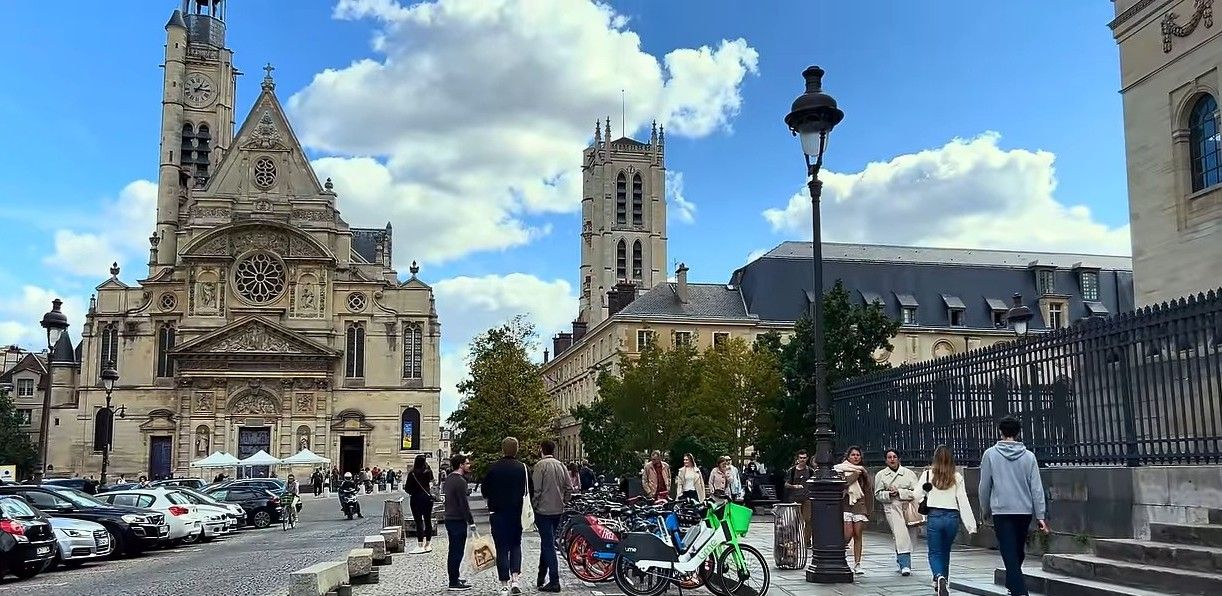
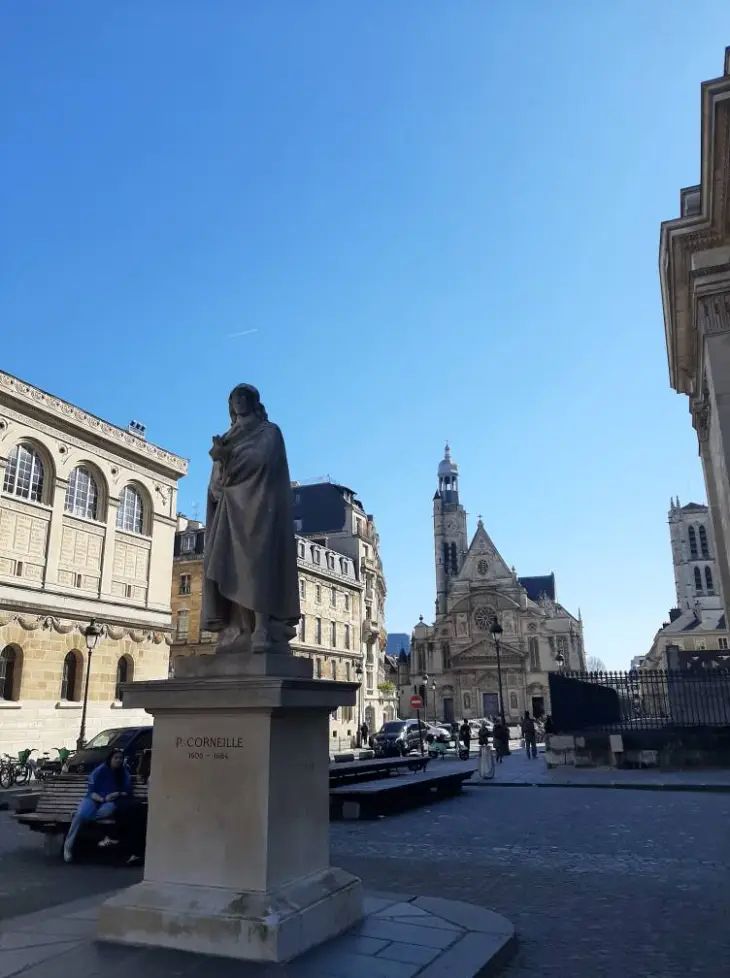
Notable buildings here are, of course, the Panthéon (see right of pic), Centre Panthéon (Paris I and Paris II univ), Bibliothèque Sainte-Geneviève (library), See back of picture the Church Saint Etienne du Mont (see pic and post) that house the relic of Sainte Geneviéve, Patron Saint of the city of Paris and where Pascal and Racine were buried showing a beautiful rood screen from 1545 unique in Paris, The Lycée Henri-IV , the statues of Pierre Corneille (to the left of the Panthéon (see pic) ) and Jean-Jacques Rousseau (to the right of the Panthéon). At No 8: Jacques-Doucet literary library. No 17: Hôtel des Grands Hommes, in an 18C building. André Breton, the father of surrealism, lived there in the spring of 1919. No 21: City/Town Hall of the 5éme arrondissement. As an anecdote one of my favorites, in Gérard Oury’s Le Corniaud movie, we witness the collision, at the beginning of the film, between Bourvil’s 2CV and Louis de Funès’ Bentley. Memorable film indeed.
I have written posts on these monument but fitting will put a teaser here for you and me,
At the Panthéon, they have organised it into four stages in the life of the Panthéon existance, the first one and oldest is that was there before the Panthéon, in effect, the Church of Sainte Geneviève (1744-1790); which of course, was demolished during the French revolution. The second period is that of the transformation of monuments to use the scholar choice, meaning the used of these monument to enhance the French Republic from the initial years such as (1791-1885). The third period is that of the French Republic laique from 1885-1964 upon the death of the writer Victor Hugo , a huge crowd follows the funeral car to the Panthéon. The fourth and final period we can call it the Panthéon under the Ve République (since 1958), when it was open to transfer the ashes of Resistant hero Jean Moulin ,in 1964.
The Church Saint-Étienne-du-Mont is located on the Sainte-Geneviève hill, After being briefly transformed into a temple of filial piety under the French revolution, it was returned to her parish church functions in 1801 and has not changed assignments since. The Shrine of Sainte Geneviève,(patron saint of Paris) empty of its relics since the French revolution in 1793 (when thrown in the sewers) with only one piece of bone remaining, as well as the stone of her coffin is now preserved there. The church also houses an organ whose origins and the buffet date back to the years 1630. It is the last Parisian church where you can still see a rood! The rood of finely carved stone , dating from the vicinity of 1540 and combining with a perfect elegance the late Gothic vocabulary and Renaissance. Inside the tomb of Blaise de Vigenere, Blaise Pascal, Racine, and Mgr Sibour,
The Lycée or High school Henri-IV , located at 23, rue Clovis On June 24, 1667, the copper coffin of Descartes is deposited there under a marble monument. rue Descartes now borders the Lycée Henri-IV. The Tour Clovis tower is the remnant of the old bell tower of a church Sainte-Geneviève disappeared between the high school and Church Saint-Étienne-du-Mont The breakthrough of the road in the 19C requires the demolition of the church abbey Sainte-Geneviève, of which only the bell tower known as the Tour Clovis or Clovis tower remains in the premises of the Lycée Henri -IV.
The official Panthéon of Paris: http://www.paris-pantheon.fr/en/Prepare-for-your-visit
The official Church Saint Etienne du Mont: https://www.saintetiennedumont.fr/
The official Lycée Henri IV on its history : https://lycee-henri4.com/presentation/histoire/
The City of Paris on the Place du Panthéon renovated in October 2018 : https://www.paris.fr/pages/place-du-pantheon-travaux-en-cours-6071
The Paris tourist office on walks in the Quartier Latin (see pl du Panthéon): https://parisjetaime.com/eng/article/accessible-walk-in-the-quartier-latin-paris-a1774
There you go folks, another dandy beautiful set of glorious streets of my eternal Paris. I have criss cross them many and have many in my blog already, Again, hope you enjoy this post on the Place du Panthéon of Paris !!! as I.
And remember happy travels, good health, and many cheers to all !!!


