
This is an off the beaten path trip for us, We went to visit this small town village really of Daoulas with a historical abbey, so we took off there. This was due to new pictures found in my cd rom vault that should be in my blog for you and me, Do see my several posts on the abbey in my blog. Therefore, here is my take on the Notre Dame Fountain and Oratory of the Daoulas Abbey !!!.Hope you enjoy the post as I.
The Notre-Dame Fountain and Oratory at the Daoulas Abbey Museum (see post). A visit to these monuments is included in the tour of the abbey gardens.
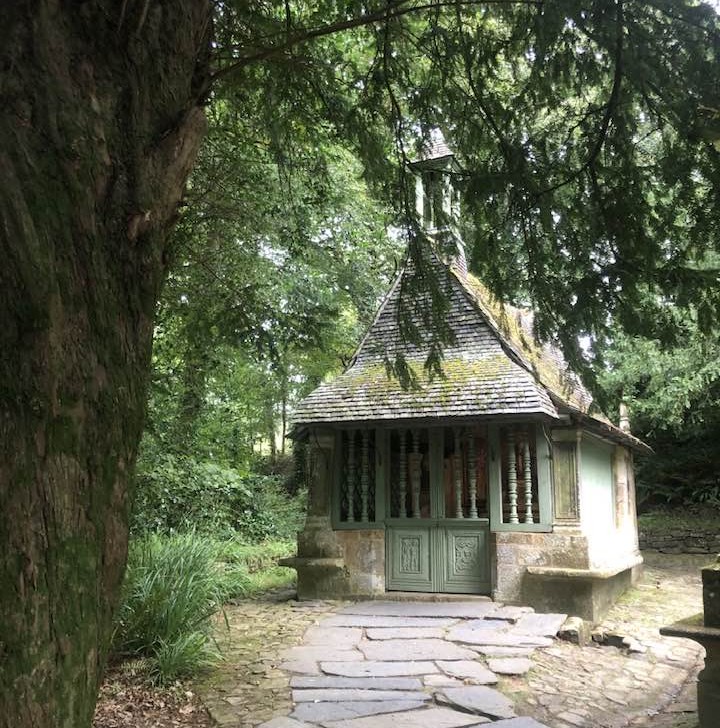
The Notre Dame Oratory is a small building. The apse is made of masonry. The sides are glazed. The facade is made of openwork wood with balusters. The interior of the chapel is decorated with sculpted friezes. The oratory is made from part of the monks’ chancel. It features two old choir stalls from the old Gothic church, a Virgin and Child, and a curious Saint Théleau ,riding the stag whose race, in one night, was to mark the boundaries of the site of his future monastery.
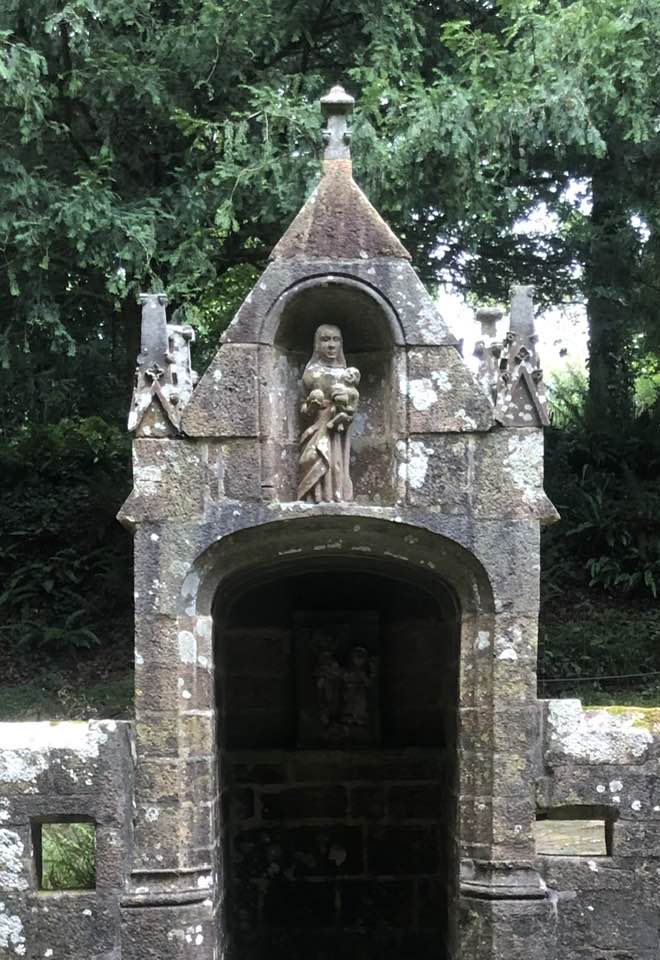
The Notre Dame Fountain, from the same period, consists of a niche decorated with four pinnacles and a pool. It bears an inscription indicating that it was built in 1550. At the wooded end of the abbey gardens stands a small fountain, mentioned in a 1456 document as the Notre-Dame Fountain. It was renovated in 1550 was remodeled in 1880, and restored again around 1875, The three basins of this fountain recall the Trinity, but also the number 3, a sacred number for the Celts.The basin of the fountain forms a rectangle of 6 meters by 4 meters and is surmounted by a sort of small Gothic chapel made of Kersanton stone, covered with two acute crawlers with pinnacles at the four corners.
A bit of history I like tell us that it was founded in the 12C by the Canons Regular of the Order of Saint Augustine, Daoulas Abbey overlooks the small town of Daoulas. It still preserves beautiful testimonies of its initial splendor: a Romanesque cloister, remains of 13C community buildings, a fountain, and a 16C oratory. Sold during the French revolution, transformed into a bourgeois residence in the 19C, and then occupied by a religious congregation and a school after the war, the site tells the story of a great history through its transformations. Unique in Brittany, the Romanesque-style cloister was built between 1167 and 1173 and restored in the 18C. Dismantled after the French revolution, with its stones salvaged here and there, three of its sides were nevertheless rebuilt at the end of the 19C. In the center, an exceptional cloistered basin, probably Irish in inspiration, dates back to the Middle Ages (between the 7C and 9C). Water flows through the mouths of ten masks separated by geometric motifs. Exceptional gardens, including the herb garden, which brings together species representative of traditional pharmacopoeias from five continents, enhance the visit.
The city of Daoulas on the abbey: https://daoulas.bzh/fr/rb/854128/labbaye-de-daoulas-et-les-monuments-classes
The local Landerneau tourist office on the Daoulas Abbey : https://www.tourisme-landerneau-daoulas.fr/sinspirer/art-et-heritage/daoulas/decouvrir-abbaye-daoulas-jardins/
The Finistére dept 29 ways of heritage site on the Daoulas abbey: https://www.cdp29.fr/en/presentation-daoulas-l-abbaye-de-daoulas
The Bretagne region tourist board on the Dauolas abbey: https://www.brittanytourism.com/offers/abbaye-de-daoulas-chemins-du-patrimoine-en-finistere-daoulas-en-2016044/
There you go folks, you are now arm to come see this jewel of my lovely Brittany,in quant nice Daoulas , small but packing a lot of history/architecture in it. Again, hope you enjoy this post on the Notre Dame Fountain and Oratory of the Daoulas Abbey !!! as I.
And remember, happy travels, good health, and many cheers to all !!!


