
I am , again reviving old glories of my belle France I used to lived not far from here, and came often , the shopping and the church are really nice, and the local liquor fantastic. It is very easy from Paris too, can be done in half a day tour. I am talking about Poissy, in department 78 Yvelines, region of Île de France. I have found me pics from my cd rom vault that should be in my blog for you and me. Anyway ,this is a nice off the beaten path city that should be visited more, me think. Therefore, let me tell you on the vieux pont of Poissy !!! Hope you enjoy it as I.
I like to remember memorable places of mine and this is another one. I used to come by here on many business/family trips and to get my sons off school at the train station in Poissy. The A13 autoroute de Normandie direction Rouen until exit /sortie 6 Versailles centre that brings you on the N186 is only 23 kms or take a bit longer but more scenic route on the D190 into the old N13 now D113 (route de quatre sous) at St Germain en Laye and onwards to the N186 to Versailles. And you will love the forest. Indeed memories forever !
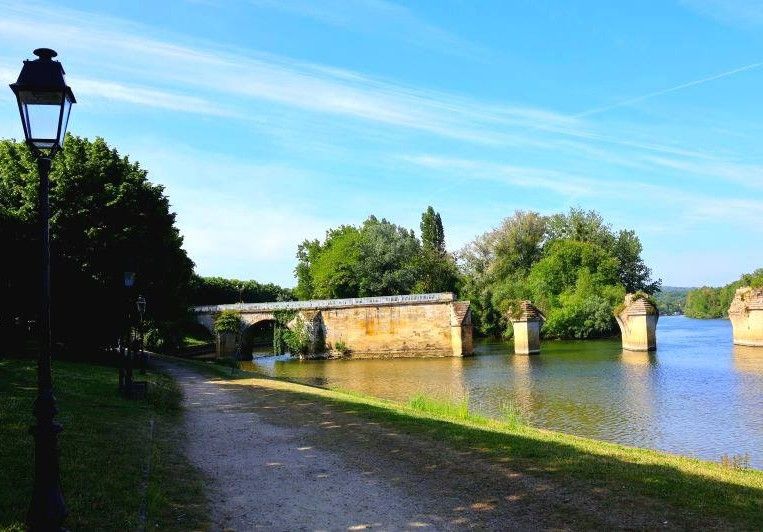
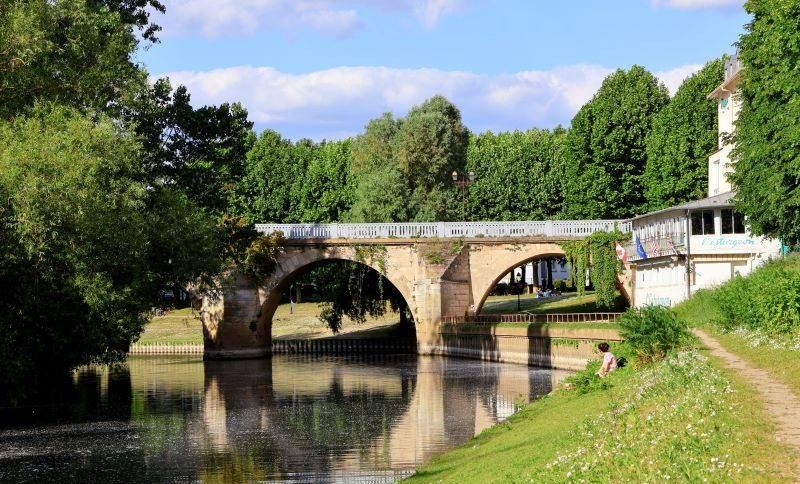
The vieux pont de Poissy, was a masonry arched bridge that once spanned the main branch of the Seine over a length of 400 meters and extended for nearly a km between the cities of Poissy and Carrières-sous-Poissy. This bridge, of which only six visible arches remain, is located 330 meters downstream from the new Pont de Poissy bridge and 570 meters upstream from the Migneaux Island Bridge. It was an important commercial route in the region since the Middle Ages, due to the passage of cattle from Vexin and Normandy heading to the Poissy livestock market via the Rouen road, and the surrounding port, fishing, and milling activities across its arches. It remained a strategic location during the wars until its destruction in 1944.
A bit of history long lazy, the credit goes to wikipedia, Until the end of the 19C, the origins of the bridge remained uncertain and confused. According to the archives of the canons of Poissy, the bridge did not exist in 1061, the date of the foundation and endowment of the church… The crossing of the Seine was done by means of a ferry boat and when the bridge was built, the owners of the ferry retained the use of it. Nevertheless, Thibaut de Marly mentions the existence of a wooden bridge in 1162 in the foundation act of the Saint-Blaise priory. Two other documents confirm the existence of the bridge. The first, dated 1209, states that the mayor of Poissy and the peers of the city granted Bernard Lequeux, and his heirs, caretaker of the castle of King Philippe-Auguste in Poissy, the use of the arch between the great arch and its three previously built mills in exchange for twelve deniers payable to the City on the day of Saint-Rémy. The second, dated 1213, granted him the right to establish a fishery under the main arch of the bridge on the condition that it did not hinder the passage of boats. The lease lasted until 1230 and allows us to state that the bridge was made of stone around 1200. In 1221, Philippe Auguste granted the town the status of a freed city, which allowed the construction of walls, one of the seven entrances of which opened at the Porte du Pont. The bridge was fortified and served as a road and sea toll. Mills were installed on stilts. The bridge then had thirty-seven arches from which fishermen set nets at night.
In 1346, the arrival of the English was reported; the Poissy garrison cut the bridge. On July 12, 1346, Edward III arrived in Poissy. To head north, he had to reestablish the crossing, which was easily done because the deck had been removed, the supports still existing. In September 1347, the truce was signed in Poissy; the bridge was equipped with fortifications and its approaches with small forts. In 1357, despite the protests of the inhabitants, the bridge was cut again on the orders of the Dauphin, which did not prevent the town from being invaded by the English. In October 1411, the bridge was cut again to prevent the advance of the Armagnacs, on the orders of the king. The old bridge, during the Wars of Religion, was defended by the Catholics; the Huguenots Gabriel I de Montgomery and Dandelot had to seize it. Their troops arrived from the left bank and forced the bourgeois militia of Poissy to withdraw to the bridge, the gate of which was closed. Recalled to Saint-Denis, Montgomery and Dandelot did not have time to attack the bridge. In 1568, King Charles IX had a drawbridge built to avoid bringing troops from Paris. Fleeing the court on February 3, 1573, Henry of Navarre (the future King Henry IV) crossed the bridge. On February 9 and 10, 1590, Charles de Mayenne occupied Poissy. Henry IV invests the City, The bridge had been so damaged that Henry IV could not pursue Mayenne which had just lifted the siege of Meulan ( today Meulan en Yvelines).
The two arches destroyed in 1590 were rebuilt in wood nine years later; the bridge then consisted of twenty-four arches and was 406 meters long at the end of the 17C. The bridge had only 17 stone arches over the Seine and nine wooden spans at the beginning of the 19C. On July 19, 1870, France declared war on Prussia. The enemy approached Paris in September. The bridge was then mined at its central arch and the explosion destroyed the two neighboring arches. The timber levee between the maritime arch and the Triel road was set on fire. In the afternoon of September 19, the Prussians were on the right bank but could not cross. After the Franco-Prussian War of 1870, restoration work carried out in 1875 gave the bridge its final form until its destruction. From then on, the bridge was 312 meters long, its roadway was 5.50 meters wide and included two sidewalks. It was made up of twenty arches: the first three and oldest were on the Migneaux arm, the eighth arch was the old stone marine arch, the seventeenth was the cast iron marine arch. The city was informed of the passage through Poissy on June 2, 1810 of Napoleon I during his return from Normandy. The program was given by the prefect; the bridge gate was decorated with a triumphal arch. On December 12, 1840, a large number of locals witnessed, despite the cold, from the bridge and the banks, the return of the ashes of Napoleon I. On July 26, 1931, during the final stage of the 25th Tour de France, the peloton entered the city via the bridge. In 1938, the old bridge was deemed unfit for road traffic.
During WWII on June 7, 1940, a defensive position was established on the port and the banks of the Seine: a machine gun at the front, an anti-tank gun further along at Boulevard Gambetta and a 75 mm gun and a searchlight at the rear, all pointing towards the bridge. On the morning of June 13, 1940, French engineers destroyed the maritime arch and three arches in the center of the bridge to delay the nazis advance. They finally entered Poissy three days later. On May 26, 1944 at 17h50 (5:50 p.m.), for twelve minutes, 38 American A-26 Marauder bombers of the 391st Bombardment Group, moving from west to east, attacked the bridge. The first 48 meters consisting of the first three arches were unharmed, the Petit Motteau wall was shaken, the next 92 meters, consisting of four arches, were badly damaged, and the 172 meters on the riverbed lay in the water apart from one arch still standing. The American tanks of Company A of the 10th Tank Battalion commanded by Arthur Whitley, arrived at Poissy at 21h (9 p.m.), established themselves on the Cours du Quatorze-Juillet and supported the FFI (Free French ) with their artillery, cannons, and tanks. For two days and two nights, shells were fired from both banks. On Sunday afternoon, the ferry and its tug were sunk. It was on Tuesday 29 at 10h (10 a.m.), that the Americans crossed the Seine by boat for reconnaissance; a pontoon bridge was established that same evening. A second bridge was launched on Friday, September 1st to allow the passage of armored vehicles; three days later, everything was removed.
At the Liberation, the France decided to build a temporary bridge connecting the remaining arches on the two banks. Construction of this bridge, made of concrete and wood, began in June 1945. On December 31, 1945, pedestrians were able to use the temporary bridge; on February 9, 1946, cars were able to do the same. The new bridge (the one use today) was inaugurated on July 19, 1952 slightly upstream., after six years of study and work. The temporary bridge was closed on July 25, 1952, then dismantled in the fall. Today, three renovated arches and four piers remain on the Seine on the Poissy side, as well as three other arches on the Carrières-sous-Poissy side. The arches on the Carrières-sous-Poissy side are currently fenced, covered with earth, grass and in ruins. During the summer of 2006, the bridge railings were replaced, the road was paved and the public lighting was modified.
The City of Poissy on the old bridge : https://www.ville-poissy.fr/index.php/sport-culture/vie-culturelle/patrimoine-et-sites/le-pont-ancien-et-les-berges-de-seine.html
The local Terres de Seine tourist office on the old bridge of Poissy : https://www.terres-de-seine.fr/patrimoine_culturel/pont-ancien-de-poissy/
The Yvelines dept 78 tourist office on the old bridge of Poissy : https://www.destination-yvelines.fr/sur-le-vieux-pont-de-poissy/
There you go folks, for a good day of seeing something different in France, and Poissy is a Royal town to boot ,Worth a detour me think. The bridge is a landmark and wonderful walks along the Seine river, sublime ! Again, hope you enjoy the post on the vieux pont of Poissy !!! as I.
And remember, happy travels, good health, and many cheers to all !!!


