
We have driven in the area and would like to have an imprint in my blog on the wonderful Vincennes! Which brings lots of memories of our forays into this part of France,long gone need to be back,eventually, The pictures are again from my vast cd rom vault collection and they should be in my blog for you and me, Therefore, here is my take on the Sainte Chapelle of Vincennes !!! Hope you enjoy the post as I.
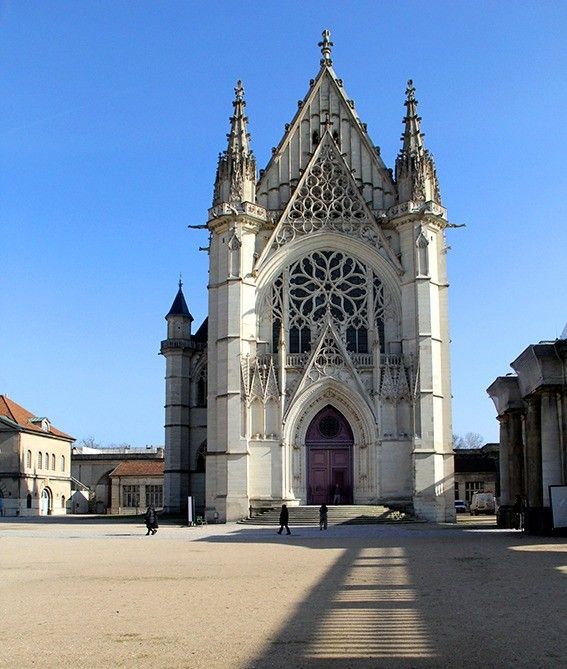
The City of Vincennes is located in the Val-de-Marne dept no 94 in the Île-de-France region of my belle France, It borrowed its name in the Bois de Vincennes located south of the city, which has become owned by the city hall of Paris. It is about 7 km from the Île de la Cité in Paris, Coming from Paris, we enter the city by the avenue de Paris which connects the city center to the Porte de Vincennes;and coming from the east on the A4 , it is entered by this same avenue after having crossed the forest of Vincennes you come into the avenue de Nogent. The City of Vincennes is 64 km from Fontainebleau, 55 km from Maincy (Vaux le Vicomte) ,36 km from Disneyland Paris, 37 km from Versailles, and 477 km from my current home.
The Sainte-Chapelle de Vincennes is built on a single level. Its structure borrows from the Rayonnant Gothic style, with tall windows separated by powerful buttresses. It then evolved towards flamboyant Gothic, which gave pride of place to lavishly ornate sculptures. The sumptuous decoration of the west facade is a perfect example! The magnificent stained-glass windows of the choir represent the Apocalypse according to Saint John and were offered by Henry II between 1556 and 1559. During the French revolution, part of the interior layout of the Sainte-Chapelle was destroyed. However, as early as 1793, the stained-glass windows were removed and preserved, proof that its historical interest was already perceptible. It is one of seven holy chapels of France
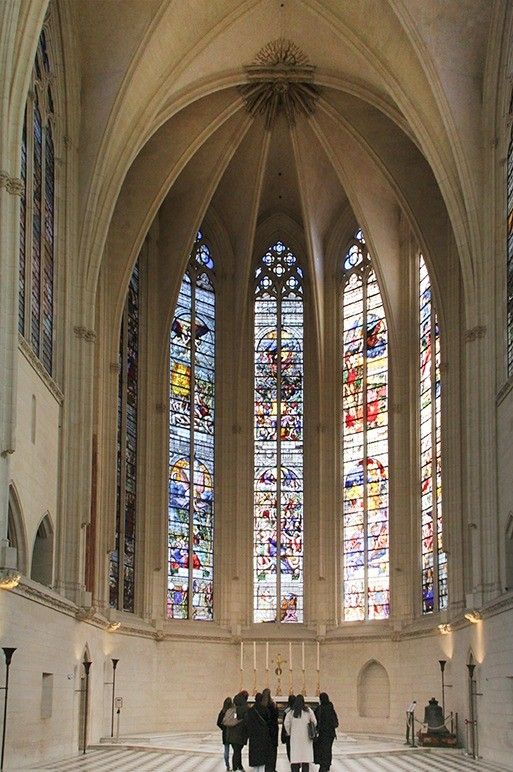
The composition of the stained-glass windows was structured in four overlapping registers, separated by Renaissance architectural elements contrasting with the Gothic frames into which the windows were inserted. All the architectural elements are executed in grisaille. At the bottom, there was a sculpted base of trophies, in front of which stood praying figures facing the choir. These were Knights of Saint Michael in the robes of the order. In the central stained-glass window of the choir, in the place of honor, we see the king in prayer flanked by two trophies bearing the arms of France, facing an enthroned Virgin and Child, the original of which is now in the Louvre, at which all these figures seem to be looking.
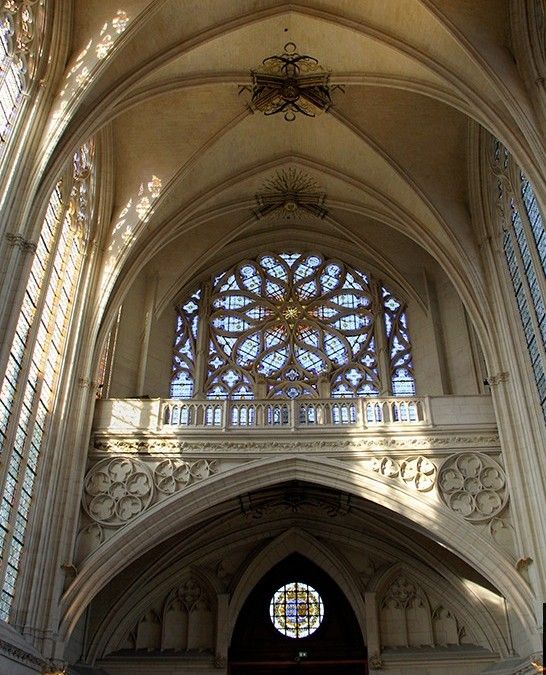
The Sainte-Chapelle started from 1379 had the relics of the crown of thorns kept in Vincennes having been transferred to the Sainte-Chapelle in Paris, the works of construction of a new chapel, entrusted to Raymond du Temple, begin in 1379. The Sainte-Chapelle was to receive a fragment of the relic, which remained in Vincennes. On the death of Charles V, in 1380, Charles VI decided to continue the work, and during his reign are completed the choir, the two oratories, the sacristy and the treasure containing the relics of passion ,and the elevation of the nave, of a single level and with dizzying proportions. The work will continue under the successive reigns of the kings of France, with a certain number of interludes. It is 20 meters high, 40 meters in length and 12 meters in width. It is only under Henri II that the interior sets are made. In 1551, he transferred the headquarters of the Order of Saint-Michel du Mont-Saint-Michel to Vincennes for reasons of accessibility. The building was inaugurated in 1552. The final stained glass windows replaced in 1559 white canopies temporarily installed in 1556. The Sainte-Chapelle de Vincennes preserved for a long time, in its treasure, the baptistery of Saint Louis. From Louis XIII at least, it served as a baptismal font during the baptisms of the children of France. The royal baptistery was transferred to the Louvre museum after the French revolution in 1793. Within its walls is buried Louis Antoine de Bourbon-Condé, Duke of Enghien , prince of French blood, executed in the ditches of the Château de Vincennes. He is the 10th and last Duke of Enghien, and the ultimate descendant of the Maison Condé’s house.
The City of Vincennes on its heritage : https://www.vincennes.fr/rayonnement-culturel-et-patrimonial/decouvrir-vincennes
The official National Monuments Center on the Château de Vincennes : https://www.chateau-de-vincennes.fr/en
The Local Vincennes Marnebois tourist office on its heritage : https://tourisme-vincennes-marnebois.fr/fr
The Val de Marne dept 94 tourist office on Vincennes : https://www.tourisme-valdemarne.com/incontournables/
There you go folks, a dandy area to explore and enjoy with the family, Memorable moments on my road warrior trips and family visits of yesteryear always remember and always looking forward to be back, eventually. Again hope you enjoy the post on the Sainte Chapelle of Vincennes !!! as I.
And remember, happy travels, good health, and many cheers to all !!!


