
Oh yes another wonderful old little village of my dear Castilla La Mancha region; this is deep country and our road warrior trips at its best. There are so many towns that will take you a life time to see them all, and each is unique. I found me ,again, pictures in my cd rom vault that should be in my blog for you and me, Therefore, here is my take on this is the castle of Embid !!! Hope you enjoy it as I.
The village of Embid is located in the province of Guadalajara ,in the autonomus community of Castilla La Mancha ,and in the kingdom of Spain, It has a population of 33 inhabitants per (INE 2024 National Institute of Stadistics of Spain), The village is 162 km from Guadalajara, 26 km from Molina de Aragon, 93 km from Medinaceli, 70 km from Calatayud,130 km from Zaragoza from where we came from on our way south from France to our home rental in Las Majadas (see posts), we drove on the A23 Autovia Mudéjar to exit/salida 210 or centro penitensario (prison) to take the A1506 road dir Nombrevilla continue to roundpoint bearing left onto the N234 dir Daroca continue and bear right onto the A211 road dir Molina de Aragon,(see post) but go into City center Daroca making a tight left on Avenida de Madrid same A211 road continue on curvy mountaneous road to cross the border from Aragon to Castilla La Mancha region on the CM2122 road past the hermitage de Santo Domingo which continue on same curvy mountaneous road into the village turning right into the castle,see panel, And we continue into Molina de Aragon towards our final destination,
The origin of the Castillo de Embid Castle dates back to 1120 during the reign of Alfonso I the Battler, King of Aragon and Pamplona, when this monarch annexed these lands to his kingdom. It stood in a strategic area during the Middle Ages, due to, among other factors, its border status between the kingdoms of Castilla and Aragon. Around 1331, Alfonso XI of Castilla, once the Lordship of Molina became dependent on the Castilian Crown, granted the Lordship of Embid to Diego Ordóñez de Villaquirán, empowering him to repopulate these lands and build the castle. During the time of Pedro I it was partially destroyed, and after its reconstruction, it was retook by assault by the Aragonese. After many vicissitudes, the fortress passed into the hands of the Count of Medinaceli, who in turn donated it to Juan Ruiz de los Quemadales (the Old Knight). It was he who rebuilt it almost entirely in the mid-15C, giving it its current appearance, and ordered that it be repaired and a loft be built on its tower.During the War of the Spanish Succession, in 1710, the castle was burned by retreating Austrian troops after participating in the Battle of Brihuega and Villaviciosa. From that moment on, news about Embid Castle became increasingly scarce, although it is known that in 1687, King Carlos II granted the ninth lord of Embid, Don Diego de Molina y Mendoza, the title of Marquis of Embid. From this moment on, it lost its function as a defensive enclave, and thereafter it fell into evident deterioration. In 2005, the Ministry of Culture undertook its consolidation and restoration, providing it with the necessary infrastructure to make it accessible to visitors, The works were completed in 2006.
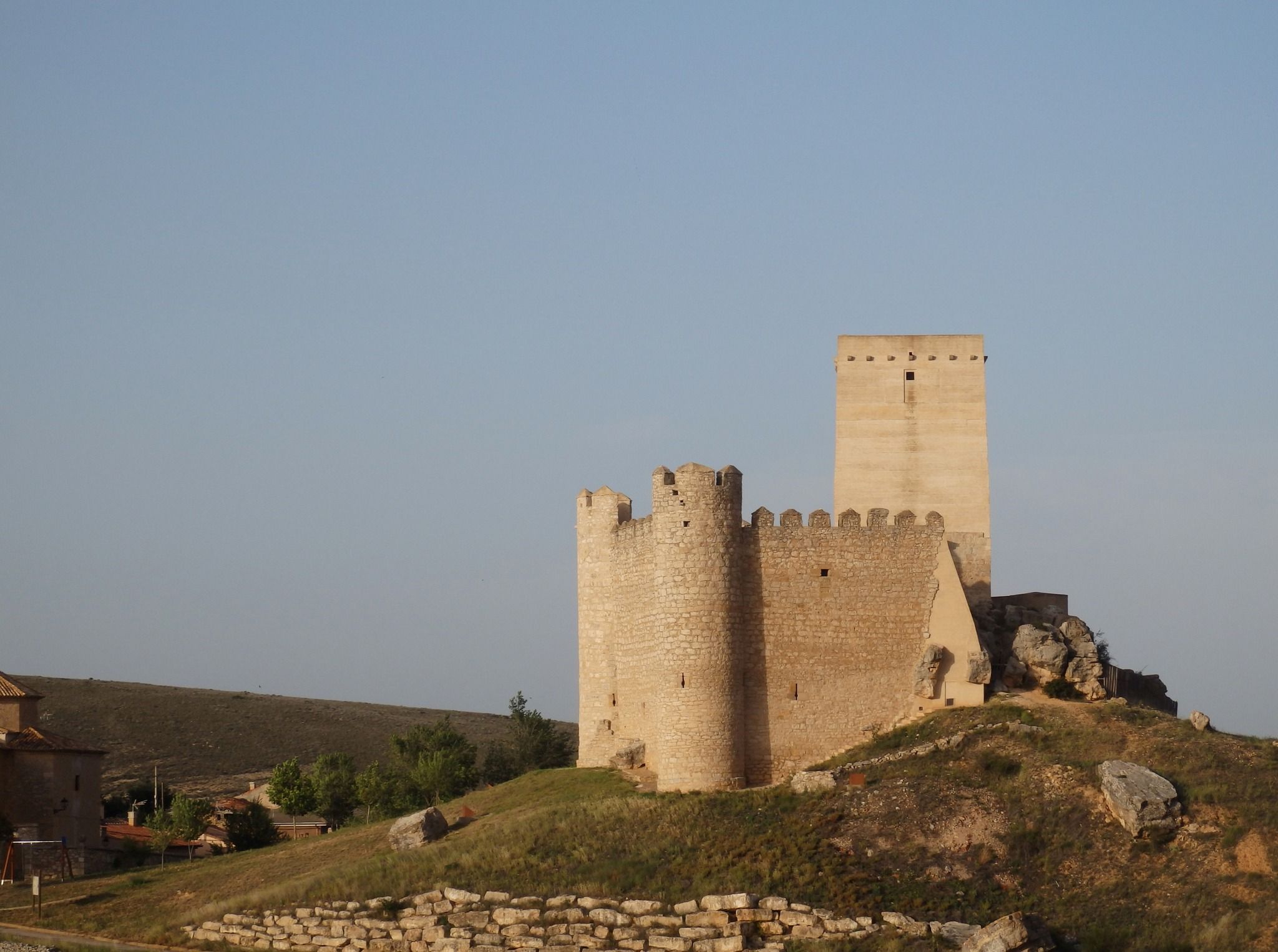
The Castillo de Embid has a pentagonal floor plan, with cubes in its corners to reinforce the wall, and a keep with a high entrance, which made a ladder necessary to reach it. It features three crenellated cylindrical towers, connected by the two sections of wall that still stand. One of the other two has been partially rebuilt, as has the wall that connects them to the other towers, but without crenellations. The other has been destroyed , and then a concrete one has been built, with the main gate located between the two towers. Its surroundings are further enclosed by another concrete wall, which surrounded the surrounding scree. Some windows are still preserved on the walls and towers, with the traditional stone benches inside and the characteristic loopholes in the cylindrical towers. Above this rocky terrain, the majestic keep rises majestically. Access was via a ladder, as the entrance was located higher up. At the top, some modillions remain, which, if necessary, would support the projecting wooden dormers or balconies. Currently, the small interior courtyard has a cantilevered and covered walking area, resembling a wooden porticoed walkway.
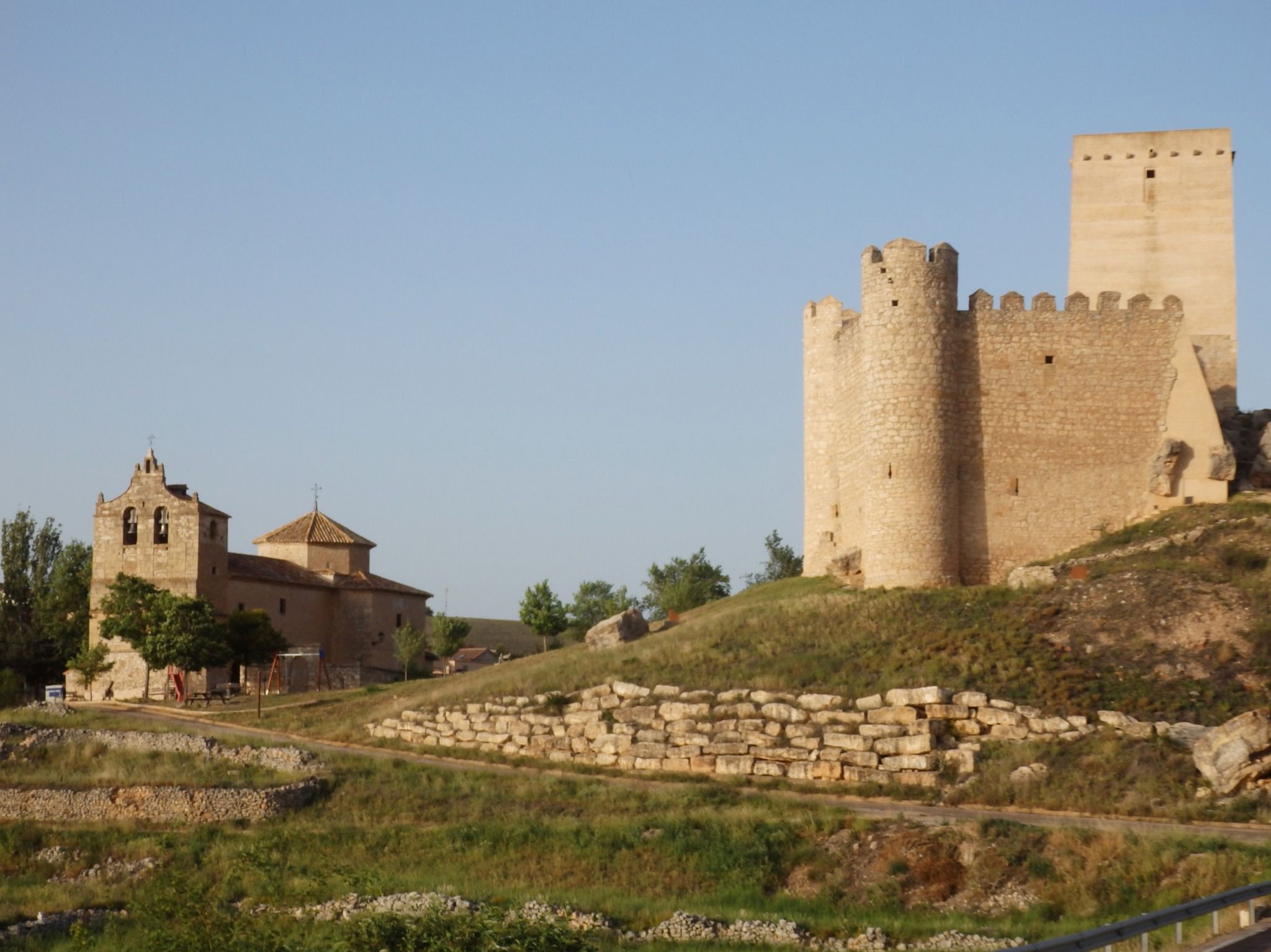
Other things to see which we did not is the parish Church de Santa Catalina (St. Catherine) next to the castle (see pic above) was built in the 15C and has undergone several renovations and restorations over the years. Its Gothic style can be appreciated in every detail, from its tall towers to its intricate ornamentation. A single nave and altars from the 16-17C, the spacious open-air atrium is particularly noteworthy.
The Cultural Heritage site of the Castilla La Mancha region tourist office on the Embid Castle : https://cultura.castillalamancha.es/patrimonio/yacimientos-visitables/castillo-de-embid
The private site castles of Guadalajara on the Embid castle : https://www.castillosdeguadalajara.es/castillo-de-embid/
There you go folks, another dandy in the wonderful region of Castilla La Mancha, in country Spain from its foundations. Enjoy Molina de Aragon , the town and the thrill of driving in mountain barren areas is good indeed. Again, hope you enjoy this post on this is Molina de Aragon !!! as I
And remember, happy travels, good health, and many cheers to all !!!


