
Yes indeed in a small town and so much architecture and history as in Châteaulin ! One of the nice road warrior trails to see this great off the beaten path gems of my lovely Bretagne!! I found again pictures in my cd rom vaults that should be in my blog for you and me, Therefore, let me tell you about curiosities of Châteaulin !!! Hope you enjoy the post as I.
The town of Châteaulin is located in the Finistère department no 29, in my lovely region of Bretagne, and in my belle France. The town is surrounded by the hills of the Armorican Massif, the Monts d’Arrée to the northeast, the Montagnes Noires to the southeast, and the Ménez Hom to the west. Châteaulin is a crossroads town: it is at the intersection of two expressways: N165 connecting Nantes to Brest via Vannes, Lorient, and Quimper, and N164 connecting Châteaulin to Rennes via Carhaix and Loudéac, which connect via the Pouillot interchange. Furthermore,the D788, which starts from the same interchange and crosses the town, is one of the two main roads providing access to the Crozon Peninsula. The town is 47 km from Brest, 44 km from Camaret sur Mer , 121 km from Saint Brieuc, and 118 km from my current home from where I came along the N165 to exit/sortie 59 to take the D41 road dir Châteaulin, bear right to take the D770 road with the Aulne river on your right hand side continue to roundabout just before the passerelle bridge bear left to take Rue Notre Dame then sharp right into Rue Font de la Vierge to the Enclos Church.
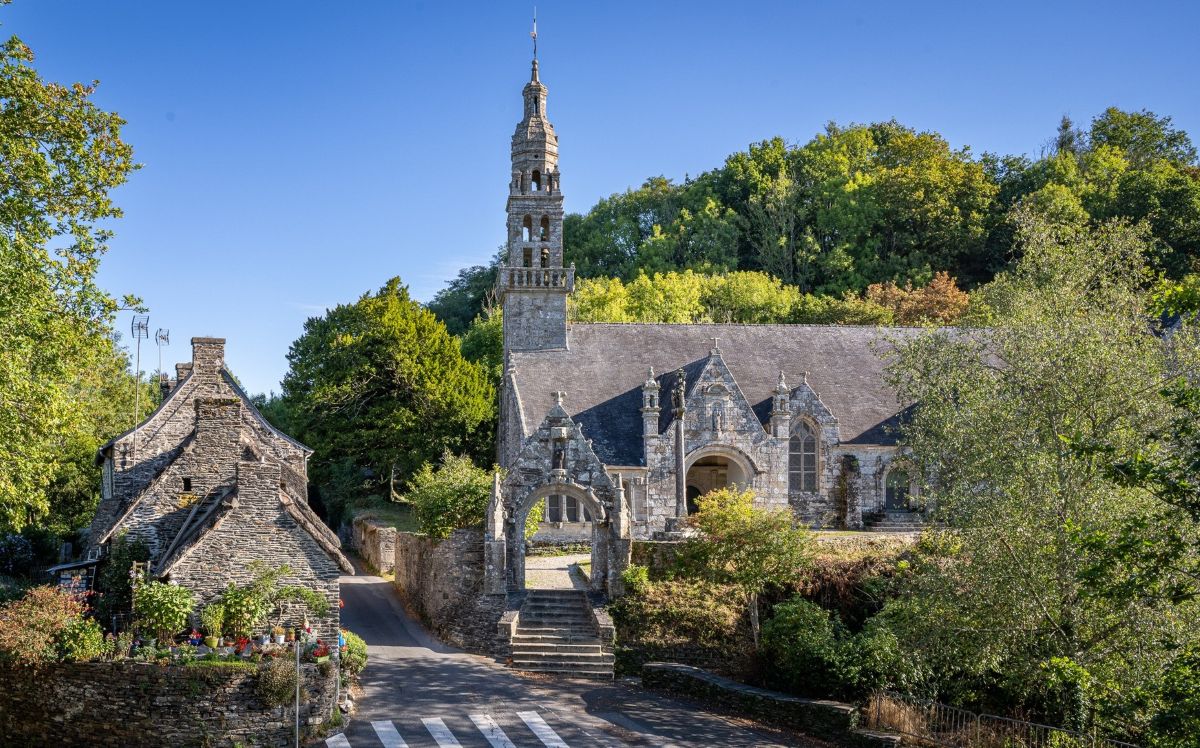
The Parish Enclosure with the Church Notre-Dame aka Chapel, see its Triumphal Arch, Cross, and Ossuary, This enclosure was built on a flat area of a hill that had been a fortified point since the 10C, the oldest parts of Notre-Dame Church date back to the 13C. The whole constitutes a complete parish enclosure.
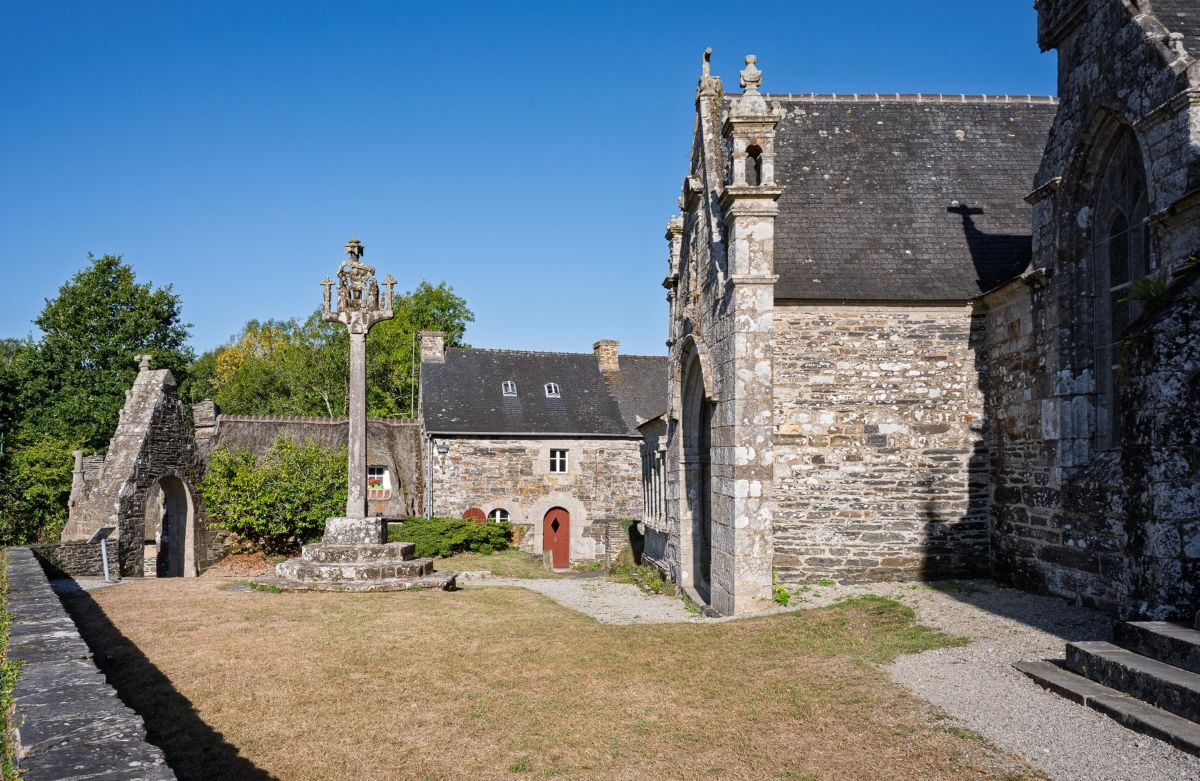
At the time, it was the parish church of a small village established on a nearby hill, of which the place known as Le Vieux-Bourg remains. The structure of the church evolved over the next five centuries according to the different styles of the time. Despite these modifications, this church exudes a certain unity that makes it a small masterpiece of Breton architecture. An interior visit to the church is a must: pillars in the style of the Pont-Croix school, painting of the brotherhood of Saint-Crépin and Saint-Crépinien… The Notre-Dame Church is open in July and August for a self-guided or guided tour. Pardon takes place on the first Sunday of September.
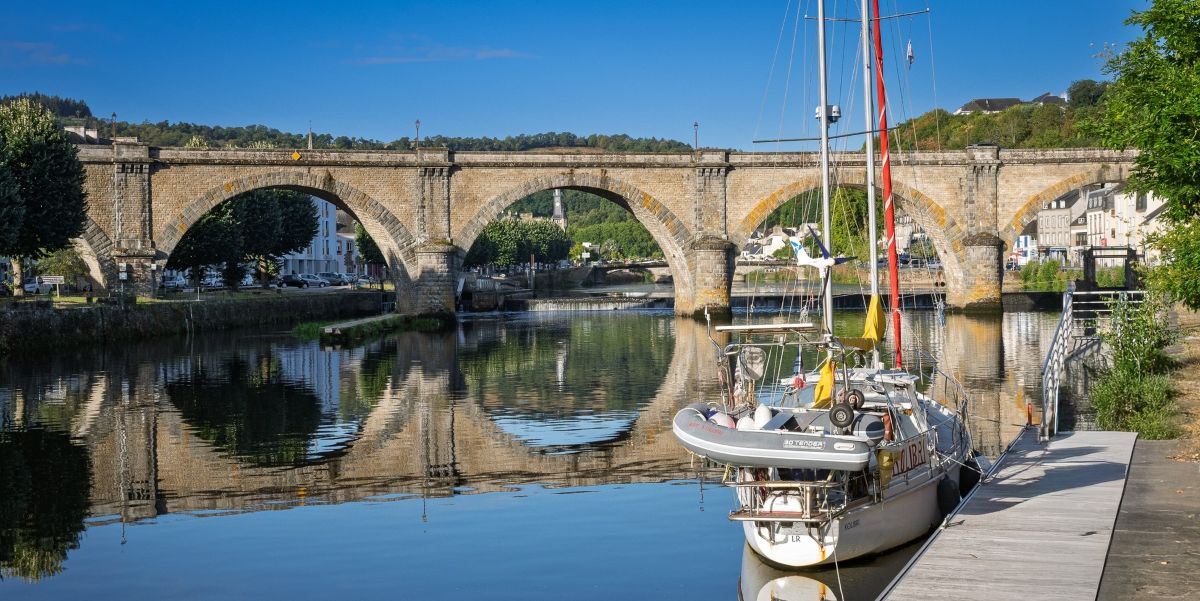
The viaduct, a curved bridge built in 1905-1906, spans the canal, overlooks the town and offers a beautiful view. It is 165 meters long, it is a curvilinear bridge with eleven masonry arches. The viaduct is now a single-lane road bridge, offering a clear view of the town and the canalised Aulne River.
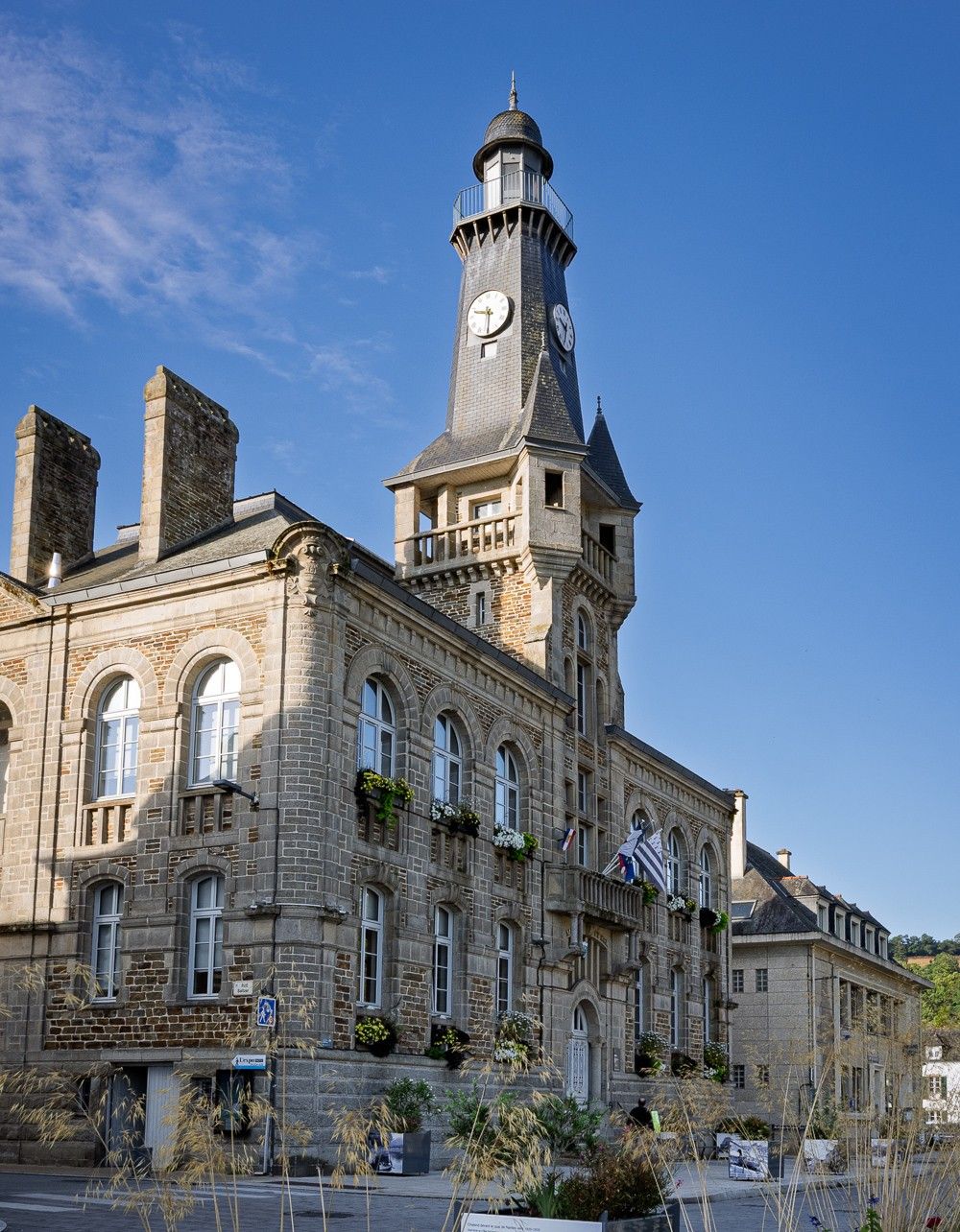
The Hôtel de Ville or city/town hall on the right bank of the Aulne river, which replaced an old dilapidated city hall, was built between 1912 and 1925.
Other things to see here are the Saint-Compars Chapel in nearby village of Lospars, which dates from the 16C, was restored in 1989, Notre-Dame Chapel in nearby village of Kerluan, in the shape of a Latin cross, dates partly from 1653, but has undergone numerous restorations since then. The keep of the old Château de Châteaulin dates from the 10-11C. The Nantes-Brest canal and its locks: Guillec, Pen-ar-Pont, Prat-Hir, Toul-ar-Rodo, Coatigrac’h, Châteaulin; near the latter, an aquatic observatory allows a descent into the bed of the Aulne river, and to see the fish pass inaugurated in 1996.
I like to show some interesting historical anecdotes of Châteaulin, Of a very fine and beautiful grain, Châteaulin slate was used since at least the 16C; transported to Brest by sailing ships , it was shipped as far as Normandy, to cover, for example, the Saint-Maclou church in Rouen (see post) and to England. The first velocipede races, organized as part of the Fêtes du Pardon, were held on July 14, 1889. The small Pardon cycle race, the “Grand Prix de Châteaulin”, created in 1933, was renamed “Circuit de l’Aulne” in 1935. Among its winners were Louison Bobet in 1949 and 1953, Rik Van Steenbergen in 1952, Rik Van Looy in 1962 and 1963, Raymond Poulidor in 1967, Jacques Anquetil in 1968, Eddy Merckx in 1966, 1969 and 1975, Bernard Hinault in 1978 and 1979, etc. What was the biggest criterium in the region was replaced in 1999 by “Les Boucles de l’Aulne – Grand Prix Le Télégramme” for the newspaper, The French road cycling championships were organized in Châteaulin in 1955, In 1982, coming from Concarneau, the 8th stage of the Tour de France (see posts) stopped in Châteaulin. The stage was won in a sprint by the Belgian Frank Hoste. Bernard Hinault won his fourth Grande Boucle that year.
A bit of history I like tell us that in the region of Châteaulin, several megalithic monuments have been discovered. The menhirs that make up these alignments are blocks of schist 2 to 3 meters long while the subsoil is made of Armorican sandstone. Two Roman roads passed through Châteaulin: the strategic road (via militaris) linking Le Mans to Camaret via Rennes and Carhaix, crossed the Aulne on a ford at the height of the current bridge; it followed roughly the route of the Grand-Rue and the old road to Pleyben; the local road (via vicinalis) leaving Châteaulin (or Carhaix) for the peninsula of Cap Sizun. It is believed that it passed through Cast and ended at the Baie des Trépassés where curious remains of Roman buildings remain. The last prior of Châteaulin, Dom Pierre Lemoyne, was also prior of the abbey of Landévennec, which at the end of the 18C had only three monks. The Revolution of 1789 led to the disappearance of the latter and of the priory of Châteaulin. The priory house was sold to the town in 1824 to serve as a presbytery. Few people know that Châteaulin was endowed with a castle and yet, on the heights of the town, near the parking lot of the retirement home, some ruins remain, including a tower. A count of Cornouaille, probably Budic de Châteaulin, built a fortified castle there in the 10C. When the Cornouaille family inherited the ducal crown in 1066 with Hoël II of Brittany, the Châteaulin castellany became part of the ducal domain. In 1084, Duke Alain Fergent donated the locks, mills, and fisheries of Châteaulin to Landévennec Abbey. In 1373, the castle was burned down by the English before their departure in the face of the advancing royal army of Guesclin. It was never rebuilt; its ruins were used as a quarry for the construction of houses and even during the expansion of the Notre-Dame Church. In 1689, the castle and its mound were donated to establish a hospice. Today, the hospice has given way to a retirement home. Former ducal bar, Châteaulin became, after the attachment of the duchy to the kingdom of France in 1532, the seat of a royal seneschal’s court whose jurisdiction extended over 27 parishes. The courtroom and the jail were located at the current location of the court, rue de l’église, In December 1593, during the Wars of the League, the Count of Magnane, captain of the Duke of Mercœur, obtained permission from the commander of Quimper to pass with his troops through Châteaulin, After having sacked the town of Faou, for fifteen days, the parishes of Châteaulin, Plomodiern, Plounévez, Quéménéven, Locronan, were in a way bled white by a frenzied soldiery. It was in a difficult economic context that the stamped paper revolt broke out in 1675. On the morning of June 9, 1675, the alarm bells rang from the bell towers of Châteaulin and the surrounding parishes. Peasants from around thirty parishes rose up and marched towards the town, armed with pitchforks, iron-tipped sticks, rifles and muskets. Arriving within the walls, on the wheat square, they attacked the Marquis de La Coste, the king’s lieutenant for Lower Brittany, nicknamed by the population “the great salt tax collector”, who had come to enforce the new edicts on tobacco and stamped paper. Marquis de La Coste managed to leave Châteaulin in a hurry to take refuge in the Château de Brest. This revolt was one of the bloodiest in the history of Brittany, also called the Revolt of the Bonnet Rouge or Red Caps in reference to the color of the caps worn by the peasants. In 1793, everything that recalled the past had to be destroyed. The Republican calendar had replaced the Gregorian calendar. Châteaulin would go on to be called Cité-sur-Aône, Montagne-sur-Aône, and Ville-sur-Aône, the latter name finally being chosen on November 15, 1793. The town would regain its name a few years later. The Nantes-Brest Canal was built to unblock Brest from the hinterland. Work began in 1810 and was completed in Châteaulin with the inauguration of the Guilly-Glas maritime lock and the wet dock by Napoleon III and Empress Eugenie in 1858. Under the Second Empire, Châteaulin’s dominant activity remained the slate industry. Châteaulin was the first electrified town in the West and the fourth in France. The hydroelectric plant was commissioned on March 20, 1887. Jean Moulin, the future leader of the French Internal Resistance, was sub-prefect of Châteaulin between 1930 and 1932, frequenting poets such as Saint-Pol-Roux in Camaret and Max Jacob in Quimper. Châteaulin was occupied by the nazis on June 19, 1940. The town was liberated on August 11, 1944 by the 2nd “Stalingrad” battalion (leftists), formed of FTPF resistance fighters from the Saint-Goazec – Spézet maquis, commanded by Auguste Le Guillou, who also created the Penarpont maquis.
The town of Châteaulin on its other heritage : https://chateaulin.fr/se-divertir/patrimoine-historique-architectural-chateaulin/
The town of Châteaulin on its religious heritage : https://chateaulin.fr/se-divertir/edifices-religieux/
The local Menez Hom Atlantique tourist office on Châteaulin : https://www.menezhom-atlantique.bzh/en/decouvrir-menez-hom-atlantique/nos-17-communes/chateaulin/
There you go folks, another dandy off the beaten path town in my lovely Bretagne, worth the detour, me think. This is Châteaulin, and its Enclosure. Again, hope you enjoy this post on curiosities of Châteaulin !!! as I.
And remember, happy travels good health, and many cheers to all !!!

 Paris1972-Versailles2003
Pretty spot
LikeLiked by 1 person
Oh my dear there are so many glad you like it too. Thanks for stopping by Cheers
LikeLiked by 1 person
Aren’t there just!
LikeLiked by 1 person