
I bring you back to tell you again about the wonderful town of Dinan, in the Côtes d’Armor dept 22 of my lovely Bretagne. I am happy to have found me more pictures in my cd rom vault that should be in my blog for you and me. Therefore, here is my take on the curiosities of Dinan part II !!! Hope you enjoy the post as I.
From the birth of Dinan until the 19C, the western facade of the city was protected by a deep valley that stretched from the current Place Duclos to Bas Bourgneuf. At the bottom of the valley, a small stream was called “Cocherel”. This valley is overlooked by a counterscarp converted into a promenade in the 18C call the Petits Fossés. The garden dates from 1850 and from the 1930s, the upper part of the valley, between Place Duclos and Trou au Chat was urbanized. The Mayor of the time surrounded the beautiful building of the Caisse d’Epargne (today CCAS) with a garden below. Then to develop the rest of the valley between the promenade and rue Chateaubriand. The city bought the De Ferron mansion and its park to install the municipal library there. The Jardins du Val Cocherel garden or commonly called “the garden of the Little Devils” takes its name from the small stream “Cocherel” which flows at the bottom of the garden, this magnificent park of approximately 4 hectares of greenery is located in the heart of the city of Dinan. You will find slides and swings for children, a covered picnic area, mini-golf, ping-pong tables, animals (fawns, aviaries) a wide variety of flowers as well as a kiosk in the middle from the garden offering cold drinks, ice creams and sandwiches. Below the garden, a pond offers a space of calm and relaxation. Most of this information from the City of Dinan webpage,
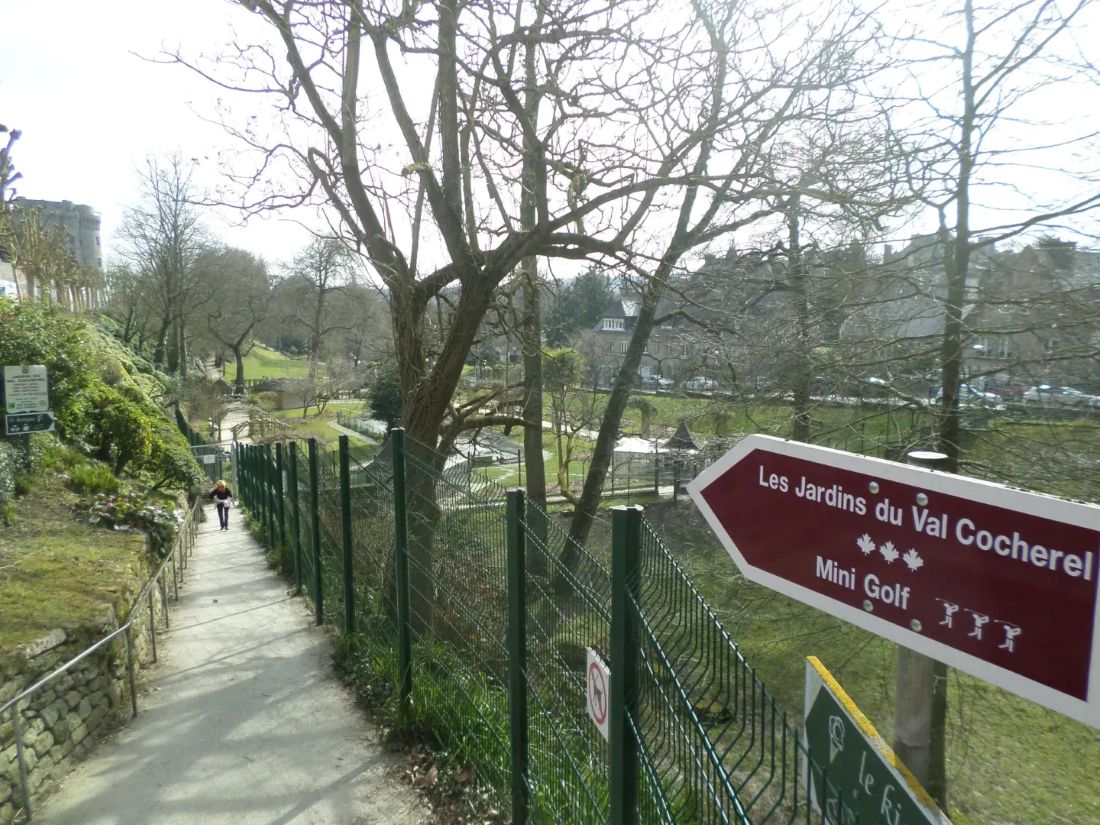
The city of Dinan on the garden Cocherel : https://www.dinan.fr/196/jardin-du-val-cocherel
The history of this tour de l’Horloge (see post) or Clock Tower begins at the end of the medieval period, that is to say at the end of the 15C and beginning of the 16C. The construction of the Clock Tower began during the reign of the Duke of Brittany François II, when the first stone was laid by Jean II de Rosnyvinen, governor of the city between 1471 and 1481. It was only in 1507 that the daughter of François II issued a letter of patent authorizing the installation of a clock on the tower, thus making the municipal tower a real belfry. A clock that is also famous was built and equipped with an exceptional mechanism still visible today on the ground floor of the building. Thanks to this clock, Dinan became one of the first Breton towns to have a belfry, at the same time, a bell was installed, named the Duchess Anne, an obvious tribute that resonates throughout the town… See before it on the pic the wonderful medieval house by 27 rue de l’Horloge.
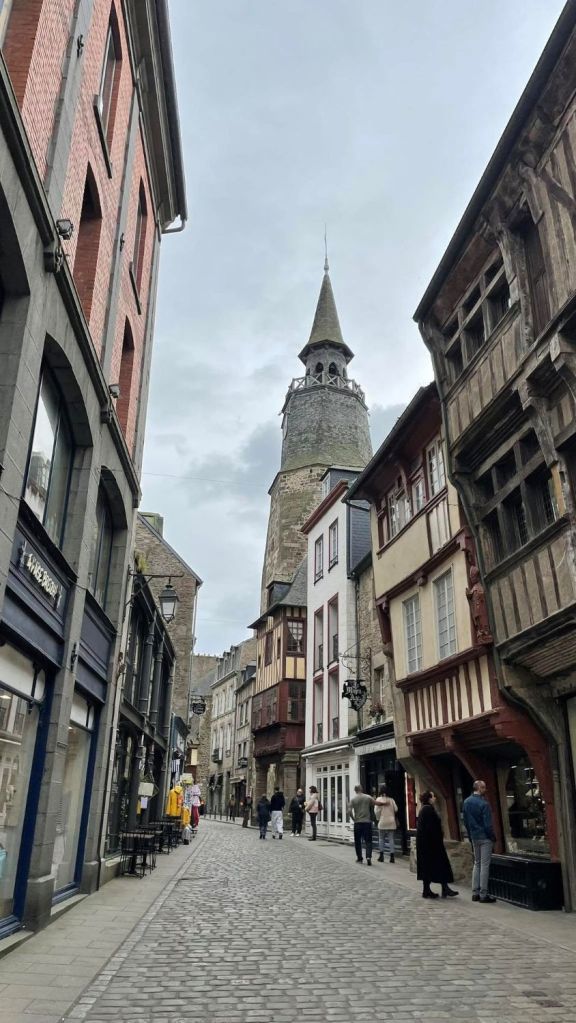
The rue du Jerzual, the hill most famous in Dinan that connects the port harbor to city center/downtown with a difference in height of 75 meters a slope of 35 % . A poor and noisy commercial artery until the 19C, the oldest street in the city has now become a tourist attraction. The construction of a viaduc in 1852, below the town, will change the vocation and appearance of Jerzual. Craftsmen took over the area to set up their workshops. Until 1930, the street was home to weavers, basket makers and tanners. Then it would experience silence and abandonment. In the 1970s, artists took over the street. The houses were in ruins, they would restore them step by step. Until they made Jerzual the prettiest street in the city. The most enigmatic too. To this day, no one knows what the word “Jerzual” means.
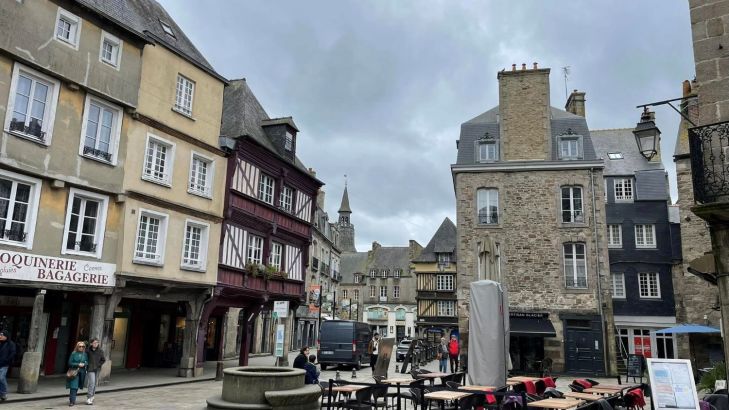
Not much written on the square per se ,Place des Cordeliers , It has a house at 10 Place des Cordeliers from the 12C, At no, 16 another medieval house, See the La Bigoudène – Restaurant, at 17 Place des Cordeliers ,On August 7, 1944, GIs paraded on Place des Cordeliers. The city had just been liberated by the American army. However, the most historical and architecturally to enjoy here is the Cordeliers Convent dating from the 13C, was built by Henry d’Avaugour, Lord of Dinan. This fromer convent now houses the private Catholic Cordeliers high school.
The Théatre des Jacobins is an intercommunal theater hosting various types of shows ,such as theater, concerts, circus, etc. Before being a theater inaugurated in 1966, the Jacobins was a convent founded by monks in 1232. In 1824, the city bought the building which was to undergo a series of architectural modifications throughout the 19C. Initially, the town of Dinan set up various businesses. At the same time, in another part of the convent, several dramatic societies perform. In 1868, the city/town hall decided to close the shopping areas and wanted to transform the place into a casino. On the other hand, it is urgent to undertake the repair work, because the building is deteriorating and is the cause of several serious accidents. The work was interrupted by the Great War or WWI, during which the casino was requisitioned. At the end of the 1920s, the hall hosted operettas whose companies rented the premises. It was therefore necessary to wait until the middle of the 20C for a municipal theater to settle in the premises, this time completely secure and refurbished in 1966.
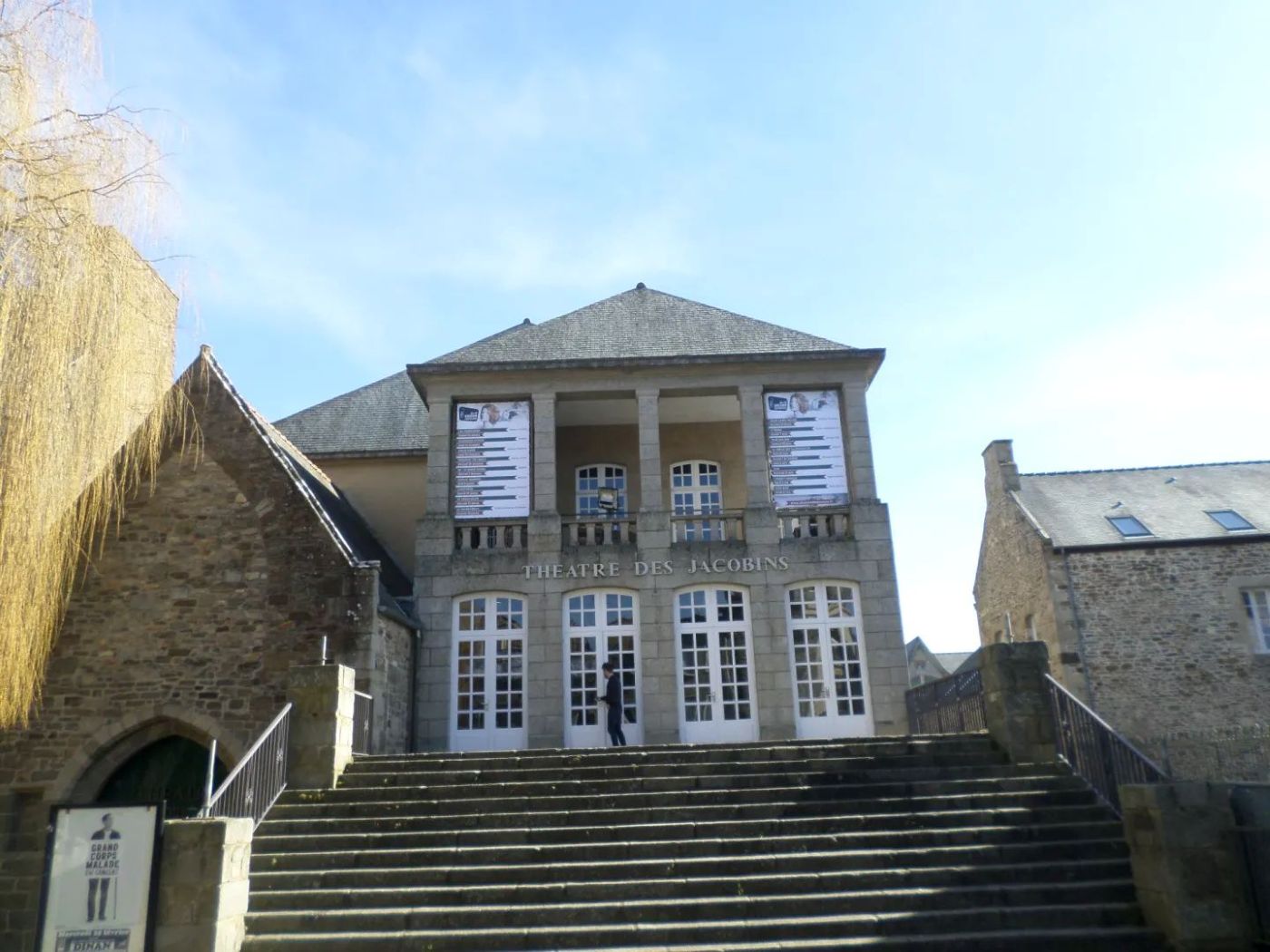
The Dinan metro area cultural agenda on the Theater of Jacobins : https://saison-culturelle.dinan-agglomeration.fr/Lieux-de-spectacle/Theatre-des-Jacobins-Dinan
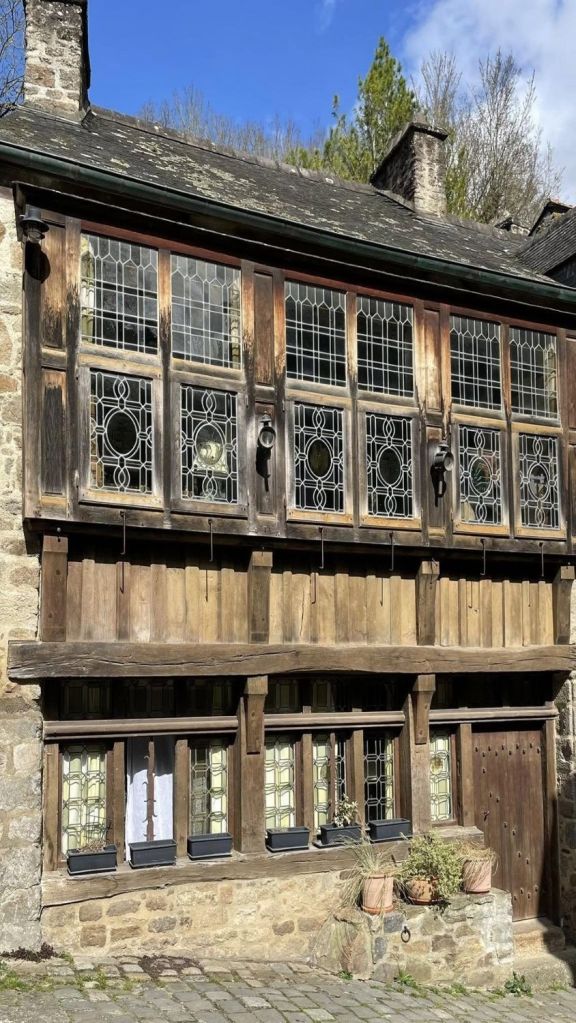
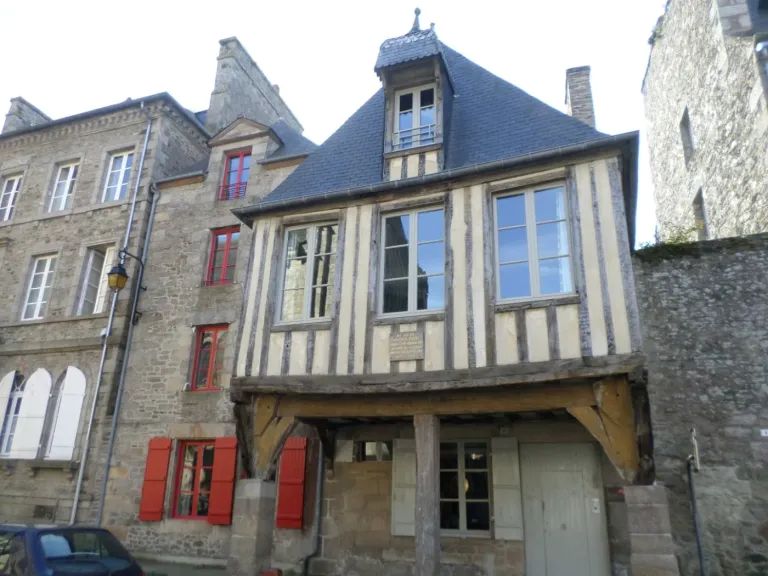
The Maison d’Auguste Pavie is located at 10 place Saint-Sauveur, in the historic center of Dinan, It is a half-timbered house where Auguste Pavie was born, this magnificent 15C residence where Auguste Pavie, explorer and diplomat in Indochina in the 19C was born. We are welcomed in an elegant and cozy living room with dark blue woodwork, inhabited by sofas draped in white linen. Elegance again at breakfast time for the carmine red dining room which fits perfectly with the Asian atmosphere. Objects brought back from Vietnam, carefully chosen, and magnificent statues populate the residence like this female representation of Buddha The rooms bear the name of the places where Auguste Pavie stayed: “Champassack” with vanilla-coloured walls, “Kampot” in beige tones and chestnut, “Angkor”, enhanced with plum… Nothing outdated though. In the “Luang-Prabang” room, a very contemporary blue canopy sits majestically under the age-old beams. A nod to Laos with these rice paddy hats but a designer bathtub for the bathroom. Auguste Pavie also stopped at Vinh-Long on the shores of the Mekong Delta, a small Vietnamese port made famous by Marguerite Duras’ novel “L’ Amant” or The Lover. The room of the same name has a magnificent gray wall fresco with elephants. . It is today a rental house or chambre d’hôtes in City center Dinan, so you can rent it and we just saw it, Webpage : https://www.lamaisonpavie.com/fr/chambre-hotes-charme-dinan/
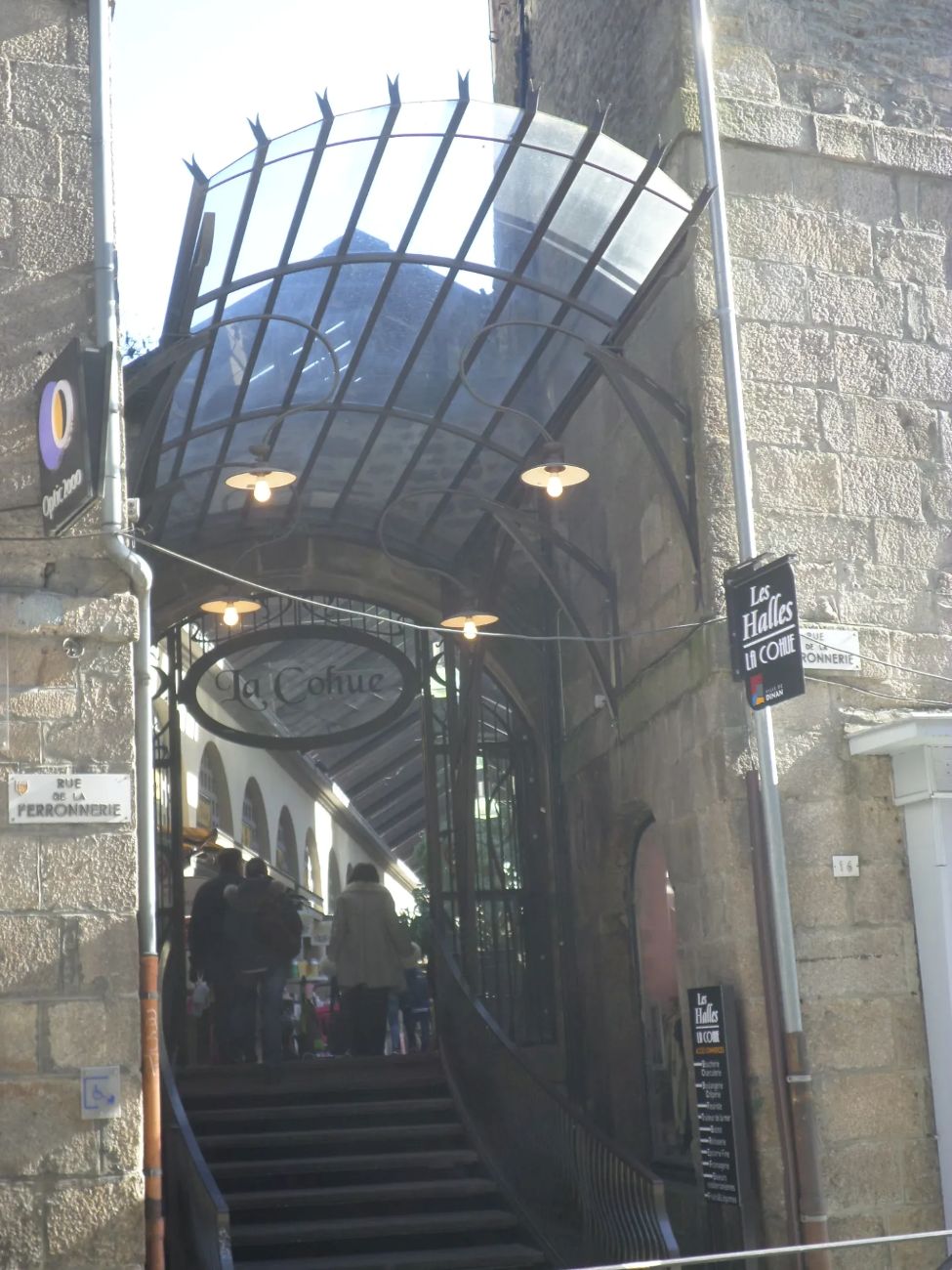
Located in the historic heart of the medieval city, the Halles de Dinan called “la Cohue”, It is accessed by different entrances: rue de la Ferronnerie, rue de la Mittrie and Place du Petit Pain . The 245 m² commercial space, which was completely renovated in 2009, remains little known. Sometimes even to locals ! This is now in concertation to do improvement for the visibility of the market Cohue and decision expected any time now, Hope it stays and can get improvement done as needed. The city of Dinan on the market Cohue : https://www.dinan.fr/80/les-halles-dinan-la-cohue
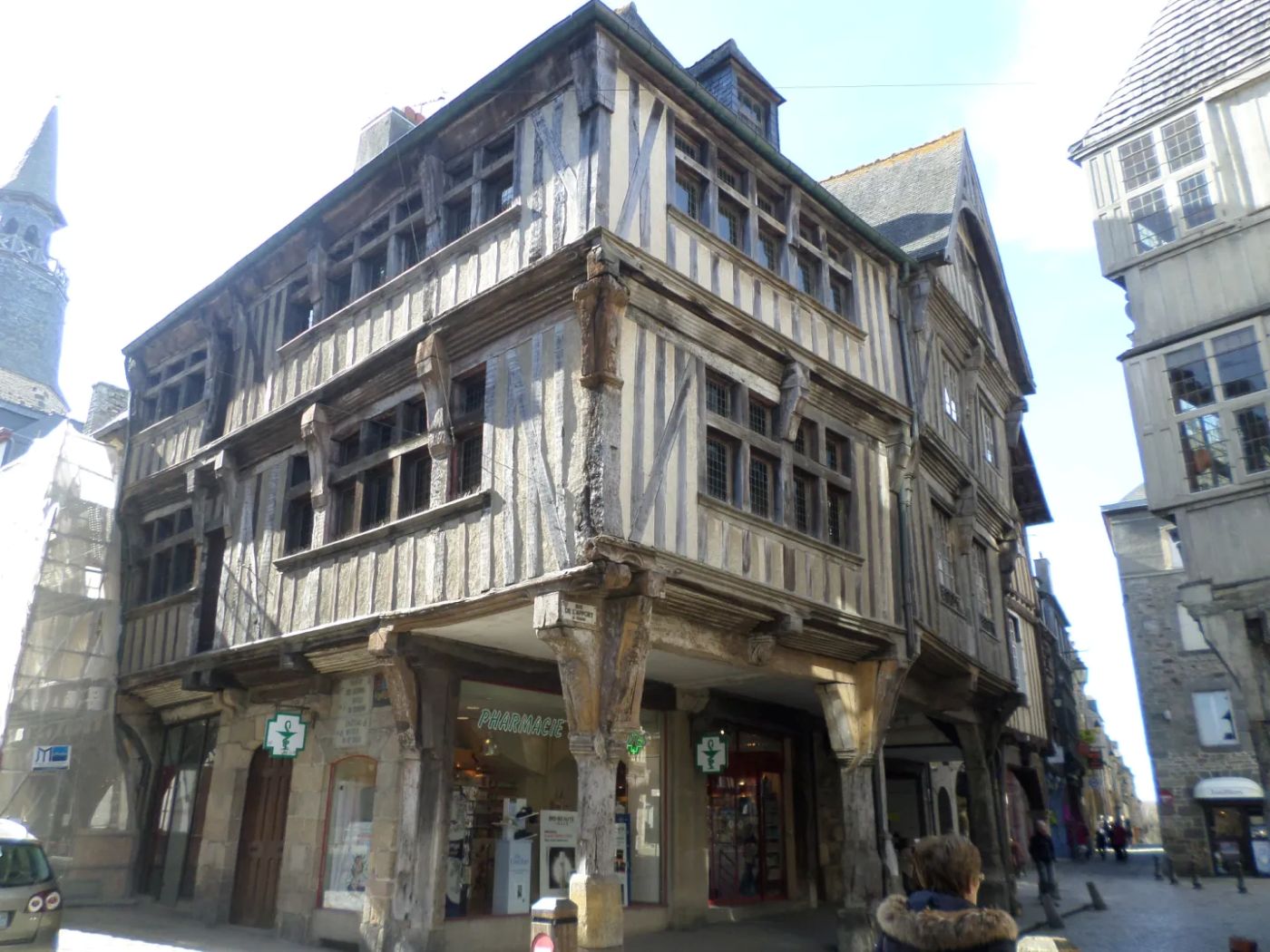
The Pharmacie des Arcades at 4, rue de L’Apport at the corner of rue de L’Apport and rue de l’Horloge, This is undoubtedly one of the oldest houses in Dinan, or even in Brittany, and in all surely the most photographed in the historic city center. But modern times are tilting and the five pharmacies in city center/ downtown Dinan have been merged since 2020 to become one. Indeed, the Place Duclos pharmacy, which is the most strategic square in this medieval town, is the one hosting this merger , The Place Duclos pharmacy has a surface area of more than 200 m², The former house of the pharmacie des Arcades was on sale last I heard.
The local Dinan Cap Frehel tourist office on Dinan : https://www.dinan-capfrehel.com/nos-incontournables/dinan-cite-medievale-bretagne/
The city of Dinan on its heritage : https://www.dinan.fr/mes-loisirs/culture-et-patrimoine/lieux-culturels/
The label Ville et Pays d’art et d’histoire on Dinan ( City and Country of Art and History): https://www.sites-cites.fr/territoires/dinan/
There you go folks, another dandy in my lovely Bretagne, in my road warrior trails of ever finding beauty all over my belle France, Delightful Dinan is a must to see , me think. Again, hope you enjoy the post on the curiosities of Dinan, part II !!! as I.
And remember, happy travels, good health, and many cheers to all !!!


