
I take you up north to beautiful Dinan, in the Côtes d’Armor dept 22 of my lovely Bretagne and my belle France, again. Ah yes very popular town and famous for the chic and famous nice living good beaches and several nice places to see if reading my blog. I have written several entries on Dinan, and just found me older pictures in my cd rom vault ,not yet in my blog and they should be, Therefore, here is my take on curiosities of Dinan, part I !!! Hope you enjoy the post as I.
You can admire the wonderful statue on Jehan III (or IV) de Beaumanoir, was a Marshal of Bretagne/Brittany. Knighted in 1342, Marshal of Brittany for Charles de Blois, This statue is at Place Duclos, He was a friend and comrade-in-arms of Duguesclin. During the War of the Succession of Brittany (1341-1365), he warmly embraced the cause of Duke Charles of Blois (who lost the war see post) against Jean de Montfort, who disputed with him the possession of Brittany and was one of the most distinguished heroes in the Battle of La Roche-Derrien in 1347. Charged as captain of the defense of the castle of Josselin, he sent a challenge to the English governor of Ploërmel from which the battle of the Thirty, fought on March 26, 1351 by 30 Bretons against 30 English from which he emerged seriously wounded. In 1354, he went to England to negotiate the release of Charles de Blois and attended, in 1364, the Battle of Auray where he was taken prisoner. In 1365, he was one of the negotiators of the Treaty of Guérande, and the peace made, is confirmed by his title of Marshal of Brittany. He is buried in the abbey of Saint-Magloire de Léhon (Côtes d’Armor dept 22).

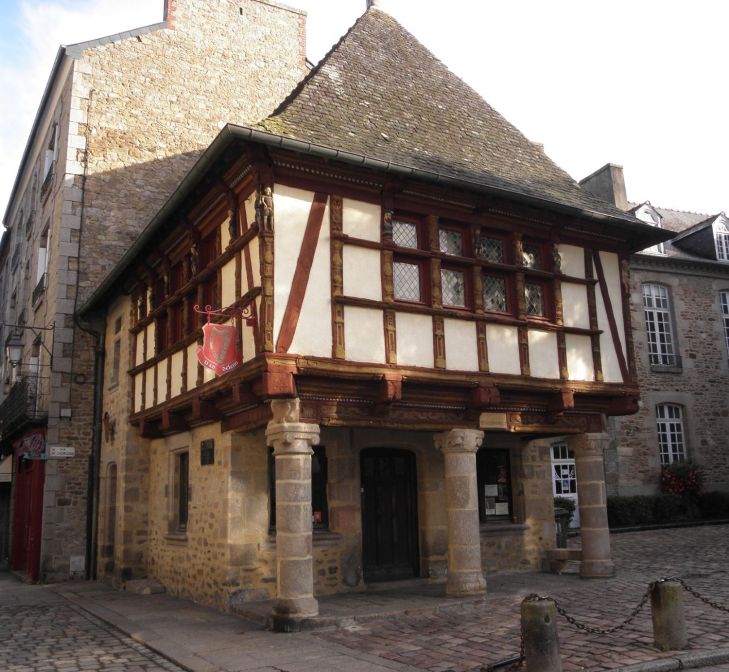
The Maison de la Harpe Celtique or the Celtic Harp House, in Breton Ti an Delenn called Hôtel de Kératry, at 4 rue de l’Horloge built in 1559 at 1 rue Guével in Lanvollon, it was sold in 1936. The mayor of Dinan, Michel Geistdoerfer, a volunteer in matters of protection of half-timbered houses, acquired it for the town and had it rebuilt in its current location in 1938. Since 2003, it has housed the headquarters of the International Celtic Harp Meetings Committee (CRIHC) and served as a venue for exhibitions and workshops. The first floor, projecting onto the street, rests on three granite columns. Its main pieces are made of wood, the walls are made of cob and on two of the facades, small figures have been sculpted and painted, in 16C costume. The official Maison de la Harpe Celtique : https://www.harpe-celtique.fr/maisondelaharpe/
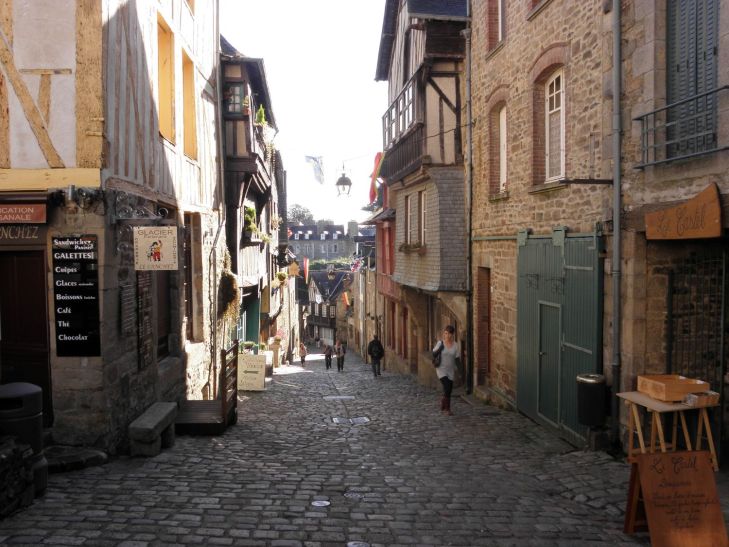
The Rue du Jerzual was a commercial artery, poor and noisy until the 19C, the oldest street in Dinan has become a tourist curiosity today. It is a narrow street that walks from the port on the banks of the Rance to the center of town. For centuries, merchants, travelers and walkers will take this unique, extremely steep route. This essential link between the bourgeois upper town, and the shopping and popular lower town. Craftsmen take the neighborhood to set up their workshops. Until 1930, the street welcomed weavers, basket makers and tanners. Then know silence and abandonment. In the 1970s, artists took place. The houses were in ruins, and they will restore them. The emblematic Sanchez glacier artisan, present for more than 40 years in Saint-Malo, crosses the Rance ,and set up here the Glacier du Jerzual at 1 rue du Jerzual , a must stop for us.
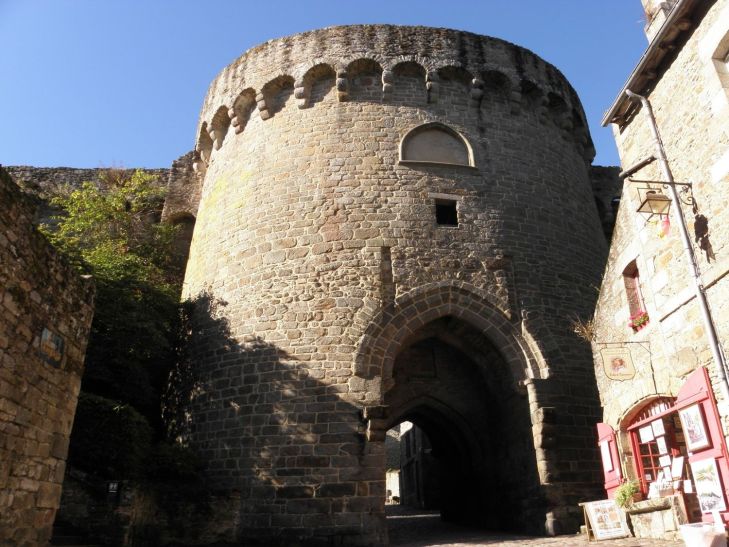
The Porte de Jerzual gate dates from the 14C, and is an old entrance to the city enclosure. It marked the limit between the ancient medieval city and the suburbs of the city of Dinan. It is located on the access route which connected the port to the upper town, with on one side of the gate, the rue du Petit Fort, and on the other rue du Jerzual. This communication route was used for the trade of leather, canvases, wood, spices, cereals, ceramics, etc.
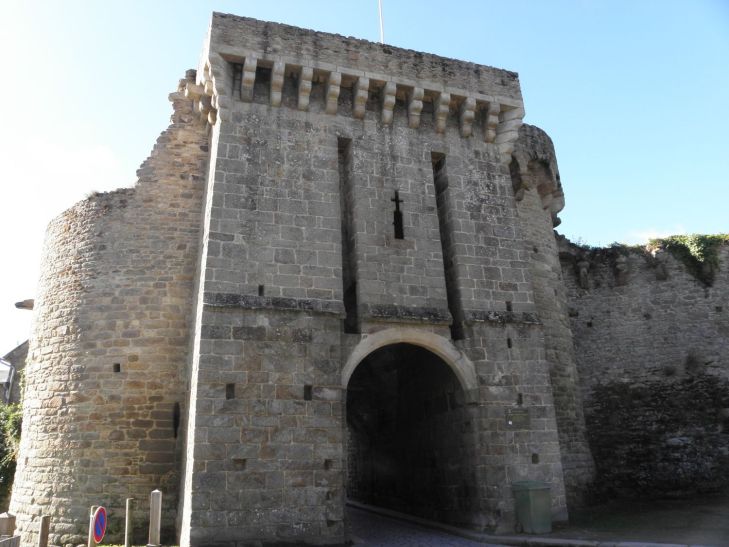
The Porte Saint-Louis gate at 14 Rue du Château is the youngest of the city gates, the date of 1620 can be read on its exterior face. On the interior side appears at the top the gate ,there was a guardhouse demolished in 1791. It was in ruins and each hurricane carried away flights of slates and structural parts. A concrete platform has replaced the small house. Another guardhouse occupied, at the foot, the site of the house on the right, near the niche made in the wall where perhaps the lantern for the rounds was placed. we find at the entrance a statuette of the Virgin in its niche, it is the continuation of a tradition which put the gates of the cities under the protection of Heavens. Given the date of construction of the Porte Saint-Louis, the dangers of a siege seemed past or henceforth unlikely. The gate then waited for its drawbridge until the end of the 17C. Access to the city from the route de Rennes having become impossible following the construction of the towers of Penthièvre and Coëtquen (15C) and the closing of the Porte du Guichet (end 16C). The Porte Saint-Louis was built in 1620 and restored in 1929. It is still open for vehicular trafic and we tried it of course, superbe !

The Bastion Mercoeur or the Grand Fort at rue Saint-Malo between 1585 and 1598, in the midst of the war of religion , the city defenses were reactivated by the Duke of Mercoeur, who makes Dinan a strong place in the League against the Protestants. It includes, in what is called Fort Mercoeur, A first two -round building is built in the 13C with the characteristic features of the Capetian fortification, It therefore seems possible to attribute the construction of the Châtelet, with the two towers and the systems defenses, to Duke Jean Ier, between 1265 and 1286, Later, in the years 1450-1470 the quadrangular before-body was built in front of the 2 laps of flanking , In 1585, the Duke of Mercoeur had bastions built in several points of the enclosure wall ; built an advanced position or Bastion Mercoeur in front of the Porte Saint-Malo gate, It is through this gate that the royal army, thanks to the complicity of certain locals, entered the city in February 1598 and obtained the surrender of the men of the Duke of Mercoeur. It is also through this northern access that royalist troops entered in 1815.
The Chapelle Sainte-Catherine of Dinan was built in the 17C by the Dominicans who arrived in Dinan in 1631, First installed in the Hotel de la Garaye (current Hotel Beaumanoir rue Haute-Voie), they obtained permission in 1664 to establish themselves, to the east of the city, on land belonging to Dominican monks. It became the Hospital Chapel in the 19C and is the subject of an important decorative program that can be found on the apse of the choir and in the transepts. It features a Jesuit-style facade. Don’t miss the collection of statues among the oldest in the churches of Dinan and its monumental painting. These statues are a Saint-Antoine 17-18C, Saint-François d’Assise 16C in limestone, two bishops 17-18C, Saint-Pierre 16C, and a Christ on the Cross . There is also the oldest and the most exceptional, “The education of the Virgin”, from the beginning of the 14C,another, a limestone Virgin 15C, did not budge from the chapel because it was intact. She had been found in the 1930s, buried in a garden. The Chapelle Sainte Catherine is a jewel of Counter-Reformation architecture. The interior splendor of the 16C chapel, restored over seven years, dazzles visitors: immaculate walls, polychrome wooden statues, restored stone floor, and at the bottom of the church, a breathtaking trompe-l’oeil. After extensive renovation work it reopened on January 2022 for worship.

The City of Dinan on religious monument so the Chapelle: https://www.dinan.fr/298/les-edifices-religieux
The Dinan Cap Fréhel tourist office on the Chapelle Sainte Catherine : https://www.dinan-capfrehel.com/culture-patrimoine/chapelle-sainte-catherine/
With more walk on the ramparts along the Tour Saint Catherine with a nice view of the viaduc de Rennes over the Rance river, this grandiose granite monument is 250 meters long including the abutments; its height is 40 meters above the towpath and 50 meters including the foundations. It is made up of 10 arches 16 meters wide, separated by straight feet 4 meters thick; the width of the cart track is 5 meters; it is bordered by sidewalks 1 meter wide.

The port of Dinan from the castle. Here, you walk along the small harbor, take the time to sit on the benches and contemplate the boaters who moor. In the shade of the palm trees, relaxation is guaranteed!

The city of Dinan on the castle/museum : https://www.dinan.fr/mes-loisirs/culture-et-patrimoine/le-patrimoine/les-sites-historiques/le-chateau-de-dinan/
The local Dinan-Cap Fréhel tourist office on Dinan: https://www.dinan.fr/mes-loisirs/culture-et-patrimoine/le-patrimoine/
The Bretagne region tourist office on Dinan : https://www.brittanytourism.com/destinations/the-10-destinations/cap-frehel-saint-malo-mont-saint-michel-bay/dinan/
There you go folks, as you have read my previous posts on Dinan, the sights are endless, the beauty is out of this world,and I encourage you to come over and see it first hand. Lots of history, architecture here. Again, hope you enjoy this post on curiosities of Dinan, part I !!! as I.
And remember, happy travels, good health, and many cheers to all !!!


