
I come to my nice Rennes. This time one of the nicest monument , and of course the City is in Îlle et Vilaine dept 35,of my lovely Bretagne, I have come back to this beautiful City after a long hiatus and it was wonderful, Bear with me as the next posts will be on this wonderful City. To end the tour, I will detail the chapels and pulpit on this post ok, Let me tell you about the Cathédrale Saint Pierre de Rennes, part II !!! Hope you enjoy it as I.
The Cathédrale Saint-Pierre or St Peter’s Cathedral is located in the heart of the city of Rennes. It is the seat of the Archdiocese of Rennes, Dol and Saint-Malo. Classically styled, it is one of the nine historic Cathedrals of Brittany. The towers of the Cathédrale Saint Pierre house a ringing of five bells. The bourdon, named Godefroy, is housed in the North tower and weighs about 7 900 kg. Its beating of 240 kg was changed on December 12, 2011. The other four bells, located in the South Tower, bear the names of Mary, Pierre, Amand and Melaine. They weigh 3 950 kg, 1 467 kg, 1 155 kg and 475 kg. Pierre is the only preserved bell of 1843, which had three sound vases. The bourdon, named after the first Cardinal-Archbishop of Rennes, Mgr. Brossay-Saint-Marc, is the biggest hidden bell in Brittany. The names of its sisters evoke the holy patron of the cathedral, Peter, that of the Archdiocese of Rennes, Dol and Saint-Malo, Melaine, and his predecessor on the Episcopal throne, Amand.
Besides the front, the façade has five coats of arms of tufa , showing from top to bottom, from right to left we have that of the Beaumanoir, that of Charles Albert of d’Ailly, 3rd Duke of Chaulnes, governor of Brittany, that of Jean-Baptiste de Beaumanoir de Lavardin, Bishop of Rennes from 1676 to 1711. that of Henri de La Mothe-Houdancourt, Bishop of Rennes from 1642 to 1662. And that of Duke Charles de la Porte. To underline the strength and solidity of the new ensemble as opposed to the fragility of the previous construction, the architects have endowed the facade with 22 granite columns. The pediment is to the arms of Louis XIV. Sculpted in the tuffeau, the bas-relief includes, in its center, a circular badge with the arms of France, wearing a royal crown. The necklaces of the Order of Saint-Michel and the Order of the Holy Spirit surround the crest. Above, the figure of the sun with the motto of Louis XIV: Nec pluribus imper. On the pediment: the keys to Saint Peter.These royal badges were not hammered during the French revolution ! Maybe too high up.
The floor covering of the Choir is made up of austere slabs of granite. These offer a violent contrast to the high altar made with marbles offered by Pope Pius IX and from the Roman Forum (Rome). The cul-de-furnace of the apse is adorned with a painting depicting the giving by Christ of the keys of the Kingdom of Heaven to Saint Peter, made circa 1871 by the 19C painter Alphonse le Hénaff. The Choir is surrounded by an ambulatory whose walls are decorated with representations of the various Saints of Brittany grouped according to their diocese (Rennes, Dol-de-Bretagne, Saint-Malo, Saint-Brieuc, Tréguier, Saint-Pol-de-Leon, Quimper, Vannes). They are also due to Alphonse Le Hénaff. The two crosses of the transept each have a sumptuous chapel adorned with remarkable frescoes. Those of the southern Chapel are consecrated to Sainte Anne, patron Saint of Brittany. There is also the painting of Saint Peter by the painter Henri-Joseph de Forestier given by king Charles X. The work dates from 1827 and represents Saint Peter delivered from his prison by an angel. The northern Chapel has a series of frescoes dedicated to Mary. They thus participate in the Marian cult widespread in Brittany. Above the crossing of the transept, an artistic project for the development of the four pendants was chosen; consisting in the installation of four statues of three meters in height each, in the four pendants under the dome which will represent the symbolic tetramorphous of the four Evangelists, associated with scenes from the Gospels, such as the Man for Saint Matthew, the Lion for St. Mark, the Bull for St. Luke, and the Eagle for Saint John. The crypt entrance is under the heavy slab engraved with the names of the buried bishops, in the middle of the Cathedral’s central aisle. This crypt is only open during burials. You can go down only upon the burial of a bishop or archbishop.
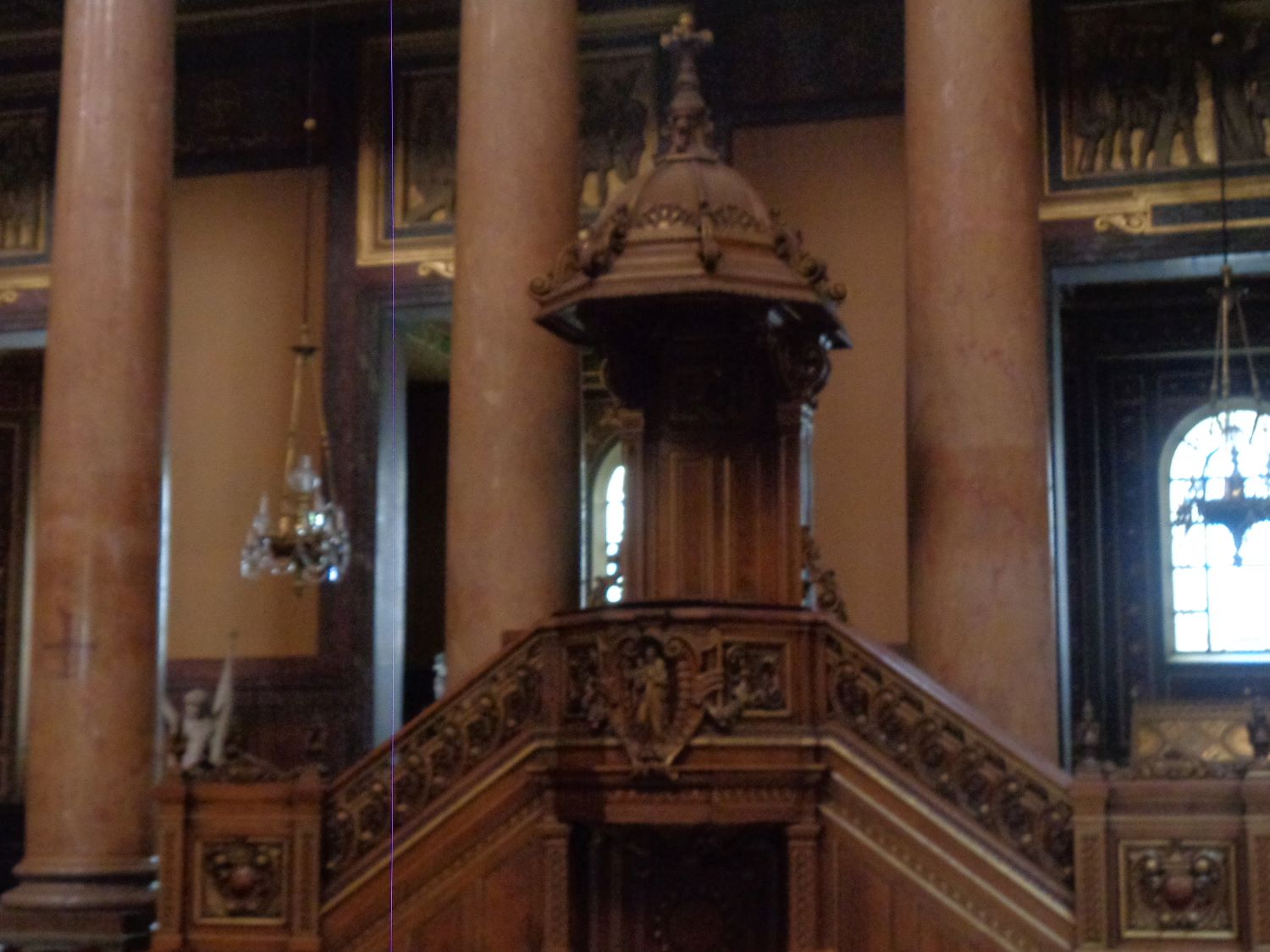
The current preaching chair or pulpit dates from 1886.
The side chapels offer a good panorama of religious painting in the 19c to say the least. Portraits and murals exalt the life of Christ, the Virgin and the saints of Brittany at a time when religious renewal will be won by ultramontanism. Such as the Chapelle Saint-Jean-Paul II , Chapelle Notre-Dame de la Cité ,and the Chapelle Saint-Jean-Baptiste. The baptism table of Christ deserves a supported look. Painted in 1846 by Joseph-Nicolas Jouy, bought by the State and sent to Rennes to furnish the cathedral to her reopening..Chapelle Saint-Yves ;done in the 17C or 18C. As well as others to follow.
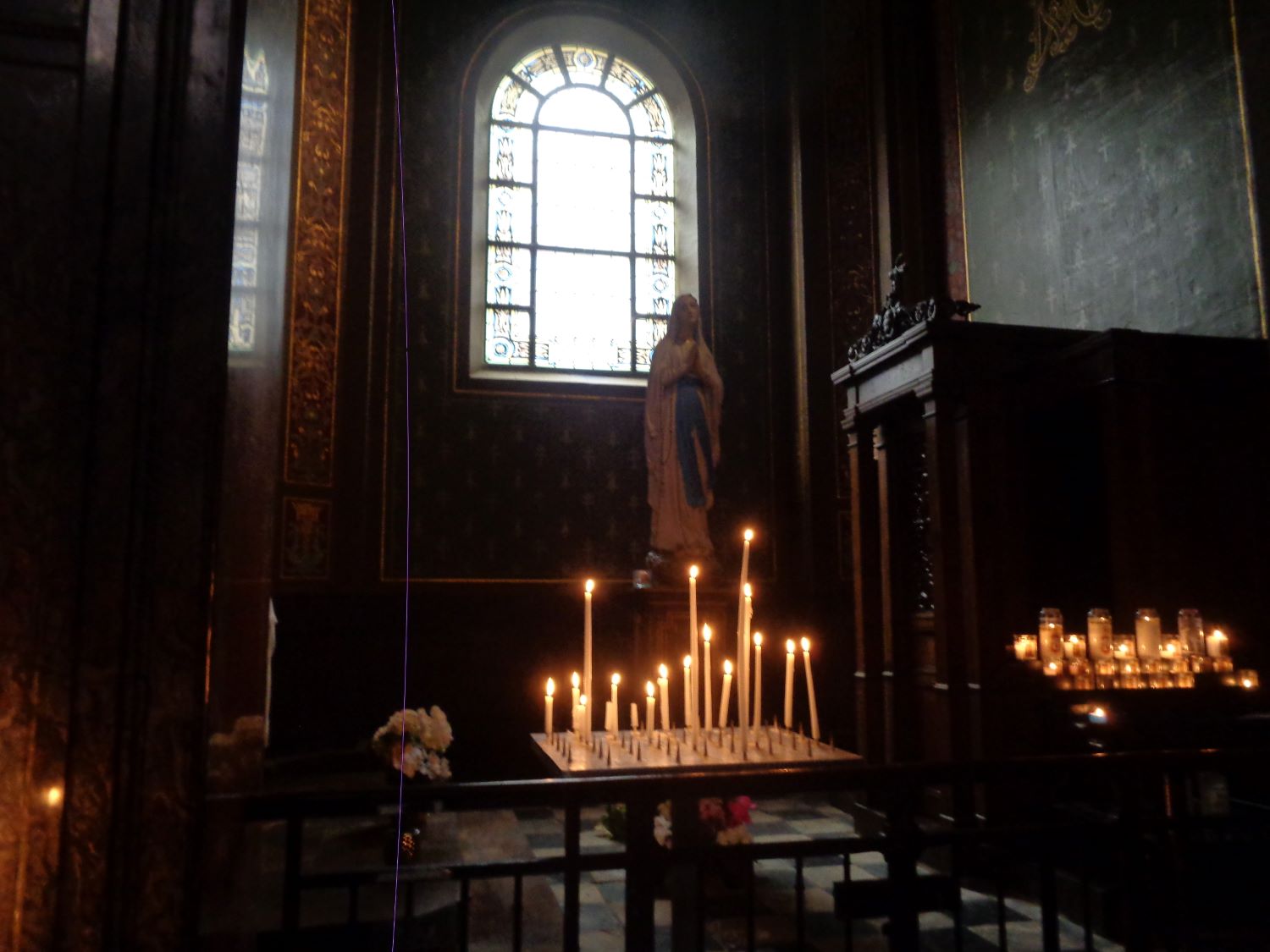
Upon entering you have the Chapelle of the Virgin Mary
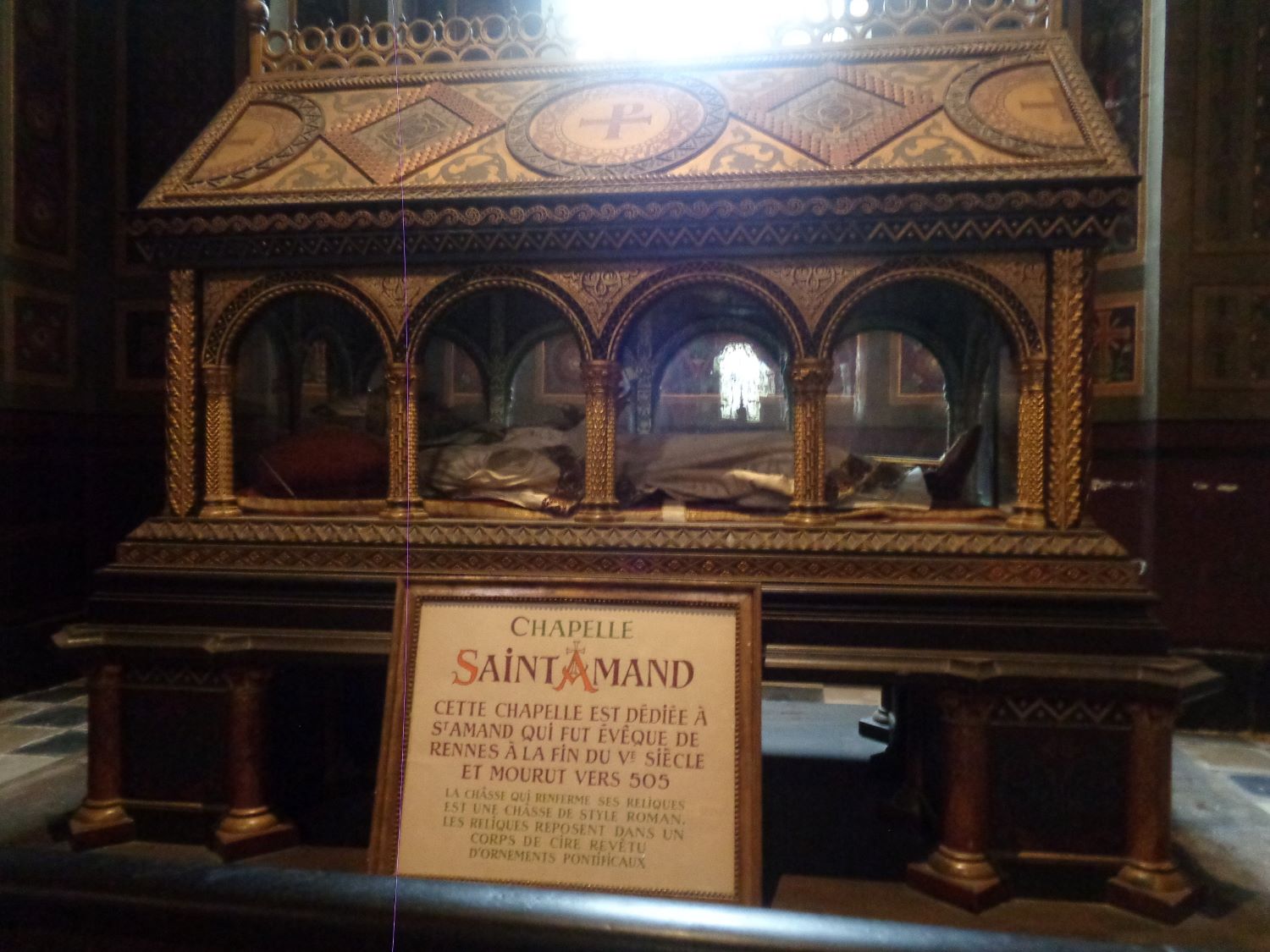
The Chapelle Saint-Amand . Amand was bishop of Rennes at the end of the 5C and died around 505. Made in 1852, the shrine which contained his relics is in a novel style.
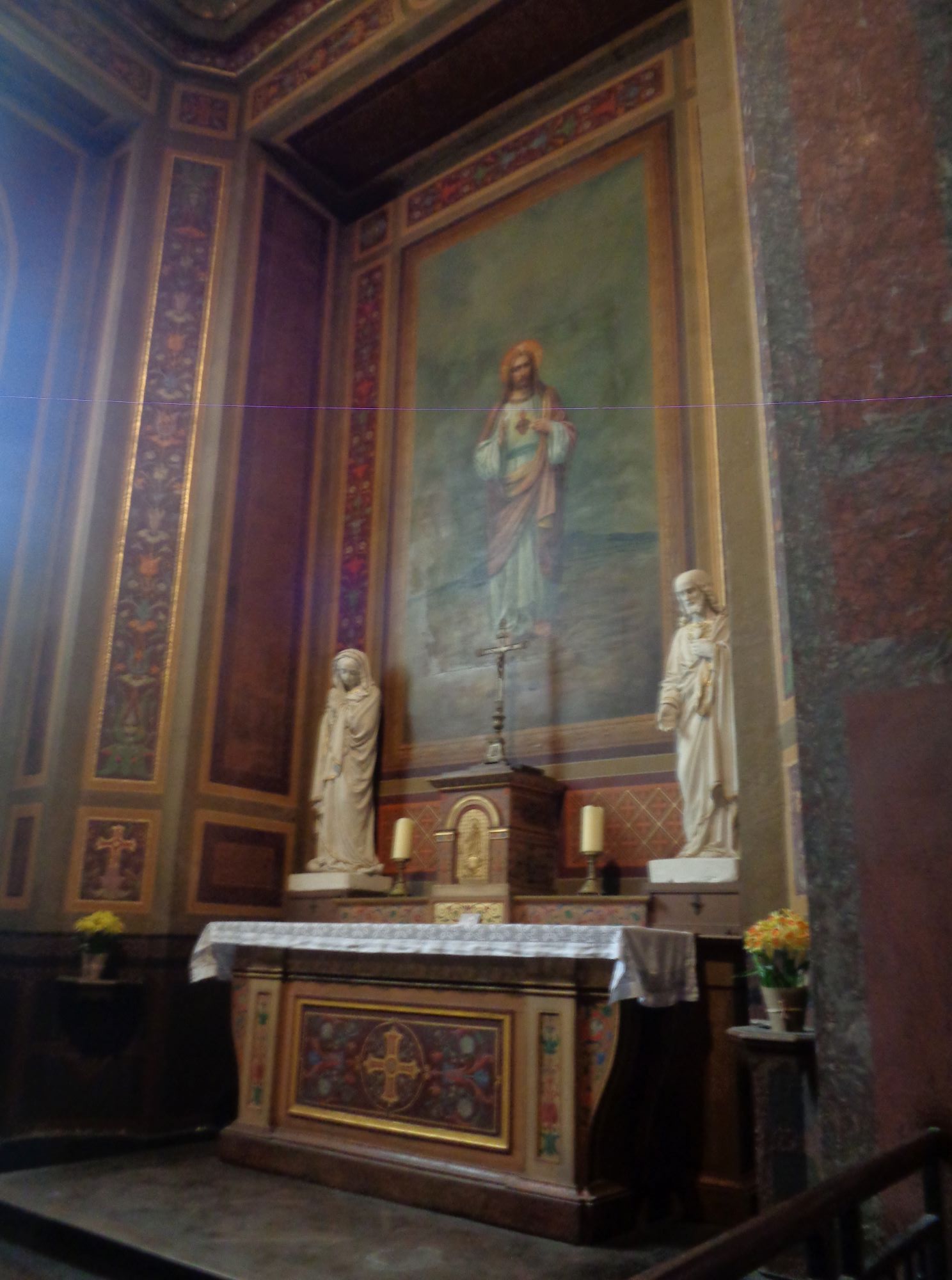
The Chapelle of Blessed-Marcel-Callo. The canvas, represents the “Christ of the Sacred Heart”. It was included in the second half of the 19C.
The Chapelle de La Bonne-Nouvelle.
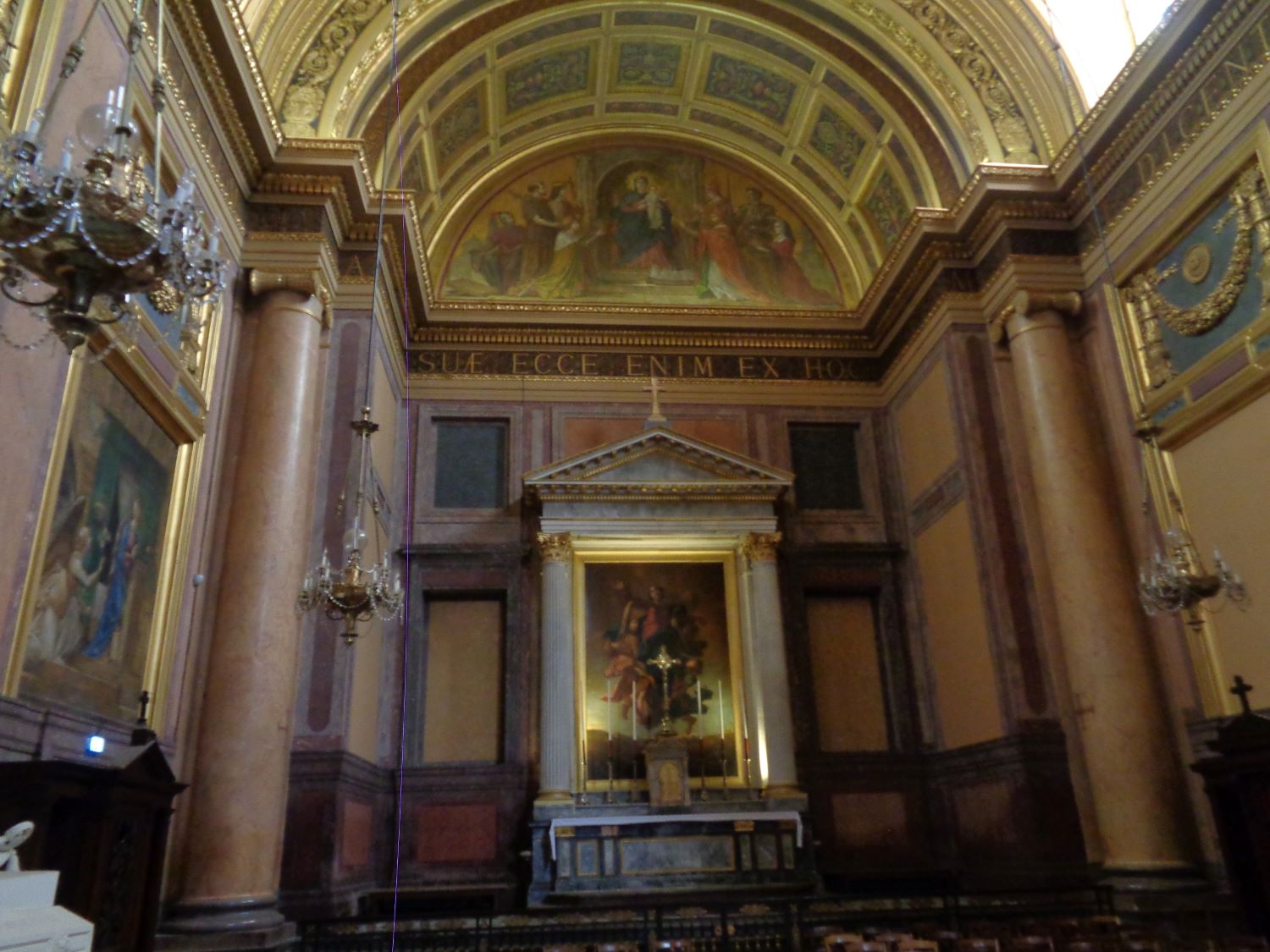
The Chapelle Sainte-Marguerite inside a statue of Sainte Jeanne Jugan, Also, the painting of Sainte Marguerite, dating from the 17C. This painting is a copy of that of Raphael who is currently in the Department of paintings of the Louvre museum.
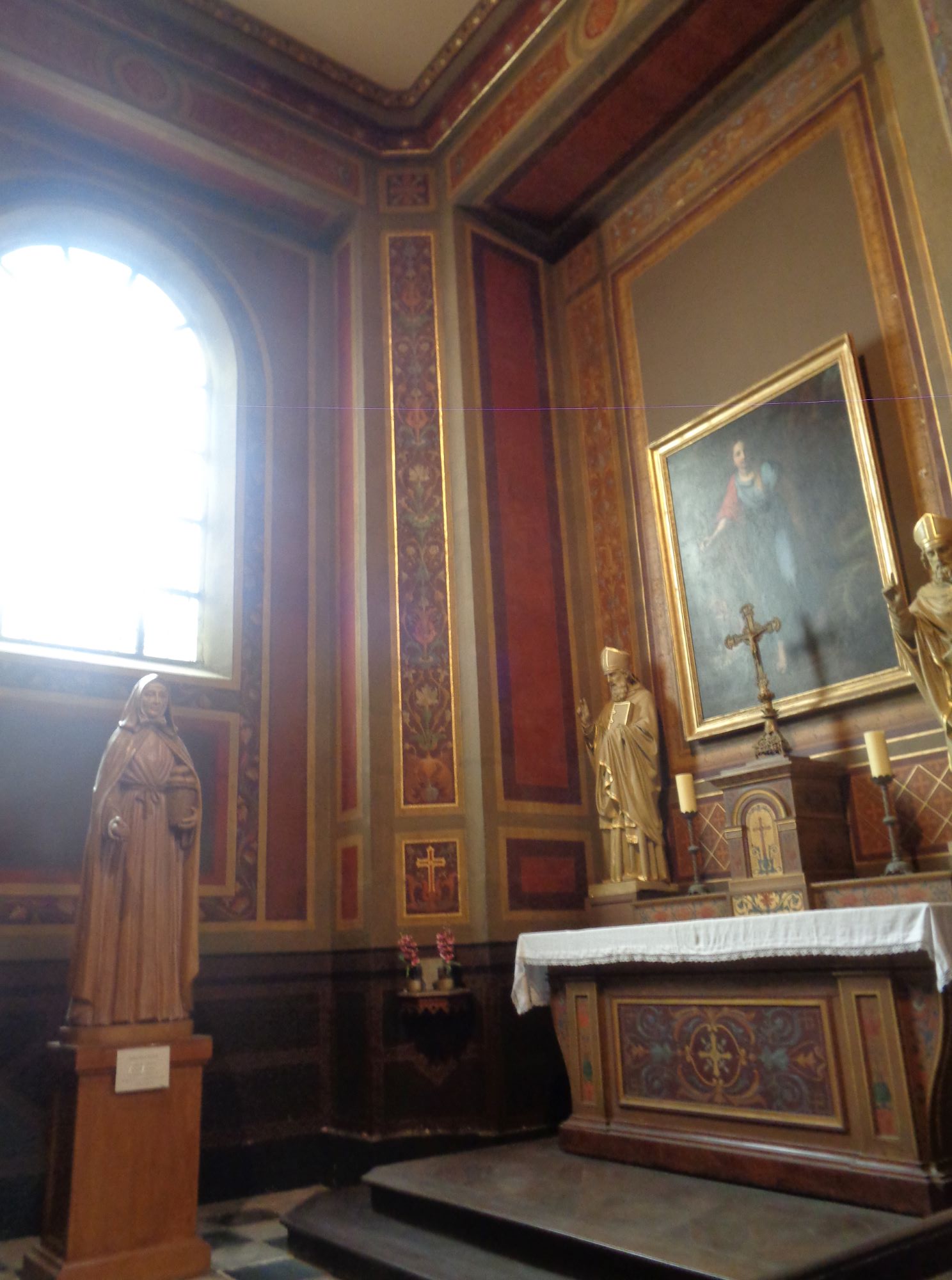
The Chapelle Saint-Melaine
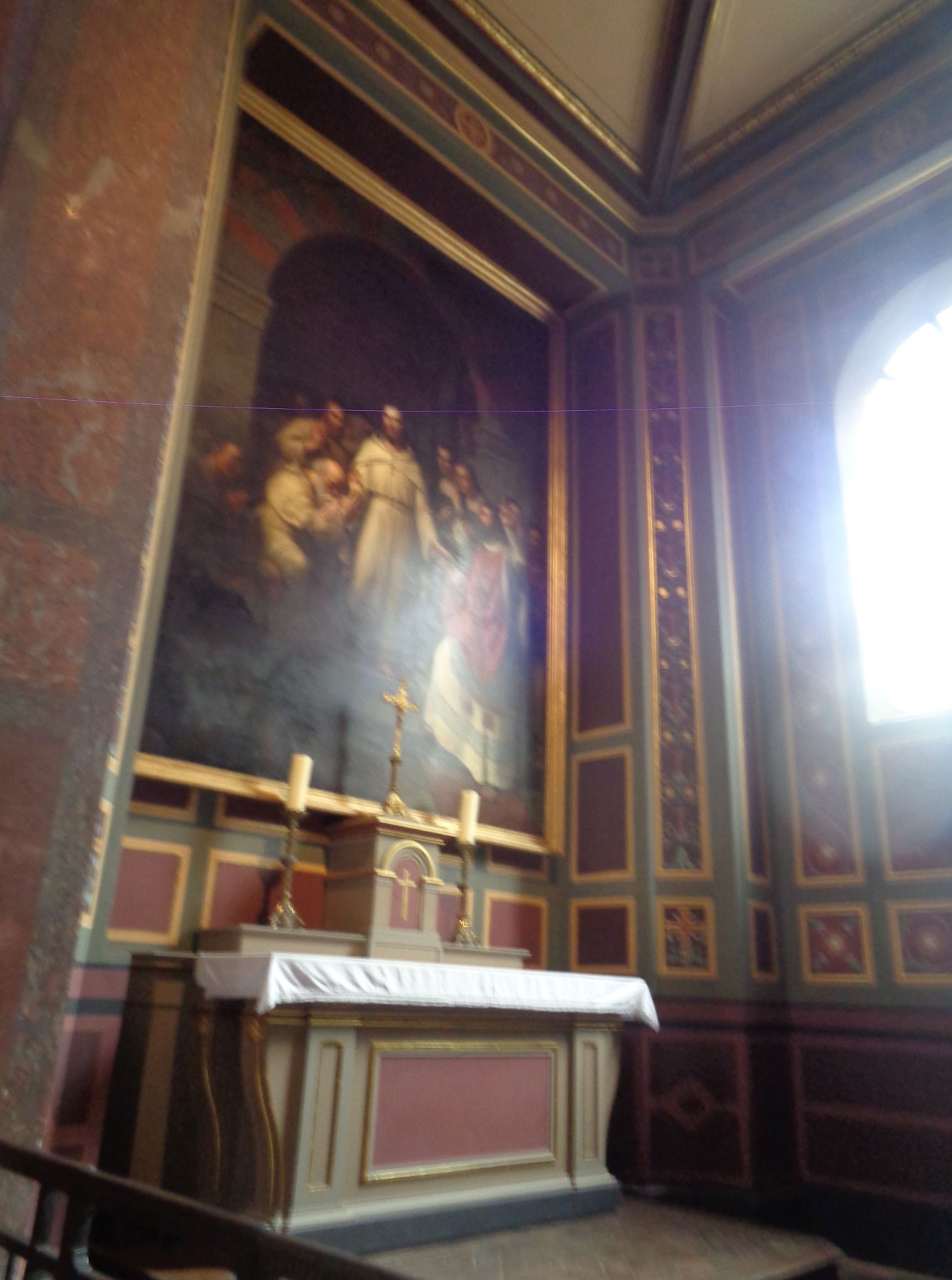
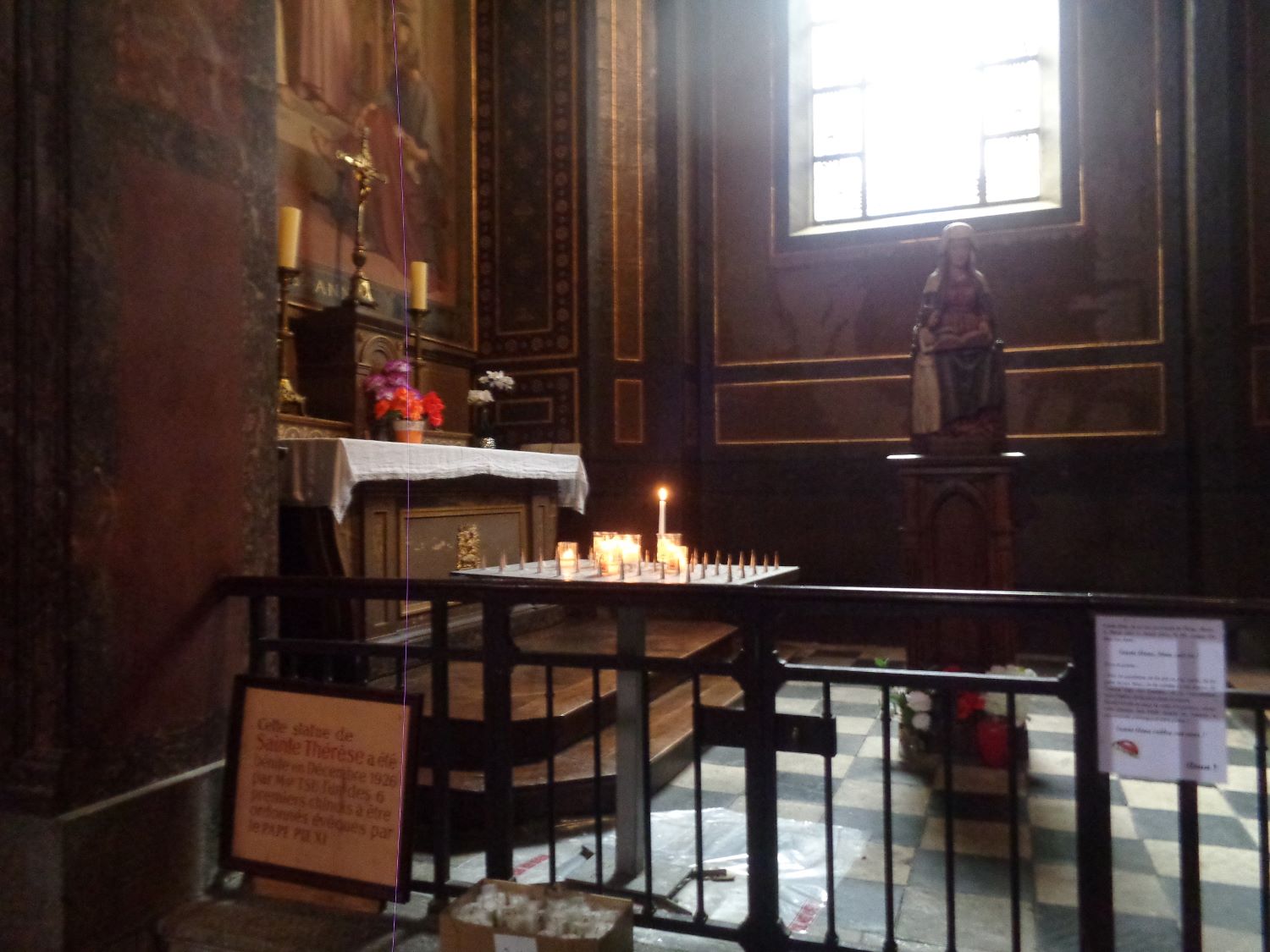
.The Chapel altar dedicated to Sainte Anne, illustrating the deliverance of the apostle Peter of his prison by an angel .
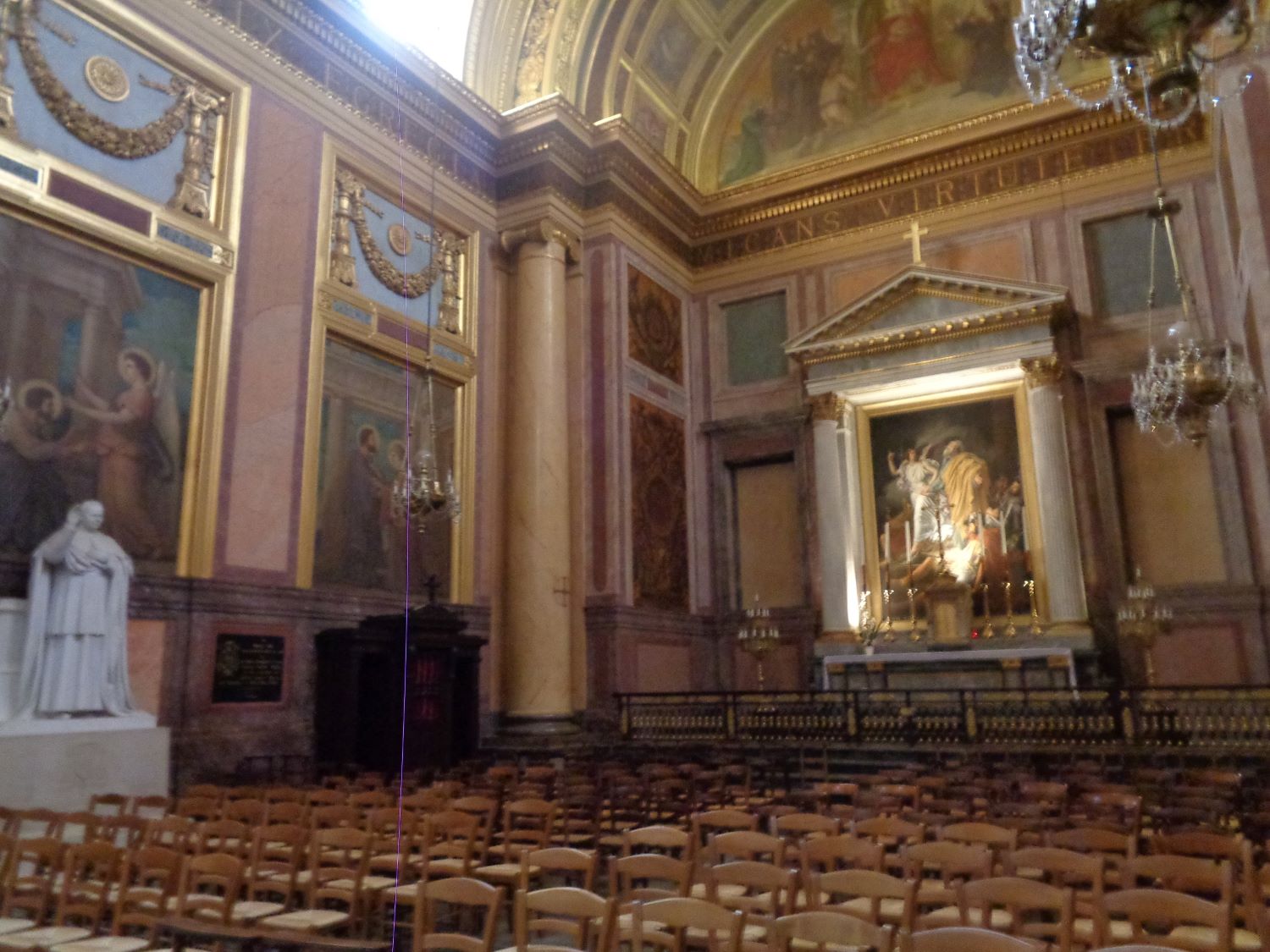
The Chapelle Sainte-Anne with the cult of Bretons in Sainte Anne. The torch stretched in the peasant Yves Nicolazic evokes the visions of 1624. In front of him, in black: the libertine Pierre de Kériolet, who became a priest. Behind him, the sailor who offers an ex-voto.
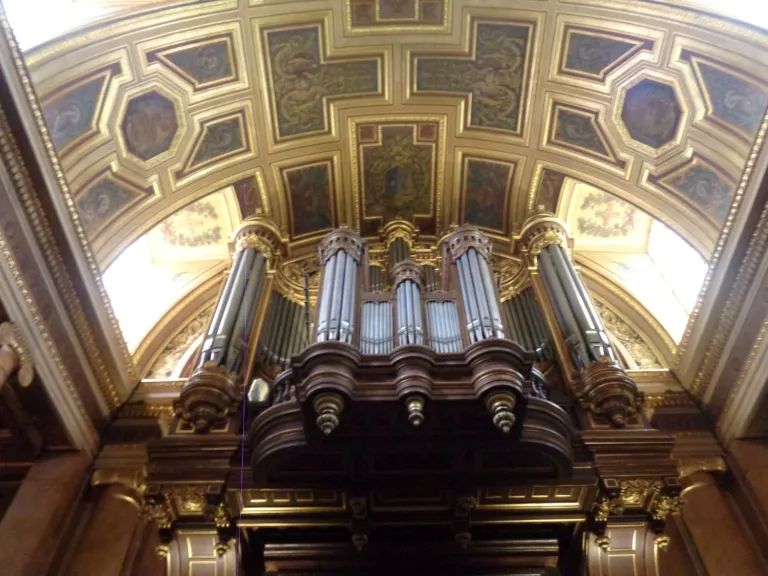
The Grand organs of the Cathédrale St Pierre date from 1874 and is housed in a buffet, rebuilt in 1970 in a neo-classical style. A dorsal is then added, the pipes finding place in a buffet. Today, the main organs of the Cathedral constitute the most important instrument of the Department 35 of Ille-et-Vilaine. The Choir organ, it is housed in a neo-classical oak buffet and occupies the central section of the ambulatory , at the bottom of the apse of the Cathedral. Carried by a high base, partially in corbelled, its piping is masked by false pipes in painted and gilded wood. Grouped by seven, in two platforms framed by pilasters summoned by Corinthian capitals for the lateral facades, these canons are numbered twenty-nine for the main façade, two plates-faces of seven false pipes framing a central section of fifteen. Dating back to 1867, the instrument will only be installed current 1869.
The official Cathédrale Sainte Pierre of Rennes: https://cathedrale-rennes.fr/
The Rennes tourist office on the Cathedral: https://www.tourisme-rennes.com/decouvrir-rennes/histoire/cathedrale-saint-pierre/
The Îlle et Vilaine dept 35 tourist office on the Cathedral: https://www.ille-et-vilaine-tourisme.bzh/a-voir-a-faire/visites-et-patrimoine/la-cathedrale-saint-pierre-rennes-fr-2725595/
The Bretagne region tourist office on Rennes: https://www.brittanytourism.com/destinations/the-10-destinations/rennes-and-brittanys-historic-gateways/
There you go folks ,another jewel in my wonderful capital city of Rennes. The walks are worth it with plenty of lovely areas, Until we meet again, eventually. Again, hope you enjoy the post on the Cathédrale Saint Pierre de Rennes, part II !!! as I.
And remember, happy travels, good health, and many cheers to all !!!


