
I come to my nice Rennes. This time one of the nicest monument , and of course the City is in Îlle et Vilaine dept 35,of my lovely Bretagne, I have come back to this beautiful City after a long hiatus and it was wonderful, Bear with me as the next posts will be on this beautiful City, Let me tell you about the Cathédrale Saint Pierre de Rennes, part I !!! Hope you enjoy it as I.
The towers of the Cathédrale Saint Pierre house a ringing of five bells. The bourdon, named Godefroy, is housed in the North tower and weighs about 7 900 kg. Its beating of 240 kg was changed on December 12, 2011. The other four bells, located in the South Tower, bear the names of Mary, Pierre, Amand and Melaine. They weigh 3 950 kg, 1 467 kg, 1 155 kg and 475 kg. Pierre is the only preserved bell of 1843, which had three sound vases. The bourdon, named after the first Cardinal-Archbishop of Rennes, Mgr. Brossay-Saint-Marc, is the biggest hidden bell in Brittany. The names of its sisters evoke the holy patron of the cathedral, Peter, that of the Archdiocese of Rennes, Dol and Saint-Malo, Melaine, and his predecessor on the Episcopal throne, Amand.
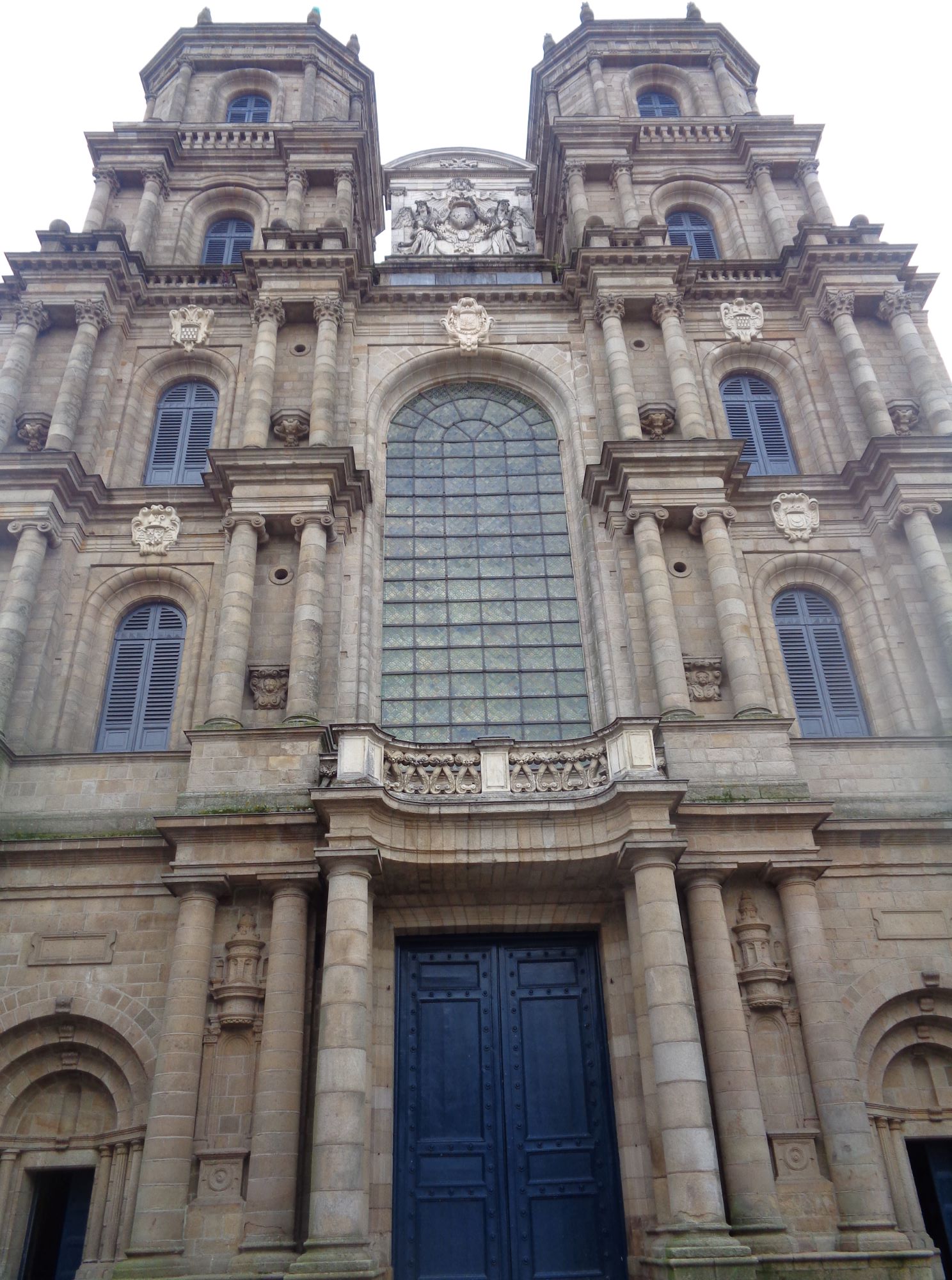
The facade and its two classical granite towers of 48 meters high were built in several stages throughout the 16C and 17C. The towers have four levels. The first level was built from 1541 to 1543, the second as well as the third from 1640 to 1654 and the fourth and last from 1654 to 1678. Finally the coronation of the towers between 1679 and 1704, bearing them at their present height of 48 meters and added on the pediment to the top of the façade the motto of Louis XIV. Besides the front, the façade has five coats of arms of tufa , showing from top to bottom, from right to left we have that of the Beaumanoir, that of Charles Albert of d’Ailly, 3rd Duke of Chaulnes, governor of Brittany, that of Jean-Baptiste de Beaumanoir de Lavardin, Bishop of Rennes from 1676 to 1711. that of Henri de La Mothe-Houdancourt, Bishop of Rennes from 1642 to 1662. And that of Duke Charles de la Porte. To underline the strength and solidity of the new ensemble as opposed to the fragility of the previous construction, the architects have endowed the facade with 22 granite columns. The pediment is to the arms of Louis XIV. Sculpted in the tuffeau, the bas-relief includes, in its center, a circular badge with the arms of France, wearing a royal crown. The necklaces of the Order of Saint-Michel and the Order of the Holy Spirit surround the crest. Above, the figure of the sun with the motto of Louis XIV: Nec pluribus imper. On the pediment: the keys to Saint Peter.These royal badges were not hammered during the French revolution ! Maybe too high up.
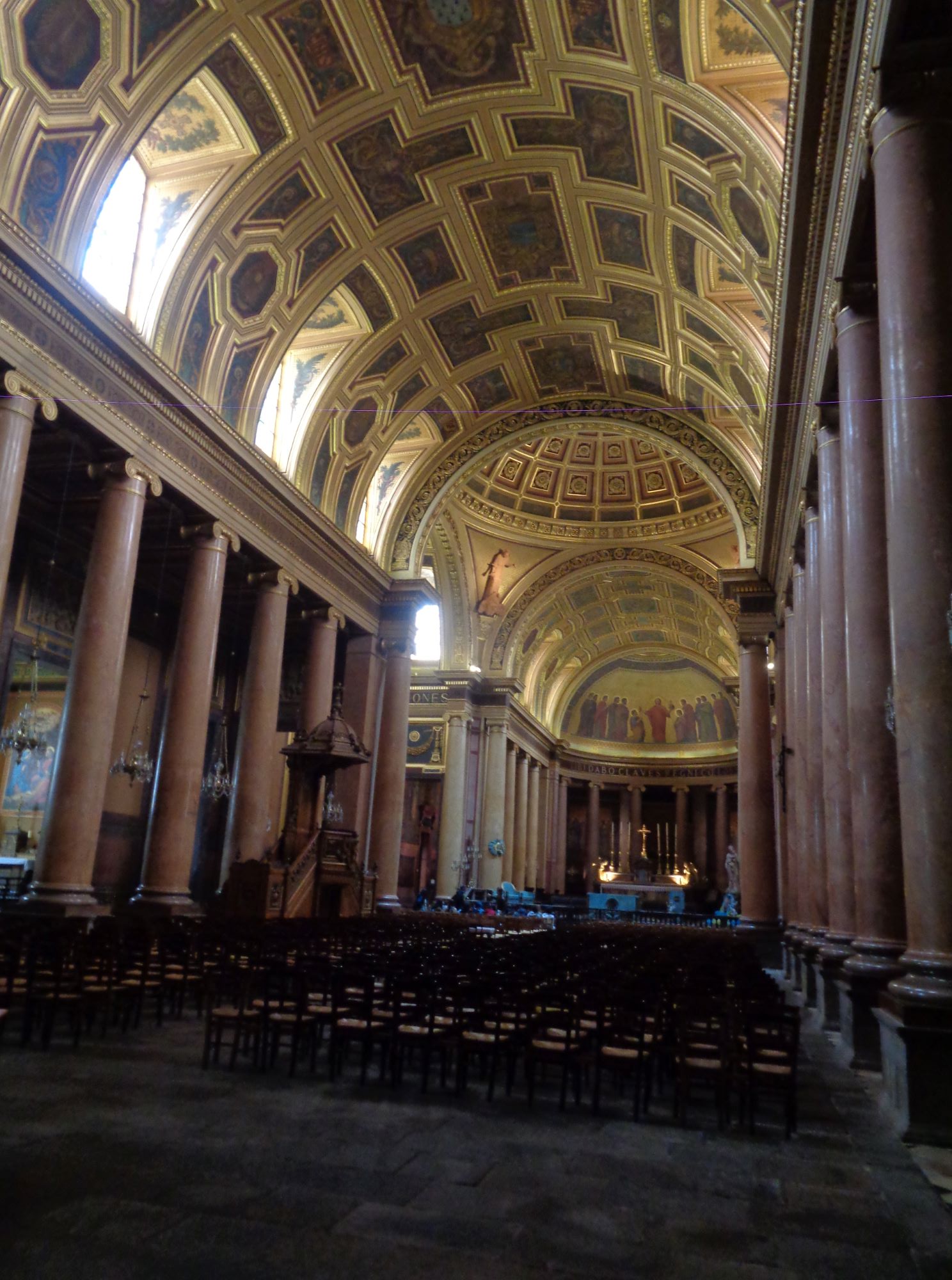
The nave has forty-four ionic columns. It was the most austere part of the Church. In order to alleviate this austerity, in the 19C, the columns and part of the walls (this is a mixture of marble dust, lime and chalk) were made into stucco, giving the building a greater brightness. The vault on the other hand is decorated with gold leaves. The vault contains crests to the arms of Brittany and the dioceses of the Archdiocese of Rennes.
The dome and the four living done in Classic style, The so-called four living sculptures in the pendants are recent (early 21C) ; the four living, that is to say the four evangelists, for Matthieu, Jesus is surrounded by birds In reference to the passage of Matthew’s Gospel: for Marc and his lion, Jesus touches his face with the blind of Bethsaide with his hand; As for Luke, he holds a tight sheep against his heart; Finally, for John and his eagle, Jesus stands kneeling before the apostle Peter which tends his right foot. The four living are sculptures made of pink clay, 3.50 meters high and each weighing between 400 and 600 kg.(882 to 1332 lbs)
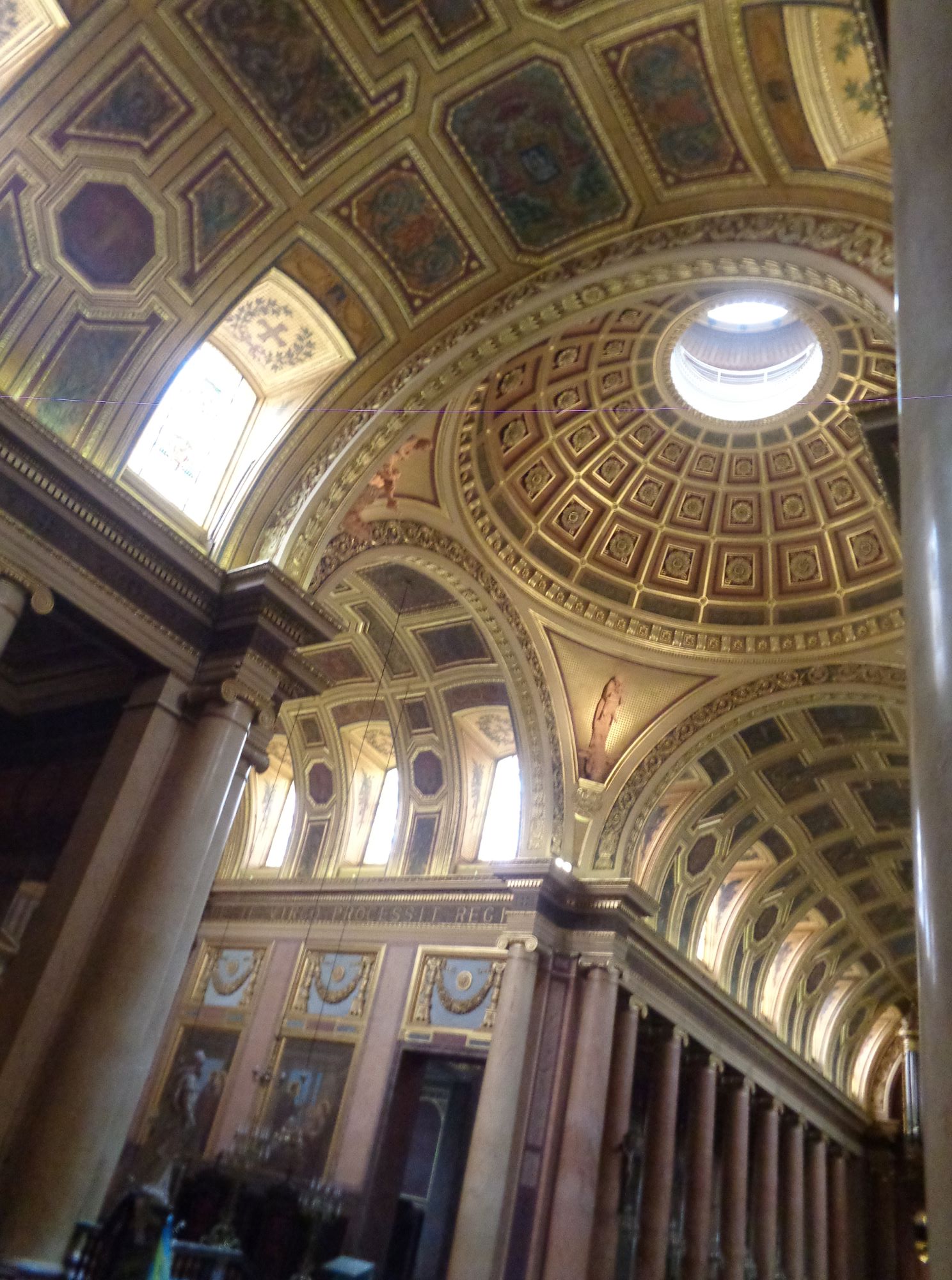
The vault is one of the masterpieces of the cathedral. The visitor will take advantage of looking up to admire, with a pair of binoculars, central panels in regular boxes, in the middle of fines and gold lilies, made from 1843, displays badges with arms of Brittany and to the arms of the suffranging dioceses of the archdiocese of Rennes. These vaults are an essential element in the general beauty of the cathedral. The central nave, the arms of the transept and the choir, were vaulted in semicircular form.
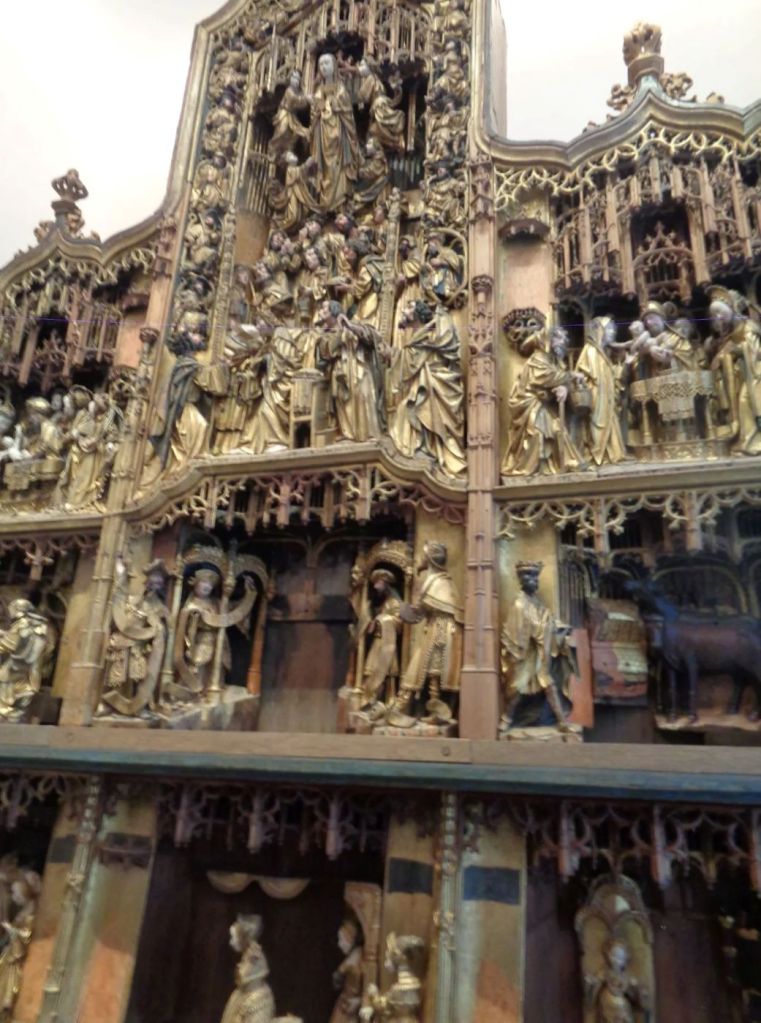
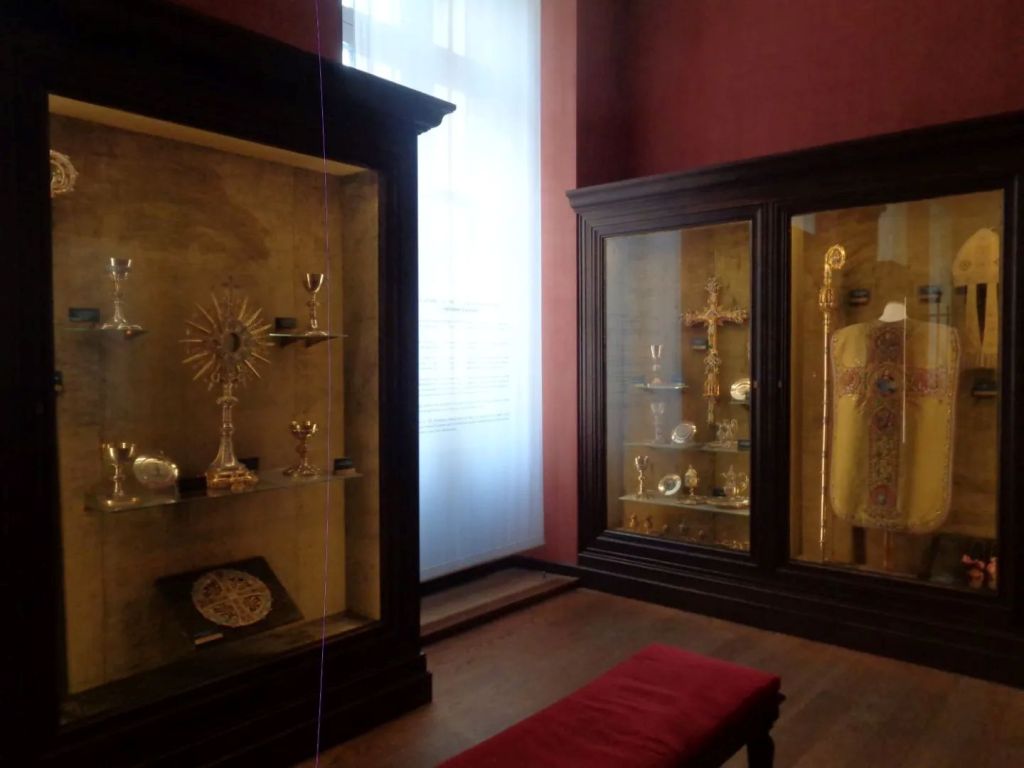
The almost all of the treasure of the Cathédrale Saint Pierre comes from purchases or donations of faithful to the very end of the 18C and the end of the 19C. It is full of works of art, almost all dated from the 19C. As such, the visitor can admire an interesting panorama of French religious painting in a century marked by a renewed devotion after the French revolution. Since 2019, part of the treasure has been presented to visitors. The parts of liturgy, rubbed shoulders with a magnificent Antwerp altarpiece dated 1530 which deserves the glance. You can see on it the Virgin of the Dormition surrounded by the Apostles, the play which seems to be the oldest is an “kiss of peace” representing Christ crucified between the Virgin and Saint John, dated the second half of the 16C, Assumption and the tree of Jesse from around 1520. The proud and amused face of the woman who keeps the child Jesus in circumcision makes her look like a porcelain doll. That of Saint John carrying a chalice, in the Dormition, shows a great mastery at the top of the tree, the Virgin sits on a crescent moon in reference to the description of the woman in the apocalypse. A set of circumcision with the Child Jesus , run by high priest, is surrounded by eight sumptuously shared women. The presentation at the temple. The Nativity, which sadly some characters of this compartment were stolen in 1975. The marriage of Anne and Joachim. Located in the center of the second level of the altarpiece, the two pairs of prophets supervised a sleeping jessé who has disappeared.
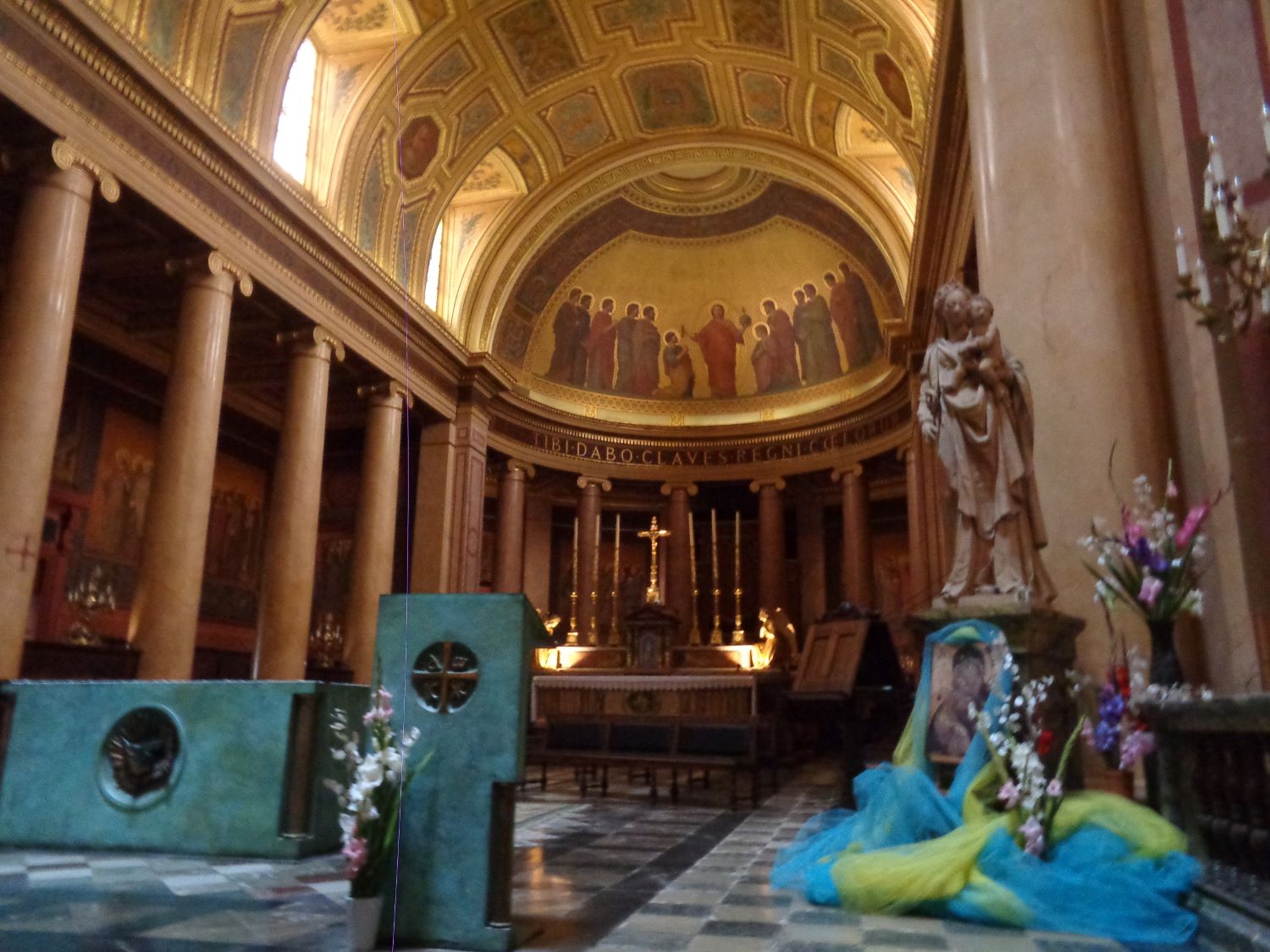
The floor covering of the Choir is made up of austere slabs of granite. These offer a violent contrast to the high altar made with marbles offered by Pope Pius IX and from the Roman Forum (Rome). The cul-de-furnace of the apse is adorned with a painting depicting the giving by Christ of the keys of the Kingdom of Heaven to Saint Peter, made circa 1871 by the 19C painter Alphonse le Hénaff. The Choir is surrounded by an ambulatory whose walls are decorated with representations of the various Saints of Brittany grouped according to their diocese (Rennes, Dol-de-Bretagne, Saint-Malo, Saint-Brieuc, Tréguier, Saint-Pol-de-Leon, Quimper, Vannes). They are also due to Alphonse Le Hénaff.
The Cathédrale Saint Pierre, houses a great Flemish Altarpiece masterpiece from the 16C adorned with 80 characters, which was restored in 1984. There is also the painting of Saint Peter by the painter Henri-Joseph de Forestier given by king Charles X. The work dates from 1827 and represents Saint Peter delivered from his prison by an angel.
Above the crossing of the transept, an artistic project for the development of the four pendants was chosen; consisting in the installation of four statues of three meters in height each, in the four pendants under the dome which will represent the symbolic tetramorphous of the four Evangelists, associated with scenes from the Gospels, such as the Man for Saint Matthew, the Lion for St. Mark, the Bull for St. Luke, and the Eagle for Saint John. The crypt entrance is under the heavy slab engraved with the names of the buried bishops, in the middle of the Cathedral’s central aisle. This crypt is only open during burials. You can go down only upon the burial of a bishop or archbishop.
A bit more on the construction and architecture features I like tell us that the facade and its two classical granite towers of 48 meters high were built in several stages throughout the 16C and 17C. The towers have four levels. The first level was built from 1541 to 1543, the second as well as the third from 1640 to 1654 and the fourth and last from 1654 to 1678. Finally the coronation of the towers between 1679 and 1704, bearing them at their present height of 48 meters and added on the pediment to the top of the façade the motto of Louis XIV. Besides the front, the façade has five coats of arms of tufa , showing from top to bottom, from right to left we have that of the Beaumanoir, that of Charles Albert of d’Ailly, 3rd Duke of Chaulnes, governor of Brittany, that of Jean-Baptiste de Beaumanoir de Lavardin, Bishop of Rennes from 1676 to 1711. that of Henri de La Mothe-Houdancourt, Bishop of Rennes from 1642 to 1662. And that of Duke Charles de la Porte. To underline the strength and solidity of the new ensemble as opposed to the fragility of the previous construction, the architects have endowed the facade with 22 granite columns. The pediment is to the arms of Louis XIV. The nave has forty-four ionic columns. It was the most austere part of the Church. In order to alleviate this austerity, in the 19C, the columns and part of the walls (this is a mixture of marble dust, lime and chalk) were made into stucco, giving the building a greater brightness. The vault on the other hand is decorated with gold leaves. The vault contains crests to the arms of Brittany and the dioceses of the Archdiocese of Rennes.
A bit of history I like tell us that the current site of the Cathédrale St Pierre, has been used as the seat of a bishopric since the 6C. It is likely that it was built instead of an older sanctuary. The old Church was completely replaced by a Gothic Church in the 12C. It is within its walls that on December 25, 1483, Henri Tudor, future Henry VII of England, then in exile in Brittany promises to marry Elizabeth of York to join the army that remained loyal to the late Edward IV of England. This effective marriage in 1486 sealed the end of the war of the Roses and initiated the Tudor dynasty, which would give five sovereigns to England, including the first two reigning queens, successively Mary I of England and Elizabeth I of England. In 1490, the tower and the western façade of the Gothic Church collapsed. A long-term reconstruction of the western massif, which lasted 163 years, culminated in the granite façade we know today, which is largely classical in style. It appeared then that to avoid a total collapse, it was necessary to rebuild the entire building, with the exception of the facade of recent and solid construction was approved by king Louis XV in Council meeting of 1762. The demolition took place from 1756 to 1768. The reconstruction began in 1787, but the French Revolution stopped the work. These resumed in 1816. The now neoclassical Cathédrale St Pierre with classic façade was completed in 1845. During the works, from 1803 and 1844, the former abbey Church of Saint-Melaine (see other churches of Rennes post) was the pro-Cathedral of Rennes.
An anecdote worth telling me think, Once the Hundred Years War ended (1453), the war of the two roses, which the English more properly called the wars of the roses, opposed, for the throne of England, the Lancasters to the Yorks. These two families, resulting from two sons of Edward III, tore after the ouster of King Lancastre Henri VI for the benefit of the York Édouard IV. This eviction was largely the work of the Count of Warwick, which remained in history under the singular name of Kingsmaker . For thirty years, the Yorks will manage England, but constantly warlike against the opposing family. During these thirty years, Louis XI of France served as a basis for the Lancasters’ opposition, while the Tudors will use Brittany for theirs. In 1483, the Duke of Buckingham launched an attack from Wales, while Henri Tudor, coming from Brittany, landed in Plymouth and Poole, on the southern coast of England. Buckingham was expected to be supported by local uprisings. The coordinated attack failed completely in the face of Richard III’s counter-offensive. Buckingham was captured and executed in November. Nevertheless, the main heads of the rebellion (among whom were former supporters of Édouard IV York, who died in April 1483) were able to escape and join the Tudor party in Brittany. It was there that on Christmas day 1483, in the St Peter’s Cathedral of Rennes, they recognized Henri Tudor as their king. For his part, he promised to marry Élisabeth d’York, daughter of Édouard IV. In 1485, the army of Tudors, landed in Wales and reinforced by French and Scottish, confronted that of Richard III at the battle of Bosworth, on August 22. Thanks to the intervention of Thomas’ troop, Lord Stanley, second husband of Margaret Beaufort, Henri Tudor won the victory and went on the throne of England under the name of Henry VII. The Tudor dynasty, inaugurated on the battlefield, died in 1603 at the death of the Queen Elisabeth Ist.
The official Cathédrale Sainte Pierre of Rennes: https://cathedrale-rennes.fr/
The Rennes tourist office on the Cathedral: https://www.tourisme-rennes.com/decouvrir-rennes/histoire/cathedrale-saint-pierre/
The Îlle et Vilaine dept 35 tourist office on the Cathedral: https://www.ille-et-vilaine-tourisme.bzh/a-voir-a-faire/visites-et-patrimoine/la-cathedrale-saint-pierre-rennes-fr-2725595/
The Bretagne region tourist office on Rennes: https://www.brittanytourism.com/destinations/the-10-destinations/rennes-and-brittanys-historic-gateways/
There you go folks ,another jewel in my wonderful capital city of Rennes. The walks are worth it with plenty of lovely areas, Again, hope you enjoy the post on the Cathédrale Saint Pierre de Rennes, part I !!! as I.
And remember, happy travels, good health, and many cheers to all !!!


