
I am going to update this older post and tell you a bit condense history of the Elysee Palace, the Presidential palace of France. Oh wait, it is a Republic but we have the President/king living in a palace!!! So does the Senate and the National Assembly, go figure my loving French. Anyway, here is my take on the Palais de l’Elysée. Hope you enjoy the post as I.
The Palais de l’Elysée (Palace) is located at No 55, rue du Faubourg-Saint-Honoré in the 8éme arrondissement or district of Paris. It is the seat of the Presidency of the French Republic and the official residence of the President of the Republic since the Second Republic (1848). A fine example of classical French architecture. It changes ownership many times. It knows several owners, such as Napoleon I and various vocations, such as that of Café-concert, place of pleasures of good society, before becoming National in 1816 and decreed residence of the President of the Republic. The Palais de l’Élysée has 365 rooms, ceremonial rooms on the ground floor of the main building, where visitors are received, the Salon Doré (Golden Lounge), the president’s office, on the first floor as well as the offices of its collaborators and reception rooms. Attics are arranged in an apartment. It is in the east wing that the apartments where the presidential couple resides, when they choose to live at the Elysée. The palace is surrounded by a 1.5 ha park with one of the sycamore trees measuring 40 meters high. It is open to the public only on the occasion of the heritage Days (journées de patrimoine). I made once in 2006 , with long lines, and then just walk around it.
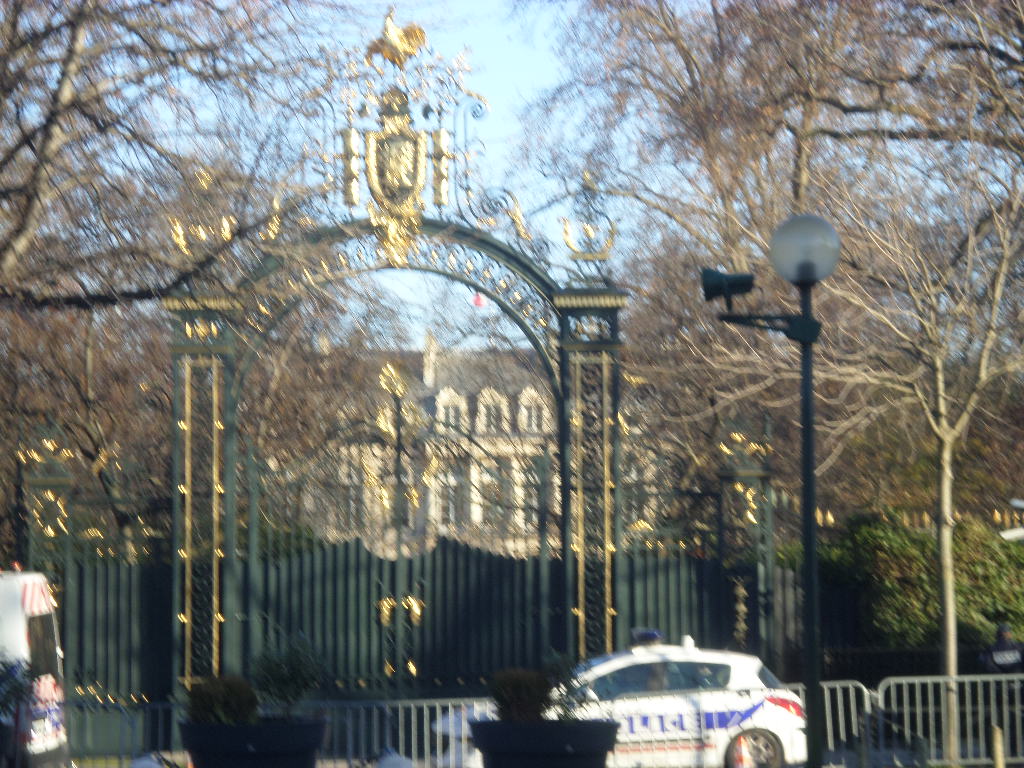
Built by the architect Armand-Claude Mollet in 1720 for Louis-Henri de La Tour d’Auvergne, Count of Evreux, the palace of the Élysée has an illustrious history: it was offered by Louis XV to his favorite, the Marquise de Pompadour, in 1753, then became the princely palace of Joachim Murat, brother-in-law of Napoleon I. The latter made in 1805 his imperial residence. His nephew, Napoleon III, also lived there. After the death of king Louis XIV, in 1715, whose end of reign rhymed with a certain austerity, the regent of the kingdom, Philippe d’Orléans, left Versailles for the benefit of Paris, bringing with him the court, which therefore was built there as members of the bourgeoisie with various palaces and private hotels.
The hotel of Evreux, remains imposing in the midst of the modest shops of the Faubourg Saint-Honoré, arranged according to the principles of architecture in vogue at the time. There is a two-story building body, raised on a vast basement. It remains one of the best examples of the classic model; It starts with a vestibule on the axis of a courtyard of honor, a central building double in depth and three levels and two wings in square side and another in single ground floor. The large courtyard is lined with two blind walls with high arcades surmounted by a balustrade and opens onto a monumental portal with four Ionic columns supporting the owner’s coat of arms. The interior decorations, in Regency style, are made in 1720. They offer a number of woodworks, florets, rosettes, top-of-doors or rinses. The décor of the reception rooms, although modified over the centuries, retains most of its original appearance.
The king decides at the death of the marquise de Pompadour that the hotel of Evreux will now be devolved to house the extraordinary ambassadors, at the place of the Hotel des Pontchartrain, located on Rue des Petites-Champs. The hotel of extraordinary ambassadors thus becomes a property of the crown. During this time, and until 1773, the people of Paris can come to stroll in the gardens, among the old decorum’s of the Marquise, the waterfall and the grotto in particular. In August 1786, it was sold it as a life annuity to King Louis XVI; the King wishes to house, like his predecessor, the extraordinary ambassadors as well as the foreign sovereigns passing through Paris. The last occupant of the hotel before the French revolution was Louise-Marie-Bathilde d’Orléans, Duchess of Bourbon, who settled there in 1787, Louis XVI having finally abandoned his project. During the French revolution, the Palace of the Élysée suffered a lot during these troubled years. The estate has successively welcomed the Commission for the dispatch of laws and printing of the Bulletin of laws and then the national deposit of furniture from seizures of emigrants or convicts. In January 1797, the Directoire board officially made the Duchess of Bourbon possession of the hotel. However, she can no longer maintain this large house and is obliged to rent the ground floor. The Directoire board then sells the hotel as a national property. In 1797, the new establishment opened its doors with a lavish inauguration: a montgolfière hot air ballon laid in the gardens takes a sheep into the air and the dropped with a parachute. The parents and the young and future writer Alfred de Vigny, lodge on the first floor on the left, on the side of the courtyard; Guillaume Bonnecarrère, future minister and diplomat, is their neighbor. The ancient hamlet of Bathilde d’Orléans is transformed into a rustic restaurant.
The consulate, in 1799, ends these years of madness. The brother-in-law of Emperor Napoleon I, the Marshal of the Empire Joachim Murat, bought the property in 1805 and undertook enormous work. He settled there with his wife Caroline Bonaparte and made it one of his many luxurious mansions. The hotel then takes on the status of Palace. When Murat became king of Naples, in 1808 he had to give up his palace at the Élysée, his castle in Neuilly, as well as his stables of Roule and other lands. Having to give up all the furniture in it, the new queen consort of Naples goes against the official request and moves a large part of the furniture of the palace to Naples. Napoleon I occupied the mansion, until the French campaign, after a short occupation by Josephine de Beauharnais. He worked in the old salon of the Muses and stayed in the small apartments while the empress lived, before the divorce, on the first floor. The Emperor thus recovers the Palace in 1812 and offers the former Empress in exchange for the Château de Laeken. For the new Empress, Marie-Louise of Austria, are installed on the first floor a chapel as well as private apartments for her young son, the king of Rome. The emperor returns to the palace in 1813. Marie Louise becomes in the meantime regent of the Empire. In 1814, after the defeat, Tsar Alexander I of Russia, the Emperor’s great adversary, took possession of the building; at the palace, he received Chateaubriand, who told him of his hatred for Napoleon I and arranged dinners to make him hear the nobility of Empire and nobility of costumes. Bathilde d’Orléans took advantage of the turbulence of these years to go and asked King Louis XVIII the Palace of the Élysée; he refuses, but offers her the hotel Matignon. The Tsar then left the Duke of Wellington, the winner of the Battle of Waterloo, to dispose of the building. Finally, in 1815, Napoleon I dictated to his brother his surrender in the Salon d’Argent (silver parlor): He leaves the palace for Malmaison, through the back door of the garden, overlooking the Champs-Elysées, after having burned various papers and received former high dignitaries.
The new regime, the Restoration, brings king Louis XVIII to the throne of France which recovers the deprived property by the various regimes. The Duke of Berry in December 1815 come to lived here and moved there with his wife Marie-Caroline in 1816. In 1820, Marie-Caroline is pregnant. She then submits to a draconian regime that prohibits her from leaving or receiving. But on February 13th, bypassing the rule, they go out to the opera (where it was played the nightingale, the Carnival of Venice and the wedding of Gamache). There, the Duke of Berry was assassinated by the worker Louvel, who decided to extinguish the Bourbon dynasty. The Duke de Berry’s wife returns to the palace in a blood-stained dress. After a few days of depression, she cuts her hair and puts them in her husband’s coffin, moves to the Tuileries where she gives birth to the future Count of Chambord on September 29, 1820 (thus perpetuating the dynasty as would be Henri V), which, by his fidelity to the Royal white flag and His refusal to renounce it between 1871 and 1873 , failed to persuade Orleanais’s members not to contribute to the definitive installation of the Republic at the Élysée. And the chance for the Bourbon to regain the monarchy is over.
The palace of the Élysée remains overall empty between 1820 and 1848, except exceptions, Louis XVIII and Charles X first to welcome foreign monarchs or princes passing through Paris. The National Assembly assigns the palace as the residence of the President of the Republic. Article 62 of the Constitution of 1848 provided that the president is “housed at the expense of the Republic” and resides “at the place where the National Assembly sits”, thus in Paris. Louis-Napoléon Bonaparte, first President of the Republic elected by universal suffrage in 1848, is assigned not the Tuileries but the palace of the Élysée, souvenir of his uncle who had made his residence of heart but had abdicated. He sets up his personal office in the Cleopatra Lounge and places himself at the helm of the various services of the men of confidence but soon has to reduce the number of employees of the palace, because of their cost and the futility of some. But not being able to represent himself, the president made a coup d’état in the third year of his four-year term: He became Emperor under the name Napoleon III. It is finally a marriage of love that takes place with Eugénie de Montijo, (Spanish) which passes in the small apartments of the palace of the Élysée their last night of maiden, living here from January 22 to 30, 1853.
The present structures of the Elysées Palace come mainly from this period, and all of these works, which ended in 1867, constitute the last major developments. The dependencies are rebuilt, forming the two lateral wings with balustrades that surround the courtyard of honor, the palace is cleared to the west with the piercing of the Rue de Élysée, an additional floor is added to the east wing of the palace housing the small Apartments, a new dining room is built in the extension of the Salon Murat. Finally, the façade overlooking the Rue du Faubourg-Saint-Honoré is pierced by windows, while the main entrance, the monumental four-column portal, is replaced by an arch of triumph porch today still used. Terraces adorned with washbasins are created on the floor of buildings surrounding the Cour d’honneur, the lounges on the ground floor are completely reworked. The strangest landscaping is certainly the secret underground passage connecting the hotel number 18 rue à la sacristie de la chapelle du palais. Paintings of European sovereigns are hung on the walls of the Eastern salon (Queen Victoria or Pope Pius X). The palace at last habitable, however, never receives the imperial couple although it has kept an apartment in the palace, but becomes the official hotel of the sovereigns visiting Paris where Napoleon III organizes grandiose feasts ,especially in the ballroom built to the west of the palace. During the war of 1870, it was from the palace that left for the German border the first battalion of French Corps; they are commanded by Col. Lafont . With the fall of the Second Empire, the palace is for a sixth time renamed and becomes the “Élysée National”; it’s being handed over to the state. The fall of Napoleon III in 1870, put an end to the monarchical era of the palace. The new president Patrice de Mac Mahon settled permanently in the palace from September 1874 with his wife and four children. But it was only by the law of January 22, 1879 that the Elysée officially became the residence of the Presidents of the French Republic.
On June 10, 1940, the Elysée Palace welcomed the last Council of Parisian ministers in the history of the Third Republic, in which the government decided to leave Paris. On 14 June 1940, at 5h35 ( a.m), the Nazis hoisted their red and black flag with the swastika. Abandoned between 1940 and 1946, it was not commandeered by the Nazis, Hitler agreeing to leave this symbolic place vacant but refusing that Pétain invests it. A section of Republican guards took over the palace on 24 August 1944 during the liberation of Paris. It is completely renovated and modernized and regain possession of the palace on January 16, 1947: Charles de Gaulle occupies this place that he hated due to previous history. From 1959, it will define the general organization of the Interior of the palace that lasts until today with the central building and the West Wing the official functions, on this wing is the private apartments and to the Commons surrounding the Court of Honor the Offices of its technical advisors, responsible for mission and certain technical services. The general will use as an office the old room of the Empress Eugénie, called the Salon Doré (golden lounge). This lounge located in the central axis of the palace, will serve as an office to all Presidents of the Fifth Republic, except Valéry Giscard d’Estaing who chooses as office a room located on the eastern corner of the central building. De Gaulle transformed the private apartments on the first floor of the central building into offices, Georges Pompidou arranged a projection room in the basements and Valéry Giscard d’Estaing installed the PC Jupiter, which runs the nuclear weapon and is in secure contact with command of the air base 921 at Taverny. The palace was first opened to the public on July 14, 1977 by Valéry Giscard d’Estaing, but the experience could not be renewed due to the high attendance of visitors. However, every year since 1990, during the Heritage Days (journées de Patrimoine), the Palais de l’Élysée is open to the public.
The official Palais de l’Elysée : https://www.elysee.fr/exposition/evreux-300
The Paris tourist office on the Elysée Palace : https://parisjetaime.com/eng/culture/palais-de-l-elysee-p1004
There you go folks , a historical building in the trouble history of my belle France. Now,you know a bit more of the Presidential house of France! Again, hope enjoy the post on the Elysée Palace as I
And remember, happy travels, good health, and many cheers to all !!!

 Paris1972-Versailles2003