
And here we come to the wonderful intra muros center in Saint Malo. Again written before, but these are older new pictures in my blog on the Castle of Anne of Brittany a wonderful place. This has the City hall and maritime museum but now closed until 2028, in a new building, It is still a must place to see . Let me tell you a bit about the Château Anne de Bretagne of Saint Malo, part I !!! Hope you enjoy this post as I
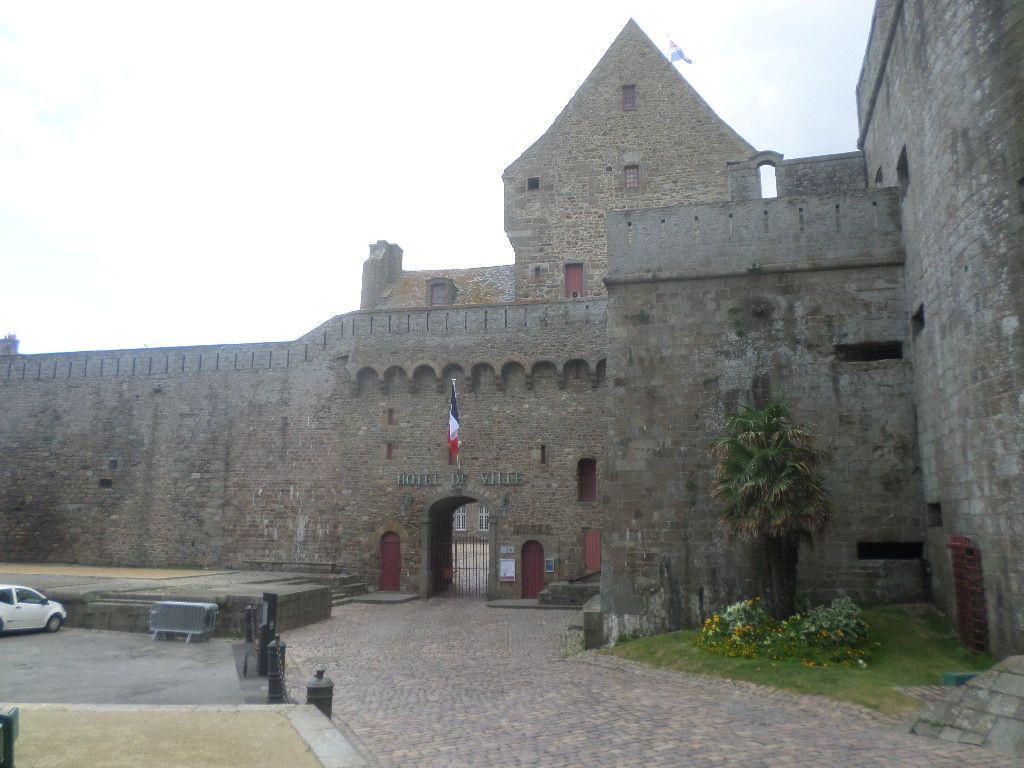
You know, Saint-Malo owes its name to the Welsh monk Mac Low who, around the 6C, became bishop of Alet, the ancient cradle of the current town founded in the middle of the 12C.The Château de Saint-Malo, which now houses the city/town hall, was built by the Dukes of Bretagne ; integrating the northern part of the enclosure by the Porte Saint-Thomas, it separates the Porte Saint-Vincent-by an interruption, the latter corresponding to the old moat which isolated it from the rest of the city. As said, the castle was built by the Dukes of Brittany to ensure their guardianship over the city of Saint-Malo, it’s impressive! It is possible to access the upper parts of the large keep of the castle ,The current collections, valued at more than 8,500 pieces, focus more particularly on the history and maritime heritage of Saint-Malo and its surrounding country. Modified and completed by the construction of several other towers over the centuries ,such as the La Générale , Quic-En-Groigne, Moulins and Dames ,the castle then became a prison, garrison, and later museum. From the entrance,the large Porte de Saint-Vincent gate, you can see on the right side of the ramparts, several keeps and towers adorned with the coat of arms of Saint-Malo. From these turrets, the view is breathtaking: a 360° view of the city and the surroundings.

The construction of the ducal castle of Saint-Malo began in 1424 with the construction of the Grand Donjon 35 meters high in the shape of a horseshoe. Crowned with machicolation, the keep has a covered gallery on the top floor, the roof of which is surmounted by two watchtower turrets joined to one another. Then, Duke François II had the La Générale or General Tower built . Then, it was his daughter, the Duchess Anne of Brittany, who raised the Tour Quic-en-Groigne tower, completed in 1505. Four other towers finally came to complete the building: the Tour des Dames , the Tour des Moulins ,and the less imposing Petit Donjon and Tour Carrée. The castle was thus to resemble, according to Duchess Anne’s wishes, a carriage, with four wheels , the towers connected by curtain walls, a box , the Grand Donjon, and a drawbar , the Pointe de la Galère which extends the castle. Since 1927, the Grand Donjon has housed the city’s History Museum, which traces the past of the corsair city through some famous figures in Saint-Malo, such as Jacques Cartier, Duguay-Trouin and Chateaubriand. In the General Tower is also the Ethnographic Museum of the Malouin Country (closed awaiting a new bigger one by 2028) which evokes among other things the time of fishing in Newfoundland and shipbuilding in the region. The Château also houses the City/Town Hall of Saint-Malo. The panorama over the city and the bay of Saint-Malo from the top of the watchtowers of the Grand Donjon is awesome !
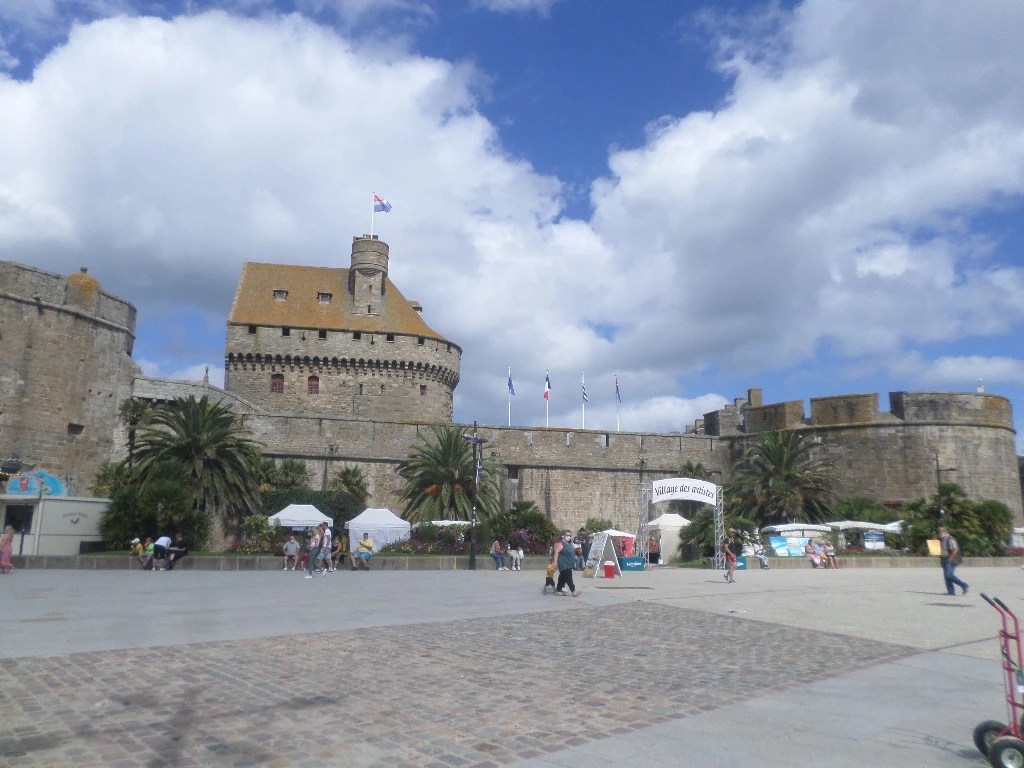
A bit of history I like tell us that the Château de Saint-Malo is a building built between the 15Cand the 18C. Saint-Malo, which had been ceded by the Duke of Brittany to the King of France in 1395, was returned in 1415 by the King of France Charles VI to Duke John V of Brittany, his own son-in-law. Shortly after, in 1424, he began construction of the future castle by building the Grand Donjon on the isthmus which at that time was the only crossing point between the walled city and the mainland. The Grand Donjon is based on a portion of the original 14Cenclosure of Saint-Malo, namely the Petit Donjon and the western curtain wall. However, the castle has the particularity of being detached from the ramparts. The Grand Donjon is a tall structure with a horseshoe-shaped plan. The result is an original silhouette with its large gable facing the city, its high roof which partially covers a crenellated rampart on machicolations and its two watchtowers.
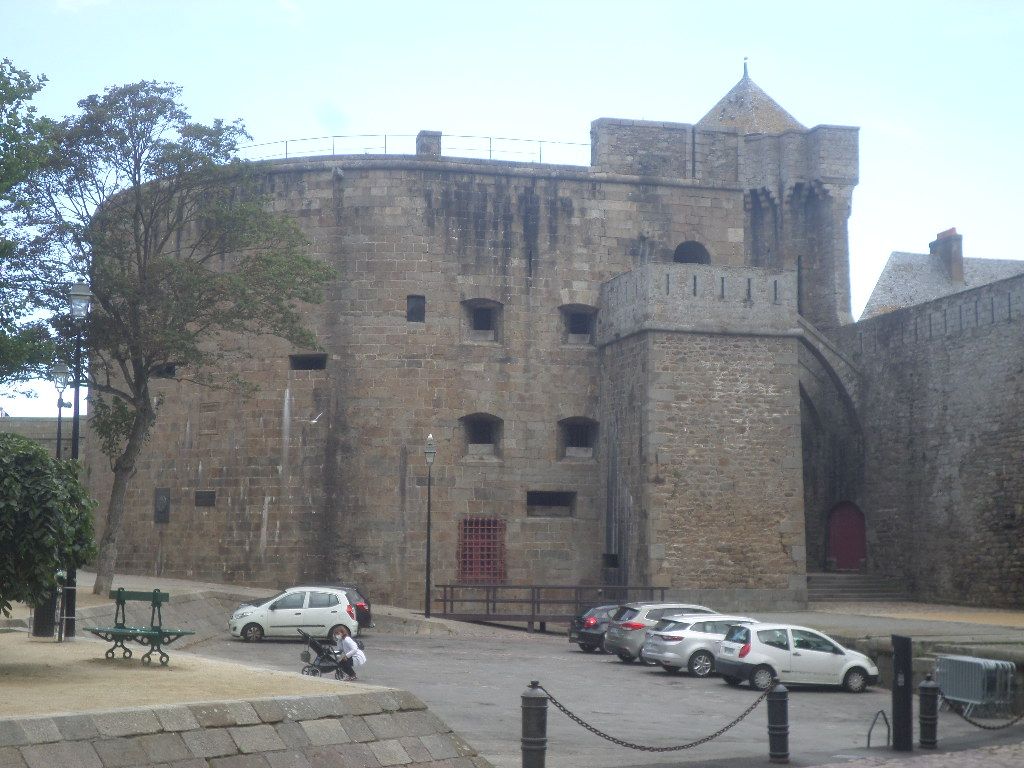
In 1475, the Duke of Brittany François II had the La Générale tower built, which was lower than the Grand Donjon, but more massive. His daughter Anne, future queen of France, had the Quic-en-Groigne tower built from 1498 to 1501, so named because it was built against the wishes of the Saint-Malo residents. The Duchess Anne of Brittany engraved the inscription “who will be so grumpy, for that is my pleasure”. Two other towers, the Tour des Dames and the Tour des Moulins, were built in the years that followed. These are large bastions opened by rare mouths of fire thus ensuring an effective defense to the artillery.
In 1590, the castle was stormed by the inhabitants of Saint-Malo who wanted to prevent the governor from handing over the city to the supporters of the Protestant king Henri IV. The governor was killed during the riot. In the 17C the bastion of Galerius in the shape of a ship’s prow completed the defenses. Under the reign of Louis XIV, Vauban had modified, from 1690, the curtain walls and the upper parts of the towers to allow the installation of artillery pieces. Two buildings, serving as barracks, are built along the north and east wings.
In 1765, Louis XV had the Attorney General of the Parliament of Brittany, La Chalotais, locked up in the castle. During the French revolution, the curtain connecting the Quic-en-Groigne and La Générale towers were removed. In 1792, the castle was again stormed by the local Malouins. In the 19C, the castle became a barracks. This state lasted until 1921. On that date, the town of Saint Malo bought part of the buildings to install the museum in 1927. When Saint-Malo was liberated in 1944, the castle was heavily damaged and was subsequently restored. The inner courtyard of the castle is bordered on the north and east by barracks which date from the beginning of the 18C. In the east building, the Mayor’s Office is adorned with carved woodwork from the end of the 17C, coming from a former shipowner hotel in the city destroyed in 1944. Behind this building is the Cour de la Galère. This name was given to the triangular pointed bastion which was added to the castle in the 16C which was reinforced by Vauban due to its analogy with a ship’s prow.
The city of Saint Malo on the museum opening 2028 (not 2025) : https://www.st-malo.com/tourisme/art-culture/musee-histoire-de-la-ville/
There you go folks, a dandy castle of Saint Malo, a must to see, Be aware the museum is closed for renovation and moving to new quarters by 2025 , Nevertheless, the castle is worth the detour ! Again, hope you enjoy the post on the château Anne de Bretagne of Saint Malo, part I !!! as I
And remember, happy travels, good health, and many cheers to all !!!


