
Lots of history here, and lots of memories visiting on business meetings and later passing by on my road warrior trails once living in nearby Versailles. It has been a while and perhaps nostalgic ,glad to found me this picture in my cd rom vault to share here for you and me, Therefore,here is my take on the Church Saint Eloi of Les Mesnuls !!! Hope you enjoy this post as I.
The village of Les Mesnuls is located in the Yvelines department no, 78 in the Île-de-France region of my belle France. It is 27 km from Versailles and 16 km from Rambouillet. The village is crossed by D191 road, which leads to Mareil-le-Guyon and the Mauldre Valley to the north and to Perray-en-Yvelines to the south. At a junction with D191, the D155 road begins, leading east to Montfort-l’Amaury. We came from Versailles from rue de la Paroisse right on Rue du Maréchal Foch continue into Avenue de l’Europe, Avenue du Général de Gaulle ,Rue Royale and then right on Rue du Général Leclerc or D10 road ,left on Rue du Général Joffre passing on your right the Potager du Roi and on your left the Cathédrale Saint Louis continue into Avenue Clément Ader or D91 road to connect with the N12 highway dir Dreux but bear right on exit to Neauphle le Château and get on the D134 road quickly bear right on the roundabout onto the D912 or Route de Paris ,then at the roundabout in Jouars-Pontchartrain continue on the D23 road or Route de Chevreuse ,go thru City center Bazoches-sur-Guyonne then continue on the D13 road also Route de Chevreuse then bear left onto the D191 dir Les Mesnuls entering the village on the Grande Rue then bear left onto Rue Neuve and the church.
The Church of Saint Eloi, built in the late 15C and early 16C, consists of a single nave with a barrel vault spanning six bays, a three-sided apse, and a square bell tower on the south side. The church is dedicated to Saint Eloi, patron saint of goldsmiths and blacksmiths. The baptismal font and the Chapel of the Virgin, located on either side of the church entrance, as well as the entrance rose window, date from 1859. The wooden gallery and the painting depicting the Flight into Egypt were donated in 1925. In October 1979, the church bell stopped ringing. This bell, installed in April 1611 and named Marie, was cracked along its entire length. On December 23, 1979, the new bell was christened by the Bishop of Versailles before being installed in the bell tower.
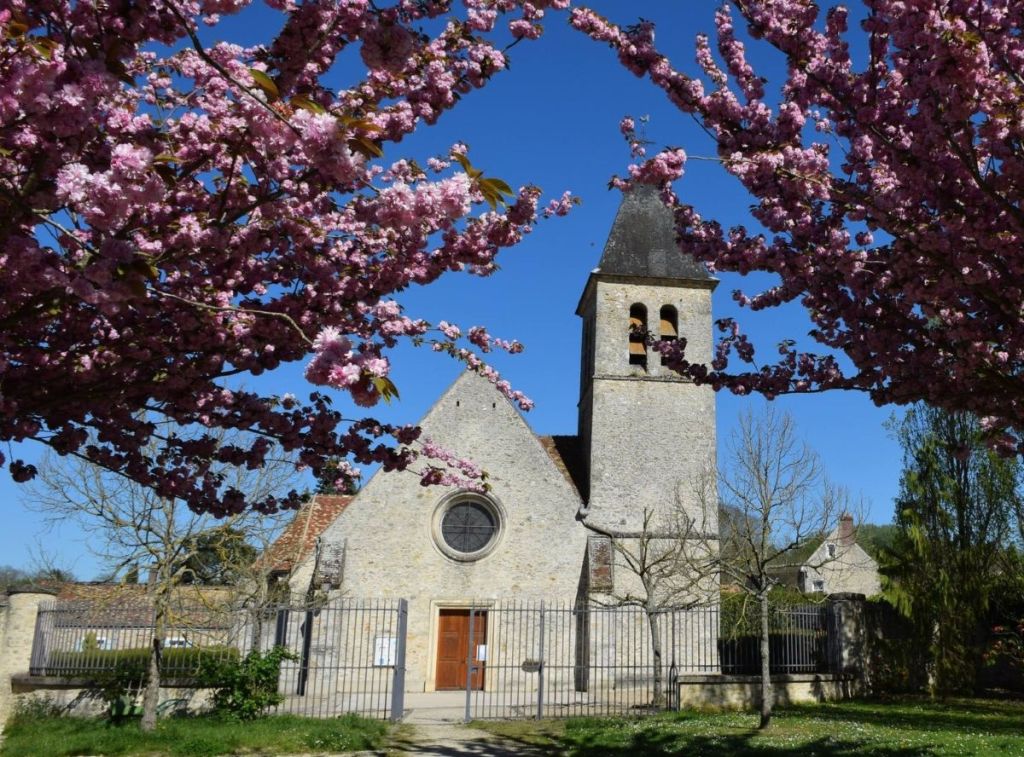
A bit of history I like on the church tell us that in the 16C, at the Essartons crossroads, on the road connecting Les Mesnuls to Montfort l’Amaury, stood an oak tree whose trunk sheltered an image of the Virgin Mary, greatly venerated in the region. In 1646, Robert de Garro, Lord of Blainvilliers, obtained permission from Achille Courtin, Lord of Les Mesnuls and Les Essartons, to erect an oratory measuring eight to nine square feet at the foot of the oak. By the beginning of the 18C, many faithful were coming to pray at this place, masses were being said there every Sunday, and the oratory had become too small. Popular tradition recounts the following: On Easter Monday 1713, during the wars of Louis XIV, the Chevalier de Saint Mars, leaving his fiefdom of Blainvilliers to join Marshal de Villars’ army in Flanders (Villars would later become the owner of the Château des Mesnuls-see post), arrived at the crossroads of Notre-Dame du Chêne. There, despite the cold and rain, he prayed before a large crowd of the faithful. The Chevalier dismounted, prayed to the Virgin Mary, and promised the assembled crowd that he would build a more spacious chapel if he returned safe and sound from the war. A few months later, the Chevalier, returning home after a victorious campaign, passed by Notre-Dame du Chêne without stopping. But his steed refused to move forward, as if held back by an invisible hand. Faced with this miracle, the knight remembered his promise and set about building the chapel. According to popular tradition, Queen Marie Antoinette occasionally came from Rambouillet to pray to the Virgin at Notre-Dame du Chêne. Like so many other religious buildings, the chapel disappeared during the French revolution. It was put up for sale on May 8, 1792, in Montfort. The chapel was rebuilt in 1825. This is the church we know today.
Other things to see here are the Château des Mesnuls (see post), and the Lavoir or washhouse on Rue du Moulin, 19C.
A bit of history I like on the village tell us that in Roman times, a north-south Roman road linking Chartres to Beauvais crossed the current village territory; a marker was found in the hamlet of La Millière. In 1964, after their discovery by the archaeologist François Zuber in 1963, the ruins of a Gallo-Roman villa were unearthed on a slope of the Guyonne valley, at a place called “le Bois de Mareil”. A fresco known as « des quatre saisons » or the four seasons was found there, dating from the 1-2C AD. The later history of the village is linked to that of the castle,see above.
The village of Les Mesnuls on its heritage : https://lesmesnuls.fr/decouvrir-les-mesnuls
The local Coeur des Yvelines community of town on the heritage of Les Mesnuls : https://www.coeur-yvelines.fr/patrimoine/nos-communes/les-mesnuls/
The Parc Naturel Régional de la Haute Vallée de Chevreuse on the heritage of Les Mesnuls: https://www.parc-naturel-chevreuse.fr/un-territoire-preserve/le-patrimoine-dans-les-55-communes/la-carte-des-communes-du-parc/les-mesnuls
There you go folks, a historical wonderful area we love from our former hunting ground. The village of Les Mesnuls is worth the detour ,me think; surrounded by lush surrounding in noble French traditions. Again, hope you enjoy this post on the Church Saint Eloi of Les Mesnuls !!! as I .
And remember, happy travels, good health, and many cheers to all !!!


