
I bring you back to my nostalgic Seine et Marne dept 77, and a familiar town. It is an off the beaten path area that should be visited more, and I look forward to be back, eventually. I found me new pics in my cd rom vault that should be in my blog for you and me, Therefore, let me give you my take on the Church Saint Etienne of Brie Comte Robert !!! Hope you enjoy the post as I,
The town of Brie-Comte-Robert is located in my nostalgic Seine-et-Marne department no 77 ,and in the Île de France region of my belle France, It is the historical capital of the Brie region.
The Church of Saint-Étienne was built in the 13C at the behest of Robert II of Dreux and is dedicated to Saint Stephen, the first martyr of Christianity. In the Gothic and Romantic styles, it features a 13C rose window above the choir, superb 15C sculptures and woodwork; on the exterior, its flying buttresses are adorned with gargoyles, and a tower completes its façade. Its spire, which dominates the town, can be seen for miles across the Brie plateau.
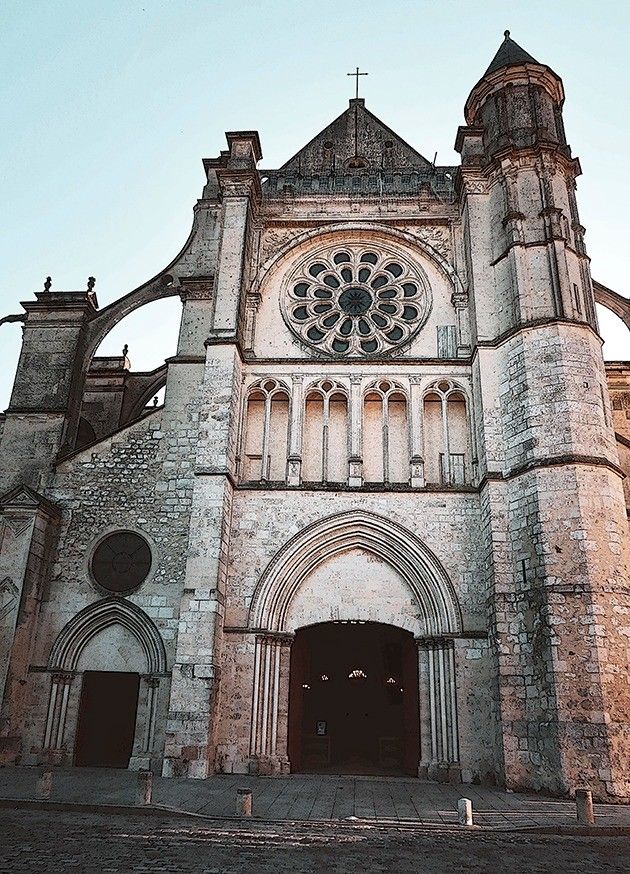
The west portal of the nave opens beneath a pointed arch, decorated with six tori on three different planes, as well as a molding enclosing a band of four-leaf trefoils. The lintel, with its basket-handle arch, is constructed of dressed stone, and the tympanum is a simple wall. A short distance from the portal, the Gothic sections of the nave buttresses and the stair turret are set back by a molding, then punctuated by a dripstone at the boundary with the second level of elevation. The apse is organized on three levels, which do not correspond to the stories of the side elevations. The first level features a triplet: before it was blocked by a large Louis XVI-style altarpiece, the choir was even brighter. This marks the beginning of the second level. From here, the wall decreases in thickness and is set back slightly, so that the single columns placed in the corners to support the ribs of the high vaults do not reach the floor. The second level corresponds to a particularly elegant, early five-arched clerestory. The third level begins slightly below the capitals of the second order, whose abaci also adopt a polygonal plan. In the corners, each receives a pointed arch, the transverse arch of the apse, and a slender column supporting a lateral transverse arch. The most distinctive feature of the third level is the large original rose window, a copy of the one on the façade of Notre-Dame Cathedral in Paris ,minus the second row of colonnettes, which dates from 1220-1225. The other large arcades rest on single-cylinder piers constructed in a drum pattern. The second level is reserved for a triforium, which is of the same light and elegant design as the clerestory of the apse.
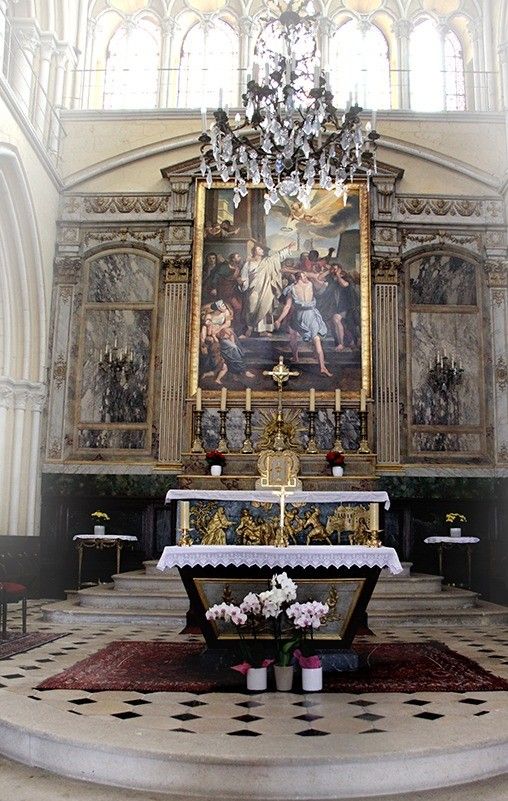
Since construction began with the bell tower, north of the last bay of the chancel, and then progressed gradually westward, it is appropriate to examine the chancel first. Here, the master builder established the arrangement of the great arcades, the organization of the elevation, and the moldings, which would also be applied to the adjacent bays of the nave. Due to its length, the nave was not completed entirely in a single phase of construction, and the bays finished in the 14C were the first to be altered, while the chancel has remained unchanged since the first quarter of the 13C. The fifth and sixth bays of the nave can be included in this section, remaining perfectly consistent with the chancel from the fourth transverse arch and its supports excluding the arches. The south face of the bell tower and the apse naturally exhibit distinctive features not found elsewhere in the church. Of the six bays of the nave, the last two are similar to those of the choir, except for the transverse arch separating the fifth from the fourth bay. Up to this transverse arch, the large arcades were underpinned at the beginning of the Flamboyant Gothic period, and the supports for the high vaults were also rebuilt. In the third and fourth bays, the triforium is almost identical to that of the choir, with only minor differences. In the fourth bay, the clerestory windows and vault are also similar to those in the choir. In the first two bays, the triforium is even more refined and dates from the 14C. The side aisles are aptly named, as their height under the vaulting ridges is half the height of the piers supporting the high vaults of the nave.
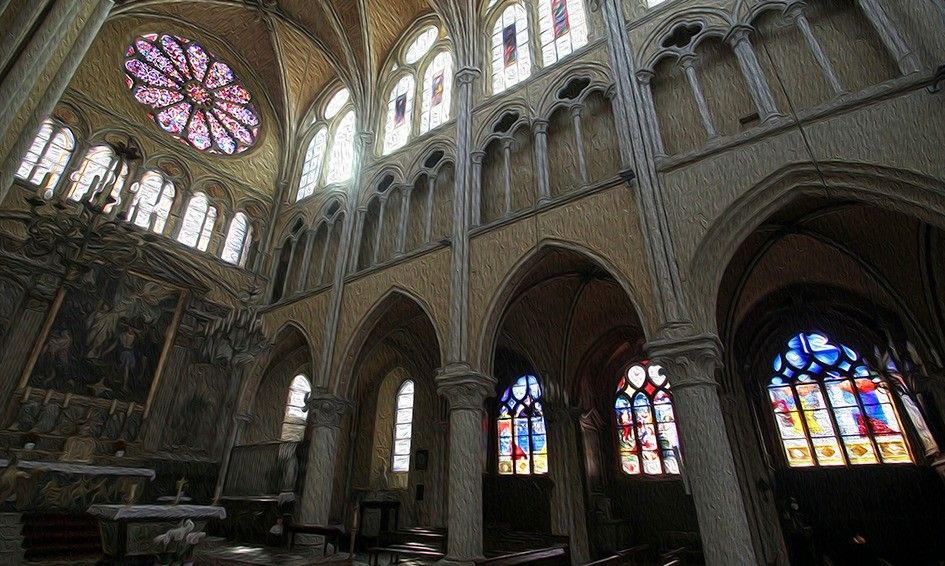
The only 14C chapel, the oldest of the side chapels, was probably founded on February 13, 1327, by Agnès La Vanière, Lady of Bien-Assise. This chapel, located in front of the sixth bay on the north side, was originally dedicated to the Virgin Mary. The chapel in the preceding bay ,fifth bay on the north side, where Our Lady of Fatima is venerated today, was initially dedicated to Saints Peter and Paul, as suggested by their busts decorating the corbels of the arch opening into the chapel. To the south, the two 15C chapels, in front of the fifth and seventh bays, are separated by an early 16C chapel. Its former dedication is not discernible. In front of the other corbels, a cherub holding a banner, vine leaves, and bunches of grapes are depicted. Today, the chapel is dedicated to the Sacred Heart of Jesus. The chapel in the seventh bay is the only one that has been restored and repainted in bright colors. The remains of a statue niche, complete with its console and canopy, can still be seen at the head of the chapel. This chapel commemorates Saint John Paul II; previously, it was dedicated to Saint Francis de Sales, The 16C chapels are located in front of the first three bays on the north side, in front of the first two bays on the south side, and in front of the sixth bay on the south side. The first chapel is believed to be the one in front of the sixth bay on the south side. Saint John the Baptist and Saint Anne, his mother, are venerated in this chapel. The chapel of Saint Peter and Saint Paul is also present. The four Renaissance chapels include the chapel in the second bay on the south side, dedicated to Saint Denis. The same tracery is found in the two rib-vaulted chapels on the north side. These chapels are dedicated to Saint Nicholas and Saint Claude. According to inscriptions on site, it was restored in 1791 and 1811. And the chapel housing the baptismal font.
A bit of history I like on the church tell us that a Christian community and a church are documented in
Brie-Comte-Robert as early as the 6C. The important relics that Lord Robert II of Dreux brought back from the Holy Land in 1192 undoubtedly motivated the construction of the present church. Gothic in style, it is a vast, elegant, tall, and luminous building, with a homogeneous plan and particularly meticulous execution, as evidenced by the clerestory and rose window of the apse, the triforium, and the systematic use of detached column shafts. The stained-glass windows of the eastern rose window are contemporary with those of the Sainte-Chapellef Paris, and of the same style. The church was completed around 1230, except for the first two bays and the vaults of the first three bays. In her will, Queen Jeanne d’Évreux, Lady of Brie-Comte-Robert, established an annuity in favor of the church, to ensure the perpetual celebration of religious services for her late husband, King Charles IV the Fair. In January 1350, the marriage of Philip VI of Valois, aged 56, to Blanche of Navarre, niece of Jeanne d’Évreux, who was only 17, was celebrated there! The completion took place in two stages: in the 14C, which justifies a solemn dedication in 1363, and during the Renaissance, between approximately 1540 and 1545.
The Catholic Parish of Brie Comte Robert on the church : https://www.paroisse-brie.com/
The official Church St Etienne de Brie : https://eglisedebrie.fr/
The town of Brie Comte Robert on the church : https://www.briecomterobert.fr/services-au-quotidien/decouvrir-le-patrimoine/leglise-saint-etienne/
The Seine et Marne dept 77 on the church : https://www.seine-et-marne.fr/fr/actualites/canton-combs-la-ville-leglise-saint-etienne-brie-comte-robert
There you go folks, again another dandy in my nostalgic Seine et Marne, This is one town that needs to be visited more ,still off beaten path mode but worth the detour, It is sublime, and darn good to be at. Again, hope you enjoy this post on the Church Saint Etienne of Brie Comte Robert !!! as I,
And remember, happy travels, good health, and many cheers to all !!!


