
The beautiful Petit Trianon of Versailles. You know if reading my blog, I lived here for 9 + years! sublime but more importantly for me , the Petit Trianon was my hanging out area, we jogged here, and ate on the little Angelina open air terrace; so many family memories. Do go along with me on this new journey on the history of this wonderful little castle! Glad to have found more pictures in my cd rom vault that should be in my blog for you and me, Therefore, here is my take on the Pavillon Frais of the Petit Trianon of Versailles !!! Hope you enjoy the post as I.
This is a wonderful beautiful little castle we love so much as it was our playground when living in Versailles, many memorable moments walking and jogging and playing catch ball by it, It is located on the site of the former village of Trianon, purchased by Louis XIV in 1661, the Trianon estate was gradually expanded and transformed until the end of the Ancien Régime (absolute monarchy). Originally composed of the Grand Trianon, (see posts) built by Jules Hardouin-Mansart for Louis XIV in 1687, it was later augmented by a second château, the Petit Trianon,(see posts) built by Ange-Jacques Gabriel for Louis XV between 1761 and 1768. By the time of Louis XV’s death in 1774, the Trianon gardens were considered one of the most beautiful and richest botanical gardens in Europe. Marie Antoinette, who became mistress of the estate, profoundly altered the area around the Petit Trianon, creating a vast Anglo-Chinese garden dotted with follies, but she spared the French garden and its formal layout. She frequently resided there, added a small, whimsical village, the Hameau (see posts) constructed by Richard Mique between 1783 and 1786. Considered by Louis XIV, Louis XV, and Louis XVI as highly private residences and places of relaxation, these châteaux offered a respite from the court of Versailles for a few days during the summer. The sovereigns strolled there, hosted dinners, parties, and performances. It was only under Napoleon I in 1810 that the Trianon estate was created, thus distinguishing it from the Versailles estate. It was then that the gates and palisades were erected, and the entrance pavilions were built at the junction of the avenues of the two palaces. This estate lasted only a century and was reunited with Versailles in 1910.
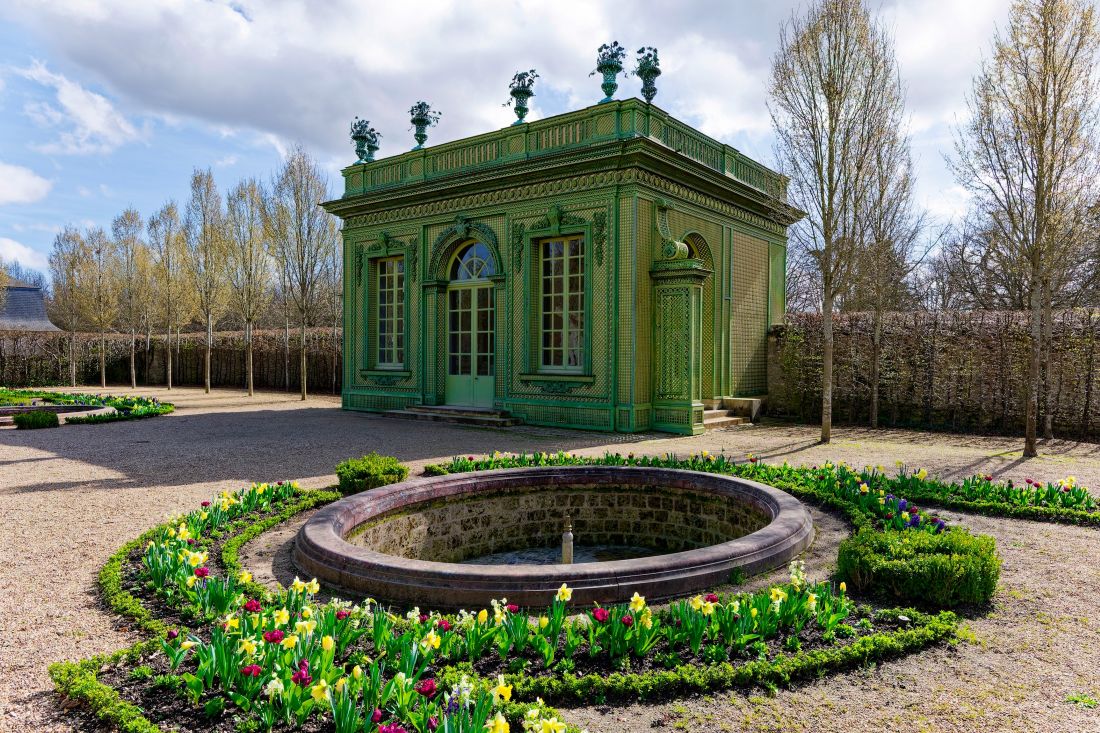
The Pavillon frais is located at the southern end of the Latin cross forming the jardin Français or French garden. Opposite it lies the menagerie. In front of the drawing room is a rectangular garden, 50 by 20 meters, a veritable green sanctuary entirely enclosed by trellis arcades. These arcades, aligned along the north facade of the building, consist of a series of iron frames nearly 3.50 meters high and 2.35 meters wide. These frames support trellis pilasters embracing the trunks of linden trees with topiary. The entrance is framed by two imposing pillars supporting large baskets. The paths are covered with river sand. On the Pavillon frais side, a second row of arcades forms two walkways, each accessed through a side French door. At the ends of the two walkways are trellis niches beneath which, in 1756, two statues by David Bourderelle, from the Hall of Antiquities in the park of Versailles, were installed: Sickness and Health, originally intended to decorate a tomb. The keystone of each of the fifty-four arches is surmounted by a basket-shaped vase, recalling the four acroterion ornaments of the pavilion.
The interior of the Pavillon frais is richly decorated, despite the pavilion’s small size, barely exceeding 60 square meters; the walls are covered with oak paneling. These same shades of green are preserved on the frames of the three mirrored panels. A fireplace, made of Languedoc marble like the edge of the pools, was added on May 30, 1752, completing the furnishing of the back wall, more for show than for practicality, as it was a summer salon. In the center of the white ceiling, a lantern similar to the one in the Pavillon Français or French Pavilion, adorned with garlands of porcelain flowers, is placed, and on the walls, a pair of three-branched canopies. The five doors and windows are decorated with double curtains of fifteen-sixteen white gros de Tours. The floor is made of black and white marble. The furniture was lost, mostly during the French revolution,
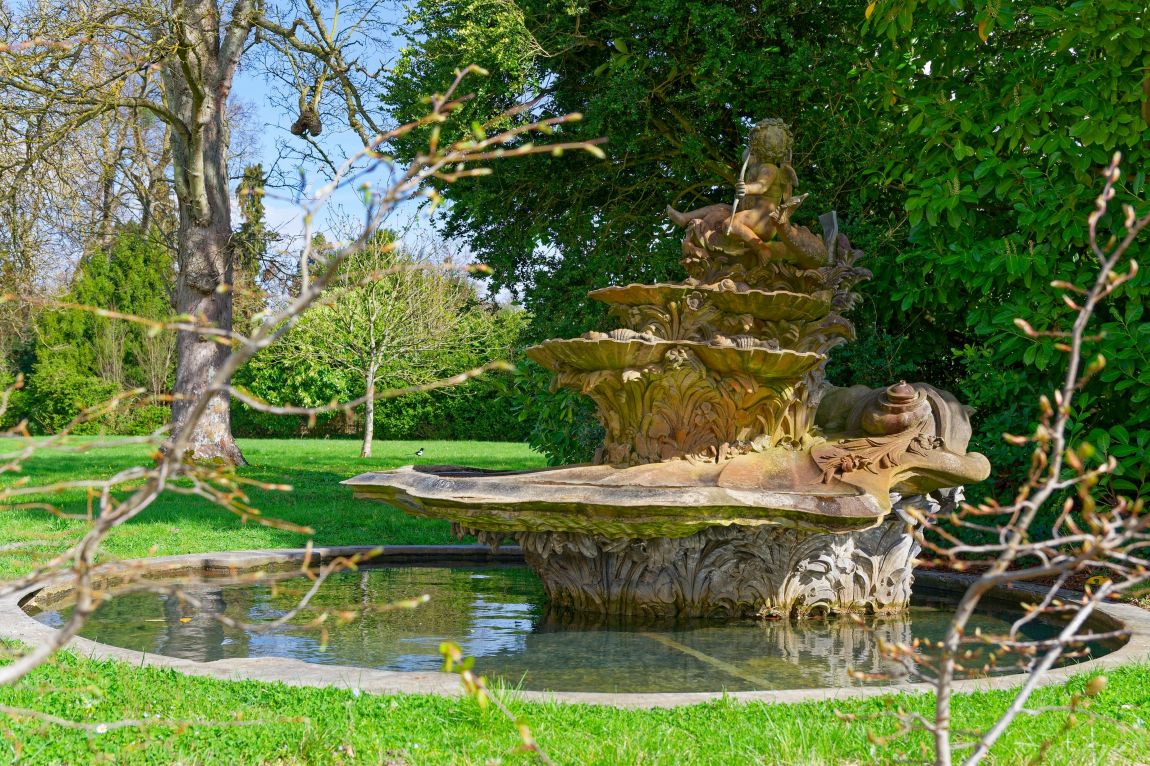
The Fontaine de l’Amour assis sur un dauphin or the Fountain of Cupid Seated on a Dolphin was executed after a drawing by Charles Le Brun. Placed in 1673 in the bosquet du Théâtre d’Eau ( Water Theatre Grove) , in the northern recess, opposite the entrance to the grove’s central room. Moved in 1704 or 1705 to the Trianon Gardens, and modified: the rocaille-decorated basin support was replaced by the current one, made from a plaster model completed in 1705. Moved, probably in 1710, to the Grande Salle Ronde ou Salle des Quatre-Figures ( Great Round Hall or Hall of the Four Figures) in the Trianon Gardens, as evidenced by a second drawing, also held at the National Library, which depicts the group in a different setting. Moved to the jardin des Sources (garden of the Springs) between 1713 and 1730 after the installation in 1713 of the plaster group of Zephyr and Flora in the Grande Salle Ronde ( Great Round Hall).
The Pavillon frais or fresh pavilion, aka Salon frais or fresh salon, is a folly built for Louis XV and Madame de Pompadour by Ange-Jacques Gabriel within the French Garden of the Petit Trianon, in the Domaine de Versailles. A new addition to this small estate, desired by the king to escape the constraints of court life, it was built between 1751 and 1753. Facing the French Pavilion, (see post pavillon français) it served as a summer dining room where one could enjoy the fresh air, and enjoy produce from the nearby kitchen garden. This pavilion, consisting of a single room, is designed as an architecture of greenery and is entirely covered in green trellises. It is adorned with a rectangular and symmetrical garden, surrounded by arcades topped with basket-shaped vases, the whole creating an architectural and horticultural harmony. Two small oval basins at the ends of the flowerbeds complete the decor.
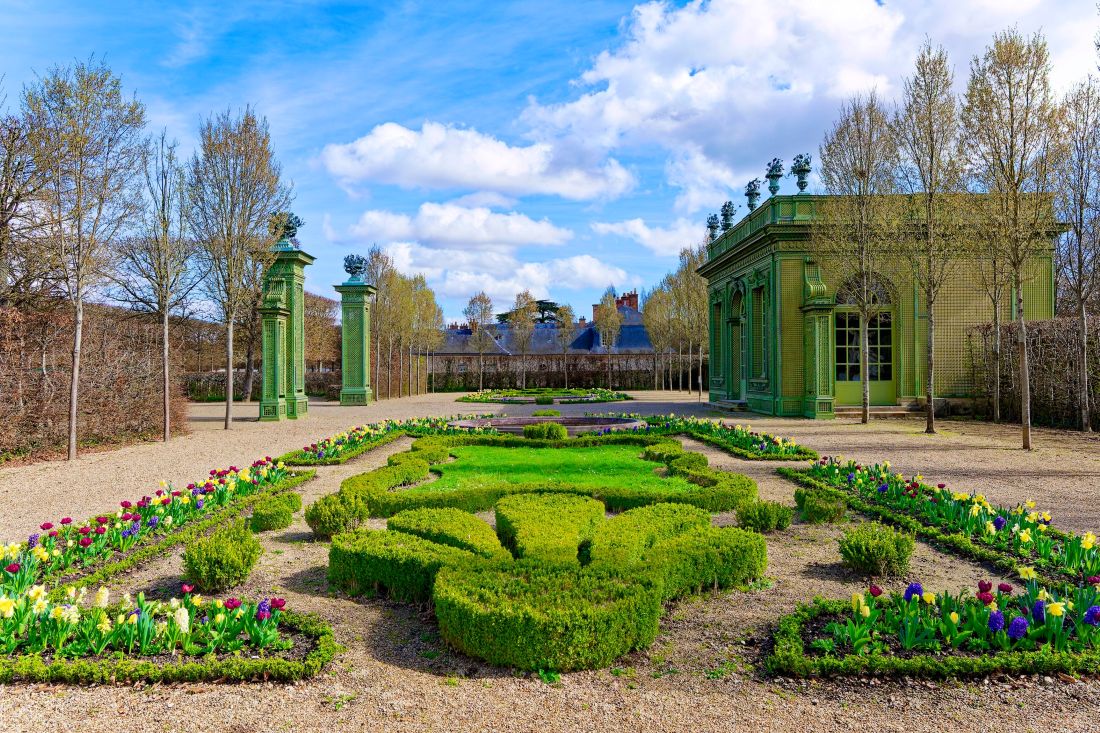
Abandoned to the elements and subjected to damage during the French revolution, the pavilion was demolished in 1810 and the garden replaced with lawn. In the 1980s, and again in 2010, thanks to the patronage of The American Friends of Versailles, and following an archaeological campaign, the trelliswork on the façades was restored, including the six crowning vases, as well as the pilasters framing the garden entrance. The second phase involved extending the trellis gallery, reconstructing all the arcades, and completing the interior decoration of the building. After the installation of the two wood-paneled walls that had been preserved, it was entirely rebuilt according to the original design, and the initial garden layout was faithfully reproduced. It is now open to the public as part of the National Museum of the Palaces of Versailles and Trianon.
The Château de Versailles on the French gardens of the Petit Trianon: https://en.chateauversailles.fr/discover/estate/estate-trianon/french-gardens-petit-trianon
The Château de Versailles on the Petit Trianon : http://en.chateauversailles.fr/discover/estate/estate-trianon/petit-trianon
The Friends of Versailles on the restoration from the American Friends of Versailles : https://amisdeversailles.com/patronage/projects/264
The city of Versailles tourist office on the Petit Trianon: https://en.versailles-tourisme.com/the-petit-trianon.html
There you go folks, Versailles is Royal, magnificent, gorgeous, historical, architectural wonders and the history of France and the world. You need to spent more time, there are a lot of wonderful architecturally stunning full of incredible history to see in my dear Versailles. Again, hope you enjoy this post on the Pavillon Frais of the Petit Trianon of Versailles !!! as I.
And remember, happy travels, good health, and many cheers to all !!!


Beautiful ❤️
LikeLiked by 1 person
Yes! Thanks for stopping by Cheers
LikeLiked by 1 person
👏🏼
LikeLiked by 1 person