
I am coming back at you with this wonderful castle as found me a picture in my cd rom vaults that should be in my blog for you and me. These are all firsts amazing abundance of marvelous places to see in my belle France. I was on my road warrior trails and took a peek by it, Therefore, here is my take on the Château de Courtanvaux of Bessé sur Braye !! Hope you enjoy the post as I.
The village of Bessé-sur-Braye is located in the Sarthe department no, 72 in the Pays de la Loire region of my belle France. The village is part of the historical province of Maine and lies in the Upper Maine area. The village is 31 km from Vendôme, 52 km from Le Mans, 70 km from Tours, and 355 km from my current home, However, we came here on our way back home from Tours taking the A10 autoroute dir Paris to exit of the A28 autoroute dir Le Mans to exit/sortie 27 dir Neuillé pont Pierre to connect with the D766 road dir Beaumont la Roncé to connect bearing left onto the D29 road dir Chemillé sur Dême go thru village bearing right onto the D68 road same road becomes the D57 road continue dead end bear right onto the D305 road dir Tours see panel on castle here continue go thru village of Sougé sur Braye on the D303 road go thru entrance to village of Bessé sur Braye but bear left onto the Avenue de la Gare with panel to castle continue bearing left onto Rue Paul Herbault with panel to castle then bear right to Rue de Salvert then bear left onto Avenue de Courtanvaux continue to castle entrance on your right hand side,
The Château de Courtanvaux was built at the end of the 15C, is an example of the late Gothic period. It retains traces of the former medieval manor: openings for the drawbridge, dry moat, watchtowers, and machicolations. The estate is accessed through a Renaissance gate dating from 1582, flanked by two round turrets, sculpted with arabesques and interlacing patterns, topped with lantern domes. The 19C entrance, or Lions’ Gate b1874, remains visible one kilometer from the castle and consists of a limestone and wrought-iron gate. The castle chapel, dedicated to Our Lady of Loreto and founded in 1454, features a Neo-Gothic portal. The 15C dovecote, the 19C orangery and stables, and the English-style park complete the imposing ensemble of buildings. The interior of the château, restored in the 19C, features sliding doors, Y-shaped ribbed vaults, and mirrors inlaid in the shutters. The nearly 68-hectare park surrounds the château, with hiking and cycling paths winding through the woods, a pond, a children’s playground, and picnic areas. The English-style park faces the main château, while the inner courtyard houses an elegant French-style garden. The entire park is open to the public free of charge year-round.
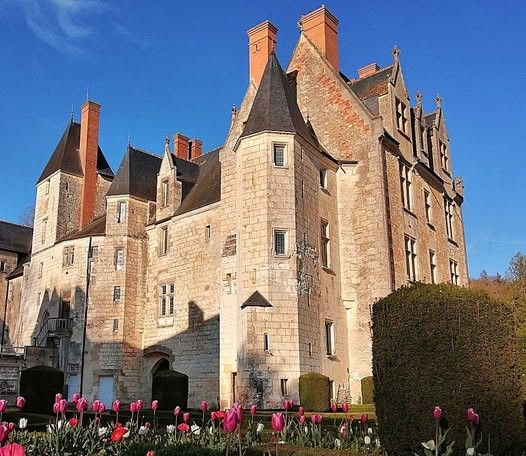
A bit of history I like tell us the the earliest buildings of the Château de Courtanvaux date back to the 14Cth century, when the lords of Bessé built a medieval manor house intended to reassure the local population and serve as a refuge in times of conflict. However, it held little strategic importance. It was only a century later that Courtanvaux gained prominence. Thus, in the mid-15C, Jacques Berziau, the king’s secretary-general, became the owner. He undertook numerous works and enlarged the estate with a chapel, a small castle, a dovecote, and above all, the main castle between 1450 and 1490. The Château de Courtanvaux was passed down through inheritance or marriage, owned by illustrious families, such as the Montesquiou-Fezensac family, related to d’Artagnan, the famous musketeer. Among them were Maman Quiou, governess to the son of Napoleon I, and direct descendant of the Grand Louvois, Louis XIV’s Minister of War, as well as Marie Bibesco, a very wealthy Romanian princess succeeded one another, constantly developing the estate, until its sale to the village of Bessé-sur-Braye in 1978, which opened it to the public.
Other things to see here are the Château de La Massuère from the 17C and 19C. The Church Notre Dame de l’Assomption, built in the late 19C, is in the Neo-Gothic style. The bell tower, dating from the 14C to 17C, is a remnant of the earlier church. This church houses: a 16C wooden rood screen; and a 16C stone group depicting Saint Anne, the Virgin, and the Child. The 15C Chapelle Notre-Dame-de-Lorette, located at above castle, and features a Neo-Gothic portal.
A bit of history of the village tell us that is was a lordship of parishes of families of Bessé, then of Vendosmoys, attached to the lordship of Courtanvaux in 1586 by Gilles de Souvré, Marshal of France, Marquis of Courtanvaux.
The official Château de Courtanvaux : https://www.chateaudecourtanvaux.com/
The village of Bessé-sur-Braye on its heritage : https://besse-sur-braye.fr/decouvrir/
The association of castles of the Loire on Courtanvaux : https://leschateauxdelaloire.org/chateaux/chateau-de-courtanvaux-2/
There you go folks, this is what road warrior trips in my belle France are all about, finally it hit you, the castles of the Loire are mythical beautiful a must to visit them all : I am working on it. The Château de Courtanvaux is unique and worth the detour me think. Again, hope you enjoy the post on the Château de Courtanvaux of Bessé sur Braye !! as I
And remember, happy travels, good health,and many cheers to all !!!


