
Let me tell you about a dandy in my road warrior rounds in the wonderful sublime Loire Valley. This is a spot have come several times even if to this one a bit back from the river was just a peek briefly , more power to be back eventually, I did found me a picture in my cd rom vault that made me do this post for you and me, For reference, Amboise i located in the Indre et Loire dept no, 37 in the Centre Val de Loire region of my belle France, Do read my several posts on the City in my blog, This time let me tell you on the Domaine Royal de Château Gaillard !!! Hope you enjoy the post as I.
The Château Gaillard luxuriously furnished in period style, it allows visitors to wander, accompanied by the sounds of operatic voices, through the art of living in the 16C. Its ornate double-mullioned windows, adorned with 8,000 stained-glass panels and 36 polychrome medallions created in the pure tradition of the 16C glassmakers of Saint-Just, tell the story of the castle. Each room boasts a fireplace with pediments adorned with intricately sculpted scrollwork, crafted by the most skilled Italian artists of the era, who drew inspiration from the discoveries of new worlds and left this testament etched in stone. The castle’s façade, a veritable stone lacework, is richly detailed, revealing a cornice with four friezes, 1.20 meters high, richly sculpted. A place steeped in history, the estate, successively the royal residence of Charles VIII, Louis XII, Francis I, and then Pacello da Mercoliano, later belonged to René of Savoy, Victor of Marignano and uncle of Francis I, and to Cardinal de Guise, the most powerful man in Europe. Subsequently, all the “illustrious” figures of the 16C possessed this marvelous and magical place. After having been one of the residences of Charles VIII and Anne of Brittany, the royal estate of Château-Gaillard successively saw the following people reside within its walls: Anne Lascaris, John III of Lorraine, Francis II and Mary Stuart, Charles of Guise-Lorraine, René de Villequier, the Della Rovere family, André Malraux and Louise de Vilmorin. The setting for numerous historical events, such as Mary Stuart’s honeymoon and Catherine de Medici’s secret meetings to thwart the Amboise conspiracy, Château Gaillard tells the story of the royal city of Amboise. You will also discover the legend of Anne of Brittany’s Unicorn, characters from the Commedia dell’arte, and a cabinet filled with astonishing curiosities like a 4-million-year-old meteorite, the Mask of Shame, etc., among many other objects belonging to the master gardener. This small Italian palace, surrounded by the first gardens of the French Renaissance, has been rediscovered and opened its doors to the public after five years of restoration.
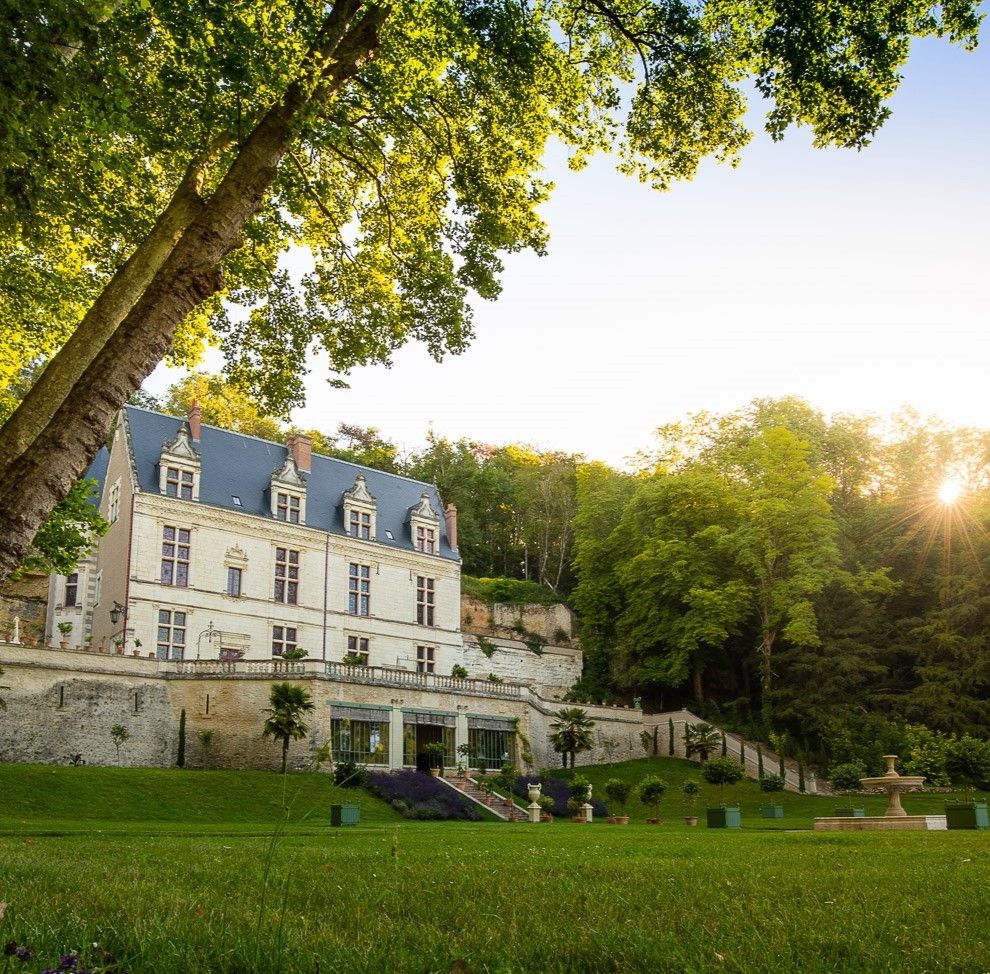
Let’s step back in time to 1500, when this prestigious place became known as the Jardin du Roi or King’s Gardens. For Charles VIII, these gardens were much more than just green spaces. They were a symbol of prestige, where he could showcase to his visitors the rare and exceptional citrus varieties he cherished. It was in these gardens that Dom Pacello created the famous French plum, the Reine Claude, in honor of Claude of France, the wife of Francis I. The King’s Gardens were also a place for courtly strolls and entertainment for the royal court. The continuous melody of the fountain still resonates today in this stone amphitheater, mingling with the birdsong of the park. We invite you to wander along the seven hillside Paradise Paths, explore the ancient forest, and refresh yourself at the Gallo-Roman spring. Enjoy the viewpoints and the breathtaking view over the Jardins du Roy, 15 hectares of park and forest in the heart of Amboise !
A brief description tell us that Charles VIII, husband of Anne of Brittany (duchess of Brittany), and then the young King of France, driven by a thirst for conquest, led the first Italian campaign in 1496 at the head of 30,000 knights. Captivated by the Quattrocento, the Italian cities, and so much new beauty, he returned with 22 artists, known as “Gens de Mestier,” to establish the French Renaissance at his home in Amboise. Inside you see the Charles VIII Grand Salon, of grand and well-proportioned dimensions, features a monumental Italianate fireplace whose mantel is adorned with a cartouche of scrolling foliage and whose jambs are decorated with rosettes. It also boasts a French-style ceiling, a terracotta tile floor, and two sculpted doors: one with dragons and sirens, the other with the emblem of Francis I: a crowned salamander. The dining room of Cardinal Charles de Guise-Lorraine has a monumental fireplace whose lintel, bearing the coat of arms of the cardinal who owned the property, and its mantel are richly decorated in the French Renaissance style: scrolling foliage, cornucopias, mascarons and grotesques, putti, griffins, etc. This room hosted the secret meetings in 1559 between Catherine de Medici, the Duke of Guise, his brother the Cardinal of Guise, and the young King Francis II accompanied by his wife Mary Stuart, aimed at thwarting the Amboise Conspiracy initiated by the Protestants. The restored stained-glass windows depict episodes of the conspiracy and a portrait of the Cardinal of Guise who suppressed it. A troglodytic chapel, or semi-troglodytic, is located at the foot of the cliff overlooking the eastern part of the terrace. Adjoining the east gable of the Logis Royal or Royal Lodgings, with which it communicates, it was consecrated to Marian devotion on August 19, 1515. Its façade, faced with rubble stone, features a window and an arched portal whose panels are constructed of dressed white tufa stone. The latter is surmounted by a sculpted pier bearing the Great Coat of Arms of the First House of Valois, flanked by the monograms of Louis XII and Anne of Brittany. The kitchens are enclosed by a façade faced with rubble stone. The vaulted and intact wine cellar maintains a temperature of 13°C year-round. Three bread ovens, at least contemporary with the construction of the Royal Lodgings, have been rediscovered. One of them, in perfect condition, is visible on the terrace. The icehouse has also recently been rediscovered, halfway along the “Dom-Pacello Trail.” In addition, a dovecote with 200 nesting boxes is built into the cliff. A well, still filled with water, has also been rediscovered in an unusual location: on the terrace in front of the Royal Lodgings. It consists of a 12-meter-deep shaft lined with dressed stone. A watermill for metallurgical use (known as the Moulin à Fer or Iron Mill, located on the banks of the Amasse river, also belonged to the estate. Another mill was situated on the Chateau Gaillard Alley, lined with double elm trees , called Pont Moulin or Mill Bridge.
The official Domaine Royal de Château Gaillard of Amboise : https://chateau-gaillard-amboise.fr/le-chateau/
The Blois Chambord area tourist office on the Château Gaillard : https://www.bloischambord.co.uk/offers/royal-estate-of-chateau-gaillard-amboise-en-1532598/
The Centre Val de Loire region tourist office on the Château Gaillard : https://www.loirevalley-france.co.uk/discover/visit-garden/royal-domain-chateau-gaillard/
There you go folks, another dandy town and beautiful castles, always great memories of always ! . It was a great experience to know it, always wonderful uplifting and with great history and architecture I like. Again, hope you have enjoy the post on the Domaine Royal de Château Gaillard !!! as I.
And remember, happy travels, good health, and many cheers to all !!!


