
I come back with another memorable street of my eternal Paris. I am amazed of the material in my cd rom vault of so many years hanging around my belle France. And ,again, found this picture to share in my blog for you and me, This was/is my entry point into Paris by car, so many times going up the challenge of the Arc de Triomphe , a super thrill, must try it, its glorious, This avenue packs a punch and worth even walking on it, Therefore, here is my take on the Avenue Foch of Paris !!! Hope you enjoy it as I
The Avenue Foch is located in the 16éme arrondissement of Paris. This thoroughfare begins at Place Charles-de-Gaulle (formerly Place de l’Étoile) and ends at Porte Dauphine (Place du Maréchal-de-Lattre-de-Tassigny). One of the twelve avenues radiating from Place de l’Étoile, (around Arc de Triomphe) ,it is considered one of the most prestigious addresses in Paris. The following metro and RER stations are located on the avenue: Charles de Gaulle – Étoile (lines 1, 2, and 6); Gare de Charles-de-Gaulle – Étoile (RER line A); and Porte Dauphine (the terminus of line 2). The Foch Avenue station RER Line C is located at the corner of Boulevard Flandrin (Porte Dauphine). This majestic avenue, 140 meters wide and 1.5 kilometers long, was created in 1854 to connect the Bois de Boulogne to the city. Avenue Foch is not only the widest avenue in Europe but also one of the widest in the world. It was only in 1929 that it was named after Marshal Foch, having previously been called Avenue de l’Impératrice, Avenue du Général Ulrich, and then Avenue du Bois de Boulogne. Avenue Foch thus became a meeting place for elegant, fashionable, and demimondaine women, who had magnificent private mansions built there, which can still be admired today.
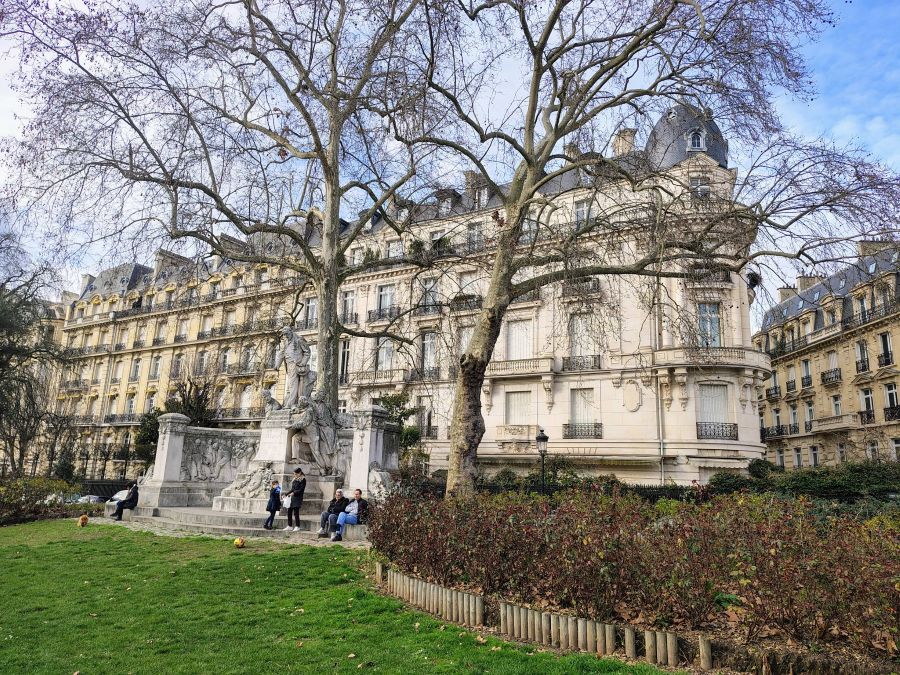
In the gardens of Avenue Foch you see the monument created by the sculptor Dalou and the architect Jean-Camille Formigé celebrates the glory of Jean-Charles Alphand, (see pic) located between nos 17 and 22 . Along the avenue, you can discover what can be considered a veritable arboretum. It boasts over 600 trees of various species, some of which are over a century old. It was my main entry by car into Paris when living in Versailles for many years, This majestic avenue, 140 meters wide and 1.5 km long, was created in 1854 to connect the Bois de Boulogne to the city. It was only in 1929 that it was named after Marshal Foch, having previously been called Avenue de l’Impératrice, Avenue du Général Ulrich, and then Avenue du Bois de Boulogne. The Avenue Foch thus became the meeting place for elegant, fashionable, and demimondaine women, who had magnificent private mansions built there, which can still be admired today. The lawn between nos 84 and 92 pays tribute to Pierre Brossolette. The lawn opposite nos 49 to 61 is named the Ingrid-Bergman lawn, the one between nos 46 and 50 is named the Isabelle-Eberhardt lawn, and between nos 61 and 71, a lawn honors the memory of Nina Berberova. Between nos 70 and 82, you will find the Marie-France Pisier lawn, and between nos 73 and 77, the Jean-Seberg lawn.
At the end of the 19C, prominent figures in high society abandoned the center of Paris to build private mansions along this new avenue: the Marquis de Breteuil, Baron Étienne van Zuylen, the Ephrussi de Rothschild family (at no 19), the playwright Adolphe d’Ennery (where the Musée d’Ennery d’Art Asiatique is located), Anna Gould (where her son Howard committed suicide in 1929), and Boni de Castellane (Palais Rose). Even in fiction, the Prince de Guermantes in Marcel Proust’s *In Search of Lost Time* left the Faubourg Saint-Germain for Avenue Foch. Other prominent figures followed, such as the artists Claude Debussy, Georges Feydeau, and Octave Mirbeau. In October 1896, on the occasion of their visit to France, Tsar Nicholas II and his wife Alexandra arrived at the Passy-la-Muette train station, located alongside the Jardin du Ranelagh (see posts) garden. The procession then crossed the Bois de Boulogne, to the Porte Dauphine, then took the Avenue du Bois (now Avenue Foch), the route to which was to take them to the Russian Embassy. In the 20C, it became the residence of socialites and celebrities such as Jacques Dutronc and Françoise Hardy, Maria Callas and Aristotle Onassis, Rainier III and Grace Kelly, Arthur Rubinstein, Fernandel, Marcel Pagnol, Gérard de Villiers, Loris Azzaro, Daniel Hechter, the hairdresser Jacques Dessange , Middle Eastern King Salman bin Abdulaziz Al Saud) or African (Mobutu) heads of state. The fact that the area lacks shops and activity doesn’t bother the wealthy residents, who appreciate its tranquility. During the Nazis occupation of Paris, the area was nicknamed “Avenue Boche” as the nazis requisitioned several buildings. A high-ranking officer took up residence in the Palais Rose, the Jewish Affairs office was located at N31 bis, and the Gestapo headquarters (where Pierre Brossolette was tortured was at No 84.
Notable buildings here are many, these are on the even-numbered side, at the level of Rue Chalgrin: monument in homage to Adolphe Alphand (see above ) by the sculptor Jules Dalou and the architect Jean-Camille Formigé, erected in 1899. A westward perspective see the monument in homage to Marshal de Lattre de Tassigny. No. 2 bis: “Le Duplex” nightclub, accessible via an entrance opening onto the sidewalk. No. 12: Hôtel de Breteuil, built in 1902 for Henry Le Tonnelier de Breteuil. Today, it houses the Irish Embassy. No. 19: Hôtel Ephrussi de Rothschild. Residence of the banker Maurice Ephrussi and his wife, née Béatrice de Rothschild. Today, the Angolan Embassy in France occupies the premises. No. 22: Art dealer Paul Guillaume moved to this address with his wife Domenica in the late 1920s, into a 600 m2 apartment (it was then still Avenue du Bois). Between 2002 and 2019, the American multimillionaire and convicted sex offender Jeffrey Epstein owned an 800 m2 apartment on the second floor of the building. He hosted numerous guests there for lavish dinners, including Prince Andrew, son of Queen Elizabeth II; French politician Jack Lang; businessman and politician Steve Bannon, former advisor to Donald Trump; entrepreneur Bill Gates; and many others. No. 34 (and 3, rue Le Sueur): Hôtel Blumenthal, also known as Hôtel de Montmorency, built in 1900 on land acquired from the insurance company La Nationale by the German-born American businessman Ferdinand Blumenthal. Ferdinand Blumenthal displayed his collection of antiques and paintings in his hôtel particulier, notably works by Corot and other painters of the Barbizon School. After Ferdinand Blumenthal’s death in 1914, the hôtel particulier became the residence of his widow, née Cécilia Ulman, who remarried in 1917 to Louis de Talleyrand-Périgord, 7th Duke of Montmorency and the second of the House of Talleyrand-Périgord. Later, the hotel was acquired by Jorge Luis Ortiz de Linares, Bolivian ambassador to France after World War II, and his wife Graziella Patiño, whose father, Simón Iturri Patiño, lived at 30 Avenue Foch, across the street from Rue Le Sueur. In the 1980s, it belonged to Mohammed Mahdi Al Tajir, Minister of Petroleum of the United Arab Emirates and their ambassador to London. At the end of December 2023, he sold the hotel to a French management company, Mindston Capital.
No. 35: In an apartment requisitioned after the liberation of Paris, the Government of the Spanish Republic in exile was established at this address and remained there until the early 1960s. Other offices were located on Avenue Kléber (16th arrondissement) and Rue des Pyramides (1st arrondissement). No. 41 (corner of Avenue Raymond-Poincaré): A building constructed in 1907, featuring a colonnaded loggia on the fourth floor, with a signature to the right of the entrance. It houses the headquarters of the Yacht Club de France, founded in 1867, as well as the residence of the Israeli ambassador to France. No. 44: In the 1900s, the Legation of San Marino. Maria Callas lived here after her breakup with Aristotle Onassis (they had previously lived at number 88 on the avenue). Fernandel also lived at this address until his death, in a superb duplex above Callas’s apartment. Number 46: Vera Nimidoff held a literary salon here, frequented by Paul Valéry, Jean Cocteau, Louis Barthou, Prince Pierre de Polignac, François Mauriac, Henry Bordeaux, Abel Bonnard, Anna de Noailles, Léon-Paul Fargue, Georges Henri Rivière, and Henri de Régnier. At the end of the avenue, just before the Porte Dauphine, stands a remarkable structure above a metro entrance, designed by Hector Guimard, the only one of the last three of its kind remaining in Paris in its original location. It is an Art Nouveau entrance entirely covered by a glass roof. Number 50: Françoise Hardy and Jacques Dutronc lived in this building. Number 59: private mansion Built in 1875, it belonged to the playwright Adolphe d’Ennery; upon his death, he bequeathed his mansion and his collections of chinoiserie and japonerie to the State; the Musée d’Ennery, which therefore bears his name, was inaugurated in 1908. No. 60: the singer Prince lived here from 1987 to 1997 in a 600 m² apartment. No. 75: United States Embassy in France during the Siege of Paris (1870-1871) and the Commune. The Communards occupied the building, and Ambassador Elihu B. Washburne followed the exiled government to Versailles. No. 80: entrance to the Square de l’Avenue-Foch, a private road, where the writer Marcel Pagnol and the musicians Arthur Rubinstein and Claude Debussy lived. In the 1920s, the building housed the Liberian legation. Numbers 82, 84, and 86: During the Second World War, these buildings housed the Gestapo headquarters. For this reason, the street was nicknamed “Avenue Boche” (German Avenue). It was in one of these buildings, at number 84, that Pierre Brossolette committed suicide rather than talk. The writer Octave Mirbeau lived at number 64, which became number 84, from 1901 to 1909 in a very luxurious apartment rented at a very high price. Number 85: Station on Avenue Foch, on the former Petite Ceinture railway line. Number 88: The Greek shipping magnate Aristotle Onassis owned two apartments at this address, one above the other; he lived in the upper apartment, which had a surface area of 450 square meters; the lower one was occupied by his daughter Christina. Number 90: A Louis XVI-style mansion built in 1917. It was the home of the industrialist Louis Renault. At the end of During World War II, its owner, accused of economic collaboration with the occupying forces, had the townhouse searched and its kitchens looted on September 5, 1944, by armed members of the Liberation Committee of the 16th arrondissement. In 2015, enlarged by the addition of two apartments from the neighboring number 88, the property belonged to the son of King Abdullah of Saudi Arabia.
Several characters from the works of writer Marcel Proust frequented the avenue: on the advice of Charles Swann, Odette regularly jogged there, as it was a chic place to be seen. After the war, the avenue became the address of the Prince of Guermantes. In 1950, Maurice Chevalier performed a song entitled “Sur l’avenue Foch” (On Avenue Foch).
The Paris tourist office on the 16éme arrondissement de Paris : https://parisjetaime.com/eng/article/a-la-decouverte-du-16e-arrondissement-de-paris-a830
The Paris tourist office on the Place Charles de Gaulle : https://parisjetaime.com/eng/transport/place-charles-de-gaulle-p1968
There you go folks, a wonderful avenue Foch in my eternal Paris. It is worth the walk or drive on it, we enjoy it very much, and many times, this road warrior went in into the Arc de Triomphe by car !!! Again, hope you enjoy the post on the Avenue Foch of Paris !!! as I.
And remember, happy travels, good health, and many cheers to all !!!


A route packed full of historical significance
LikeLiked by 2 people
Indeed, many memories by there. Thanks for stopping by Cheers
LikeLiked by 1 person