
This is one of my first areas visited in Paris as came by it with my then girlfriend in 1990 and later dear wife Martine on many more times by here. I was able to see the huge transformation of this area the 19éme arrondissement of Paris. from a low unknown to a vibrant lively area . I like to tell you about a submarine ! Therefore, here is my take on the Argonuate of the Cité des Sciences et de l’Industrie of Paris !!! Hope you enjoy the post as I
The Argonaute (S636) is an Aréthuse-class submarine of the French Navy, commissioned on October 23, 1958, and decommissioned on July 31, 1982. It has since been on display in front of the Cité des Sciences et de l’Industrie (opened in 1986) at 30 Avenue Corentin-Cariou, in the 19éme arrondissement of Paris. The Argonaute opened to the public in 1991.
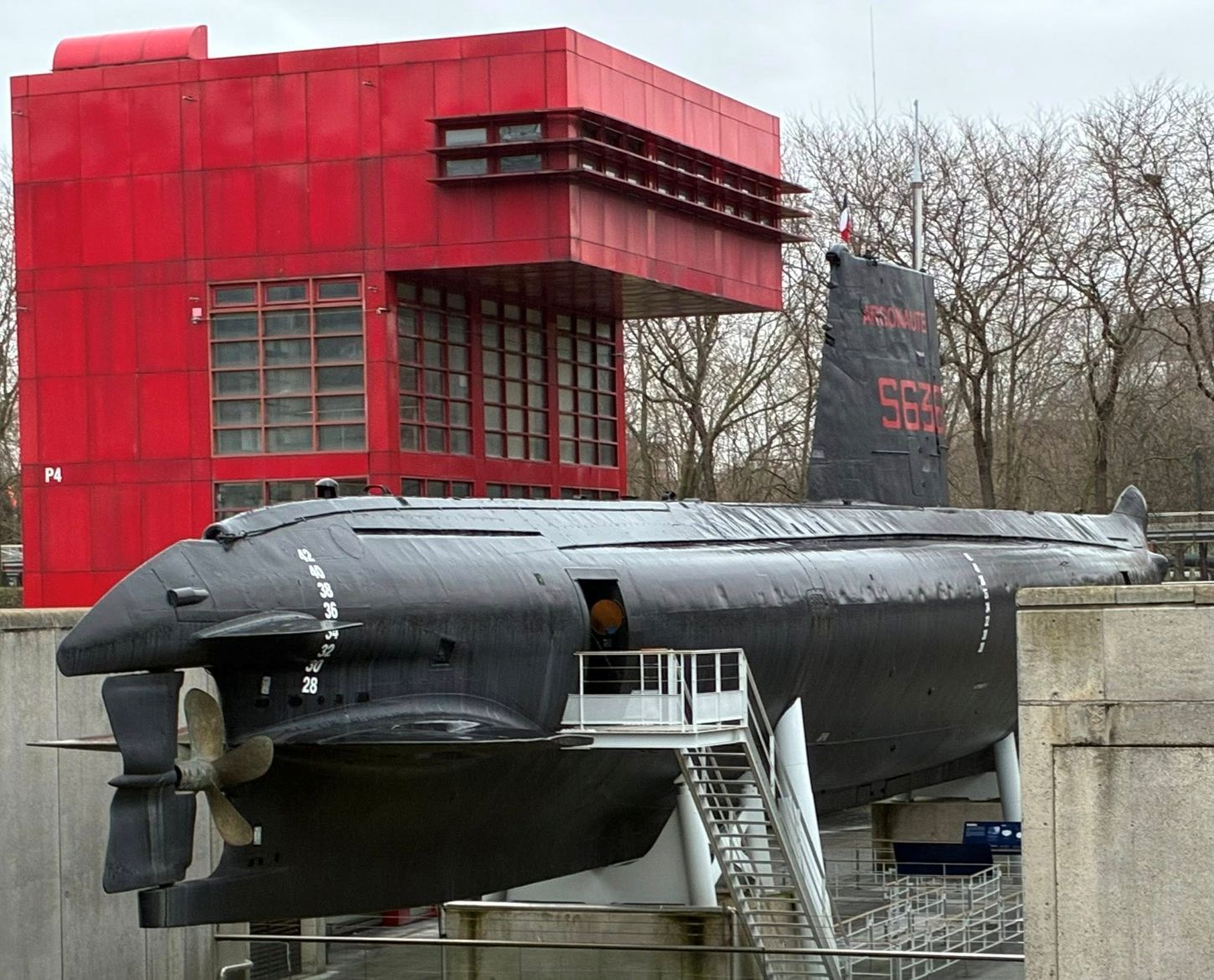
The endurance of a diesel-powered submarine submerged depends on the capacity of its batteries. Everything runs on electricity, but propulsion consumes the most power. The Argonaute could maintain a speed of 14 knots (approx 27 kph or about 17 mph) for one hour and cover 270 km (aprox 167 mi) in 33 hours. It could dive for several hours at very low speed, conserving as much electricity as possible. The hull and hatches used for personnel and equipment access must withstand the water pressure experienced by the submarine when submerged. To prevent deformation, the hull, with its circular cross-section, is made of special high-yield-strength steels several centimeters thick. Water exerts a pressure of 1 kg per cm² at a depth of 10 meters. The Argonaute‘s hatch thus experiences a thrust of 56.5 tons at a depth of 22 meters. The periscope is a telescopic mast that allows observation above the surface when the submarine is operating at shallow depths. Along with the antennas and radar detectors, it is essential to the submarine’s safety system. Optical tubes are now being replaced by optronic masts, which house high-definition digital and infrared cameras.
A bit of history I Like tell us that in 1984, Charles Hernu, then Minister of Defense, entrusted the Argonaute to the Friends of the Atlantic Maritime Museum for preservation. Located in Toulon, the submarine was transported on a 94-meter-long barge, itself towed by a tugboat, which arrived in Le Havre three weeks later. It then traveled up the Seine river to Gennevilliers, where a dozen flotation balloons were added to give it a draft of 3 meters. The most delicate part was yet to come: upon reaching the Saint-Denis Canal, it had to pass through seven locks and, most importantly, be hauled ashore at La Villette. This required digging a pit, installing two enormous cranes on the quay, lifting it out of the water, rolling it 400 meters on a 96-wheeled trolley, and finally, placing it on two concrete blocks. Awesome !
The Cité des Sciences et de l’Industrie on the Argonaute: https://www.cite-sciences.fr/en/argonaute
The Paris tourist office on the Argonaute of the Cite des Sciences et de l’Industrie : https://parisjetaime.com/eng/culture/l-argonaute-cite-des-sciences-et-de-l-industrie-p3520
There you go folks, a wonderful park for all to enjoy the parc de la Villette is awesome. You will do good to visit this off the beaten path area of Paris, it is very nice. Again, hope you enjoy this post on the Argonuate of the Cité des Sciences et de l’Industrie of Paris !!! as I,
And, remember, happy travels, good health, and many cheers to all !!!


