
We have driven and walked in my eternal Paris, and would like to have an imprint in my blog on the wonderful family times we had there, There is so much to see , doing my best, and glad found me these pictures in my cd rom vault ,which now transposing in my blog for you and me, This was my former worked city, so glad to post more memorable spots on it, I thank you for your readership over the years and to bear with my rants! After all, Paris is to rant, shout and yelled about, me think. Therefore, here is my take on curiosities of Paris, part LXXVI !!! Hope you enjoy the post as I.
The rue du Parc-Royal is located in the 3éme arrondissement of Paris, in the heart of the Marais quartier. It begins at Rue de Turenne and ends at Place de Thorigny. It runs alongside Square Léopold-Achille and was named for the gardens of the former Hôtel des Tournelles, the residence of the Kings of France, which extended partly onto the site of the present-day Place des Vosges. The area is served by the Saint-Paul metro station (line 1) and the Saint-Sébastien – Froissart metro station (line 8). The street’s name refers to the park of the Hôtel Royal des Tournelles, which it borders. This complex of buildings was constructed starting in the 14C. Long a residence of the Kings of France, it was in this Hôtel des Tournelles that Kings Louis XII and Henry II died. The street was opened in 1545, as one of the roads created to serve the Sainte-Catherine agricultural estate. It was called “rue du Parc-du-Roi” or “rue du Parc-des-Tournelles”, then “rue du Petit-Paradis” and it was around 1605 that it took its current name. It is mentioned as rue du Parc Royal in a manuscript from 1636. By a resolution of April 11, 2025, the section of the street between rue de Turenne and rue Madame-de-Sévigné became rue Michel-Blanc (French actor, director, screenwriter, and dialogue writer). Notable buildings here are at No. 4: former Hôtel Berruyer, also known as Hôtel de Canillac, de Jassaud, de Lamoignon, or de Coursin. The Carnavalet Museum preserves an exterior view of the former hôtel dated 1908 and a photograph of the stairwell taken in 1920. Since 1935, it has housed the headquarters and showroom of Maison Delisle, bronze and wrought ironwork manufacturers, and lighting fixture makers. No. 8: Hôtel Duret de Chevry (see pic) No. 10: Hôtel de Vigny; Purchased by the State in 1938 and renovated in the 1980s, it officially became the headquarters of the Mariage Frères tea house on June 29, 2015. No 12: former Hôtel de Croisilles, built in the 17C. Nos 14 and 16: former Hôtel de Bonneval, built in the 18C.
The Hôtel Duret de Chevry at no 8 rue du Parc Royal (see above) was built between 1618 and 1620 for Charles Duret de Chevry, President of the Chamber of Accounts (1609), Superintendent of Finances (1610), who ended his career as Comptroller General of Finances (1634). The hôtel was built modeled after the Hôtel Mégret de Sérilly, which he had built previously. It is one of the very last hôtels particuliers in the Marais neighborhood /quartier built in the brick and stone style. During the Second Empire, the main building was rebuilt in the same brick and stone style. The wings, probably older, have retained more of their original character. The Duret de Chevry family retained ownership of the hôtel particulier until 1724, but then rented it out. From 1662 to 1690, it was leased to Philippe-Emmanuel de Coulanges, cousin of the Marquise de Sévigné. In 1821, the property was acquired by Charles Crozatier, a renowned sculptor known for his trade in bronze copies of antique sculptures.Since 1994, the Hôtel Duret de Chevry has housed the German Historical Institute aka the Deutsches Historisches Institut Paris (DHIP), is an international research center specializing in history.
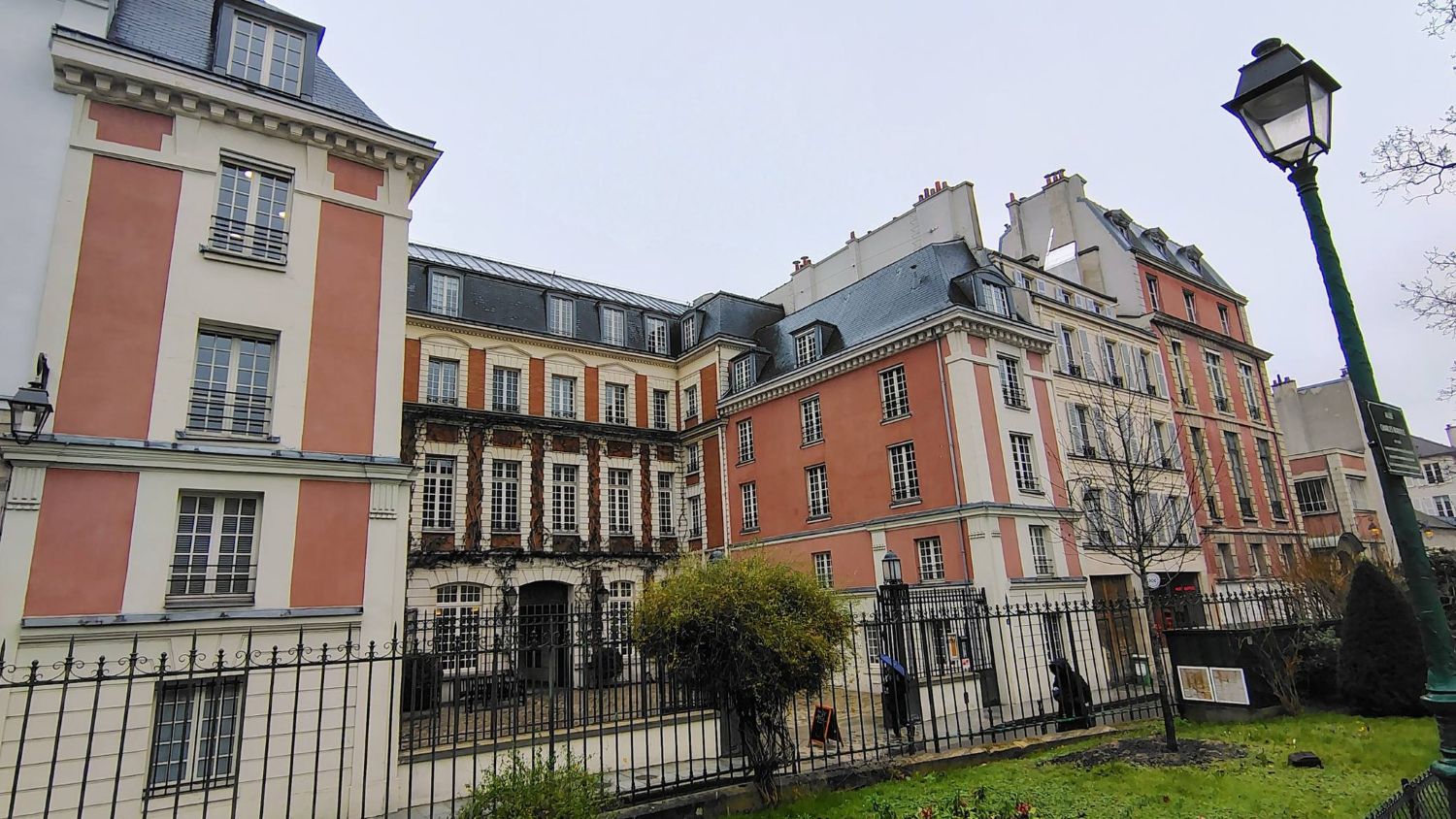
The Place de Thorigny is located in the 3éme arrondissement of Paris, in the heart of the Marais quartier/neighborhood. It is served by the Saint-Paul metro station (line 1) and the Saint-Sébastien – Froissart metro station (line 8). This intersection is named for its proximity to the street of the same name(see below), which is named after Jean-Baptiste Claude Lambert de Thorigny, who was president of the 2nd Chamber of Requests of the Parliament of Paris from 1713 to 1727 and Provost of the Merchants of Paris from 1726 to 1729. Formed by the intersection of Rue Elzévir, Rue du Parc-Royal, Rue de la Perle, and Rue de Thorigny, it has borne its current name since 1838. Notable buildings here are at No 1 houses the Hôtel Libéral Bruant, corner of rue de la Perle (see below) which was once a locksmithing museum and is now a modern art exhibition center. The entrances to the Picasso Museum and the Cognacq-Jay Museum are just steps away. The writer Charles Perrault lived on this square from 1685.
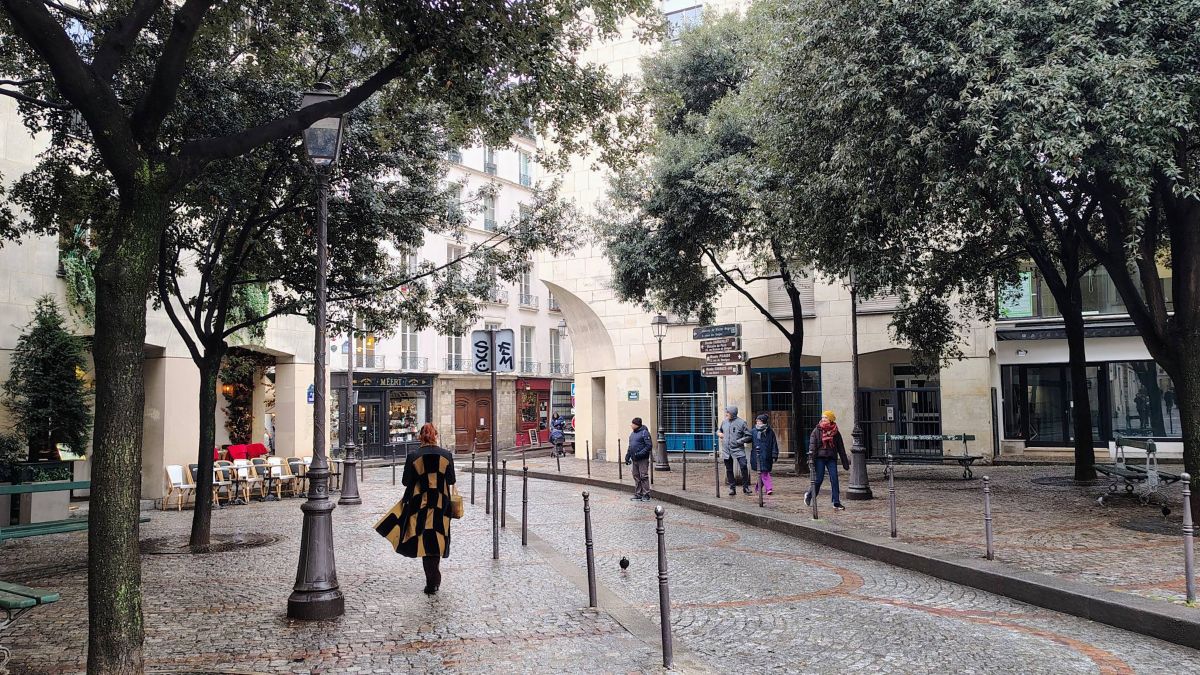
The Rue de Thorigny is in the 3éme arrondissement of Paris, located in the heart of the Marais quartier. This site is served by the Saint-Paul metro station (line 1) and the Saint-Sébastien – Froissart metro station (line 8). This street is named after Jean-Baptiste Claude Lambert de Thorigny, who was president of the 2nd Chamber of Requests of the Parliament of Paris from 1713 to 1727, and provost of the merchants of Paris from 1726 to 1729. In 1539, this street was a dead end, extended in 1620 during the subdivision of gardens belonging to the Hospitaller nuns of Saint-Gervais. It is mentioned as “rue Neufve Saint Gervais” in a manuscript from 1636. Two streets were created on this land, which, at the beginning of the 18C, took the names “rue de Thorigny” and “rue de la Perle.” Notable buildings here are at No 5 the remarkable Hôtel Salé, built from 1656 to 1659 for Pierre Aubert de Fontenay, and his wife, a Mademoiselle Chastelain. Implicated by Nicolas Fouquet’s accusations of embezzlement, Aubert de Fontenay was dispossessed of his property. However, this newly rich man died before the completion of the renovations, and the hôtel particulier was occupied by Morosini in 1671. In 1768, it became the Hôtel Juigné, owned by Monseigneur Leclerc de Juigné, Bishop of Châlons, then Archbishop of Paris, and a member of the Constituent Assembly. Pillaged and requisitioned during the French revolution, the hôtel was sold in 1797 and then leased to the École Centrale des Arts et Manufactures. The Hôtel Salé now houses the Picasso Museum (see post). At the corner with Rue des Coutures-Saint-Gervais, the boundary marker of the Saint-Gervais seamstresses’ fiefdom remains. Another fiefdom marker is inscribed at the corner with Rue Debelleyme. In 1659, Claude Gueston, Treasurer of France and one of the directors of the French East India Company, acquired three plots of land on Rue de Thorigny. He commissioned the architect Libéral Bruant to build three mansions, constructed between 1669 and 1660. Nos 6 and 8 were rented out, while Gueston himself lived in No, 10, also known as the Hôtel Gueston.(see pic) Madame de Sévigné lived at No 8 from 1669 to 1672 before moving to Rue de Montmorency. Honoré de Balzac stayed at No 9 while studying at Abbé Ganser’s school in 1815. No 13 is one of the rare examples of a modern brick building (1973) constructed in the heart of Paris, on the site of the garden of a mansion on Rue Vieille-du-Temple.
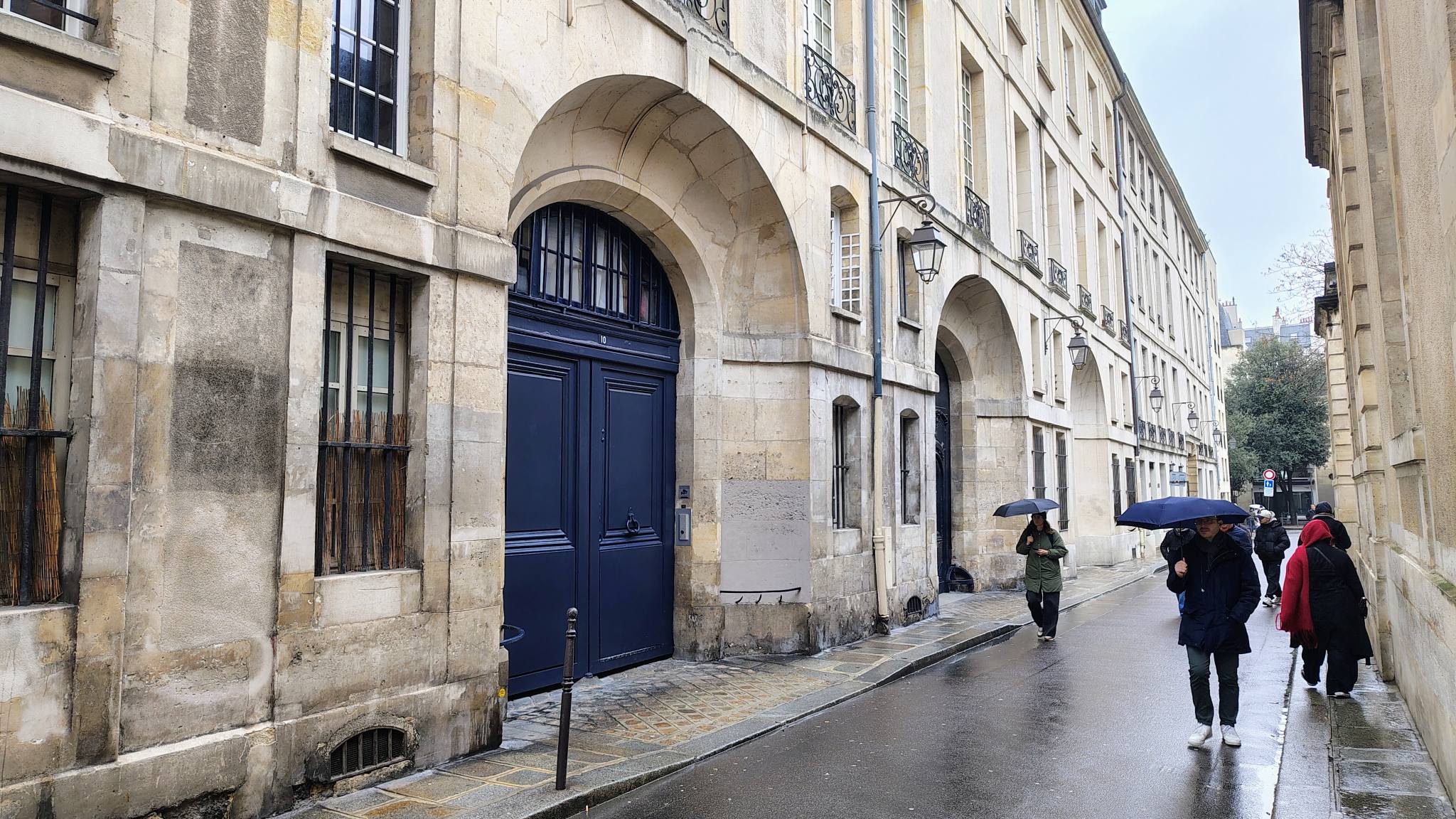
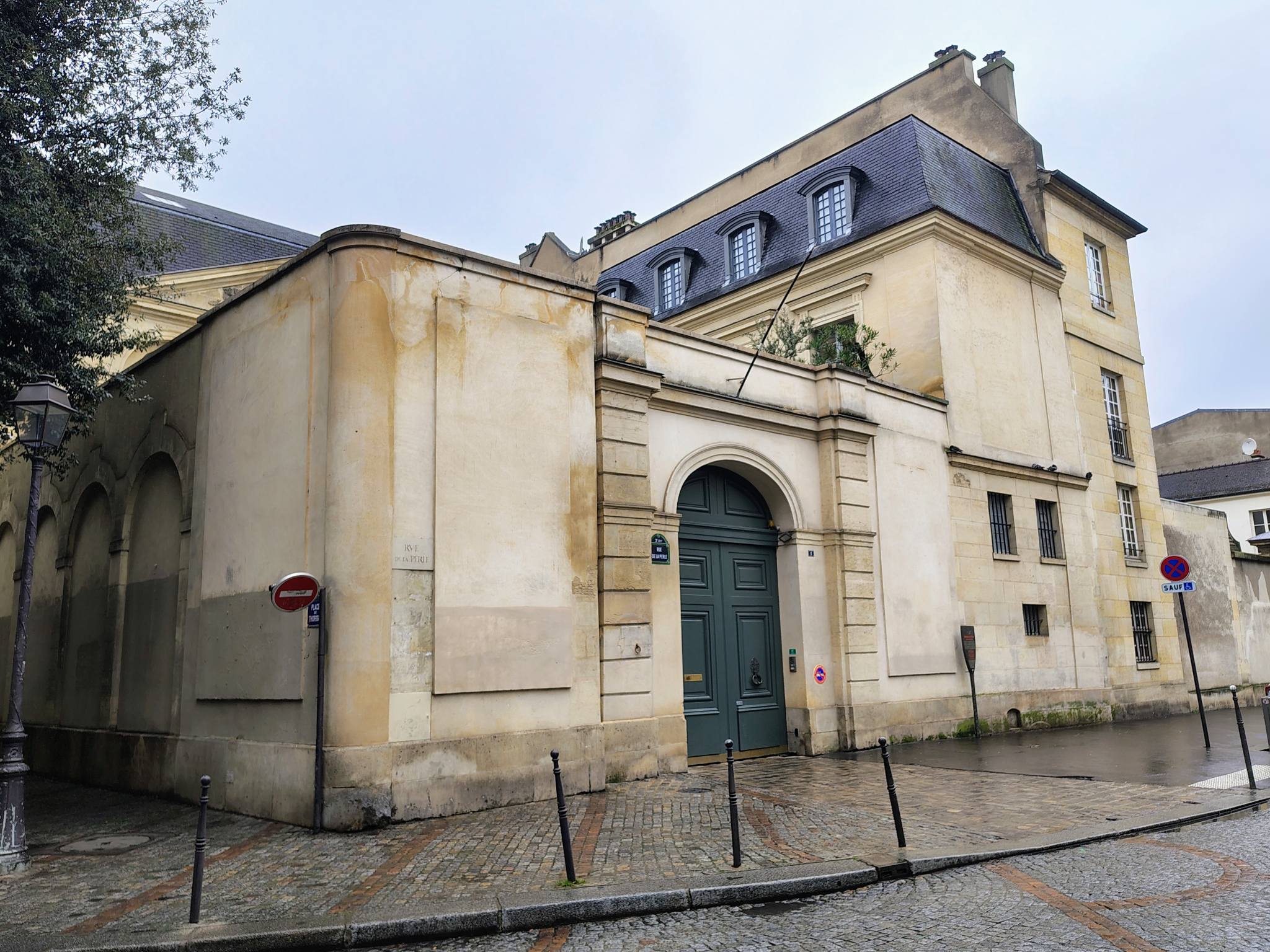
The Rue de la Perle is located in the heart of the Marais quartier/neighborhood in the 3éme arrondissement of Paris. This street, particularly wide for the area, is lined with late 17C mansions on its southern side. It is served by metro line 1, Saint-Paul station. The street takes its name from the sign of a former jeu de paume court (the direct ancestor of Basque pelota, Valencian pelota, balle pelote, tambourine ball, tennis, and more generally, all racket sports). This street, which was an unnamed path in 1579, was lined from 1620 onwards on its northern side with even-numbered houses built on plots of kitchen gardens belonging to the Hospitaller nuns of Saint-Gervais. This land, which bordered the Hôtel Barbette mansion, was acquired in 1683 by Libéral Bruant and his associates, who built five mansions there between 1683 and 1685. It was initially part of the “rue de Thorigny” before being separated from it. Notable buildings here are at No. 1: Hôtel de Libéral Bruant mansion, today a contemporary art center, former locksmithing museum (see pic). No. 3: mansion built by Libéral Bruant in 1684. Birthplace of the architect Charles Heubès. Nos. 18-20: site of the “de la Perle” tennis court.
The Paris tourist office on Paris Centre (arrond 1-4) of Paris : https://parisjetaime.com/eng/article/explore-the-centre-of-paris-a846
The Boulevard Magenta is located in the 10éme arrondissement of Paris, in the Saint-Vincent-de-Paul, Porte-Saint-Denis, and Porte-Saint-Martin quartiers/neighborhoods. It begins at Place de la République and 1 Rue Beaurepaire, and ends at 1 Boulevard Marguerite-de-Rochechouart and 53 Boulevard de la Chapelle. It owes its name to the Battle of Magenta, a victory won by Napoleon III on June 4, 1859, during the Italian Campaign, in Lombardy, against Austrian troops. A train station bearing the same name is located east of the Gare du Nord (see post). It is served by the RER E under the name Magenta, even though it is not under Boulevard de Magenta. Metro stations here are: République (lines 3, 5, 8, 9, and 11), Jacques-Bonsergent (line 5), Gare de l’Est (lines 4, 5, and 7); , Gare du Nord (lines 4, 5), Barbès – Rochechouart (lines 2 and 4). Transilien train (line P) ; RER B, D, and E); Transilien train (lines H and K), A royal decree dated January 31, 1827, authorized the construction, of a road beginning at Rue des Magasins (now Rue de Saint-Quentin) and heading towards the Poissonnière gate. It was named “Rue de la Barrière-Poissonnière” because it led towards the Poissonnière( fish market) gate, then in 1833, it was renamed “Rue du Nord.” In the 1840s, the street started at Rue des Magasins (at the current nos 9 and 11 Rue de Saint-Quentin) and ended at Rue des Abattoirs (now Rue de Dunkerque). It then continued as a dead end along Rue des Abattoirs (now Rue de Dunkerque), for a length of 193 meters. Its width was fixed at 12 meters from the Rue des Magasins (now the Rue de Saint-Quentin) to the Rue La Fayette, and at 13 meters from that street to the Rue des Abattoirs (now the Rue de Dunkerque). As part of the transformation of Paris under the Second Empire, Napoleon III approved a project to create a 1,915-meter-long boulevard linking the Château d’Eau and the Barrière Poissonnière (Boulevard de Rochechouart). This boulevard thus followed the route of the Rue du Nord, which was subsequently demolished. In 1855, the construction of a 30-meter-wide boulevard, named Boulevard du Nord, between the Faubourg-Saint-Martin (Rue du Faubourg-Saint-Martin) and the Poissonnière gate (Boulevard de Rochechouart) was declared a public utility. In 1858, the City of Paris and the State signed an agreement providing for the extension of Boulevard du Nord between the Château d’Eau (Place de la République). The project, confirmed by decree the same year, was declared a public utility in 1859. Boulevard Magenta then became the main access route to the Gare du Nord and its majestic gateway to “modern” Paris, and was lined with Haussmannian buildings featuring ashlar facades, rusticated walls, and balconies on the second (the “noble” floor before the widespread adoption of elevators at the end of the century) and fifth floors, thus attracting a wealthy population.
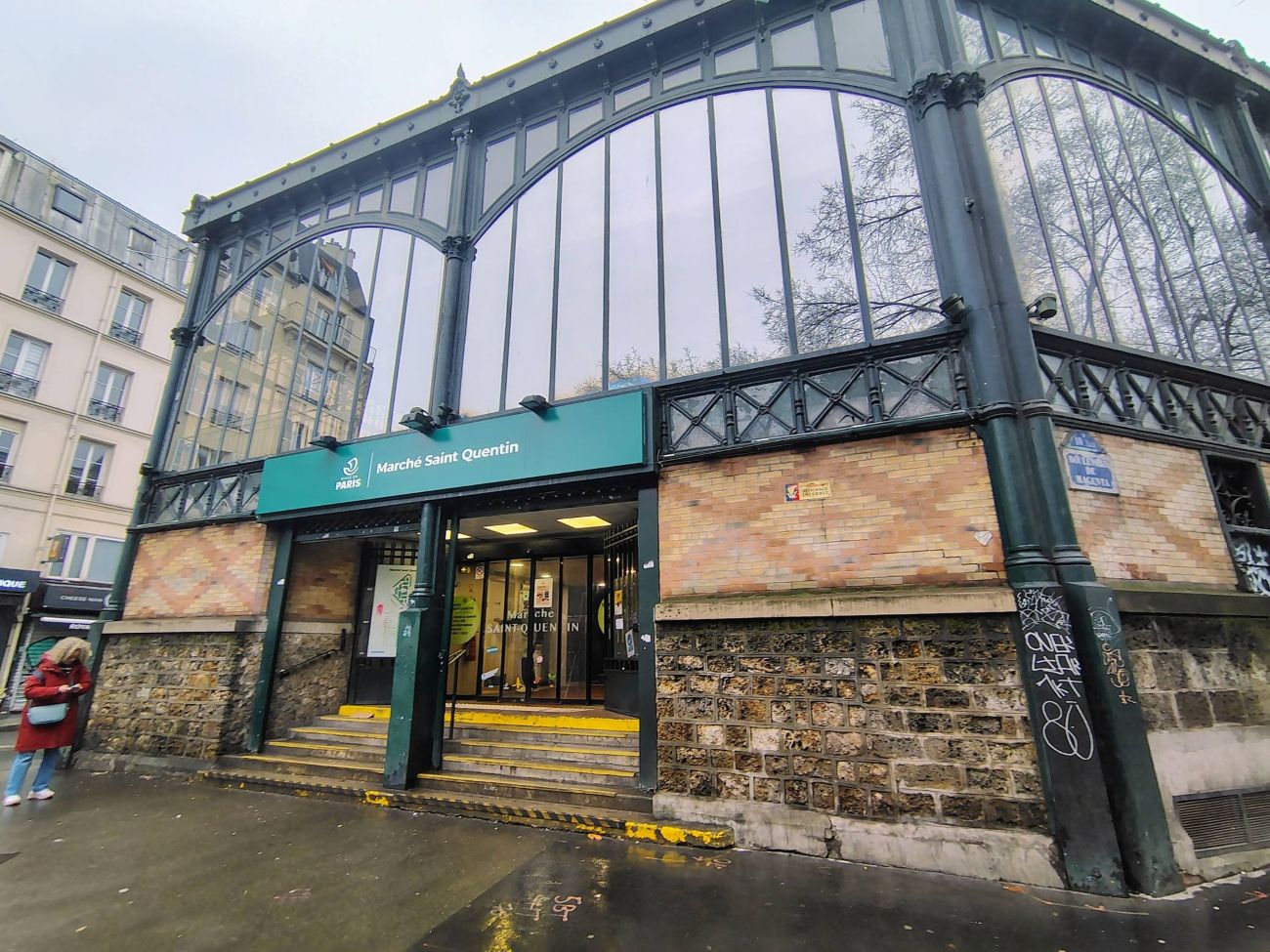
Notable buildings here are at No. 4, the building where Jacques Bonsergent lived, the first Parisian executed by the Nazis during WWII on December 23, 1940. No. 5: a Haussmannian building with a courtyard opening onto the boulevard through a porch sculpted by François Théophile Murgey, who worked on the decoration of Napoleon III’s apartments at the Louvre. No. 7: an 1869 apartment building featuring two medallions with Masonic symbols. The first medallion bears the words “Precision and Liberty” surrounding a square and compass; the other bears the inscription “The beautiful. The true. The useful” surrounding a torch. This is the birthplace of Nathalie Kraemer, a painter deported and murdered at Auschwitz. No. 11: Building from 1887. The monumental allegorical sculptures on the facade represent Science, carrying the torch of knowledge, and Industry, dressed as a worker with a cogwheel. No. 19: Building from 1867-1869 with a facade featuring sculpted decoration on two consoles, depicting Hercules and the Nemean Lion, built by the architect Paul Sédille, who lived there. No. 50: Haussmannian building with a facade decorated with two caryatid busts. No. 56: Haussmannian building built in 1866-1867 with a facade decorated with atlantes. The building was built in 1866 on the site of the formal gardens of a property belonging to a minister of Louis XV. No. 68: Saint-Laurent Church.(see post) Square Alban-Satragne (see post), built on part of the former Saint-Lazare enclosure. No. 85 bis: Saint-Quentin market (see below) with its metal architecture inspired by Victor Baltard, established in 1866 (see photo). No. 115: building where Baron Edmond de Rothschild lived in 1934. No. 170: Le Louxor cinema (see article).
The Marché Saint-Quentin market is located at 85 bis Boulevard de Magenta in the 10éme arrondissement of Paris. It sits at the corner of Rue de Chabrol, Boulevard de Magenta, and Rue des Petits-Hôtels. It was built in 1866. The market is served by metro lines 4, 5, and 7 via the Gare de l’Est station and by lines 4 and 5 via the Gare du Nord station. It is constructed of pink brick with green cast-iron arches. The heart of the market has the feel of a village square. In 1835, a market called “Saint-Laurent” was built on the site of the former “Saint-Laurent Fair,” which was part of the Saint-Lazare estate. Inaugurated in August 1836, this market hall was demolished in 1852 during the construction of Boulevard de Strasbourg. The current market hall, built a little further north on the newly created Boulevard de Magenta, replaces the demolished building.The market hall opens early in the morning on weekdays and remains open until the evening, with shorter hours on Sundays.
The Paris tourist office on the covered market Saint Martin : https://parisjetaime.com/eng/shopping/marche-couvert-saint-quentin-p2266
The City of Paris on the marché couvert Sain Martin : https://www.paris.fr/lieux/marche-couvert-saint-quentin-5474
The Paris tourist office on the 10éme arrondissement de Paris : https://parisjetaime.com/eng/article/explore-paris-s-10th-arrondissement-a843
There you go folks, a dandy city to explore and enjoy with the family, Memorable moments in my eternal Paris, driving and walking all over in my road warrior trails brings out sublime awesome spots with nice memorable family visits of yesteryear always remember and always looking forward to be back, eventually. Again hope you enjoy the post on curiosities of Paris , part LXXVI !!! as I.
And remember, happy travels, good health, and many cheers to all !!!


