
I took advantage of staying close to the City and came by for a good look as usually was just a passing by, Of course, this is another historical town of my belle France , I again found more pictures in my cd rom vault that should be in my blog for you and me. For reference, Saint Denis is in dept 93 Seine Saint Denis , in the Île de France region of my belle France, I did some heavy walk warrior trails here and you can read up my several posts on the City in my blog. Therefore, let me tell you on the Musée d’art et d’histoire Paul Éluard of Saint Denis !!! Hope you enjoy the post as I.
The Musée d’art et d’histoire Paul Éluard or Paul Eluard Museum of Art and History is located at 22 bis rue Gabriel Péri. Since 1981, the former Carmelite convent of Saint-Denis has housed the Paul Eluard Museum of Art and History. The history of the Carmelite monastery, founded in 1625, was illustrated from 1770 to 1787 by the stay of Madame Louise of France, daughter of Louis XV. The museum owes its renown in particular to its collections dedicated to original themes.
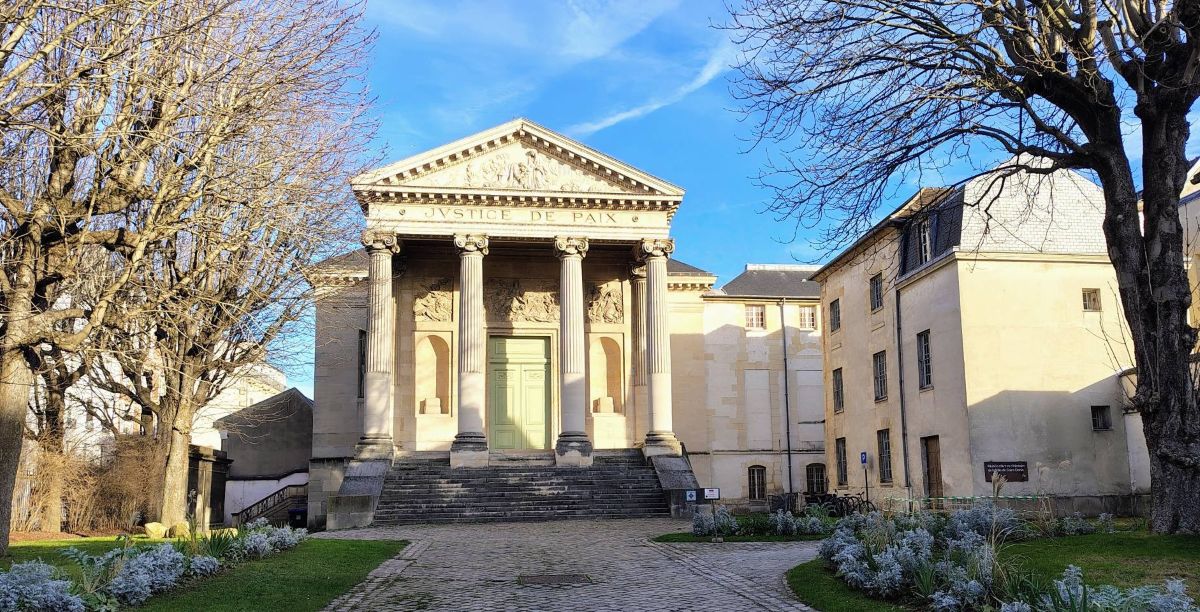
The Carmelite Convent has on the first floor, numerous objects and paintings reveal the life of the Carmelite convent, whose most famous resident was Louise of France, daughter of Louis XV. Collections of documents and objects evoking the religious community and the lives of these women devoted to God are on display. Then, the Medieval Archaeology in the former refectory, trace the history of Saint-Denis and its abbey is presented, highlighting the thriving craft industry around which a whole region developed. An entire room is dedicated to medieval ceramics produced by local artisans using traditional techniques. But these ceramics are not the only discoveries originating from Saint-Denis! From the Gallo-Roman period to the late Middle Ages, archaeological excavations have unearthed many types of objects: sculptures, weapons, furniture, clothing, and other, more surprising items such as. ice skates!
The permanent collections offer a rich iconographic and literary overview of the wars of the 19-20C: the collection on the Siege and Commune of Paris (1870-1871) sheds light on the Franco-Prussian War and the Parisian attempt at social revolution. The second floor is dedicated to the Franco-Prussian War of 1870 and the Paris Commune. It houses one of the world’s most important collections, featuring caricatures, prints, photographs, and a unique exhibit: Nicolas Kohl’s display case on the “terrible year.” Finally, visitors can also admire the magnificent chapel designed by Richard Mique. In addition to the collection dedicated to Paul Éluard, which evokes the poet’s mobilization between 1914 and 1918 and then his commitment to the Resistance through poetry during WWII, the museum also holds in its reserves prints by artists who witnessed the Great War or WWI. Théophile-Alexandre Steinlen, Francisque Poulbot, and Maximilien Luce convey the human dimension of the conflict.
The Museum of Art and History also owes its renown to its collections of prints and caricatures (Gavarni, Daumier, etc.). A unique collection of posters, prints, lithographs, and photographs offers a fresh perspective on events and contributed to the birth of modern photojournalism. The drawings department includes 4,000 lithographs by Daumier, significant collections of caricatures, and modern and contemporary prints from the 19C and 21C, One room is dedicated to Albert André, an Impressionist colorist painter, and to Francis Jourdain, a designer of decorative arts. The Louis XV Pavilion is devoted to Paul Éluard, a poet from Saint-Denis with manuscripts, first editions, photographs, public and private life. It recounts his life as a poet and his involvement in Surrealism and Communism. The Garden of the Five Senses, created in 2009 on the grounds of the Carmelite convent, was designed to allow blind and visually impaired people, as well as everyone else, to access sensory experiences. You close your eyes and gently touch, you smell. This garden is open from March to the end of October, and specific plants have been planted there, reflecting the history of the Carmel.
Take advantage here to tell you a bit on who was Paul Eluard : Paul Éluard, pen name of Eugène Grindel, born in Saint-Denis at 46 Boulevard de Châteaudun (now Boulevard Jules-Guesde) and died at 52 Avenue de Gravelle in Charenton-le-Pont, was a French poet. In 1916, he chose the name Paul Éluard, borrowed from his maternal grandmother, Félicie. He embraced Dadaism and became one of the pillars of Surrealism, paving the way for politically engaged artistic action alongside the Communist Party. He is also known by the pseudonyms Didier Desroches and Brun. Around 1908, the family moved to Paris, to Rue Louis-Blanc. He entered the École Supérieure Colbert on a scholarship. Mobilized in 1914, he went to the front as a military nurse before being removed from combat due to acute bronchitis. This experience of war and its battlefields traumatized him and inspired his Poems for Peace (published in 1918). Later, Surrealism would give his work its content. Just before the Surrealists, the Dadaists caused a scandal. Éluard, a close friend of André Breton, participated in all the Dada events. He founded his own magazine, Proverbe, in which he, like Jean Paulhan, revealed himself to be obsessed with the problems of language. Éluard adhered to the Surrealist rule summarized by this phrase from the Comte de Lautréamont: “Poetry must be made by all, not by one.” With Benjamin Péret, he wrote 152 proverbs updated for modern times. With André Breton, he wrote The Immaculate Conception. With Breton and René Char, he advocated for slowing down construction. In January 1927, he joined the French Communist Party, along with Louis Aragon, Breton, Benjamin Péret, and Pierre Unik. They justified their decision in the collective tract “Au grand jour” (In Broad Daylight). With several writer friends (René Char, André Breton, Louis Aragon, etc.), he launched a frontal attack on the 1931 Colonial Exposition, which they described as a “carnival of skeletons,” designed to “instill in the citizens of the metropolis the sense of ownership they will need to hear the echo of gunfire without flinching.” Expelled from the French Communist Party at the end of 1933, he became an ambassador of Surrealism and traveled throughout Europe to denounce fascism. The twenty-one stanzas of “Liberté,” published in the first issue of the journal Choix, were parachuted by British planes in thousands of copies over France (this poem was set to music by Francis Poulenc as early as 1944). After the Liberation, he was celebrated as the great poet of the Resistance. In April 1948, Paul Éluard and Picasso were invited to participate in the Congress for Peace in Wrocław, Poland. In June, Éluard published Poèmes politiques (Political Poems) with a preface by Louis Aragon. The official societé des amis de Paul Eluard : https://eluard.org/
The Seine Saint Denis dept 93 tourist office on the Musée d’art et d’histoire Paul Éluard of Saint Denis : https://www.tourisme93.com/document.php?pagendx=84&engine_zoom=PCUIDF0930000012
The Plaine towns community tourist office on the Musée d’art et d’histoire Paul Éluard : https://www.pop-plainecommune.com/en/discover-plaine-commune/the-must-haves/paul-eluard-museum-of-art-and-history/
The City of Saint Denis on its heritage : https://www.saintdenis.fr/je-visite
There you go folks, a town worth the detour if only for the basilica and all around one big square which is a must , Again, hope you enjoy the post on the Musée d’art et d’histoire Paul Éluard of Saint Denis !!! as I
And remember, happy travels, good health, and many cheers to all !!!


