
And here I go again digging into my clouded cd rom vault to find me pictures that should be in my blog for you and me, It is great memories coming alive again and even better on these new times of ours. We were on our road warrior mode passing by the area and stop at Condom. A very pleasant surprise and I like to tell you a bit more on its wonderful cathedral. Therefore, here is my take on this is Condom !!! Hope you enjoy this post as I
The town of Condom, aka Condom-en-Armagnac, is located in the Gers department no, 32, in the Occitanie region of my belle France, Historically and culturally, the town lies within the Condomois, a former county within the province of Gascony. You have the Toulouse-Bordeaux route passes further north through Agen, via the A61 or Autoroute des Deux-Mers and the N113 national road; the N21 national road, which runs from Agen to Tarbes, passes through Auch and Fleurance; the Route à Grand Gabarit passes further south; and the N124 national road, which connects Auch to Mont-de-Marsan, is located further west. It is located 41 km from Agen , 45 km from Auch,145 km from Toulouse, 150 km from Bordeaux, 660 km from Versailles, and 635 km from my current home, I came on my road warrior trails from Auch and before that Toulouse, From Auch we took the D924 road or Rue Victor Hugo out of town further on a roundabout bear right onto the D930 road or Route de Condom continue passing by City center Castéra-Verduzan and continue on the D930 road passing City center of Valence sur Baïse continue on the D930 road to Condom centre along the Baïse river on your left side bearing right onto Rue Barlet then bear right onto Rue Gaichies and again right onto Place Marre straight into Place Bossuet,and the cathedral,
The Cathédrale Saint Pierre or Saint Peter’s Cathedral,located at Place Bossuet is comparable to a ship of golden stone with deep buttresses, gives the appearance, seen from afar, of a fortress church. It dominates the town of Condom and overlooks the Baïse river flowing at its feet. Built in the 16C, on the site of an old abbey church from the 11C, its plan is typical of southern Gothic churches with a wide single nave with side chapels between the buttresses. The important bishopric of Condom created in 1317, known to many bishops including Jacques Bénigne Bossuet (see posts Meaux) Its 19C chancel replaced the former chancel destroyed during the French revolution. At the eastern end, a 14C chapel dedicated to the Virgin Mary opens onto the cathedral. It was preserved and incorporated into the new cathedral during its construction. Darker in appearance with its narrow windows, it contrasts with the nave, which is pierced with numerous Flamboyant Gothic windows. Also noteworthy is the elegance of the historiated keystones in the central nave.
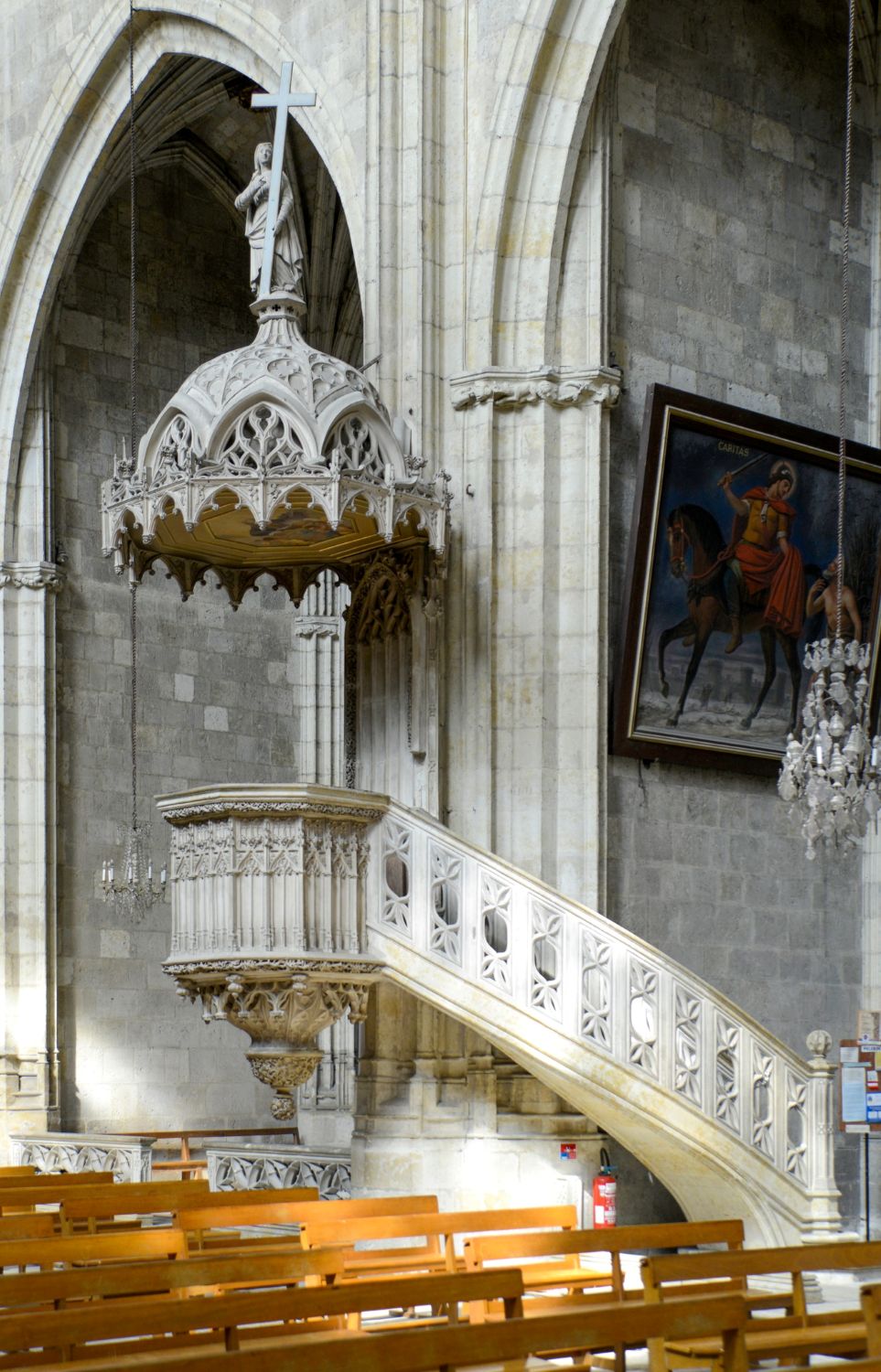
Outside, the massive buttresses enclosing the side chapels, the flamboyant portal with sculpted figures and angels in the ornate canopied niches of the portal opening onto Place Bossuet, and the tall square tower dominating the west side are undeniably impressive. The tympanum of the western portal depicts the Tetramorph and Christ Pantocrator. On the north side, a vast cloister with Gothic vaults, badly damaged during the Wars of Religion but now well restored, provides access to the former bishop’s palace, now occupied by the City/town hall.
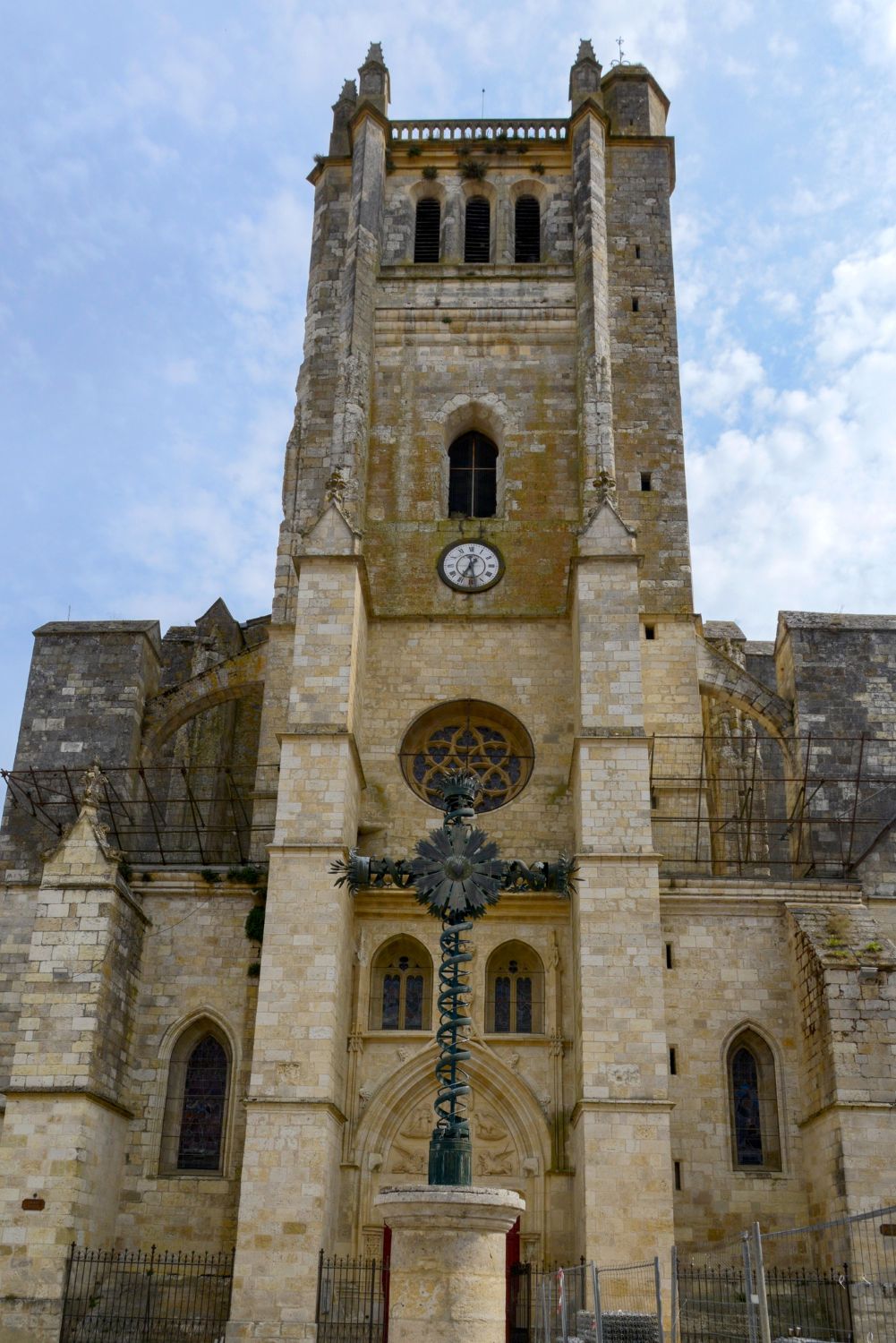
The neo-Gothic choir screen is adorned with 19C molded terracotta statues. The rood screen visible today dates from 1844. The three sets of stained-glass windows in the choir depict three scenes. On the left: Lower section: the Last Supper; Upper section: angels holding manuscripts with Latin inscriptions, addressed to God the Father. In the center: Lower section: the crucifixion of Jesus with the Virgin Mary on the left, Saint John the Evangelist on the right, and Saint Mary Magdalene at the foot of the cross. To the left of the scene is a female saint, and to the right, a king losing his crown. Upper section: floral decorations with Saint Peter on the left and Saint Paul on the right. On the right: Lower section: the Entombment. Upper section: two prophets, angels holding the instruments of the Passion, with King David in the center.
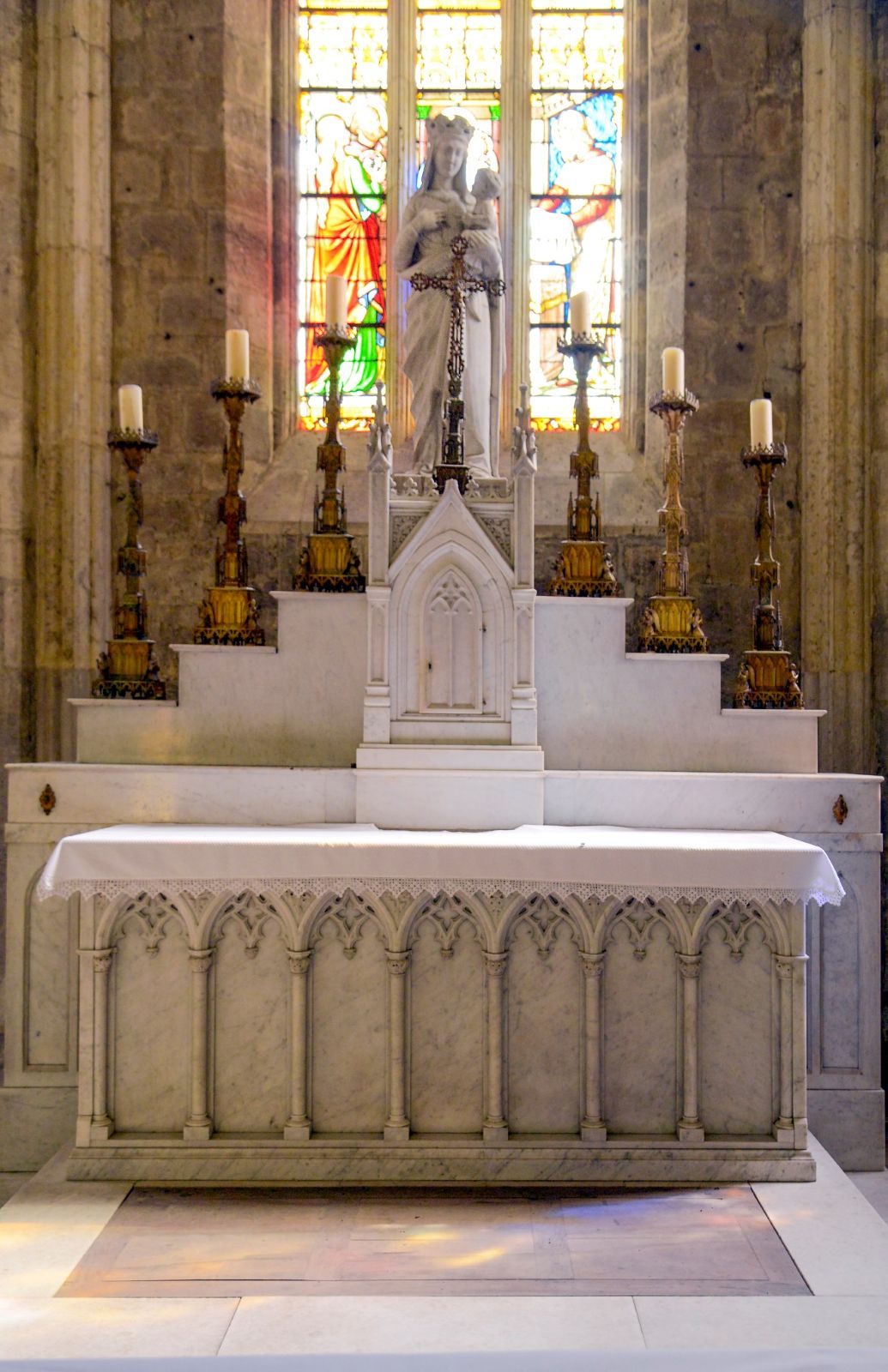
The old organ of Saint Peter’s Cathedral, built in 1605, stood on the gallery. It was destroyed in 1793. On June 28, 1836, the church council commissioned an organ for the gallery and began installing the large bellows in the case in 1838. On December 12, 1852, the church council entrusted the completion of the organ to a professional. In 1891, a 16-foot flute was added to the pedalboard. The organ was modified in 1950, retaining the original stops.
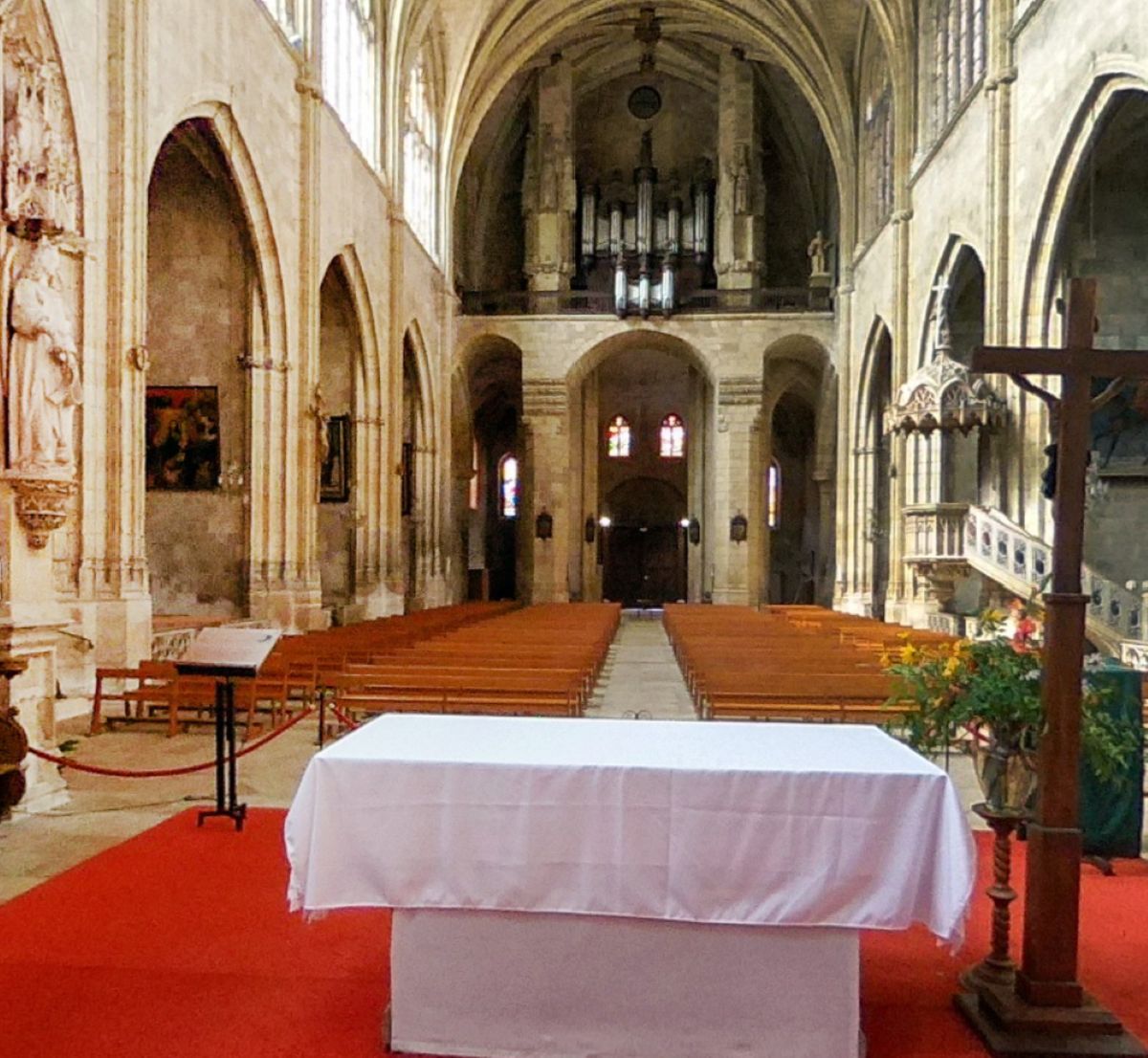
The Cathédrale Saint Pierre was the seat of the Bishop of the Diocese of Condom from 1317 to 1790. The first Cathedral was completely demolished in 1368 and rebuilt by Bishop Bernard Alamand, who completed the work around 1400. The current apse dates from this period. Rebuilt in 1507, after the bell tower collapsed, and completed in 1531, it is one of the last achievements of the southern Gothic style, and its single nave powerfully amplifies the sound of the organ originally built in 1605. Vaults with ornate and gilded keystones, large windows with flamboyant tracery.
Other things to see here, me think with more time are the 12C Pont Barlet Bridge, aka the Pierre-Mendès-France Bridge.The 13C Andiran Tower, which once housed the tourist office. Numerous 18C townhouses vie for elegance, with their grand staircases, stone balustrades, and wrought-iron balconies, along Avenue de Gaulle. The Armagnac Museum, housed in the former bishop’s stables with 17C timber framing, is dedicated to the brandy and boasts an 18-ton beam press. The Hôtel de Cugnac is one of the finest 17-18C residences in the old town; its wings surround a paved square courtyard enclosed by a wrought-iron gate. You can visit the Armagnac cellars. The Château de Puypardin: perched on a ridge overlooking the Osse Valley, this beautiful 13C to 16C castle comprises a polygonal enclosure with a rectangular keep adjoining a hall from the same period. The statue of d’Artagnan and the Three Musketeers, by the Georgian sculptor Zurab Tsereteli. Saint-Barthélemy Church,at rue Dutoya 12C, 14C 17C, and 19C; Saint-Jacques-de-la-Bouquerie Church, at place du Cardinal. 14C, 17C, 18-19C; Prouillan Convent, founded in 1280, became a Carmelite monastery in 1892 and closed in 2007,at 32 avenue Victor Hugo, converted into a community establishment providing accommodation and lodging for pilgrims.
A bit of history tell us that the origin of the town is subject to debate. Some trace it back to the rise to power of the Duke of Aquitaine, Eudes of Aquitaine, in Gascony at the end of the 7C. He is said to have distributed land to the Gascons who had helped him. Around 930, the wife of the Duke of Gascony, Garcia Sancho the Crooked or the Twisted, Honorette (or Honorée), undertook the reconstruction of the church ,and endowed it with land. She also had houses built for the new inhabitants of the village. On June 20, 1285, Auger d’Anduran, Abbot of Condom from 1285 to 1305, concluded a paréage agreement with the King of England, Edward I. In this agreement, the abbot involved the King of England in administering justice in the town of Condom, the castle of Larressingle, and their dependencies. The king did the same with the abbot for the castle of Goalard and its dependencies. This paréage agreement did not end the conflicts between the abbots, and later the bishops who succeeded them, and the consuls of the town. Twice invaded by the English, the town liberated itself. On August 13, 1317, the Abbey of Condom became a bishopric and thus separated from the diocese of Agen. The abbey church immediately became a cathedral. After his coronation, King Louis XI annexed the town to the crown and, in November 1461, authorized and confirmed several of the town’s rights, so that it might grow.
The course of the Baïse River was once canalized to allow the export of Armagnac to Bordeaux. This activity ensured the town’s prosperity in the past. Armagnac owes its fame not to the port of Condom, which was only created in 1839, but to the pilgrims of Santiago de Compostela. Upon leaving the town, they carried with them, both on their way to Spain and on their return, a few restorative vials. It was they who spread the good word of Armagnac’s healing (“eau de vie”) and medicinal properties throughout Europe. In 1314, thanks to Cardinal de Teste, a native of Condom, the first Saint James Hospital was founded, expressly intended to receive pilgrims, the infirm, the poor, and those going on pilgrimage to Santiago de Compostela. Its founders, the Confraternity of Saint James, intended to receive pilgrims traveling to Galicia. Documents specify that this hospital was also built along the pilgrims’ route, near the Church of Saint James of La Bouquerie. These two foundations established Condom as a major stop on the Way of St. James in the 14C.
The town of Condom on its history/heritage : https://www.condom.org/histoire-et-patrimoine/
The local Gers Armagnac tourist office on the St Peter’s Cathedral of Condom : https://en.gers-armagnac.com/explorer/sites-a-visiter-2/6926073_cathedrale-saint-pierre/
The official French agency on the roads to Compostela on Condom : https://www.chemins-compostelle.com/commune/condom/
The Gers dept 32 tourist office on its overall heritage : https://www.tourisme-gers.com/en/destination/sites-et-monuments-2
There you go folks ,quite a bit of nice town deep in my France, you know you should come and visit it. Condom is nice, quant, we have good memories of visiting the town and look forward to be back, eventually. Again, hope you enjoy this post on this is Condom !!! as I.
And remember, happy travels, good health and many cheers to all !!!


I’ve heard of Condom, and the name gives me a chuckle. All the same, it looks to be a beautiful little town. Thanks for sharing!
LikeLiked by 2 people
hahaha yes I know. Always interesting name places around the world. Thanks for stopping by Cheers
LikeLiked by 2 people