
We have driven and walked in my eternal Paris, and would like to have an imprint in my blog on the wonderful family times we had there, There is so much to see , doing my best, and glad found me these pictures in my cd rom vault ,which now transposing in my blog for you and me, This was my former worked city, so glad to post more memorable spots on it, I thank you for your readership over the years and to bear with my rants! After Paris all is to rant, shout and yelled about, me think. Therefore, here is my take on curiosities of Paris , part LXIV !!! Hope you enjoy the post as I.
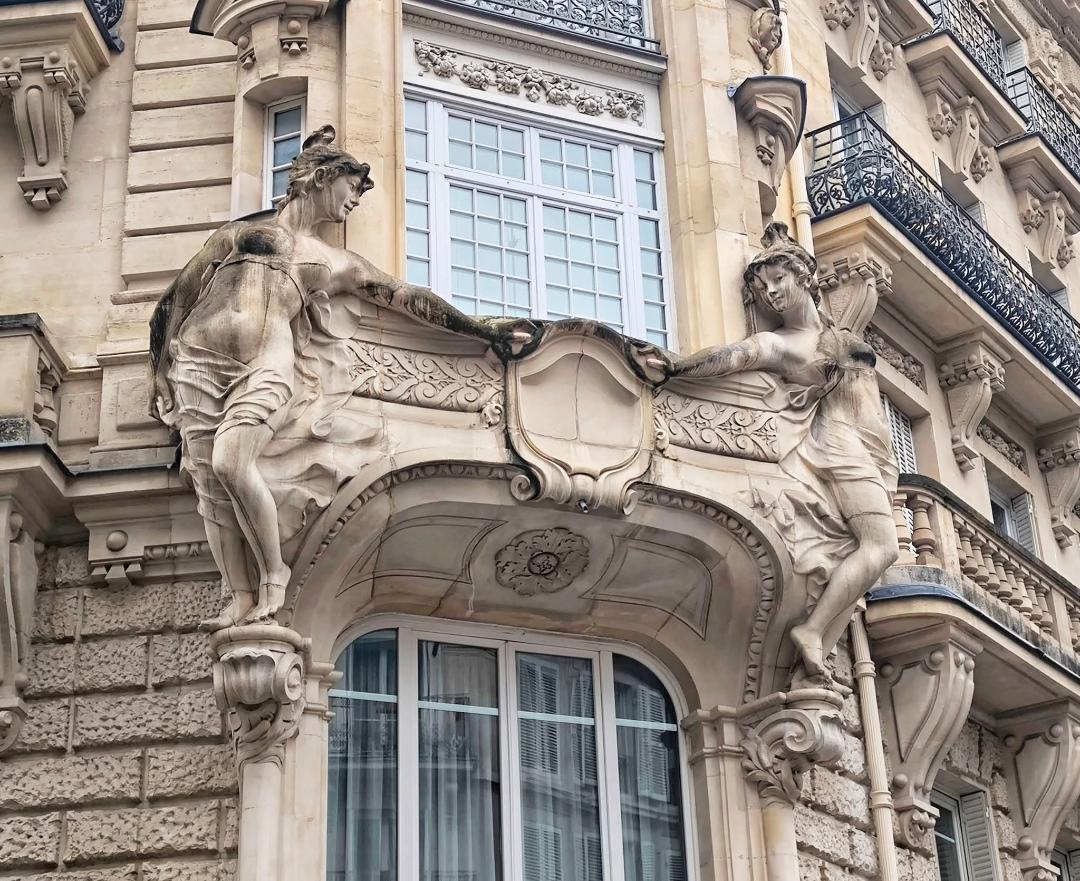
The Rue d’Abbeville is located in the 10éme arrondissements of Paris. It is served by metro line 9, Poissonnière station. The street intersects the following streets, rue Fénelon, Rue de Rocroy, Rue du Faubourg-Poissonnière, and Rue Pierre-Semard at the intersection with Rue de Maubeuge. It owes its name to its proximity to the Gare du Nord train station, which serves Abbeville, a sub-prefecture of the Somme department no 80. The street was opened, on the former Saint-Lazare enclosure, by royal decree of January 31, 1827. The street consists of two parts: the first between Place La Fayette and Rue de Rocroy, opened by decree of January 31, 1827 and named “Rue du Gazomètre”, because it was near the first gasworks installed in Paris in 1843, at No. 129 Rue du Faubourg-Poissonnière, and whose land extended over the site of Rue de Maubeuge and Rue Condorcet, then “Route d’Abbeville” in 1847; The second section, between Rue de Rocroy and Rue de Maubeuge, was opened by decree on August 3, 1861, except for the section between Rue de Rocroy and Rue du Faubourg-Poissonnière, which opened in 1894. This section received its name following a decree of December 28, 1894. Notable building: At No. 14 ,built in 1901, this stone and brick apartment building belongs to the Art Nouveau architectural movement. Created in abundant vegetal decoration in flamed stoneware of emerald green stands out against the central bay of the facade. The loggia on the third floor is supported by four double columns with vegetal capitals. Hanging from the stone balcony, a bat and an owl seem to watch over the building. Railings with plant motifs complete this stylized decor. At No. 16, (see pic) , this building was constructed in 1899 in the eclectic style. The sculpted decoration is abundant, even teeming: masks, garlands, children’s faces, lion heads, caryatids, pediments. But it doesn’t truly renew the architectural language. The eclectic style is at its peak here and will soon be out of fashion. The impressive caryatids seem to cling to the bow windows and are the building’s distinguishing feature: these statues of women covered with a light veil, above the windows of the two reception rooms on the first floor.
The Rue du Faubourg-du-Temple is located in the 10éme arrondissement of Paris. It begins at the Place de la République and runs up to the Boulevard de la Villette. It forms the border between two arrondissements; its even-numbered side (to the right when coming from the Place de la République) is in the 11éme arrondissement, and its odd-numbered side (to the left) is in the 10éme arrondissement. This area is served by metro stations République (lines 3, 5, 8, 9, and 11), Goncourt (line 11), and Belleville (lines 2 and 11). The Rue du Faubourg-du-Temple owes its name to the fact that it once crossed the hamlet located outside the Porte du Temple in the city wall, which served the Knights Templar, and that it is laid out as an extension of the Rue du Temple. This road is a very old path leading to Belleville; the ancestor of this street crossed in 1175 a property of the chapter of Saint-Merry and ran alongside the estate of La Courtille Saint-Martin, given in 1060 by King Henry I to a site located at the corner of the current rue Bichat. The construction of the Charles V wall made this small settlement a suburb of Paris. The street took its name at the beginning of the 16C because it was the thoroughfare of the Parisian suburb beyond the Temple Gate. The street is mentioned as “rue du faulxbourg de la porte du Temple, called la Courtille” in a manuscript from 1636. Later, 19C developments (Place du Château-d’Eau and Place de la République) shortened it by cutting off the section closest to Paris. The Belleville funicular ran along the street from 1891 to 1924.
Notable buildings here are: The painter Simon Mathurin Lantara, a French painter renowned for his work in 18C painting, lived on this street at one point in his life. The Temple gate was located at the entrance to the street. The Vérines Barracks, formerly known as the Prince-Eugène Barracks or the Château-d’Eau Barracks, is a military building. No. 11: headquarters of the Children’s Aid Society (OSE), dedicated to rescuing children and providing medical assistance to persecuted Jews. It rescued several thousand Jewish children during WWII. Formerly known as the “Georges Garel Center,” it became the Georges-et-Lili-Garel Center on June 23, 2014. No. 18: The English riding master Philip Astley inaugurated this courtyard in 1780 as a riding school, which he transformed into an equestrian circus under the name Astley Circus. In 1912, the site became a cinema, the Consortium, and then, in 1922, a café-concert, the Temple-Concert. In 1930, the address reverted to a cinema, named Templia. Taken over in 1969, it was modernized and renamed Action-République. In 1985, it was renamed Républic-Cinémas, then, from 1992, Reflet-Républic, and in 1995, République, focusing on art house films. Several screenings by the Cinémathèque Française took place there between 1993 and 1997. At the end of 2001, the cinema turned to short films and adopted the name Cinéalternative. In 2003, the site, renamed Temple, briefly became a theater, offering a few children’s film screenings. Since 2014, the site has housed the Apollo Théâtre. It is also the entrance to the Le Gibus nightclub. No. 28: clock and bas-relief at the corner of the street and Boulevard Jules-Ferry. No. 37: café-theater of the Palais des Glaces, built in 1876. No. 65: Louis Malécot, a French aviation pioneer, lived here. No. 105: Art Deco gallery, the Palais du Commerce, and nightclub, La Java (see pic below). No. 131: site of the Courtille de Dénoyez cabaret in the 19C; around 1850, the building was considered the largest in Paris due to the great homogeneity of its structures; the “Cour de la Grâce-de-Dieu” owes its name to Horace Meyer, owner of the property and director of the Théâtre de la Gaîté-Lyrique, where the play La Grâce de Dieu was a great success. The anecdote here is that on this street César Birotteau begins manufacturing the perfumes that will make the fortune of his future store, La Reine des Roses, in Honoré de Balzac’s novel (1837).
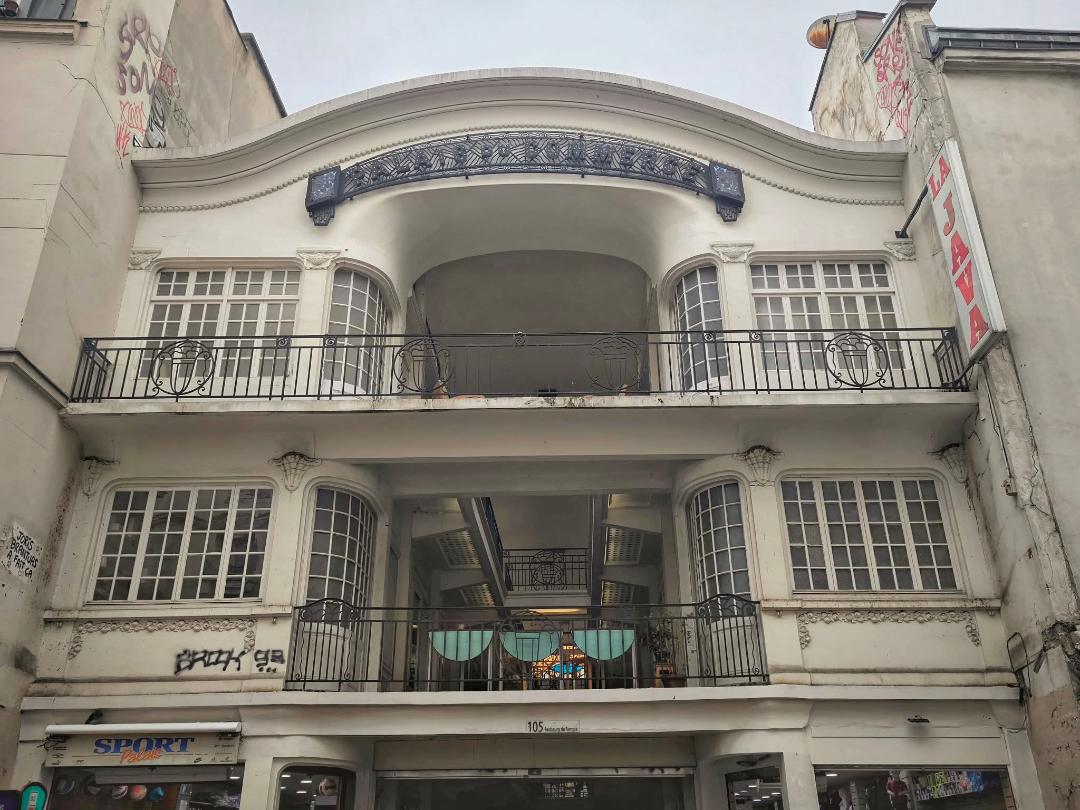
The Palais du Commerce is a shopping arcade with a single entrance in the 10éme arrondissement of Paris. It is located at 105 rue du Faubourg-du-Temple, The arcade was built in 1923-1924 in the Art Deco style with a Baroque-inspired façade. Covered by a glass roof, it comprises three levels accessed by glass-block walkways that allow light to filter through. The entire structure, including the Art Deco stained-glass windows of the staircase, has recently undergone a complete restoration. At the time, it housed around fifty shops and workshops, as well as the music venue La Java (1923), located in the basement. Today, some of the premises are abandoned while others house offices. However, La Java still exists. The venue notably hosted Django Reinhardt, Jean Gabin, Fréhel, and provided the early performances of Maurice Chevalier and Édith Piaf.
The Paris tourist office on the 10éme arrondissement de Paris: https://parisjetaime.com/eng/article/explore-paris-s-10th-arrondissement-a843
The Rue des Jardins-Saint-Paul is located in the Saint-Gervais quartier or neighborhood of the 4éme district or arrondissement of Paris. The nearest metro stations are Saint-Paul on line 1, Pont Marie on line 7, and Sully-Morland on line 7. It bears this name because the oldest part of this street was opened in the 13C on land adjacent to the Paris city walls. The section between Rue des Barrés and Rue Charlemagne is the oldest part; it is mentioned in sales contracts from 1277 and 1298. This section was called “Rue des Jardins” (Garden Street) because the land in front of the fortifications was unbuildable. It is mentioned as “rue des Jardins” in a manuscript from 1636. The street being within the perimeter of the unsanitary block no. 16, the buildings on the odd-numbered side from numbers 5 to 21 were demolished in 1946. Those from numbers 6 to 28 which were to be demolished were preserved and restored during the 1970s, as part of the creation of the Village Saint-Paul (see post) accessible by three entrances under porches.
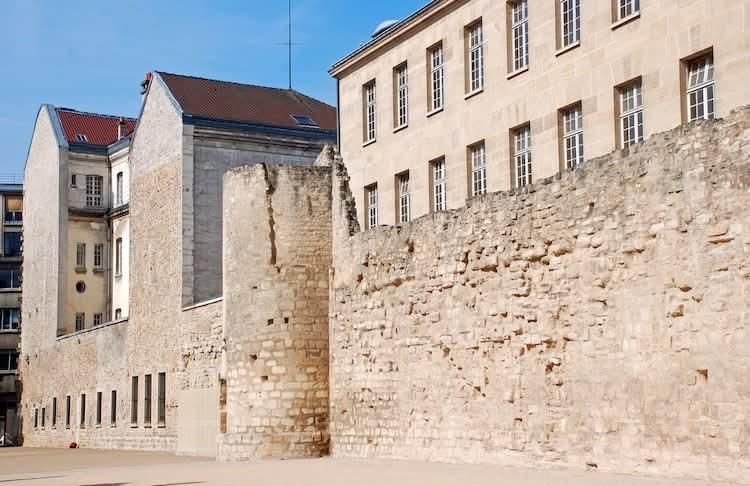
The enclosure of Philip Augustus (see pic) located along the rue des Jardins Saint-Paul is now a building with the largest visible in Paris. This wall is 120 meters, and measuring between 6 and 7 meters high. Only today lack the upper wall, which allowed the Parisian to protect themselves while firing at the attackers. With a thickness of 3 meters, it could withstand bullets stones sent by the machines of war. You can also observe circular towers, whose original height was 11 to 12 meters. Finally, on the wall, several stonemasons marks are visible. Signs which allowed recognize the work of the workers, paid by the job. Renovated in 1998, this wall has been preserved thanks, initially, its integration in the 13C in a convent (convent of the Sisters of the Ave Maria), which was converted in 1790 into infantry barracks. The wall finally reappeared when the buildings that lined one side of the street were demolished in a space still used as a sports field by the high school or Lycée Charlemagne. Notable buildings here tell us it has the distinction of running alongside the longest remaining section of the Philippe Auguste city wall. The parish priest of Meudon, François Rabelais, lived on this street, where he died on April 9, 1553. The inner facing (town side) of the base of the wall is still visible in the gymnasium of the middle school or Collège Charlemagne, which abuts it. This wall still has two visible towers, one in the middle of the sports field , and the other at the intersection with Rue Charlemagne. The latter is called the “Montgomery Tower,” named after the captain of Henry II’s Scottish Guard and the unintentional regicide of the same king in 1559, who was supposedly imprisoned there after the fatal joust. This tower, now reduced to a quarter of its original size, defended the Saint-Paul gate of the city wall. The high school or Lycée Charlemagne has its entrance at the end of the street.
The Paris tourist office on the medieval heritage of Paris: https://parisjetaime.com/article/paris-moyen-age-a845
The Paris tourist office on Paris Centre (arrond 1-4) de Paris: https://parisjetaime.com/eng/article/explore-the-centre-of-paris-a846
There you go folks, a dandy city to explore and enjoy with the family, Memorable moments in my eternal Paris, driving and walking all over in my road warrior trails brings out sublime awesome spots with nice memorable family visits of yesteryear always remember and always looking forward to be back, eventually. Again hope you enjoy the post on curiosities of Paris, part LXIV !!! as I.
And remember, happy travels, good health, and many cheers to all !!!


