
We have driven and walked in my eternal Paris, and would like to have an imprint in my blog on the wonderful family times we had there, There is so much to see, doing my best, and glad found me these pictures in my cd rom vault, which now transposing in my blog for you and me, This was my former worked city, so glad to post more memorable spots on it, I thank you for your readership over the years and to bear with my rants! After Paris all is to rant, shout and shout about, me think. Therefore, here is my take on curiosities of Paris, part LXIII !!! Hope you enjoy the post as I.
The fontaine des Haudriettes or Haudriettes Fountain is located in the 3éme arrondissement of Paris. It stands on Place Patrice-Chéreau, at no 1 Rue des Haudriettes, at the intersection of Rue des Archives, Rue des Haudriettes, and Rue des Quatre-Fils. The fountain is a freestanding, trapezoidal structure. On the longer side is the basin that collects the water, which springs from a mascaron in the shape of a lion’s head.
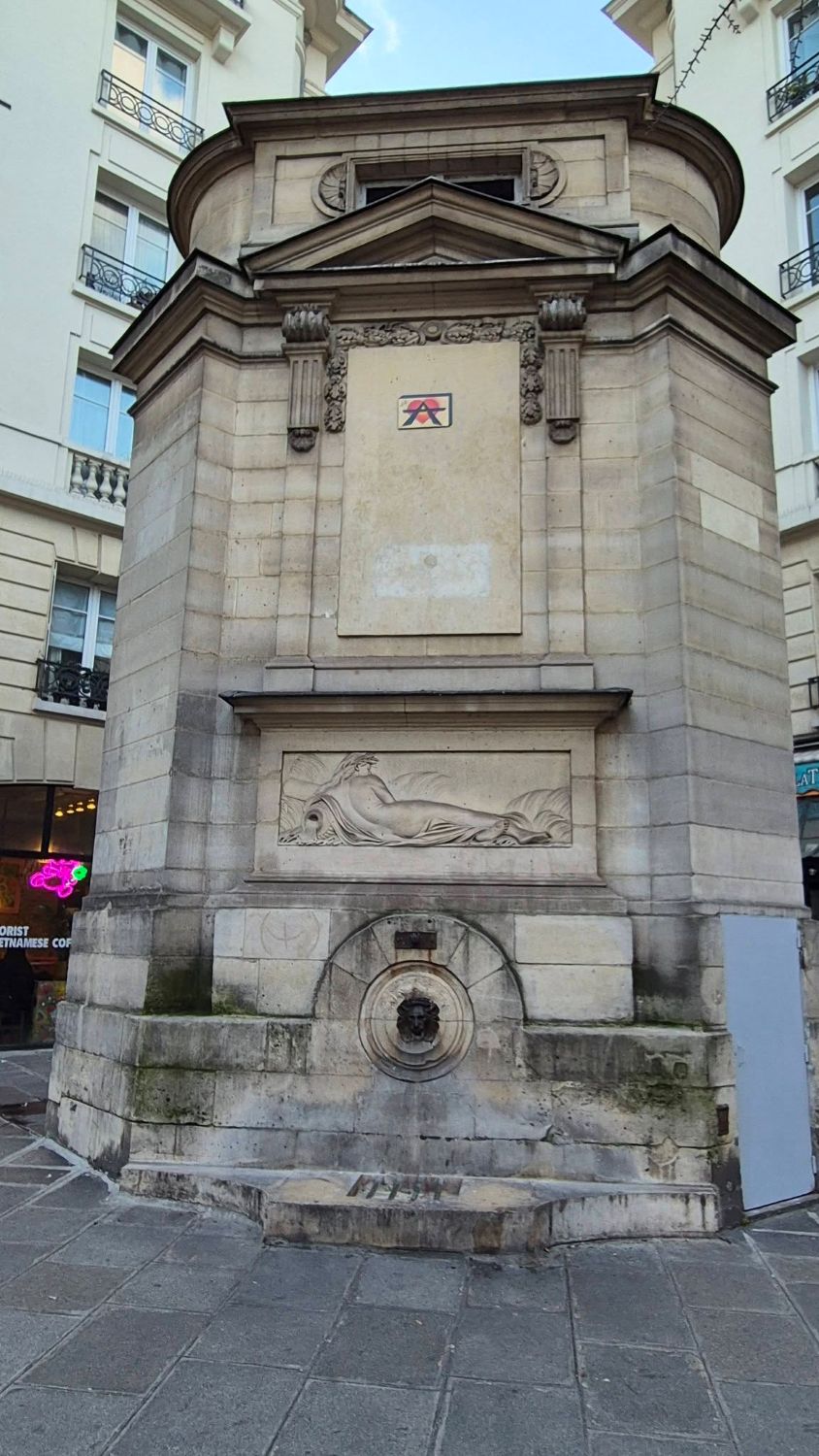
Above this is a stone bas-relief by Pierre-Philippe Mignot depicting a naiad, seen from behind, reclining among the reeds and leaning on her urn. The plaster model of the Naiad was exhibited at the Salon of 1765. This was Mignot’s last participation in the Salon of the Royal Academy. The bas-relief is set into the pedestal of the canopy. The fountain is crowned by a triangular pediment and surmounted by an attic. It was built in 1764, replacing the Fontaine Neuve, which dated from 1636. Originally, the fountain was built against a building. It has been restored several times and moved in 1933 to widen the street. Initially supplied by water from Belleville, the fountain later distributed water from the Saint-Martin Canal after it was dug.
The Place Patrice-Chéreau is located at the corner of Rue des Archives and Rue des Haudriettes in the Sainte-Avoye quartier or neighborhood of the 3éme district or arrondissement de Paris. It is accessible from the Rambuteau metro station (line 11). It is named after the French theatre and opera director, filmmaker, screenwriter, film producer, and actor Patrice Chéreau, who lived nearby on Rue de Braque. It was inaugurated on September 28, 2019. At number 1 Rue des Haudriettes stands the Fontaine des Haudriettes, dating from the 18th century.
The Paris tourist office on Paris Centre (arrond 1-4) de Paris : https://parisjetaime.com/eng/article/explore-the-centre-of-paris-a846
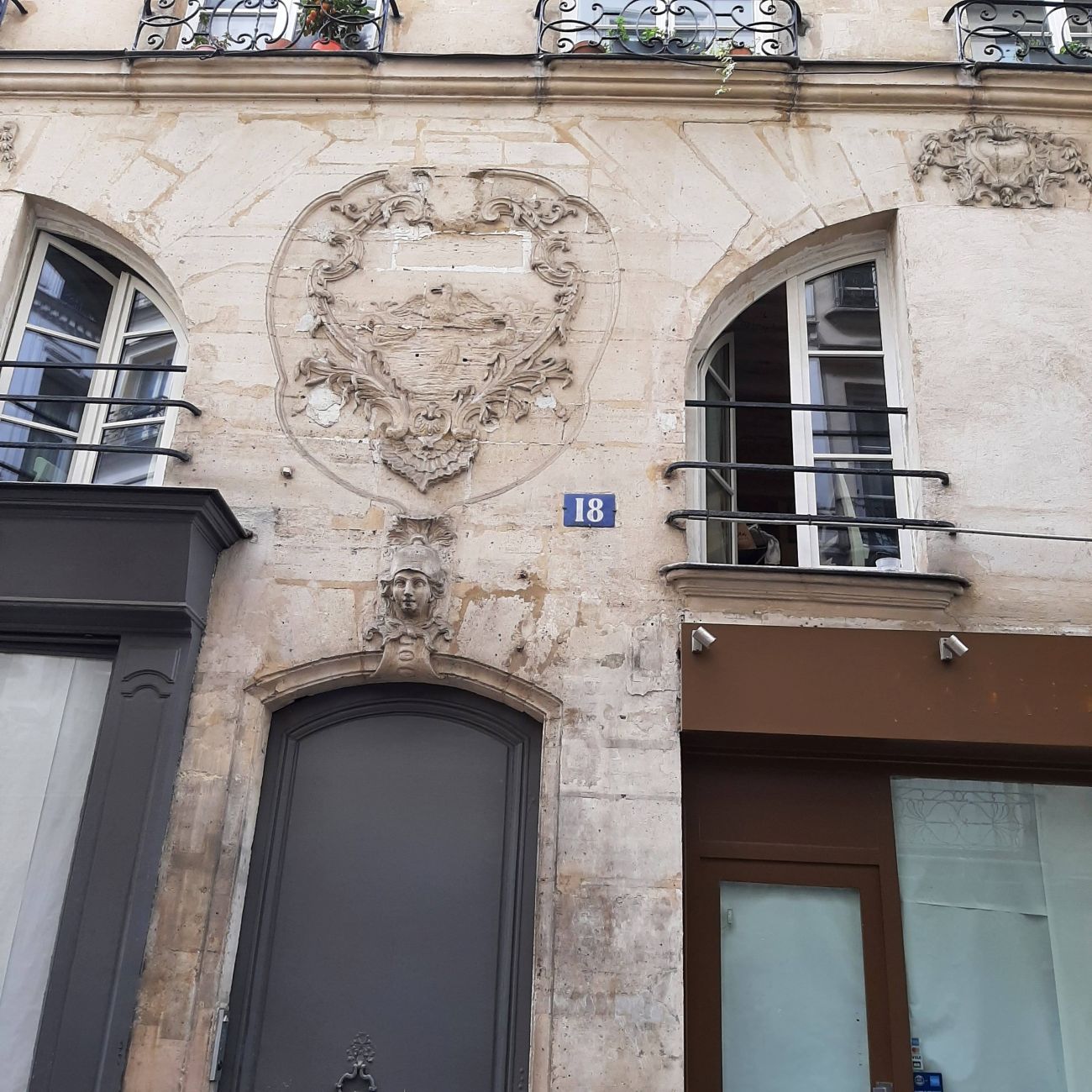
The Rue des Canettes is located in the 6éme arrondissement of Paris. The street is 132 meters long, it connects Rue du Four with Place Saint-Sulpice. Rue Guisarde joins the street just before its midpoint. At the its intersection with the Place Saint-Sulpice is shared with Rue Saint-Sulpice. You can access the street on metro Saint Sulpice station of line 4, The street takes its name from the sign at no, 18, (see pic) which depicts three ducks paddling in water under the watchful eye of their mother. The current façade dates from the early 18C and replaced another bas-relief dating from the 15C, encircled by a Rococo cartouche and featuring, as a pendant, a head of Minerva (protector of Rome and patroness of artisans). The Three Ducks sign is probably the result of the legend of the Montfort duck who every year comes out of a pond with her ducklings, passes through the crowd of people quacking, comes to the church and leaves some of her young there as an offering, The street already existed in the 13C: around 1260, it was called “Rue Saint-Soulpice.” In the 14C, it became “Rue Neuve-Saint-Sulpice.” Around 1540, it was reportedly called “Rue Viracoublé,” after a private mansion that bore that name; the name Rue du Trou Punais was also used. It took its current name in 1636. Since the early 2010s, the Rue des Canettes has been an emblematic gathering place for right-wing and far-right youth in Paris. They meet in particular at the Chai Antoine or the Cave Saint Germain. Notable buildings here tell the story that after the death of Marcel Proust, his devoted housekeeper Céleste Albaret opened, with her husband, the Hôtel Alsace Lorraine, renamed Hôtel La Perle, located on the street. The writer and poet Gabriel-Tristan Franconi, of Swiss origin and naturalized French, lived at 13 Rue des Canettes. He died for France, decapitated by a shell, in the Bois de Sauvillers (Somme, 80) on July 23, 1918.
TheParistouristofficeonthe6émearrondissementdeParis: https://parisjetaime.com/eng/article/explore-paris-s-6th-arrondissement-a823
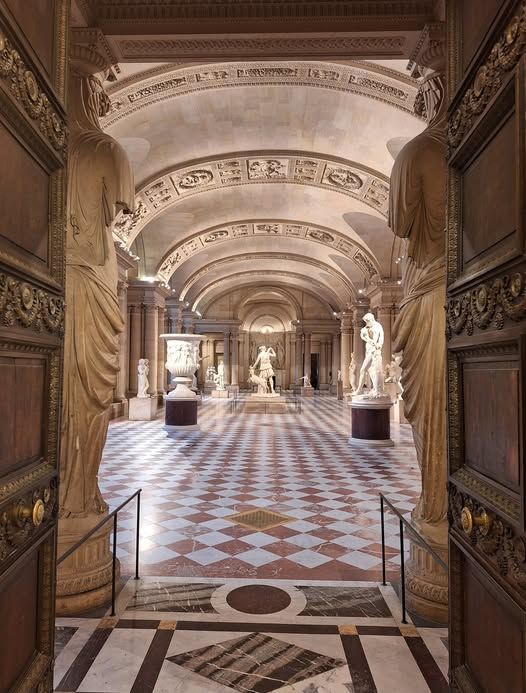
The Musée du Louvre , inaugurated in 1793 under the name Central Museum of the Arts of the Republic in the Palais du Louvre, former royal residence located in the center of Paris, is today the largest museum of art and antiques in the world. This is probably one of the Louvre’s finest architectural examples of the Renaissance. The ballroom of the French kings marks the beginning of this new artistic style in Paris. And since the 17C, its vast vaults have housed a prestigious collection of antique sculptures. The four caryatids supporting the musicians’ gallery gave it its name. These columns in the form of female figures are the work of the sculptor Jean Goujon, in 1550. This work is entirely in keeping with the Renaissance’s focus on Antiquity. Here, the artist reinterprets a monument from the 2C BC: the Forum of Emperor Augustus in Rome. Today, the Salle des Caryatides or Hall of Caryatids (see pic) houses masterpieces from the collections of Greek sculpture, and more specifically, representations of the gods, goddesses, and heroes of mythology.
TheofficialMuséeduLouvreontheSalledesCaryatides : https://www.louvre.fr/en/explore/the-palace/at-the-heart-of-the-renaissance-palace
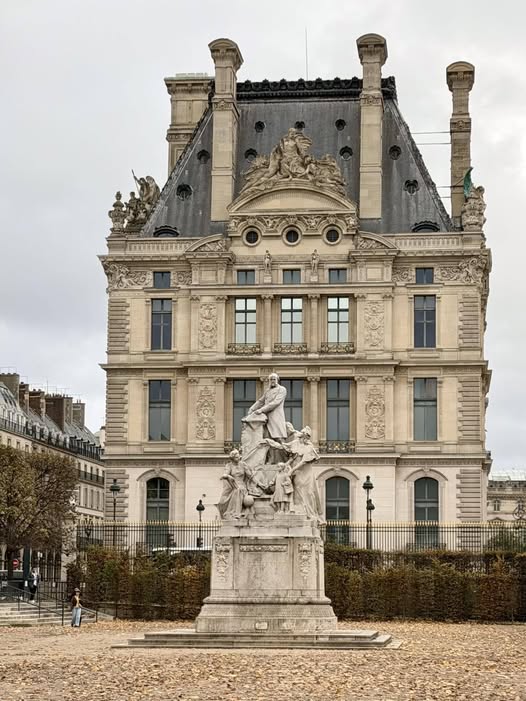
The monument to Jules Ferry is located near the eastern end of the Jardin des Tuileries (see posts), on the Esplanade des Feuillants, along the Rue de Rivoli. What you see is the French Prime Minister Jules Ferry, depicted twice in formal attire, standing and seemingly delivering a speech, perhaps in favor of equality in education, an important cause for Jules Ferry, whom many credit with establishing free education for all in France in 1881 (the Jules Ferry Laws). It was erected at the initiative of the League of Education, founded in 1866 by Jean Macé. The monument, inaugurated on November 20, 1910, was created by the sculptor Gustave Michel and the architect Charles Blondel. Jules Ferry stands atop the monument to proclaim the secular laws, while Marianne, or Education, lifts the veil of Ignorance. A schoolteacher, considered one of the pillars of the Nation, grasps the hand of a young boy. Leaning on a globe, she holds a book, a reference to Victor Hugo’s famous phrase: “This will kill that.” On the other side of the monument, the Genius of the Republic supports the flag and displays the branch of peace.
TheofficialLouvremuseummanageroftheTuileriesgarden: https://www.louvre.fr/en/explore/the-palace/from-royal-garden-to-public-park
TheParistouristofficeontheJardin des Tuileries: https://parisjetaime.com/eng/culture/jardin-des-tuileries-p3545
The city of Paris on the Jardin des Tuileries: https://www.paris.fr/lieux/jardin-des-tuileries-1795
The Rue de la Gaîté is located in the Montparnasse quartier or neighborhood of the 14éme district or arrondissement of Paris. The area still bears the marks of its past as a place of pleasure and “gaiety,” with numerous theaters, restaurants, sex shops, and music halls. It takes its name from the fact that this street was adjacent to the old city gate, once lined with various dance halls, open-air cafes, theaters, and other establishments where gaiety and joy reigned. As others , this street has been the hub for sex shops in the capital since 1969. The Rue de la Gaîté is accessible via metro line 13 at Gaîté station and metro line 6 at Edgar Quinet station.
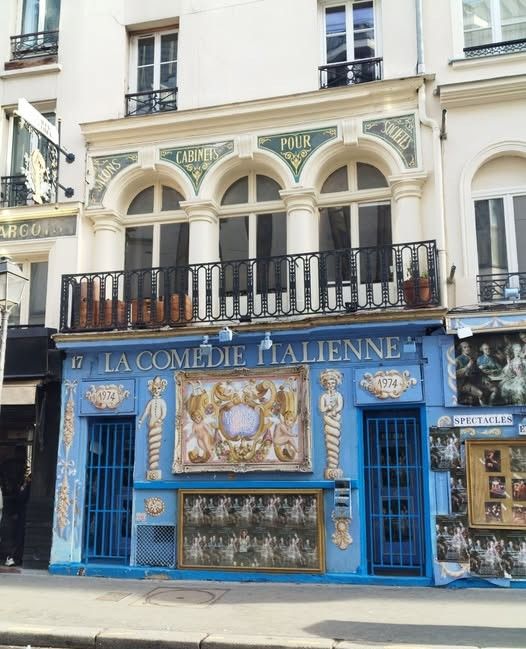
The current Rue de la Gaîté is a former street in Petit-Montrouge, within the territory of the village of Montrouge. It lost a section that extended beyond the current Avenue du Maine into the former village of Vaugirard. Both sections were annexed during the last expansion of Paris, carried out in 1860, and are now located in the 14éme arrondissement. Notable buildings here are many theaters on Rue de la Gaîté such as the Théâtre de la Gaîté-Montparnasse; Théâtre du Petit Montparnasse; Bobino; La Comédie Italienne (see pic) ,The theatre has existed in its current form since 1980. Previously, it was called Teatrino Italiano and was located at 15 rue du Maine. It continues the tradition of commedia dell’arte by staging forgotten plays by Goldoni, Fiorilli, and Gherardi, as well as some much better-known works.;and Théâtre Rive Gauche. Other theaters are located in the immediate vicinity of Rue de la Gaîté: Le Guichet Montparnasse (Rue du Maine); Le Petit Journal Montparnasse (Rue du Commandant-René-Mouchotte); and Théâtre d’Edgar (Boulevard Edgar-Quinet). You,also, have at No. 1: Richefeu restaurant, founded in 1802. No. 20: site of the former “Bal des Gigolettes” (1800), then “Escargots,” which became the “Théâtre des Folies-Bobino” (1873-1901), then the “Bobino Music-hall” (1901-1984). This was demolished in 1985 and replaced by a tourist hotel and a multi-purpose hall (in the basement) called “Studio Bobino” (1991-2009), dedicated to live performances and television recordings. Since 2010, the venue, renamed “Bobino,” has hosted one-man shows, concerts, and musical performances. No 20 bis, on the corner of Rue Vandamme, was the site, from 1833, of the renowned café, restaurant, dance hall, meeting room, and banquet hall, Les Mille-Colonnes, which also housed a cinema from 1907 to the end of 1930. Also housed the Europa Sonor studio, where Claude François recorded several songs, including “Comme d’habitude.” ( My Way copied several times) N 35 was the site of the former Casino Montparnasse (1911-1953), aka the “Théâtre du Casino Montparnasse,” a former performance venue, concert hall, and cinema. It was originally an annex of the Théâtre Montparnasse, used to store scenery. The venue enjoyed great success in the immediate post-war period, staging plays such as “La Belle de Cadix” and “Clochemerle.” Converted into a cinema in 1953, it closed permanently in 1987. It was at the Casino Montparnasse that the operetta La Belle de Cadix was created in 1945, and where Bourvil was revealed.
The Paris tourist office on the 14éme arrondissement de Paris : https://parisjetaime.com/eng/article/explore-paris-s-14th-arrondissement-a836
There you go folks, a dandy city to explore and enjoy with the family, Memorable moments in my eternal Paris, driving and walking all over in my road warrior trails brings out sublime awesome spots with nice memorable family visits of yesteryear always remember and always looking forward to be back, eventually. Again hope you enjoy the post on curiosities of Paris, part LXIII !!! as I.
And remember, happy travels, good health, and many cheers to all !!!


